What Is Temperature Coefficient of Resistance
When exploring how electrical resistance changes with temperature, you’ll encounter the Temperature Coefficient of Resistance (TCR) concept. It’s an essential electronics factor influencing how components perform under varying conditions. TCR tells you if resistance rises or falls as temperatures shift, affecting circuit stability and efficiency. Curious about how TCR works and why it matters? Let’s explore the key aspects and implications.
Key Takeaways
- Temperature Coefficient of Resistance (TCR) measures a material’s resistance change with temperature variations.
- TCR is expressed in parts per million per degree Celsius (ppm/°C).
- Positive TCR indicates resistance increases with rising temperature, which is common in pure metals.
- Negative TCR signifies resistance decreases as temperature rises, which is typical in semiconductors.
- TCR is crucial for predicting and managing electronic component behavior at different temperatures.
Understanding the Basics of Temperature Coefficient of Resistance
Understanding the basics of the temperature coefficient of resistance (TCR) is essential for anyone working with electronic components.
TCR, represented by the Greek letter alpha (α), measures how a material’s resistance changes with temperature. It’s usually expressed in parts per million per degree Celsius (ppm/°C). For example, copper has a positive TCR (α = 0.004041), meaning its resistance increases as temperature rises. Conversely, materials like silicon have a negative TCR (α = -0.075), so their resistance decreases with higher temperatures.
You can calculate the TCR using the formula: ( text{TCR} = frac{(R_2 – R_1)}{R_1(T_2 – T_1)} times 10^{-6} ).
This calculation is vital for designing systems that require precise resistance control, as temperature fluctuations impact electronic component performance.
Positive vs. Negative Temperature Coefficient of Resistance
While exploring the temperature coefficient of resistance (TCR), it is crucial to distinguish between positive and negative values. A positive TCR means resistance increases with rising temperature. For example, pure metals like copper and nickel have a positive TCR. On the other hand, a negative TCR indicates a decrease in resistance as temperature rises, as seen in materials like silicon and germanium.
| Material | Temperature Coefficient |
|---|---|
| Copper | +0.004041 |
| Nickel | +0.005866 |
| Silicon | -0.075 |
| Constantan | -0.000074 |
Understanding these differences helps you select the materials for temperature-sensitive applications, such as sensors and thermistors. Choose wisely to guarantee peak performance in your electronic projects!
Temperature Coefficients in Different Materials

Evaluating the temperature coefficients of resistance (TCR) of different substances is essential when selecting materials for electronic applications.
Pure metals like copper and nickel have positive temperature coefficients (TCR), meaning their resistance increases with temperature. For instance, copper’s TCR is 0.004041, while nickel’s is 0.005866.
On the other hand, materials like silicon and germanium exhibit negative temperature coefficients (TCRs), leading to decreased resistance as temperatures rise. Silicon’s TCR is -0.075°C, and germanium’s is -0.048°C.
Alloys such as constantan, with a TCR of -0.000074, show minimal resistance change, which is ideal for precision tasks.
Even among common materials, TCR varies widely—steel at 0.003 and iron at 0.005671—highlighting their unique electrical properties.
Calculating Temperature Coefficient of Resistance
Understanding how resistance changes with temperature is essential to calculating the temperature coefficient of resistance (TCR). The TCR quantifies this change, expressed in parts per million per degree Celsius (ppm/°C).
You can calculate it using the formula: ( text{TCR} = left(frac{R_2 – R_1}{R_1(T_2 – T_1)}right) times 10^6 ). Here, ( R_1 ) is the resistance at a reference temperature ( T_1 ), and ( R_2 ) is the resistance at a different temperature ( T_2 ).
TCR values are typically measured over specific temperature ranges, such as -55 to 25°C and 25 to 125°C. A positive TCR means resistance increases with temperature, which is common in pure metals.
Conversely, a negative TCR indicates resistance decreases with temperature, typical in materials like silicon.
Practical Applications and Implications of TCR
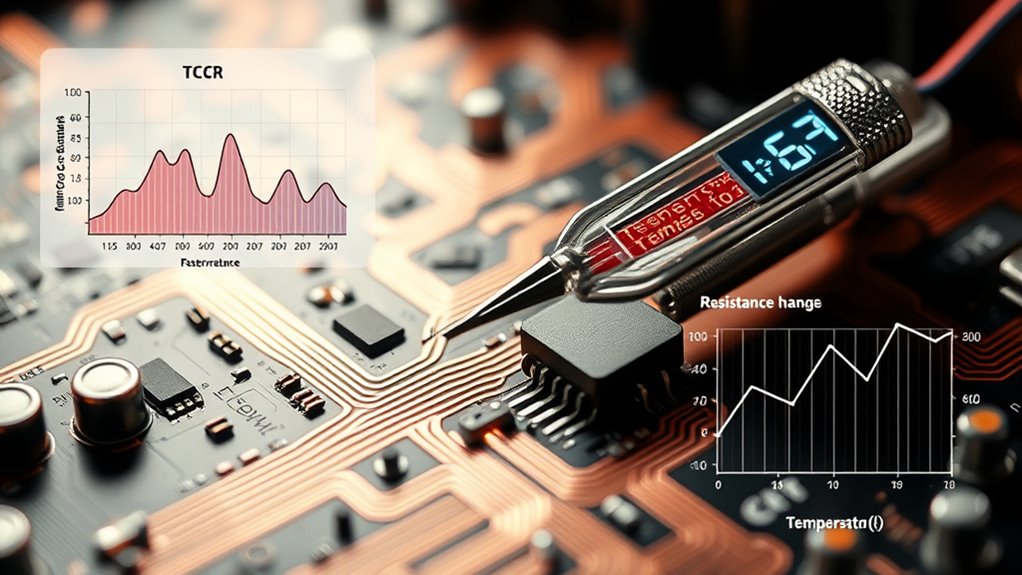
Understanding the practical applications of the Temperature Coefficient of Resistance (TCR) is vital for anyone involved in electronics design. TCR affects how a resistor’s value changes with temperature, impacting circuit performance and reliability.
Here’s why you should care:
- Precision Applications: Use resistors like constantan with low TCR to reduce temperature dependence and guarantee stable operation.
- Temperature Sensors: NTC thermistors with negative TCR provide accurate temperature readings, which is significant for temperature-sensitive applications.
- Power Transmission: Utility companies must factor in TCR to manage power efficiency, as resistance changes with positive temperature can lead to significant power losses.
Engineers often choose resistors with specific TCR values to match the operating environment, optimizing functionality and preventing failures.
Factors Affecting Resistance Changes With Temperature
Since resistance changes with temperature, understanding the factors that influence these changes is essential for optimizing circuit performance. The temperature coefficient of resistance (TCR) quantifies how resistance varies as temperature shifts. Material purity is important, as impurities or defects affect resistivity, especially at low temperatures. Accurate resistance measurements also depend on the position of sensing lines and electrode dimensions, which can lead to variations in TCR readings. The thickness of copper foil in resistors affects thermal characteristics, influencing resistance changes with temperature. Consider how different materials exhibit varying TCR values:
| Material | TCR (°C) |
|---|---|
| Copper | 0.004041 |
| Silicon | -0.075 |
| Aluminum | 0.004308 |
These factors highlight the significance of TCR in managing resistance changes.
Selecting Materials Based on Temperature Coefficient
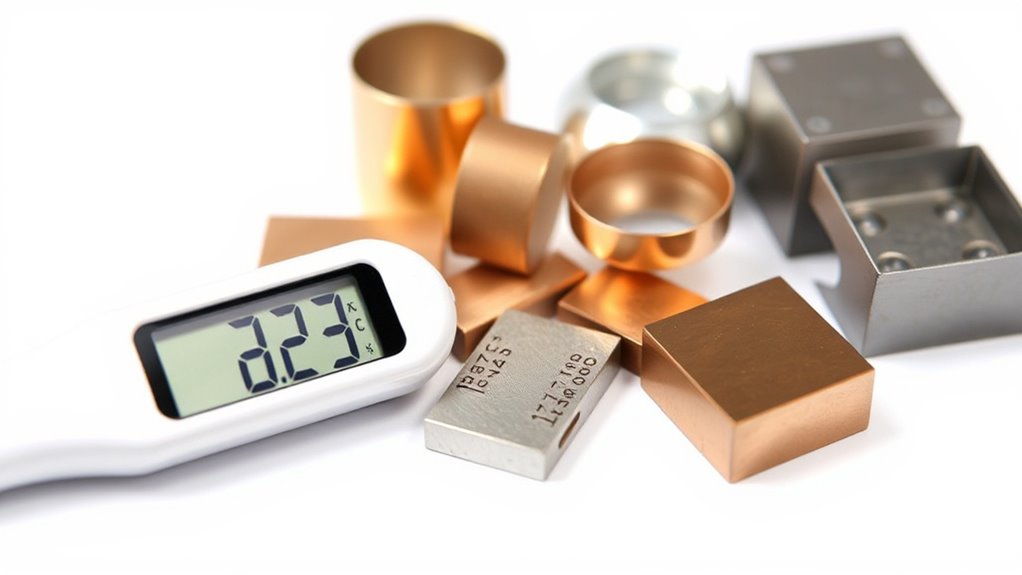
When selecting materials for resistors, it’s essential to consider their temperature coefficient of resistance (TCR), as this directly affects performance.
Choose positive TCR materials like copper for applications needing increased resistance with temperature, or negative TCR materials like silicon for cases where resistance should decrease.
Opt for low TCR materials such as Manganin for precision tasks to guarantee stable resistance despite temperature fluctuations.
Material Selection Criteria
Selecting materials based on the temperature coefficient of resistance (TCR) is essential for optimizing electrical component performance. By understanding TCR, you can predict how a material’s resistance will change with temperature, ensuring your circuits remain stable and efficient.
Here’s how you can make informed material selections:
- Identify TCR Needs: Determine if your application requires a positive temperature coefficient (PTC) material like copper or nickel, which increases resistance with temperature, or a negative temperature coefficient (NTC) material like silicon, which decreases resistance.
- Prioritize Precision: To reduce resistance variation, choose materials with low TCR values, such as Manganin or Constantan, for precision resistors.
- Evaluate Temperature Range: Consider the operating temperature range, as TCR can vary across different temperatures, affecting circuit stability.
TCR Impact on Performance
Understanding the temperature coefficient of resistance (TCR) isn’t just about choosing materials; it’s about guaranteeing your circuits perform efficiently under varying temperatures. TCR quantifies how resistance changes with temperature, impacting circuit stability. Selecting materials with appropriate TCR is essential. For instance, highly positive TCR materials like nickel increase resistance with temperature, making them ideal for self-regulating heating elements. Conversely, negative TCR materials like silicon decrease resistance with temperature, enhancing sensitivity in temperature sensors.
| Material | TCR (°C) | Application |
|---|---|---|
| Nickel | +0.006 | Self-regulating heating elements |
| Silicon | -0.075 | Temperature sensors |
| Constantan | -0.000074 | Stable performance circuits |
| Copper | +0.0039 | General wiring |
| Platinum | +0.00385 | Precision resistors |
Choosing low TCR materials like Constantan guarantees minimal resistance fluctuations, maintaining stable performance.
Applications and Suitability
Choosing the right material based on its temperature coefficient of resistance (TCR) ensures electronic components perform at their best.
Understanding the TCR allows you to select materials that maintain the circuits’ stability and efficiency. Here’s how it works:
- Positive TCR Materials: Copper, with a positive TCR of 0.004041 °C, is ideal for scenarios where increased resistance with temperature is acceptable, like power distribution systems.
- Negative TCR Materials: For applications like temperature sensing, materials with a negative TCR, such as constantan (-0.000074 °C), are preferable.
- Precision Components: For precision resistors, use materials with minimal TCR variations. This ensures stable performance across various temperatures, vital for sensitive circuits.
Consider these factors to optimize your electronic designs.
Measuring and Testing the Temperature Coefficient of Resistance
To accurately measure the Temperature Coefficient of Resistance (TCR), you need to calculate the change in resistance over a specified temperature range, typically from -55°C to 25°C and from 25°C to 125°C. Use the formula: TCR = (left( frac{R_2 – R_1}{R_1(T_2 – T_1)} right) times 10^{-6}). As temperature increases, resistance changes, and standardized methods like MIL-STD-202 Method 304 help maintain measurement consistency. Specialized techniques might be required for nonlinear materials due to significant TCR variability. Verify material purity for predictable results and use a controlled temperature environment for precise monitoring.
| Parameter | Description |
|---|---|
| (R_1) | Resistance at lower temperatures |
| (R_2) | Resistance at higher temperatures |
| (T_1) & (T_2) | Initial and final temperatures (e.g., -55°C) |
| Environment | Controlled, like a temperature chamber |
Conclusion
To conclude, understanding the temperature coefficient of resistance is essential for selecting the right materials for electronics. You need to know whether a material has a positive or negative TCR, which affects how resistance changes with temperature. By calculating TCR, you can predict these changes and choose materials that suit your needs. Factors like material composition and environmental conditions also play a role, so always consider these when designing circuits and systems.
FAQs
1. What Does Temperature Coefficient Mean in Resistors?
The temperature coefficient in resistors indicates how resistance changes with temperature. It helps you predict performance shifts. Positive coefficients mean increased resistance with heat, while negative ones show a decrease, guiding your component choices.
2. What Is the Definition of the Coefficient of Resistance?
You’re asking about the coefficient of resistance, which measures how much a material’s electrical resistance changes with temperature. Understanding this helps you design efficient circuits and ensures components work well despite temperature variations.
3. What Is the Significance of the Temperature Coefficient?
You need to understand the significance of the temperature coefficient because it predicts how resistance changes with temperature. This knowledge guarantees your electronic components perform reliably and efficiently in varying thermal conditions, which is crucial for precision and stability in circuit design.
4. What are the Positive and Negative Temperature coefficients of Resistance?
You’ll find that a positive temperature coefficient means resistance rises with temperature, like in metals. Conversely, a negative coefficient means resistance drops as temperature increases, which is typical in semiconductors. This knowledge is essential for designing temperature-sensitive systems.