Chopper Circuits: Working, Types, and Applications Explained
You’re about to explore the fascinating world of chopper circuits, a key player in modern power electronics. These circuits convert a fixed DC input into a variable DC output, allowing efficient power management. Their rapid switching capabilities make them indispensable in motor control and renewable energy applications. Curious about how these devices manage to balance power delivery with minimal losses? Let’s uncover their secrets and see how they shape today’s technology landscape.
Definition and Functionality
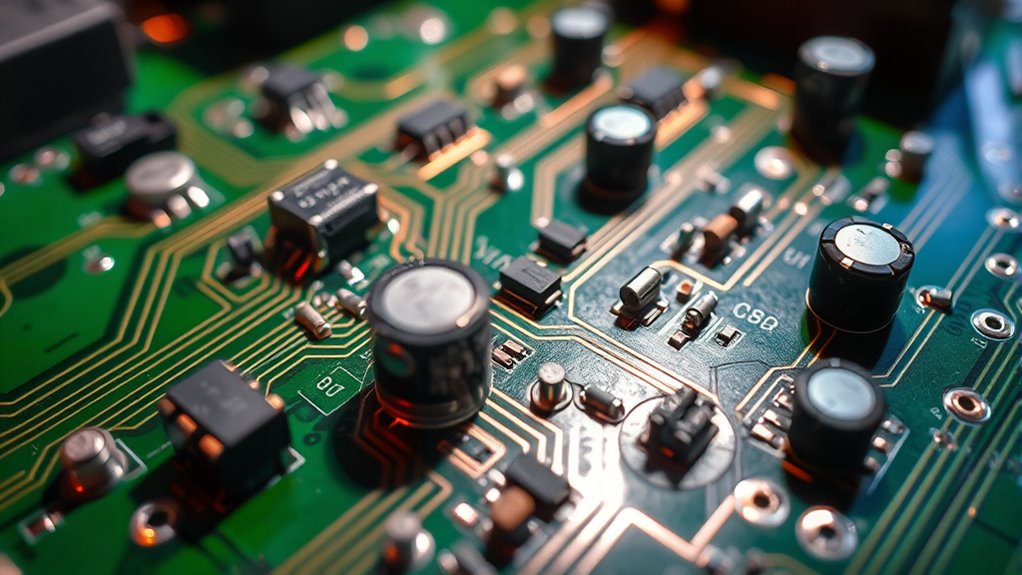
When you dive into the world of chopper circuits, you’ll find they play a crucial role in converting a fixed DC input voltage into a variable DC output voltage.
A chopper circuit efficiently controls power delivery with minimal losses by rapidly switching the input on and off, ensuring high energy efficiency. The duty cycle influences the average output voltage, which determines the ratio of the ON time to the total switching period.
These circuits are found in applications such as switched-mode power supplies, DC motor speed control, and battery charging systems.
Depending on your needs, you might use a step-up chopper to increase voltage or a step-down chopper to reduce it, optimizing energy usage and performance in various electronic devices.
Types of Chopper Circuits
Having explored the definition and functionality of chopper circuits, let’s examine the various types available to meet your specific needs.
Chopper circuits are classified into step-down, step-up, and buck-boost choppers.
Step-down choppers, or buck converters, reduce the input voltage to a lower average output voltage. They achieve this through switching devices that manage power control and utilize an inductor to smooth the voltage.
Step-up choppers, or boost converters, increase the input voltage, storing energy in an inductor when on and releasing a higher voltage when off.
Buck-boost choppers offer flexible voltage regulation by adjusting the duty cycle, allowing them to either step up or down the voltage.
Each type caters to different power control requirements.
Working Principle of Step-Down Chopper

A step-down chopper, or buck converter, is a fundamental circuit that effectively lowers a fixed DC input voltage to a variable, lower DC output voltage.
This conversion happens as the chopper switches ON and OFF. When ON, the load voltage equals the input voltage, and energy storage occurs in the inductor as the load current increases.
Upon switching off, the load current flows through a free-wheeling diode, allowing the inductor to discharge its stored energy into the load and creating a zero voltage across it.
The average output voltage is directly proportional to the duty cycle, influencing the chopper’s efficiency.
These circuits are essential for DC motor speed control applications, offering reliable performance with controlled load current.
Working Principle of Step-Up Chopper
Moving from the step-down chopper’s operation, you’ll explore a different approach with the step-up chopper or boost converter, which elevates a lower DC input voltage to a higher output voltage.
The switching operation is crucial in the step-up chopper. When the chopper switch is ON, the inductor stores energy from the input voltage. Once it’s OFF, the stored energy is released, boosting the voltage to the output.
The duty cycle, defined as the fraction of time the switch is ON, controls the output voltage magnitude. The output voltage can be determined using V V₀ = V₁ / (1 – D).
Step-up choppers are essential in applications like battery charging, LED power supplies, and renewable energy systems, optimizing voltage to meet specific requirements.
Voltage and Current Waveforms

Understanding the voltage and current waveforms in a step-up chopper, also known as a boost converter, is crucial for optimizing its performance.
In a chopper circuit, the voltage waveform displays a pulsed DC output, where the output voltage rises above the input due to energy stored in the inductor L. The current waveform shows a gradual increase as the inductor charges, followed by a decay as it discharges, impacting the average output voltage.
The duty cycle, representing the ON time fraction, directly influences this average output voltage. Additionally, the ripple voltage and current depend on the switching frequency and inductance, affecting output smoothness.
Applications of Chopper Circuits
Having explored the voltage and current waveforms in chopper circuits, let’s examine their practical applications in various industries.
Chopper circuits are pivotal in power electronics, especially for efficient DC-to-DC conversion in switched-mode power supplies (SMPS). They deliver stable output voltages to electronic devices.
In DC motor speed control, chopper circuits allow you to adjust motor performance precisely by varying the supplied voltage. They’re essential in battery charging applications, ensuring safe and efficient charging for lithium-ion and lead-acid batteries.
In electric vehicles and railway systems, chopper circuits enable regenerative braking, which allows energy recovery and enhances energy efficiency.
Moreover, while chopper amplifiers utilize these circuits, they won’t be discussed here.
These applications make chopper circuits indispensable in modern technology.
Chopper Amplifiers and Their Uses
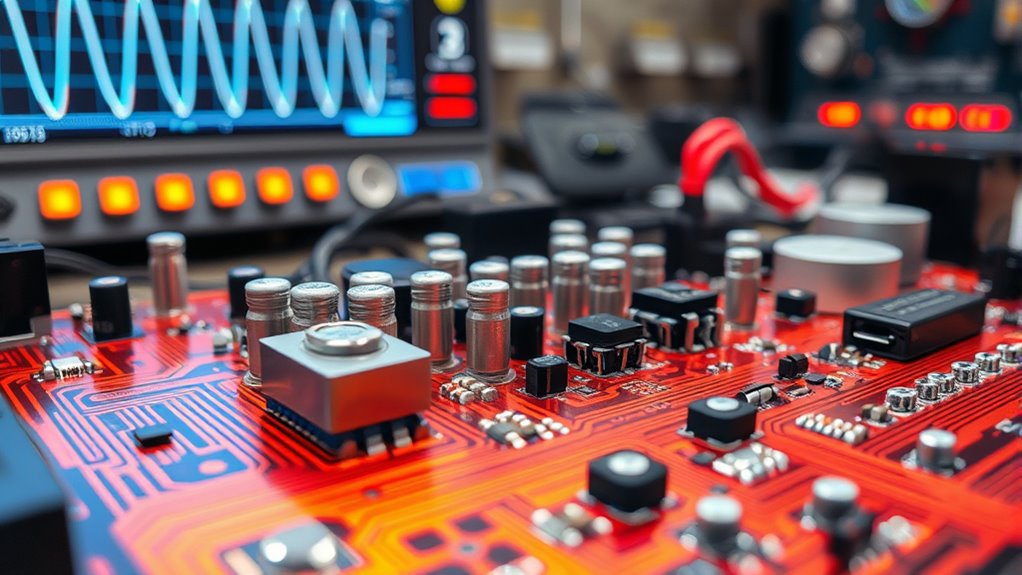
Although often overlooked, chopper amplifiers are crucial in amplifying small DC signals, especially those buried beneath the noise floor. Converting these signals to AC for processing and back to DC ensures that even the quietest signals are amplified with high precision.
Thanks to techniques like auto-zero and chopper stabilization, hopper amplifiers are particularly effective in reducing input offset voltage and drift. This results in low input offset errors, essential for accurate signal processing in high-precision applications.
Maintaining signal integrity is critical whether you’re dealing with medical instrumentation or industrial control systems. Common examples, like the LTC2050 and OPA333, excel in environments where low noise and precision are paramount. These amplifiers are indispensable in various advanced fields.
Control Techniques in Chopper Circuits
When exploring control techniques in chopper circuits, you’ll find that Pulse Width Modulation (PWM) is a key method in regulating power delivery. By varying the duty cycle, PWM effectively controls the average output voltage, ensuring the chopper circuit supplies the right power to your load.
Techniques like Sinusoidal PWM and Space Vector PWM enhance efficiency and reduce distortion. You can employ controllers such as Fuzzy Logic and Digital Signal Processors to boost performance. These tools adaptively manage voltage controllers, keeping your system responsive to load changes.
Active power control is crucial when dealing with renewable energy sources, as it stabilizes output and improves the power factor. Mastering these techniques will optimize your chopper circuit’s functionality.
Performance Analysis of Chopper-Controlled Systems
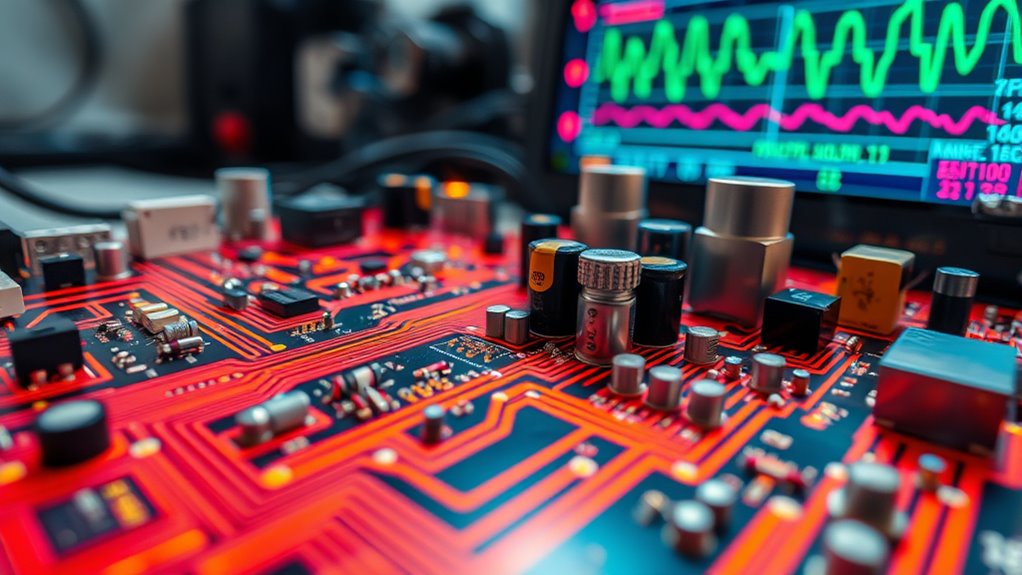
To truly understand the performance of chopper-controlled systems, it’s essential to analyze key parameters like Total Harmonic Distortion (THD) and efficiency.
Performance analysis in these systems involves optimizing techniques such as Pulse Width Modulation (PWM) to enhance switching frequency and duty cycle.
Chopper-controlled systems use high-frequency Insulated Gate Bipolar Transistors (IGBTs) to achieve faster switching, improving efficiency and thermal management.
Adaptive control strategies, including fuzzy logic and digital signal processing, are crucial in dynamically adjusting control parameters to improve voltage regulation and power factor.
With efficiency often exceeding 90%, these advancements significantly reduce energy losses, making chopper-controlled systems effective and sustainable in power electronics applications.
Current Trends and Future Directions in Chopper Technology
Chopper technology rapidly evolves, driving efficiency and innovation in power conversion applications. High-frequency IGBT controllers are at the forefront, enhancing efficiency and minimizing losses.
Researchers are focused on three-level regulator assemblies to refine voltage regulation and reduce total harmonic distortion (THD). Integrating adaptive fuzzy techniques can achieve better power factor correction and further THD reduction.
Managing increased inverter levels while simplifying control systems is crucial, balancing performance with complexity and cost.
In terms of innovative uses, chopper amplifiers are gaining attention for low-amplitude signal processing, while chopper spectrometers are being explored for neutron beam applications.
These advancements signal exciting future directions for chopper technology in both scientific and industrial realms.
Conclusion
You’ve explored the fascinating world of chopper circuits, uncovering their role in transforming fixed DC into variable DC with remarkable efficiency. By understanding different types, like buck and boost, you can appreciate their motor control and renewable energy applications. As technology advances, chopper circuits will continue to evolve, offering improved performance and new possibilities in power electronics. Embrace these innovations and stay tuned for future developments in this dynamic field.