Lightning Phenomenon in High Voltage Engineering
Lightning is one of the most beautiful and powerful natural phenomena in high-voltage engineering. Lightning strikes, with their awe-inspiring displays of electrical energy, have intrigued and fascinated humans for centuries. Beyond their visual spectacle, lightning poses significant challenges and considerations in various areas, including power transmission, surge protection, and infrastructure resilience. The discharge of the charged cloud to the ground is called the lightning phenomenon.
High-voltage Engineering is vital in electrical engineering. It focuses on testing, materials, and devices that operate under extreme voltages. It involves studying dielectric strength, conductor performance, resistance, and capacitor behavior in high-voltage environments. Engineers use advanced tools like switchgear and analyze grid frequency to ensure systems meet safety regulations.
In industry and academic departments, team members collaborate on projects to improve product performance and reliability. Detailed information, feedback, and test reports refine products and guide customer service efforts. Educational books, pages, and video games help new learners understand key concepts and support career development.
Customers can access items, track orders, manage accounts, and explore technical details through easy navigation tools. Whether you’re exploring a career or just curious, High Voltage Engineering offers insights into a field shaping the future of power. Join our community to learn more.
Analyzing Lightning Discharges: Voltage, Current & Power
Lightning is a powerful natural phenomenon that manifests as a sudden and intense discharge of electrical energy in the atmosphere. It is accompanied by a bright flash of light and a characteristic rumbling sound known as thunder. Understanding lightning discharges’ voltage, current, and power characteristics in high-voltage engineering is crucial for assessing their potential impact and designing effective protection systems.
It is a peak discharge in which charge accumulates in the clouds and is discharged into a neighboring cloud or the ground.
The large spark accompanied by the light produced by an abrupt, discontinuous discharge of electricity through the air from the clouds, generally under turbulent conditions, is called lightning.
Representative values of a lightning strike are as follows:
Voltage : 2 x 10⁸ volts; 200 MV (peak)
Current : 4 x 44 amperes
Duration: l0-5 seconds
KW : 8 x 10⁹
KWH: 22
Voltage
Lightning discharges involve extremely high voltages. The voltage levels associated with lightning strikes can reach great values, often exceeding 100 million volts (100 MV). These peak voltages result from the immense charge buildup within thunderstorms, eventually discharged as lightning.
Current
The current associated with lightning discharges can be equally remarkable. It typically ranges from tens of thousands to hundreds of thousands of amperes. On average, a typical lightning strike can have a current magnitude of around 30,000 amperes, although it can vary significantly from one discharge to another.
Power
Analyzing the power associated with lightning discharges provides insights into their potential destructive capabilities. Capacity is calculated by multiplying the voltage and current values. Lightning strikes can generate staggering amounts of power, often reaching billions of watts (gigawatts). The power levels of a lightning discharge can exceed 10^9 watts (1 GW), making it an immensely energetic event.
Duration
Lightning discharges occur rapidly, typically lasting for a fraction of a second. A lightning strike lasts relatively short, normally around 0.1 microseconds (10^-7 seconds). However, multiple strokes can occur within the same lightning event, contributing to the overall duration of the discharge.
Causes and Effects of Overvoltages
Several factors influence the formation or accumulation of charge in clouds, and they are uncertain. However, during thunderstorm conditions, heavy air currents separate positive and negative heads in the shadows, forming ice crystals in the upper part of the cloud and rain in the lower part.
The distance of separation between clouds and the ground is very large, maybe even 10000 m, but it depends on the height of the shadows. The maximum voltage gradient reached at the ground level due to a cloud could be as high as 300 V per cm.
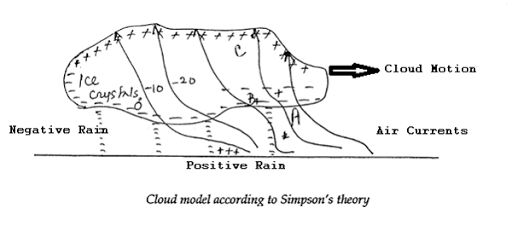
A probable charge distribution model, as shown in the fig. below, with the corresponding field gradient near the ground:

A theory by Simpson explains that there are three essential regions in the cloud for charge formation. Below part A (shown in Fig), air currents travel above 800 cm/s, and no raindrops fall through. In region A, air velocity is high enough to break the falling raindrops, causing a positive charge to spray in the cloud and a negative charge to the air. The fountain is blown upwards, but as the air velocity decreases, the positively charged water drops combine with the larger bubbles and fall again. Thus, region A eventually becomes predominantly positively charged, while region B above it becomes negatively charged by air currents. In the upper regions of the cloud, the temperature is as low as the freezing point, and only ice crystals exist. The impact of air on these crystals makes them negatively charged. Thus, the charge distribution within the cloud becomes, as shown at the top.
Effects on High Voltage Systems
Lightning strikes can cause various adverse effects on high-voltage engineering systems:
Equipment Damage
Due to lightning strikes’ high energy content, sensitive electrical equipment like transformers, circuit breakers, and power electronics can suffer irreversible damage.
Transmission Line Outages
Direct or nearby lightning strikes can induce voltage surges that disrupt power transmission, leading to service interruptions.
Insulation Failure
The high electric fields associated with lightning can cause insulation breakdown and flashovers, compromising the reliability of power systems.
Grounding Issues
Inadequate grounding of high-voltage equipment can result in increased vulnerability to lightning-induced transients.
Lightning Protection and Mitigation: To minimize the impact of lightning on high-voltage engineering, several protective measures are employed:
- Lightning Rods: Installing lightning rods on tall structures can provide a preferred pathway for lightning strikes, safely guiding the electrical discharge to the ground
- Surge Arresters: Surge arresters protect equipment from transient overvoltages from lightning strikes or switching operations.
- Grounding Systems: Proper grounding of electrical systems helps dissipate the energy from lightning strikes safely into the ground.
- Shielding and Insulation: Shielding high-voltage equipment and improving insulation can reduce the likelihood of lightning-induced damage.
Key Concepts
High-voltage Engineering is a critical field in electrical engineering that studies and applies voltages higher than the typical utility power level. It involves designing, testing, and maintaining insulation, transmission systems, and transformer circuits to ensure the safe and reliable power flow.
Essential Components
- Insulation Materials: Protect equipment and prevent electrical breakdown.
- Transformers and Circuits: Handle power conversion and distribution effectively.
- Testing and Safety Equipment: Guarantee system reliability and minimize surges.
Applications
High-voltage systems in power industries and homes, from power transmission to advanced HV testing laboratories, Discharge control, and circuit breakdown analysis, are crucial to ensuring system stability.
Career Opportunities
The field offers diverse roles, including testing engineers, industry consultants, and equipment designers, contributing to the ever-evolving electrical engineering landscape.
Future of High Voltage Engineering
With the rise of smart grids and renewable energy integration, high-voltage engineering is more critical than ever. Research continues into advanced materials and methods for voltage breakdown prevention and surge protection.
By focusing on cutting-edge techniques and robust system designs, the field ensures the world remains powered safely and efficiently.
Conclusion
Understanding lightning discharges’ characteristics and effects is crucial in high-voltage engineering. Implementing appropriate lightning protection measures can enhance the reliability and safety of electrical systems, reducing downtime and preventing extensive damage caused by this powerful natural phenomenon.
Supporting Article
Differences Between Low and High Voltage Systems