What Are the Types of Electrical Machines? Comprehensive Guide
When exploring electrical machines, you’ll find they’re split into two main categories: stationary and dynamic. Stationary machines, like transformers, manage energy transfer without moving parts. Dynamic machines, such as DC and AC motors, convert energy forms actively. Within these, you’ll uncover subtypes like series, shunt, and compound motors, plus induction and synchronous motors. Curious about their roles in industries and technologies? There’s more to discover.
Overview of Electrical Machines
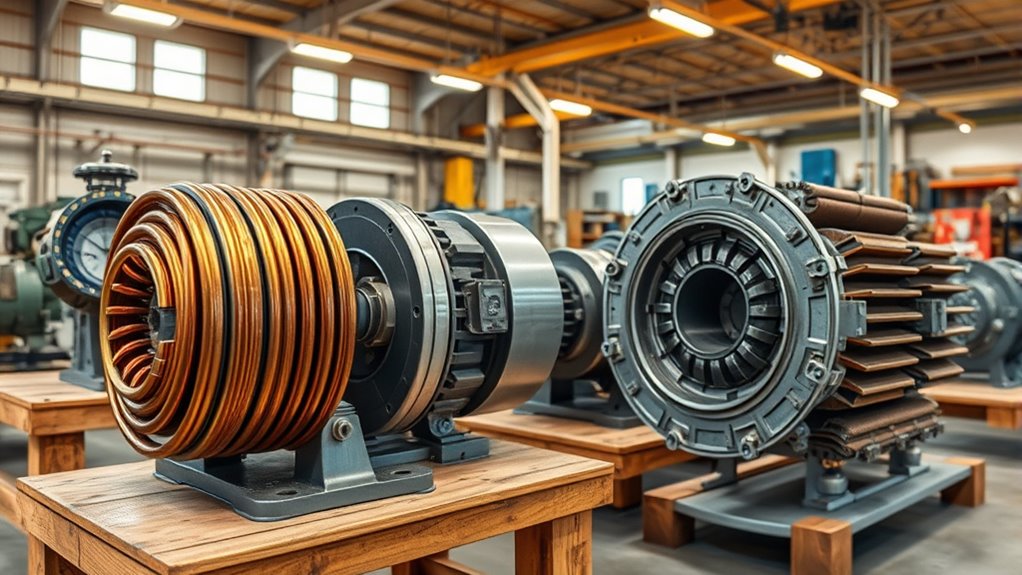
Electrical machines are the backbone of modern technology, enabling the conversion and control of energy in various forms.
You’ll find two main categories: stationary machines and dynamic machines. Stationary machines, like transformers, specialize in transferring electrical energy between circuits through electromagnetic induction without moving parts. They efficiently adjust voltage levels, crucial for many applications.
On the other hand, dynamic machines include motors and generators. Motors convert electrical energy into mechanical energy, powering everything from industrial machinery to electric vehicles. Generators do the opposite by turning mechanical energy into electrical energy, vital for power production in plants.
Both DC machines (including DC motors and generators) and AC machines (such as induction motors and alternators) play key roles in these dynamic operations.
DC Machines and Their Types
While stationary machines like transformers efficiently handle energy transfer without moving parts, dynamic machines such as DC machines shine by actively converting energy forms.
DC machines, including DC motors and DC generators, transform direct current electricity into mechanical energy or the reverse. Key to their function are the armature winding and the field winding.
DC series motors, with their field winding in series with the armature, deliver high starting torque, perfect for electric cars and cranes. On the other hand, DC shunt motors connect their field winding in parallel, ensuring constant speed operation, useful for lathes and washing machines.
DC compound motors blend both series and shunt windings for improved efficiency, offering versatility in industrial applications.
AC Machines and Their Types
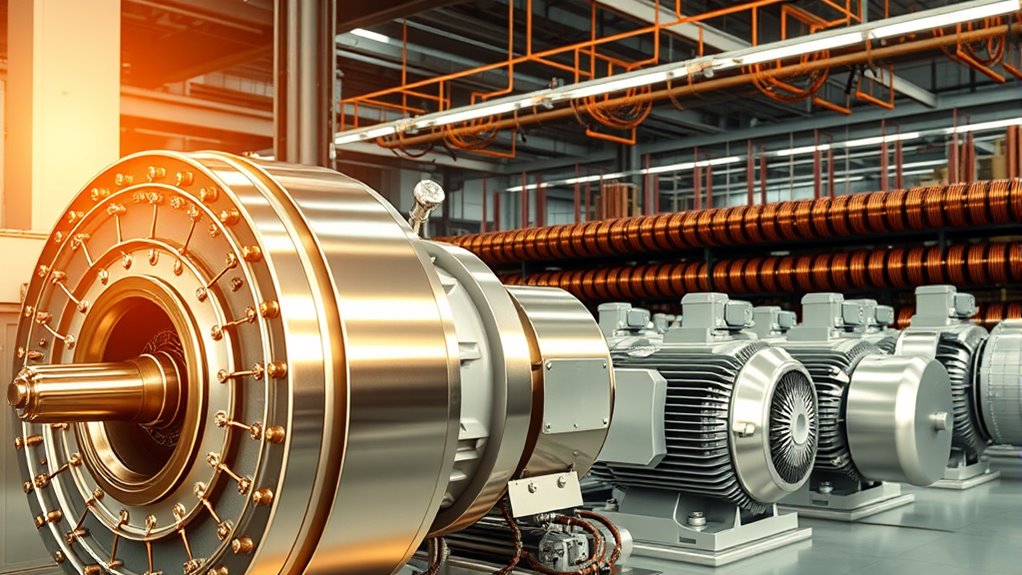
Although DC machines have their unique advantages, AC machines are indispensable in numerous applications due to their ability to efficiently convert alternating current electricity into mechanical energy and vice versa.
You’ll find two primary types: induction motors and synchronous motors. Induction motors operate through electromagnetic induction, available in single-phase and three-phase configurations. They’re self-starting, reliable, and perfect for fans and industrial machinery.
On the other hand, synchronous motors run at a speed synchronized with the supply frequency, ideal for tasks demanding precise timing and power factor correction.
Moreover, AC generators, often called alternators, transform mechanical energy into alternating current electricity. These can also be single-phase or three-phase, with three-phase generators being key for industrial power generation.
Stationary Electrical Machines
Stationary electrical machines, often known as static machines, play a vital role in modern electrical systems. They don’t involve mechanical rotation, focusing instead on energy transformation without significant movement.
Transformers are a prime example, handling voltage transformation through mutual induction between primary and secondary windings. You’ll find single-phase transformers in smaller applications, while three-phase transformers are indispensable in large industrial systems for regulating voltage and current.
These machines efficiently convert electrical energy into other forms, like heat, without moving parts. For instance, resistive loads such as electric heaters transform electrical energy into heat, underscoring their role in energy conversion.
Stationary electrical machines are crucial for efficient energy distribution and management, ensuring your electrical systems run smoothly across various applications.
Dynamic Electrical Machines
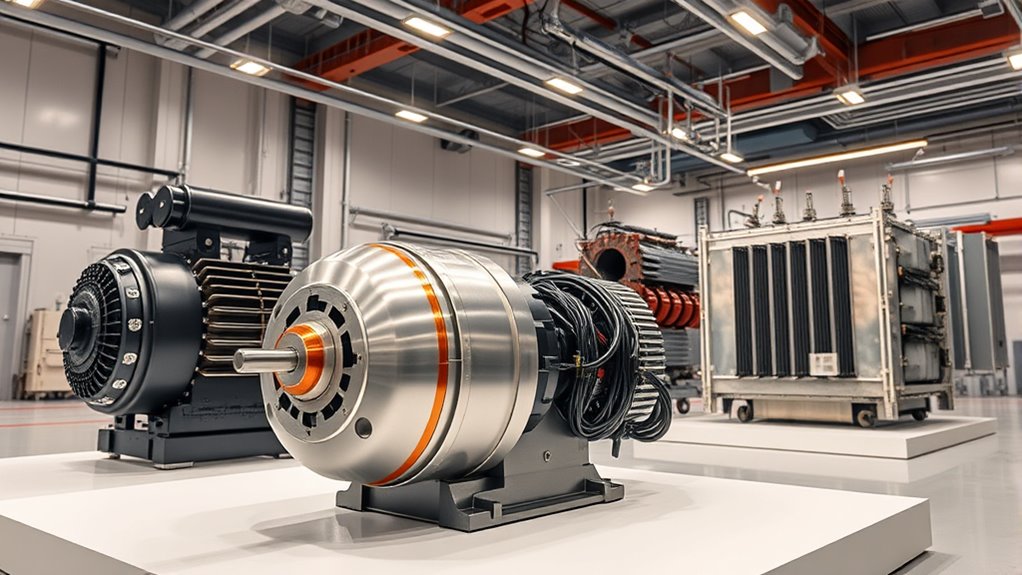
When it comes to dynamic electrical machines, they’re the powerhouse behind converting electrical energy into mechanical energy or the other way around.
You’ll find that electric motors and generators are pivotal in this conversion process, thanks to electromagnetic induction. Electric motors, such as induction motors, synchronous motors, and DC motors, transform electrical energy into mechanical energy for various applications.
On the flip side, generators do the opposite by converting mechanical power into electrical power. AC generators, or alternators, are especially common in power generation.
Both motors and generators consist of a rotor and a stator, working together in a magnetic field to facilitate efficient energy conversion.
These machines are vital in everything from industrial machinery to household appliances, showcasing their versatility.
Characteristics of Electric Machines
Electric machines, whether they’re stationary like transformers or dynamic like motors and generators, have distinct characteristics that define their operation and applications.
Electric motors transform electrical energy into mechanical energy via electromagnetic induction. These include induction motors, known for their simplicity and reliability, and synchronous motors, prized for constant speed under varying loads.
Meanwhile, electric generators, or alternators, convert mechanical energy back into electrical energy through the same fundamental principles, with AC machines being prevalent in power generation.
DC machines encompass both motors and generators, offering precise speed control and efficiency.
Transformers, on the other hand, use mutual induction to transfer electrical energy between circuits without any mechanical movement, making them essential for voltage regulation in electrical systems.
Control and Protection Mechanisms
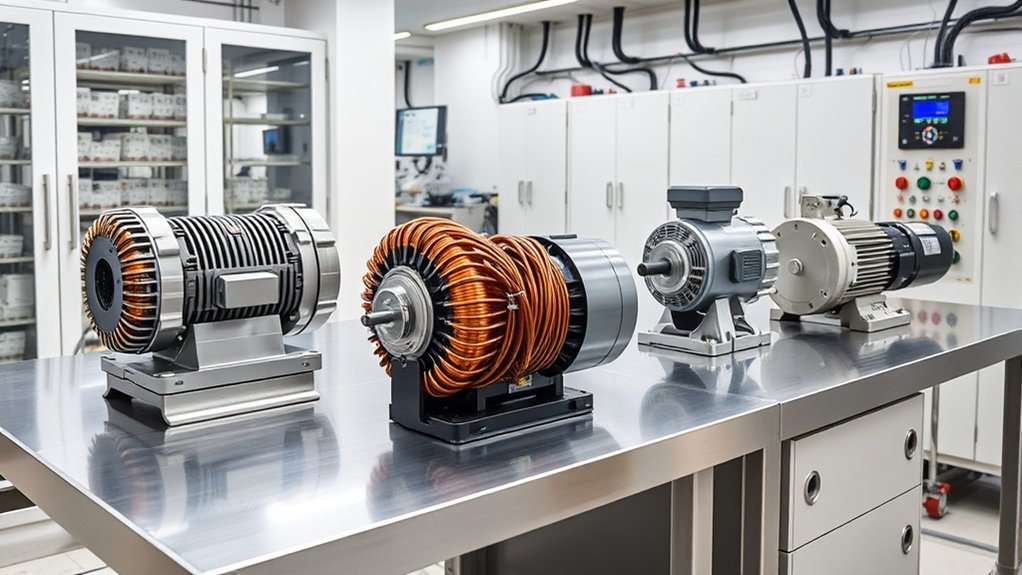
While electric machines are vital to modern infrastructure, ensuring their optimal operation requires robust control and protection mechanisms.
You can utilize control mechanisms like variable frequency drives (VFDs) for AC motors and pulse-width modulation (PWM) for DC motors to regulate speed and torque effectively.
Implement overcurrent protection to prevent excessive current flow and thermal protection systems to monitor temperatures, avoiding critical failures.
In three-phase systems, phase-sequence detection is crucial to prevent mechanical damage by ensuring correct rotation direction.
Mechanical protection measures, including thermal cutoffs and fuses, guard against overheating and electrical faults.
Applications of Electric Machines
As you explore the vast landscape of modern technology, you’ll find electric machines at the heart of countless applications across various industries.
Electric motors power everything from industrial machinery to electric vehicles, showcasing their prowess in mechanical energy conversion. In your home, electric motors are integral to household appliances, enhancing daily life.
DC motors shine in electric cars and cranes, delivering precise speed control and high reliability. Meanwhile, induction motors, loved for their simplicity, drive HVAC systems and industrial equipment with minimal maintenance needs.
AC generators play a crucial role in power plants, converting mechanical energy from wind or hydro into electricity for renewable energy initiatives. They stabilize the power supply, ensuring a consistent electricity flow.
Electric machines truly energize our world.
Conclusion
In understanding electrical machines, you’ve explored both stationary types, like transformers, and dynamic types, such as DC and AC machines. DC machines include series, shunt, and compound motors, while AC machines are mainly induction and synchronous motors. Each type serves unique roles in industries and technologies, with its characteristics dictating specific applications. Remember, effective control and protection mechanisms are crucial for safe and optimal performance, ensuring these machines meet diverse energy conversion needs efficiently.
FAQs
1. What Are the Main Types of Electrical Machines?
You’d mainly encounter transformers, generators, and motors in electrical machines. Transformers transfer energy, generators convert mechanical energy to electrical energy, and motors do the opposite. Each plays a crucial role in various applications through electromagnetic principles.
2. What Are the 8 Main Types of Electrical Engineering?
You’re asking about the eight main types of electrical engineering. These include power, electronics, control, telecommunications, computer, signal processing, microelectronics, and electrical machine engineering. Each focuses on unique aspects of electrical systems and applications.
3. What Counts as Electrical Machinery?
You’d categorize electrical machinery as devices converting electrical energy into mechanical energy or vice versa. This includes motors, generators, and transformers. These machines are essential in various applications, from power generation to industrial operations.
4. What Are the Three Main Types of Electrical Systems?
You need to understand that the three main types of electrical systems are direct current (DC), alternating current (AC), and special-purpose systems. Each one serves distinct applications and has unique operational characteristics tailored to specific needs.