Types of Rotary Electric Motors | Comprehensive Guide
You’re about to explore the intriguing world of rotary electric motors, where each type has unique characteristics and applications. There’s much to uncover from the robust and widely used AC motors to the efficient, speed-controllable DC motors and the high-performance brushless variants. Specialty motors like stepper and servo motors bring precision to robotics and automation. Curious about which motor suits your needs or what’s next in electric motor technology? Let’s find out together.
Key Takeaways
- AC motors include induction and synchronous types, which are crucial for industrial and power generation applications.
- DC motors, including brushed and brushless, convert direct current to mechanical power for varied applications.
- Brushless DC motors offer high efficiency, low maintenance, and compact design for high-performance uses.
- Specialty motors like steppers and servos provide precise mechanical movements and dynamic control.
- Torque motors deliver high torque directly to loads, which is used in automation systems like robotics and CNC machinery.
Overview of Rotary Electric Motors
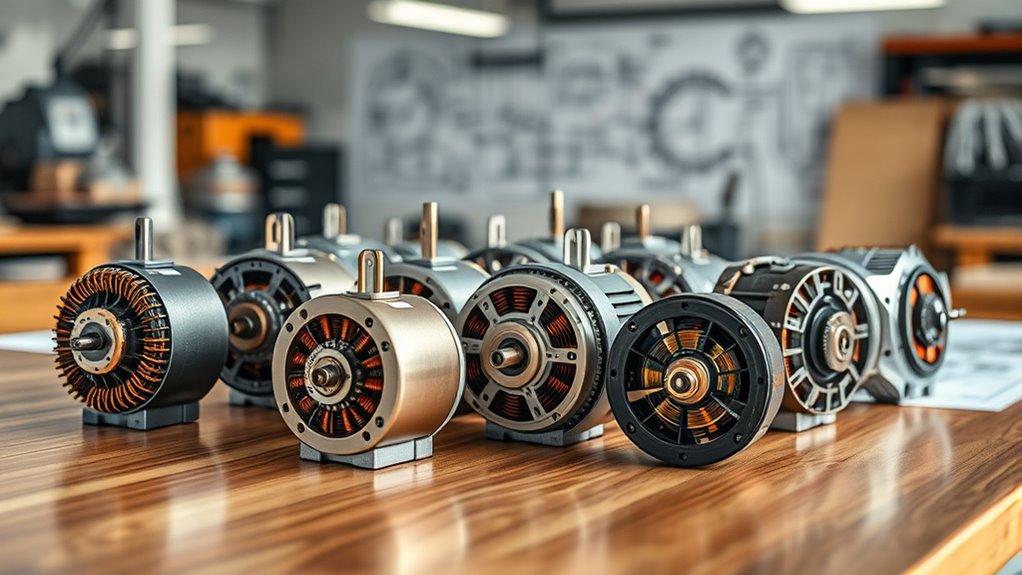
When you explore rotary electric motors, you’ll find they’re essential in converting electrical energy into mechanical energy, thanks to the interaction of magnetic fields and electric current.
These motors generate torque on the motor’s shaft and are classified into various types: AC motors, DC motors, and brushless DC motors. Each type is tailored for specific applications, delivering unique torque and precision control.
AC motors rely on electromagnetic induction, while DC motors use the Lorentz force. The stator and rotor are fundamental components that work together to create movement.
Innovations like brushless technology have enhanced efficiency and reduced maintenance. Brushless motors are used in robotics and automation, where high precision and control are vital for performance.
DC Motors: Characteristics and Applications
Although DC motors might seem straightforward at first glance, their versatility and ease of control make them a staple in various applications. They convert direct current electrical energy into mechanical power, providing smooth motion dynamics. Adjusting the voltage lets you easily control the speed, making them perfect for precise applications.
DC motors come in different types:
- Brushed DC motors: Known for their simplicity, but brush wear limits lifespan.
- Brushless DC motors: Offer enhanced efficiency and reduced noise.
- Permanent magnet motors: Provide reliable torque output and longer lifespans.
Their compact size and efficient torque output make them invaluable in applications such as precision automation, where reliable performance is essential.
Their adaptability guarantees they meet diverse needs effectively.
Applications include robotics, electric vehicles, and household appliances.
Brushless DC Motors and Their Benefits

You’ll find that brushless DC motors offer impressive benefits, including enhanced efficiency and longevity.
Without mechanical brushes, these motors reduce wear and require less maintenance, making them durable and reliable.
Plus, they operate with less noise and vibration, perfect for precision applications.
Enhanced Motor Efficiency
Because brushless DC motors (BLDC) operate with electronic commutation rather than traditional mechanical brushes, they boast incredible efficiency levels ranging from 85% to 96.5%.
This makes them perfect for high-performance applications where reliability and low maintenance are key.
With precise control, BLDC motors suit various applications, such as robotics, drones, and electric vehicles. Their compact design and high power-to-weight ratio also provide space-saving solutions.
- Brushless Motors: No brushes mean less friction and greater efficiency.
- ActiveDrive Technology: Simplifies design by integrating PWM amplifiers, reducing noise.
- Compact Design: Ideal for space constraints, offering a high power-to-weight ratio.
- Low Maintenance: Eliminating brushes reduces wear and tear, enhancing reliability.
These features make BLDC motors a superior choice for many uses.
Longevity and Durability
When considering the longevity and durability of brushless DC motors (BLDC), one can’t overlook their impressive lifespan, often exceeding 10,000 operational hours.
This extended service life is largely due to the absence of mechanical brushes, which eliminates friction-related wear. As a result, you’ll experience reduced maintenance needs and lower costs over time.
BLDC motors are designed for high efficiency, achieving remarkable energy conversion rates between 85% and 96.5%. This efficiency not only enhances longevity but also guarantees superior performance.
Electronic communication gives you precise control over speed and torque, optimizing durability in demanding applications. With less heat and electrical noise generated, BLDC motors are ideal for sensitive environments, further underscoring their outstanding durability.
Noise and Vibration Reduction
Brushless DC motors (BLDC) excel in minimizing noise and vibration, making them exceptionally suited for environments where these factors are essential.
By using electronic commutation, BLDC motors eliminate mechanical wear and reduce noise. No brushes mean no sparking, leading to lower electromagnetic interference and quieter performance.
You’ll benefit from:
- Smoother operation: The trapezoidal back electromotive force waveform reduces vibration issues.
- Precise control: BLDC motors have accurate speed and torque control, minimizing fluctuations that cause noise.
- High efficiency levels: These motors achieve 85% to 96.5% efficiency, reducing heat generation and further mitigating noise and vibration.
- Noise reduction: Ideal for sensitive environments, BLDC motors guarantee a quieter experience.
Incorporating these motors enhances performance and comfort in your applications.
AC Motors: Induction and Synchronous Types

While exploring the domain of AC motors, you’ll encounter two primary types: induction motors and synchronous motors. Induction motors, reliant on electromagnetic induction, generate torque efficiently and are prevalent in industrial settings due to their robustness. They come in single-phase and three-phase variants, offering flexibility based on power needs. With rotor speed matching the electrical supply frequency, synchronous motors excel in applications requiring precise speed control, such as power generation.
| Feature | Induction Motors | Synchronous Motors |
|---|---|---|
| Torque | High starting torque | Lower starting torque |
| Efficiency | High (especially in three-phase) | High, ideal for precise timing |
| Rotor Design | Electromagnetic induction | Permanent magnets/electromagnets |
Both types play crucial roles, with induction motors favored for their simplicity and synchronous motors for their efficiency in demanding applications.
Specialty Motors: Stepper and Servo Motors
When you’re looking for precision control in your projects, stepper motors can be a great choice as they transform electrical pulses into exact mechanical movements.
On the other hand, servo motors excel in handling dynamic responses, offering high precision with real-time feedback, making them perfect for complex tasks.
Both motors shine in applications where accuracy and reliability are key, with stepper motors favoring low-speed tasks and servo motors thriving at higher speeds and variable loads.
Stepper Motor Precision Control
Although stepper and servo motors play vital roles in precision control, stepper motors excel in converting electrical pulses into exact mechanical movements.
These motors offer precise control, making them perfect for position control in applications like CNC machinery and 3D printers. With step angles ranging from 1.8 to 90 degrees, stepper motors provide high precision without relying on feedback mechanisms, unlike their servo counterparts.
In automation, stepper motors are invaluable because they:
- Operate in discrete steps for fine motion resolution.
- Function efficiently in open-loop systems.
- Combine technologies for improved torque and resolution.
- Thrive in applications requiring high precision.
Servo Motor Dynamic Response
Servo motors excel in dynamic response because they can provide precise control over position, speed, and acceleration. They achieve this through feedback mechanisms in closed-loop systems.
With a three-phase winding stator, they generate a rotating magnetic field, enabling accurate motion control. Unlike stepper motors, servo motors offer smooth, continuous rotation, making them perfect for high-speed applications.
Position sensors like encoders or resolvers enhance accuracy, with some systems achieving position resolution down to micrometers. This is essential for applications needing both high torque and precision.
Servo motors maintain torque and performance across varying speeds, a feature that sets them apart from stepper motors, which can lose steps under high load. Overall, they’re ideal for demanding industrial tasks.
Applications and Advantages
While stepper and servo motors have unique strengths, choosing the right one hinges on your application’s specific needs.
Stepper motors are perfect for applications like 3D printers and CNC machines where precise control and position control are critical. They offer high torque even at low speeds, making them reliable for stationary tasks.
On the other hand, servo motors excel in industrial automation due to their real-time feedback and dynamic performance, delivering precise control of position, speed, and acceleration.
Consider these factors:
- Stepper motors: Simplified design, cost-effective for low-speed applications.
- Servo motors: Superior efficiency and high performance for complex tasks.
- High torque: Both motors provide this advantage, but in different contexts.
- Application specificity: Stepper for simplicity, servo for precision.
Torque Motors and Precision Positioning
Torque motors’ design shines in applications that demand direct rotor load connections without gearboxes, thanks to their ability to deliver high torque at medium to high speeds.
These motors excel in precision positioning, using dual-loop controllers and encoders to provide accurate feedback. This setup guarantees high-resolution control over position and velocity.
The integration of ActiveDrive technology further simplifies motor control. It incorporates PWM amplifiers directly into the motor, reducing electrical noise and enhancing system scalability.
Torque motors are indispensable in automation systems like robotics and CNC machinery. They offer precise movement and a high dynamic response and can handle direct rotor loads with precision, making them a top choice in demanding applications.
Emerging Trends in Electric Motor Technology
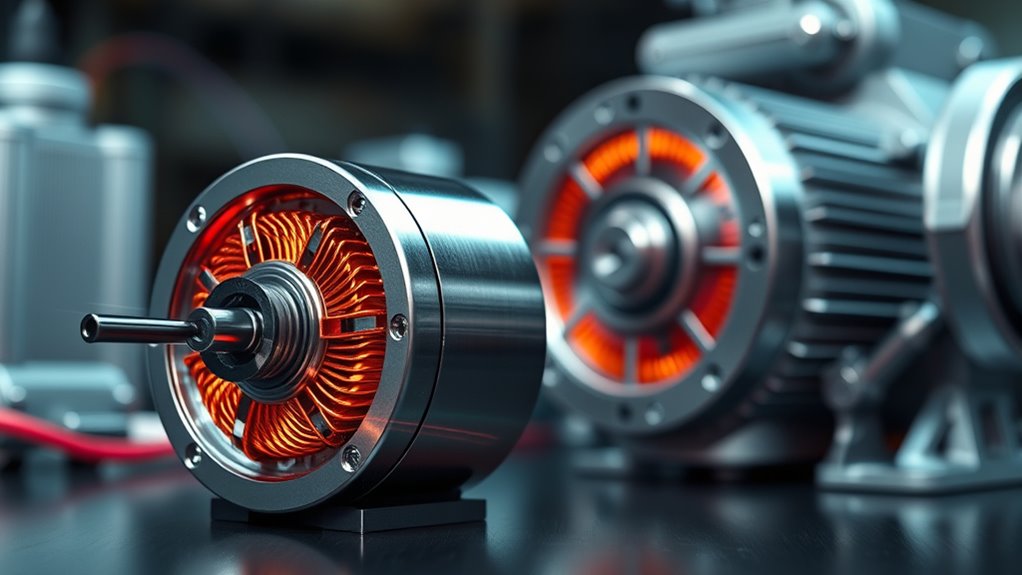
As electric motor technology advances, several emerging trends are reshaping the industry.
You’ll notice the rise of brushless DC motors, prized for their efficiency and longevity. They’re a game-changer for electric vehicles and gadgets.
ActiveDrive technology simplifies motor design by integrating PWM amplifiers, boosting performance while cutting noise.
Motors with IoT capabilities are becoming smarter; they allow for real-time monitoring and predictive maintenance, slashing downtime.
Advanced materials, like high-temperature superconductors, enhance efficiency and power density, especially in aerospace.
Innovations in motor design are fueled by:
- 3D printing for custom solutions
- Complex winding methods improve performance
- Advanced materials enhancing power and efficiency
- IoT capabilities for smarter operations
These trends are setting new benchmarks in motor technology.
Conclusion
In exploring rotary electric motors, you’ve investigated various types, each with unique advantages. DC motors offer efficient speed control, while brushless DC motors enhance performance by eliminating brushes. AC motors, with their induction and synchronous variants, are industrial workhorses. Specialty motors like steppers and servos provide precise control, essential for robotics. Torque motors excel in precision positioning. As you look to the future, emerging trends promise even more innovative advancements in electric motor technology.
FAQs
1. What Are the 4 Types of Motors?
There are four main motor types: AC, DC, stepper, and servo. AC motors are robust, DC motors can be brushed or brushless, stepper motors offer precision, and servo motors excel in precise control applications.
2. What Are the Different Types of Rotary Engines?
You’re curious about rotary engines. Typically, you’ll find Wankel engines, which use an eccentric rotor instead of pistons. These engines offer smoother operation and high power-to-weight ratios, making them unique for specific automotive applications.
3. Can a Rotating Motor Produce Electricity?
Yes, you can use a rotating motor to produce electricity. When operated as a generator, it converts mechanical energy into electrical energy. This process is efficient, especially with brushless DC motors, which minimize mechanical commutation losses.
4. What Are the Different Types of IE Motors?
There are four types of IE motors: IE1, IE2, IE3, and IE4. Each offers increasing efficiency, with IE4 being the most efficient. Opting for these motors reduces energy costs and supports environmental sustainability.