Step Down Chopper: Working, Applications, and Key Benefits
Imagine you’re tasked with efficiently regulating voltage levels in a compact electronic system, where a step-down chopper comes into play. This device, an essential type of DC-to-DC converter, transforms higher input voltages into lower, stable outputs. You’ll find it intriguing how these choppers leverage components like switches, inductors, and capacitors to achieve cost-effective voltage conversion. But what happens when you integrate a low-pass filter or apply a resistive load? Understanding these dynamics can be pivotal for modern power supply applications, and there’s more to explore about these versatile devices.
Key Takeaways
- Step-down choppers are DC-to-DC converters that efficiently reduce high input voltages to lower output voltages.
- They use switches, inductors, diodes, and capacitors to regulate voltage output.
- The duty cycle is critical, directly affecting the average output voltage level.
- Inductors in choppers store energy, smoothing voltage ripple and ensuring stable output.
- Step-down choppers are widely used in applications like DC motor control and renewable energy systems.
Understanding Chopper Basics
When diving into the world of power electronics, you’ll often encounter step-down choppers, which frequently play an important role in voltage regulation. These devices help you reduce the output voltage to a desired level, ensuring systems operate efficiently.
The magic behind a step-down chopper lies in its ability to control a switch’s duty cycle. By adjusting the time the switch is on versus off, you effectively change the average output voltage. This precise control is vital for providing voltage levels for various applications.
In your exploration, you’ll notice that the duty cycle isn’t the only factor affecting performance. The inductor is another key component that helps smooth out the output voltage ripple. A well-designed inductor minimizes these ripples, producing a more stable average output voltage. Understanding the interplay between these elements is important for mastering step-down chopper basics.
Step-down choppers are a staple in power electronics, and grasping their fundamental operations opens up a world of possibilities. You’ll discover how they seamlessly convert higher voltage levels into manageable ones, supporting the efficient operation of countless electronic systems.
Types of Choppers
Having explored the fundamentals of step-down choppers, it’s time to focus on the various choppers available in power electronics. Step-down choppers, an essential type of DC-to-DC converter, are designed to reduce input voltage to a lower output voltage. Doing so enables you to achieve the necessary voltage levels for applications like power supplies and battery charging circuits. These choppers work through switching, where the switch turns on and off rapidly to control the average voltage delivered to the output.
There are primarily two types of choppers: Type A and Type B. Type A choppers are used when the current is always positive, making them ideal for applications that require consistent power delivery.
In contrast, Type B choppers are suitable for regenerative braking in motors, as they can handle both positive and negative currents. Regardless of the type, the main role of a step-down chopper is to regulate voltage efficiently, ensuring power efficiency across various electronic systems.
Step-Down Chopper Overview
Explore the domain of step-down choppers, an important component in power electronics that effectively reduces input voltage to a lower output level. A step-down chopper, a specialized DC-to-DC converter, plays a key role in applications requiring lower voltage, such as power supplies and battery chargers. By switching the input voltage, these choppers produce a lower average output voltage, making them highly effective in converting higher-voltage sources into controlled, lower-voltage levels.
Here’s why step-down choppers are essential:
- Efficiency: They effectively convert high voltage to a lower voltage with minimal energy loss.
- Versatility: These converters are used in electronic systems needing specific voltage levels.
- Regulation: They guarantee stable output voltage, which is crucial for sensitive electronic devices.
- Compact Design: Their compact nature makes them ideal for modern, space-constrained applications.
- Cost-effectiveness: They offer a cost-effective solution for voltage conversion in many applications.
These choppers are important for regulating power levels and meeting voltage requirements across diverse electronic systems.
Key Components and Design
When designing a step-down chopper, you’ll focus on key components like the semiconductor switch, inductor, freewheeling diode, capacitor, and load. These components must be carefully selected and sized to efficiently decrease the input voltage while maintaining stable output for your connected loads.
Essential Circuit Components
Several key components work together in a step-down chopper to guarantee efficient voltage regulation. A switch, often a MOSFET, controls the circuit’s on/off state.
The inductor plays an important role by storing energy when the switch is on and releasing it when it is off, directly influencing the output voltage and current waveforms.
A freewheeling diode allows current to flow in one direction, securing a smooth energy transfer.
The capacitor filters the output, smoothing out voltage fluctuations, while the load is the component that ultimately receives the regulated voltage.
Each component is necessary for the step-down chopper to function effectively:
- Switch (like a MOSFET): Controls the circuit’s on/off state.
- Inductor: Stores and releases energy, shaping voltage and current waveforms.
- Diode: Secures unidirectional current flow and energy transfer.
- Capacitor: Filters and stabilizes the output voltage.
- Load: Receives the regulated voltage, completing the circuit.
Proper selection and design of these components are crucial. They ensure that your step-down chopper operates efficiently, provides stable voltage regulation, and improves overall circuit performance.
Design Considerations Overview
Designing a step-down chopper requires careful consideration of several essential components to guarantee efficient voltage regulation and circuit performance. As you explore the DC-to-DC conversion process, you’ll find that the step-down chopper, also known as a buck converter, is central to power control in many electronic applications. The key components of this system include the switching device, inductor, freewheeling diode, capacitor, and load. Each part plays a pivotal role in ensuring smooth and effective operation.
When selecting switching devices, focus on their capability to handle the desired current and voltage levels, as these dictate the efficiency and reliability of your circuit.
The inductor’s role is vital; it manages the inductor current and stores energy, which helps maintain a stable output.
Meanwhile, the freewheeling diode prevents voltage spikes and ensures a continuous current flow when the switch is off.
Don’t overlook the capacitor’s significance. It filters out voltage ripples, stabilizing the output voltage and ensuring clean power delivery. By carefully selecting and integrating these components, you can design a highly efficient step-down chopper that meets your specific power control needs.
Operation With Resistive Load
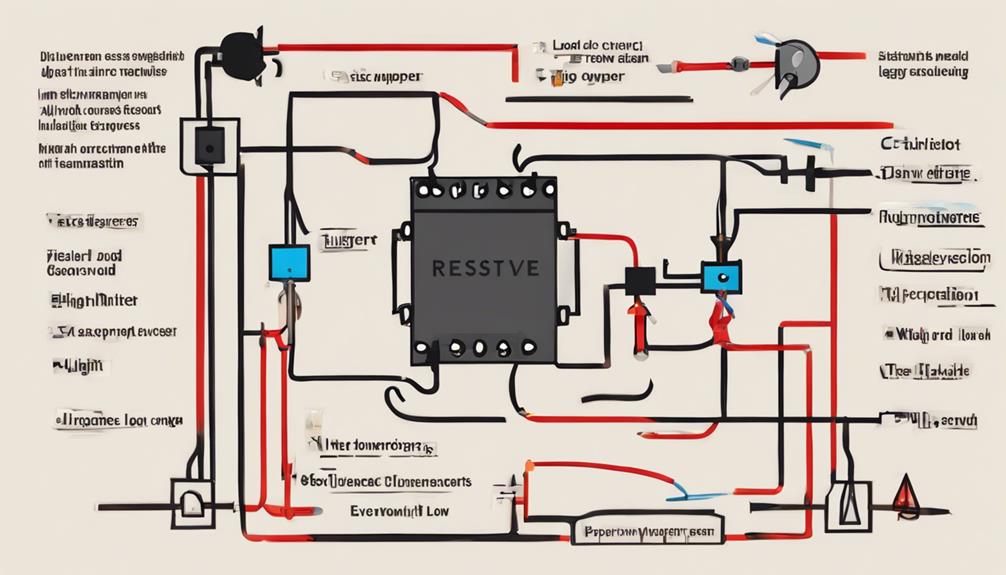
Imagine you’re dealing with a step-down chopper operating under a resistive load. In this setup, the DC voltage from the source gets converted into a lower DC voltage at the output. The average load voltage is vital here, as it’s calculated by multiplying the duty cycle with the input voltage. This is a simple relationship, but the chopper circuit must be scrutinized for power losses, especially switching losses, which can impact efficiency.
The WithiTThestive component is essential, as within an RL load, it directly influences the RMS load voltage, which is rated as the input voltage times the square root of the duty cycle.
When evaluating this type of system, consider the following:
- Average Load Voltage: It’s directly proportional to the duty cycle and input voltage.
- RMS Load Voltage: Determined by input voltage and the square root of the duty cycle.
- RMS Load Current: Calculated by dividing the input voltage by resistance and multiplying by the square root of the duty cycle.
- Power Losses: Switching losses are significant in the chopper circuit.
- Performance Evaluation: Involves integrating voltage and current waveforms over the duty cycle.
Understanding these aspects secures efficient operation and optimization of your step-down chopper with a resistive load.
Operation With Inductive Load
While operating a step-down chopper with a resistive load offers a straightforward approach to managing voltage, introducing an inductive load adds complexity and efficiency to the system. An inductor is placed in series in a chopper circuit with an inductive load to store and release energy. During the chopper’s ON time, the inductor stores energy, causing the output current to rise exponentially. This energy storage plays a pivotal role in shaping the current waveform.
Once the chopper switches off, the off inductor releases its stored energy through a freewheeling diode, allowing the current to continue flowing. This process guarantees a smoother shift and maintains the circuit’s operation, highlighting the dynamic energy transfer at play. Understanding the influence of the influence ductor on the current waveform is crucial for optimizing the system’s performance.
Here’s a breakdown of key elements involved in this operation:
| Element | Function |
|---|---|
| Inductor | Energy storage during ON time |
| Freewheeling Diode | Maintains current flow during OFF time |
| Current Waveform | Affected by the inductor’s energy storage/release |
Incorporating an inductive load into your step-down chopper requires careful consideration of the inductor’s characteristics and their impact on the average output voltage.
Calculating Average Output
To calculate the average output voltage of a step-down chopper, you’ll use the formula V_average = D x V_source. Here, the duty cycle (D) plays an essential role, representing the time fraction the switch remains closed during each cycle. Understanding this relationship helps determine the effective voltage your circuit delivers to the load.
Average Voltage Formula
When calculating the average output voltage of a step-down chopper, you need to understand the relationship between the duty cycle and the input voltage. This understanding is pivotal because the two factors directly influence average output voltage. The formula you need is Vave = D x Vs, where Vave represents the average output voltage, D is the duty cycle, and V is the input voltage. ByMasteringhis relationship allows you to actively control or regulate the output voltage of the step-down chopper, making it a crucial aspect of designing and analyzing DC-to-DC conversion applications.
Here’s what to keep in mind:
- The average output voltage depends on the duty cycle and the input voltage.
- The formula Vave = D x Vs is crucial to predicting output behavior.
- Adjusting the duty cycle lets you regulate the output voltage.
- Mastery of this relationship aids in optimizing performance.
- It is important for designing effective step-down chopper systems.
Duty Cycle Impact
Understanding the average voltage formula sets the stage for examining the duty cycle‘s impact in a step-down chopper. In this setup, the duty cycle directly influences the average output voltage. By definition, the average output voltage is the product of the duty cycle and the input voltage. If you increase the duty cycle, you’ll notice a rise in the average output voltage. This relationship is pivotal because it allows for precise control over the voltage level supplied to the load.
Adjusting the duty cycle in a step-down chopper is like having a volume knob for voltage. With the ability to fine-tune the duty cycle, you can effectively manage how much power reaches the load, ensuring the current supplied matches the load’s requirements. This precise control is crucial, especially when dealing with sensitive electronic components that demand specific voltage levels.
Moreover, the duty cycle’s role in regulating the power delivered means you can efficiently manage the current flowing through the system. By tweaking the duty cycle, you’re not just controlling voltage; you’re optimizing the entire power delivery process, ensuring that your load receives exactly what it needs.
Low Pass Filter Integration
In final engineering, integrating a low plow-passer into a step-down chopper design is necessary for improving output voltage quality. When you add a low plow-passer, you effectively reduce the voltage ripple that can interfere with your system’s performance, smoothing out the output voltage; the filter plays an important role in ensuring the high-frequency components are filtered out effectively.
A low-pass filter in a step-down chopper typically uses components like resistors, capacitors, and inductors. These components work together to attenuate unwanted high-frequency noise, which can otherwise cause problems for your output voltage. Here’s why integration is key:
- Smooth Output Voltage: The low pass filter ensures the output voltage remains stable and clean.
- Reduced Voltage Ripple: By filtering out high-frequency components, voltage ripple is minimized.
- Improved Voltage Stability: A stable voltage output is achieved, vital for sensitive applications.
- Reduced Electromagnetic Interference: The filter helps decrease electromagnetic interference, promoting a cleaner signal.
- Important Components: Resistors, capacitors, and inductors are fundamental to the filter’s functionality.
Pros and Cons
Integrating a low-pass filter into a step-down chopper enhances the output voltage quality, but it’s important to weigh the pros and cons of using this type of converter.
On the plus side, step-down choppers efficiently reduce input voltage, providing a stable power supply for power electronics. They excel at delivering a regulated output voltage, making them ideal for applications that require precise voltage reduction. Additionally, they boast low switching losses at high frequencies and a compact design, which is always a positive when space is at a premium.
However, there are drawbacks to consider. Voltage ripple can be a concern, impacting the smoothness of the power supply. High voltage stress on components is another issue, potentially affecting overall performance and reliability. Electromagnetic interference (EMI) may also arise, necessitating additional filtering or shielding to mitigate these effects.
Despite these challenges, the step-down chopper remains popular due to its efficiency in converting high input voltages to lower, regulated outputs.
Understanding these trade-offs is essential for designing reliable power supply systems. Balancing the benefits and limitations ensures you choose the right solution.
Practical Applications
You’lStep-downpers are important for efficiently controlling DC motor speeds, ensuring smooth operation in various applications.
Electric vehicles play a critical role in power management, providing stable energy to the vehicle’s systems. Additionally, they help in renewable energy setups by converting and regulating power from sources like solar panels, making them a necessary component in sustainable energy solutions.
DC Motor Speed Control
Utilizing step-down converters in DC motor speed control allows you to regulate the management supplied to the motor regularly. By precisely controlling the power delivered through voltage adjustment, you secure efficient operation and extend the life of your DC motors. This regulated power supply stabilizes motor function and facilitates precise speed adjustments, which are essential for applications requiring meticulous motor performance.
Incorporating step-down converters in your system offers several benefits:
- Efficient power utilization: Minimize energy wastage, ensuring that your motor uses only its needs.
- Smooth motor operation: Achieve consistent acceleration and deceleration, enhancing performance.
- Improved motor longevity: Reduce wear and tear by providing a stable and controlled power supply.
- Enhanced control capabilities: Gain better command over motor behavior for various applications.
- Cost-effective solution: Reduce operational costs by optimizing power and improving motor efficiency.
Electric Vehicle Power Management
Step-down choppers are vital for efficient power management and voltage regulation in electric vehicles. They convert the high voltage from the battery into the lower voltages required by various vehicle components. This conversion is important because it ensures each component receives the appropriate power level, preventing overloading and potential damage. By doing so, choppers enhance the overall performance and reliability of your vehicle’s power system.
Using step-down choppers also plays a key role in optimizing energy usage and extending battery life. By precisely managing the voltage supplied to different parts of your vehicle, these choppers help minimize unnecessary energy consumption. This efficient power distribution means your battery can last longer on a single charge, a significant advantage for electric vehicles.
Moreover, step-down choppers represent a significant advancement in modern automotive technology. Their implementation showcases their importance in shifting to more sustainable and efficient vehicles. By incorporating these devices into electric vehicles, manufacturers boost the performance and reliability of these cars, making them a more viable option for everyday use.
Renewable Energy Integration
While step-down choppers are pivotal to electric vehicle power management, their role extends beyond automotive applications into renewable energy integration. Step-down choppers guarantee that fluctuating inputs are converted into stable outputs by effectively managing the DC output voltage from sources like solar panels and wind turbines. This stability is essential for both storage and consumption, enhancing the efficiency of renewable energy systems.
Step-down choppers excel at maintaining a consistent power supply, which is crucial for guaranteeing the reliability of renewable energy generation. Their significance is particularly evident in grid-tied systems, where they help feed excess energy back into the grid or store it in batteries. This capability optimizes energy use and supports the grid’s overall stability.
Here’s why step-down choppers are indispensable for renewable energy integration:
- Voltage Regulation: They regulate fluctuating DC output voltage to ensure consistency.
- Efficiency: Improve the efficiency of energy conversion processes.
- Grid-Tied Systems: Enable seamless integration of renewable energy into existing grids.
- Energy Storage: Facilitate efficient storage of excess energy for later use.
- Reliability: Ensure a stable and reliable power supply from renewable sources.
Conclusion
You now have a solid understanding of step-down choppers and their crucial role in voltage regulation. You can efficiently design compact and cost-effective systems by mastering their components and operation. Integrating a low-pass filter can greatly enhance performance, ensuring a stable output. While there are pros and cons, the practical applications are extensive, making step-down choppers indispensable in modern electronics. Keep exploring their potential to optimize your power supply solutions.
FAQs
What is a step-down chopper?
A step step-step-step-down process known as a buck converter is a D -DC converter that reducefficiently efficiently es the voltage from a higher level to a lower level effiusineffusingductor switches; it rapidly turns the input supply on and off, controlling the output voltage based on the duty cycle, making it ideal for applications where lower voltage is needed.
Key Points:
- Reduces high DC voltage to lower DC voltage
- Works by rapidly switching input supply
- Output voltage controlled by duty cycle
What are the common applications of a step-down chopper?
Step-down choppers are commonly used in electric vehicles, power supplies, and DC motor control systems where precise voltage control is needed. They’re also found in renewable energy systems, such as solar power, to step down battery or panel voltages for safe usage.
Key Points:
- Used in electric vehicles and DC motor control
- Common in power supplies and solar energy systems
- Provides efficient voltage control
What are the benefits of using a step-down chopper?
The step-down chopper offers high efficiency and precise voltage regulation, making it a preferred choice for applications that need stable, lower voltages. It minimizes energy loss, supports flexible output voltage control, and reduces heat production, contributing to longer device lifespans and lower power consumption.
Key Points:
- High efficiency with minimal energy loss
- Precise and stable voltage regulation
- Reduces heat, improving device lifespan