Self Excited Dc Generator: Diagram & Applications Explained
Imagine you’re exploring the fascinating mechanics behind power generation, and you encounter the self-excited DC generator. This ingenious device stands out because it doesn’t rely on external sources to generate electricity. Instead, it cleverly uses its residual magnetism to kickstart the process. But what happens next, and how does it maintain voltage? These intriguing questions open the door to a world of electrical innovation and discovery.
Key Takeaways
- Self-excited DC generators utilize residual magnetism to generate electricity without needing external power sources.
- They include series-wound, shunt-wound, and compound-wound types, each with unique voltage regulation characteristics.
- The voltage build-up process is driven by residual magnetism and enhanced field current until magnetic saturation is reached.
- Shunt-wound generators maintain stable voltage, while series-wound generators adjust voltage with load, and compound-wound generators balance both.
- These generators are ideal for battery charging, renewable energy applications, and electric traction systems.
Overview of Self-Excited DC Generators

Although often overlooked, self-excited DC generators play an essential role in generating electricity without the need for external power sources.
These generators cleverly utilize residual magnetism in the rotor to initiate the magnetic field. As the armature rotates, it induces a small voltage, which increases the field current and boosts the voltage further. This feedback mechanism continues until the system reaches a state of magnetic saturation.
In self-excited DC generators, the field winding can be configured in different ways. In shunt generators, the field winding is parallel to the armature, ensuring a stable voltage for applications such as lighting.
Series generators, with the field winding in series, provide a variable voltage to match changing loads, making them ideal for electric traction. Understanding these configurations helps you appreciate their adaptability in various applications.
Types of Self-Excited DC Generators
Understanding the different types of self-excited DC generators reveals their versatility in electrical applications. These generators are classified by how their field windings interact with the armature.
- Series-Wound Generators: In this configuration, the field winding is connected in series with the armature. This design yields a voltage output that varies with load current, making it suitable for meeting fluctuating power demands.
- Shunt-Wound Generators: The field winding connects in parallel with the armature, providing a stable terminal voltage. It’s ideal for applications that require consistent voltage, such as lighting systems.
- Compound-Wound Generators: Combining series and shunt field windings, these generators enhance performance under varying loads. They can be classified further into short-shunt and long-shunt configurations, each offering distinct characteristics.
Series-Wound DC Generator
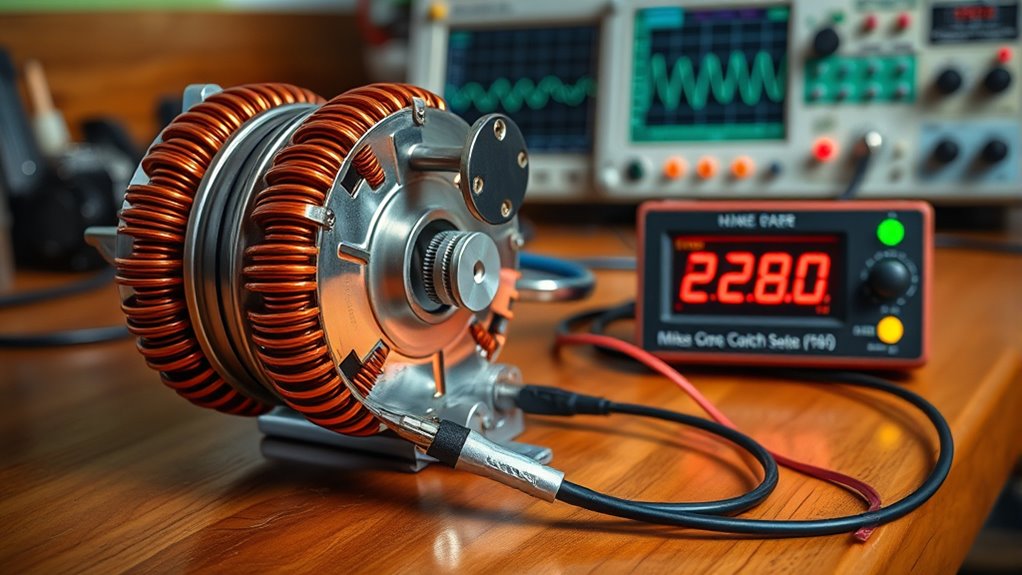
In a series-wound DC generator, you’ll notice that the output voltage changes with the load current, which makes it ideal for applications requiring variable voltage.
This characteristic is particularly useful in electric traction, where adjusting the voltage can optimize performance.
Consider how the generator’s ability to boost voltage effectively supports these specialized needs.
Voltage Variation With Load
When discussing voltage variation with load in a series-wound DC generator, it’s crucial to understand how the configuration impacts performance.
In a self-excited DC generator, the field winding is connected in series with the armature, ensuring that the field current is equal to the load current. This setup means:
- Voltage Generated: The output voltage is directly proportional to the load current.
- Load Change Impact: As the load resistance decreases, the load current increases, resulting in a higher output voltage due to enhanced magnetic saturation.
- Voltage Instability: A reduced load decreases current and magnetic field strength, resulting in a lower output voltage.
These characteristics make series-wound generators poorly suited for applications requiring stable voltage.
They’re ideal for situations where varying voltage is beneficial, but general usage is limited due to instability.
Application in Electric Traction
Although often overlooked, the series-wound DC generator finds a unique niche in electric traction systems, where its ability to deliver high starting torque is invaluable.
In applications like trains and trams, these self-excited generators excel at moving heavy loads. As the load current increases, the output voltage varies directly, adapting seamlessly to fluctuating load conditions.
The series field winding, connected in series with the armature, guarantees performance boosts as load demands rise. This responsiveness makes them ideal for dynamic environments with frequent acceleration and deceleration, such as railways.
Plus, when paired with regenerative braking, they facilitate energy recovery, enhancing overall efficiency. You’ll appreciate how these generators meet the rigorous demands of modern electric traction, guaranteeing reliable and efficient operation.
Shunt-Wound DC Generator
When exploring shunt-wound DC generators, you’ll notice their unique ability to maintain a stable terminal voltage thanks to their parallel field winding configuration.
This setup enables the field winding to handle changes in load while maintaining a consistent voltage.
With high resistance and numerous wire turns, shunt generators ensure reliable performance, making them ideal for applications requiring steady voltage.
Voltage Stability Characteristics
As you explore the voltage stability characteristics of shunt-wound DC generators, you’ll notice their impressive ability to maintain nearly constant output voltage even with load variations. This is because the field winding in a self-excited DC generator is connected in parallel with the armature, allowing independent current flows. This setup enhances voltage regulation, ensuring the shunt-wound generator’s output voltage remains stable.
Here’s why shunt-wound DC generators excel in voltage stability:
- Field Winding Design: High resistance and numerous wire turns limit current, stabilizing output voltage.
- Load Variation Handling: Slight terminal voltage decrease with increased load, but superior to series-wound types.
- Voltage Regulation: Typically ranges from 1% to 5%, providing reliable performance for battery charging and lighting systems.
Parallel Field Winding Configuration
In shunt-wound DC generators, the parallel field winding configuration plays a crucial role in maintaining a stable voltage output across varying loads.
The field winding, with its high resistance and numerous wire turns, connects in parallel with the armature winding. This setup allows the field winding to draw only a small fraction of the total armature current. As a result, the magnetic field remains relatively constant, ensuring consistent voltage output.
The terminal voltage is determined using the formula V = E0 – IaRa, where E0 is the generated EMF, Ia is the armature current, and Ra is the armature resistance.
Although increased load can lead to a slight drop in voltage output, shunt-wound generators effectively manage this within acceptable limits, making them ideal for stable voltage applications.
Constant Terminal Voltage Maintenance
Building on the understanding of the parallel field winding configuration, maintaining constant terminal voltage in shunt-wound DC generators is crucial for their reliable performance.
As a self-excited system, it utilizes residual magnetism to initiate the magnetic field, thereby stabilizing the terminal voltage. Here’s how it works:
- High Resistance in Shunt Field: This ensures minimal armature current flows through, maintaining a stable output voltage even when the load resistance changes.
- Inverse Variation with Load Current: The output voltage remains nearly constant, adjusting inversely as load current varies, a hallmark of shunt-wound systems.
- Application Efficiency: Ideal for steady voltage needs, such as battery charging and lighting, thanks to their resilience in maintaining output voltage despite load fluctuations.
Compound-Wound DC Generator
Though various types of DC generators exist, the compound-wound DC generator stands out for its capability to handle fluctuating loads with improved voltage regulation.
This type of generator combines both shunt field winding and series field winding, offering a balanced approach to voltage control. As the current increases, the series field winding, composed of a few thick wire turns, enhances the magnetic field strength, while the shunt field winding, with many thinner wire turns, stabilizes the armature voltage.
This synergy between the windings guarantees effective voltage regulation, preventing excessive drops under high loads.
Compound DC generators are versatile, serving applications such as battery charging and power distribution, thanks to their ability to maintain a consistent voltage output even when load conditions vary.
Operating Principles of Self-Excited DC Generators

When you explore the operating principles of self-excited DC generators, you’ll find that they cleverly harness kick-startism to kickstarter generation. This process involves several key steps:
- Initial Activation: Residual magnetism in the rotor induces an initial electromotive force (emf) in the armature windings, starting a small current through the field winding.
- Positive Feedback Loop: The current enhances the magnetic field, boosting voltage output. As the generated voltage increases, it raises the field current, strengthening the magnetic field until magnetic saturation occurs.
- Stabilization: The terminal voltage stabilizes when the armature emf exceeds the voltage drop across the field winding, achieving electric equilibrium.
The voltage build-up process is critical, relying on interactions between the magnetization curve and the field resistance line.
Voltage Build-Up Mechanism in DC Generators
Understanding the operating principles sets the stage for exploring the voltage build-up mechanism in self-excited DC generators.
It all starts with residual magnetism in the field winding, which leads to an initial induced electromotive force (EMF) of approximately 1-2 V in the armature. As the field current is given, the field winding carries this current, enhancing the magnetic flux. This increased flux boosts the voltage of the generator, initiating a positive feedback loop that enhances power generation.
The voltage build-up continues until the magnetic field saturates, halting further voltage increase. Initially, the terminal voltage is determined by residual EMF, simplifying to V = E0 when the armature current drop is negligible.
The interaction between the magnetization curve and the field-resistance line defines the maximum voltage that can be achieved.
Characteristics of Self-Excited DC Generators
Self-excited DC generators are fascinating because they harness kick-starting to generate electricity without external help.
These generators are classified into three main types, each with unique characteristics:
- Shunt-Wound: This configuration maintains a nearly constant terminal voltage by connecting the field winding in parallel with the armature. It’s ideal for applications requiring a stable voltage output due to its effective voltage regulation.
- Series-Wound: Here, the terminal voltage varies with load current, as the field winding is connected in series with the armature, making it suitable for fluctuating power demands.
- Compound-Wound: Combining features of both series and shunt, these generators offer improved voltage regulation and performance across different load conditions, making them versatile for varying applications.
This adaptability highlights the efficiency of self-excited generators.
Applications of Self-Excited DC Generators
You’ll find self-excited DC generators invaluable in various industrial settings, especially where a reliable DC power supply is essential.
They’re perfect for battery charging systems and small-scale renewable energy applications due to their self-sustaining operation.
Additionally, their ability to handle power fluctuations makes them ideal for electric traction and manufacturing processes.
Common Industrial Uses
In industrial applications, self-excited DC generators are distinguished by their versatility and reliability.
These generators offer a stable output voltage, making them perfect for battery charging applications. You’ll find them commonly used in automotive and industrial battery systems where consistency is key.
In electric traction systems, they provide flexible power distribution, vital for railways and electric vehicles. They adjust the output voltage based on varying load conditions.
For controlled motor drives, self-excited DC generators provide precise voltage regulation, which is crucial for DC motors in manufacturing applications.
Here are three common uses:
- Battery charging – Guarantees stable voltage for automotive and industrial systems.
- Electric traction – Adjusts voltage for railways and electric vehicles.
- Controlled motor drives – Provide precise regulation for manufacturing processes.
Power Supply Systems
Exploring the versatility of self-excited DC generators, let’s shift our focus to their applications in power supply systems.
These generators are invaluable in battery charging applications, providing a stable voltage output that ensures battery longevity and optimal performance. In remote areas without grid access, self-excited DC generators excel as a portable power supply, providing consistent electricity.
The Shunt Wound DC variant is especially useful in lighting systems, providing the constant voltage necessary for efficient illumination. Additionally, their self-sustaining nature makes them ideal for renewable energy systems, such as wind and hydroelectric power, which convert mechanical energy into electrical energy seamlessly.
Whether you’re lighting up a space or powering devices off the grid, self-excited DC generators are reliable and efficient solutions.
Advantages and Limitations of Self-Excited DC Generators
Although self-excited DC generators rely on residual magnetism for self-excitation, they offer a reliable power source without needing an external supply.
These generators are particularly advantageous due to their voltage stability. Shunt-wound generators maintain a consistent voltage despite changes in load resistance. Series-wound types adjust the output voltage as the load resistance decreases, making them ideal for variable demands.
However, limitations exist. Self-excited generators can suffer from voltage instability under heavy load conditions. Factors such as armature resistance and magnetic saturation can affect output capacity and efficiency.
Here’s a quick breakdown:
- Voltage stability: Essential for maintaining output under varying conditions.
- Load resistance: Affects performance, especially in series configurations.
- Armature resistance: Limits output capacity and efficiency, impacting overall performance.
Conclusion
In conclusion, self-excited DC generators are versatile machines that efficiently convert mechanical energy to electrical energy. You’ve learned about their types—series-wound, shunt-wound, and compound-wound—each with distinct voltage regulation traits. These generators are indispensable in applications like battery charging, lighting, and electric traction. Despite some limitations, such as their dependency on residual magnetism, their advantages —like simplicity and cost-effectiveness —make them a reliable choice for many power generation needs.
FAQs
1. What Is a Self-Excited DC Generator?
You’re wondering about a self-excited DC generator. It’s a generator that powers its magnetic field using its output. It doesn’t require external power, instead utilizing residual magnetism to generate current. It’s efficient for consistent DC power needs.
2. What Is Self-Excitation in a Generator?
You’re looking at self-excitation in a generator, where it powers its magnetic field without external help. It begins with residual magnetism, which creates an EMF. This increases the current flow, strengthening the magnetic field until it reaches stabilization.
3. What Is the Difference Between Self-Excited and Separately Excited Generators?
You’ll find that self-excited generators energize their field winding from their output, making them simpler to operate. Separately excited generators require external sources, offering better voltage control and stability. Choose based on your application’s complexity and stability needs.
4. What Do You Do if a Self-Excited DC Machine Fails to Build up Emf?
First, check for residual magnetism. Confirm that the field winding connections are correct and there is no open circuit—measure field resistance. Verify armature speed. If there is still no EMF, briefly apply an external DC voltage to the field winding.