Understanding the Mechanical Properties of Materials
When it comes to designing and engineering products, understanding the mechanical properties of materials is crucial. These properties dictate how a material will respond to various forces, temperatures, and environmental conditions, ultimately influencing the performance and durability of the final product. In this article, we will delve into the world of mechanical properties, exploring the key concepts, testing methods, and the importance of these properties in materials science and engineering.
Mechanical Properties: A Brief Overview

Mechanical properties refer to the characteristics of a material that determine its ability to withstand external forces, deformations, and changes in shape without failing. Engineers and material scientists rely on these properties to make informed decisions about material selection, structural design, and manufacturing processes. Several fundamental mechanical properties play a vital role in this context:
Stress and Strain
Stress and strain are fundamental concepts in the study of mechanical properties. Stress is the internal resistance of a material to deformation, while strain measures the deformation that occurs when a material is subjected to stress. These properties are often graphically represented on stress-strain curves, providing insights into a material’s behavior under various loads.
Elasticity
Elasticity is the ability of a material to return to its original shape and size after deformation when the applied stress is removed. Materials that exhibit high elasticity are often used in applications where deformation needs to be reversible, such as springs and rubber bands.
Strength
Strength is a crucial property that defines the maximum stress a material can withstand before it fails. There are several types of strength, including:
- Tensile Strength: A material can withstand maximum stress when pulled in tension.
- Compressive Strength: The maximum stress a material can withstand when subjected to compression.
- Shear Strength: The maximum stress a material can withstand when subjected to shear forces.
Ductility and Brittleness
Ductility is the ability of a material to deform plastically under tensile stress, allowing it to stretch without breaking. On the other hand, Brittleness is a material’s tendency to fracture when subjected to stress without significant plastic deformation. These properties are crucial in applications where materials must withstand varying degrees of deformation.
Hardness
Hardness measures a material’s resistance to localized deformation, typically through indentation or scratching. It provides insights into a material’s wear resistance and suitability for cutting or abrasive applications.
Fatigue Resistance
Fatigue resistance is the ability of a material to withstand cyclic loading without failing. This property is vital in applications where materials are subjected to repeated stresses, such as constructing bridges and aircraft.
Testing Mechanical Properties
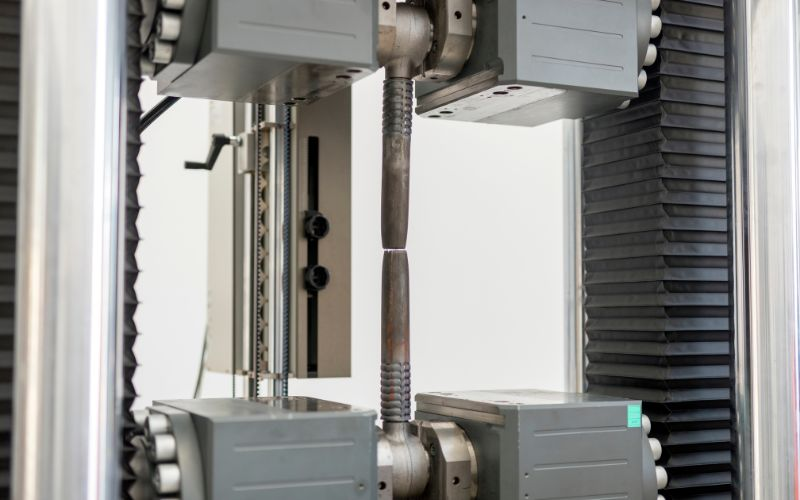
Understanding the mechanical properties of materials requires specialized testing procedures to quantify and characterize their behavior under various conditions. Here are some common testing methods employed in materials science and engineering:
Tensile Testing
Tensile testing involves gradually increasing the axial load of a specimen until it fractures. This test helps determine the material’s tensile strength, yield strength, and modulus of elasticity.
Compression Testing
Compression testing applies a compressive force to a specimen to measure its compressive strength and deformation behavior.
Hardness Testing
Hardness testing methods, such as the Rockwell or Brinell tests, assess a material’s resistance to indentation or penetration by a standardized indenter.
Impact Testing
Impact testing evaluates a material’s ability to absorb energy when subjected to sudden loading conditions, providing insights into its toughness and resilience.
Fatigue Testing
Fatigue testing involves cyclically loading a specimen to assess its fatigue resistance and predict its durability in real-world applications.
Importance of Mechanical Properties

Materials’ mechanical properties are paramount in various industries, including aerospace, automotive, construction, and manufacturing. Here are some reasons why understanding these properties is crucial:
- Material Selection: Engineers must choose materials that meet specific mechanical property requirements to ensure the safety and reliability of products. For example, aircraft components must withstand high stress and fatigue, necessitating materials with exceptional strength and fatigue resistance.
- Design Optimization: Knowledge of mechanical properties allows engineers to design structures and components that are both efficient and cost-effective. Engineers can minimize material waste and optimize performance by selecting materials with the right balance of strength, flexibility, and other properties.
- Quality Control: In manufacturing processes, monitoring and testing mechanical properties ensure that products meet quality standards and are defects-free. This is particularly critical in industries where product failure can have severe consequences, such as the medical field.
The Role of Temperature in Mechanical Properties

While the previous section provided an overview of fundamental mechanical properties, it’s essential to delve deeper into how temperature can significantly influence them. Temperature is critical in material behavior, affecting its mechanical properties in various ways.
Thermal Expansion
One of the most noticeable effects of temperature on materials is thermal expansion. As a material’s temperature increases, its particles gain kinetic energy and move more rapidly. This increased motion causes the material to expand, leading to dimension changes. Understanding the coefficient of thermal expansion helps engineers design structures that can accommodate temperature-induced changes without causing problems like warping or cracking.
Temperature and Elasticity
Temperature also influences a material’s elasticity. Most materials exhibit decreased stiffness at higher temperatures due to increased molecular motion. This phenomenon is particularly important in applications where temperature fluctuations can impact the structural integrity of components. Engineers must consider these changes when designing systems operating in extreme temperatures.
Ductility and Brittleness
Temperature can dramatically affect a material’s flexibility and Brittleness. Generally, materials become more ductile at higher temperatures and more brittle at lower temperatures. For example, metals often exhibit increased elasticity at elevated temperatures, making them suitable for forging and shaping. In contrast, some plastics may become brittle in cold environments, potentially leading to failure.
Strength at Different Temperatures
The strength of a material can vary significantly with temperature. Strong materials at room temperature may lose their power at elevated temperatures. For example, certain alloys in high-temperature applications, such as gas turbine engines, are designed to maintain stability under extreme heat. Conversely, materials like plastics and elastomers may weaken at higher temperatures, limiting their use in hot environments.
Conclusion
In conclusion, understanding materials’ mechanical properties is fundamental to materials science and engineering. These properties are crucial in material selection, design, and quality control, ultimately influencing product performance and reliability in various industries. By comprehensively testing and analyzing these properties, engineers and scientists can make informed decisions that lead to safer, more efficient, and more durable products.
FAQs
1. What are the main factors that affect the mechanical properties of materials?
Several factors influence the mechanical properties of materials, including their chemical composition, microstructure, temperature, and loading conditions. For instance, heat treatment can significantly alter the strength and hardness of metals, while impurities in a material’s composition can affect its flexibility.
2. How can I improve the fatigue resistance of a material?
Improving the fatigue resistance of a material often involves selecting a material with better inherent fatigue properties or using design techniques to reduce stress concentrations. Additionally, proper surface finishes and heat treatments can enhance fatigue resistance.
3. Are there any standards for testing mechanical properties?
Numerous international standards and testing methods are established by organizations such as ASTM International, ISO, and DIN. These standards provide guidelines for conducting mechanical property tests and ensure consistency and accuracy in the results.