Explore Power of Latching Relay for Energy Efficiency and Beyond
You’ve likely encountered situations where maintaining control over a circuit without continuous power is essential. Enter the latching relay, a device designed to hold its state through magnetic bistability even after cutting the initiating power. This capability enhances energy efficiency and broadens its applications across various fields. However, choosing the right type of latching relay—be it single-coil, dual-coil, or voltage-sensitive—depends greatly on your specific needs and the nuances of your setup. As you explore these relays’ integral components and principles, consider how their unique properties could revolutionize your energy management and circuit design approach.
Key Takeaways
- Latching relays maintain their position without continuous power, enhancing energy efficiency.
- They have two stable states, ‘set’ and ‘reset’, controlled by momentary electrical pulses.
- Available in single-coil and dual-coil versions, each offering distinct switching control advantages.
- Reduces wear and tear due to less frequent switching, increasing the relay’s lifespan.
- Used in applications requiring reduced power consumption and efficient state control.
Understanding Latching Relays
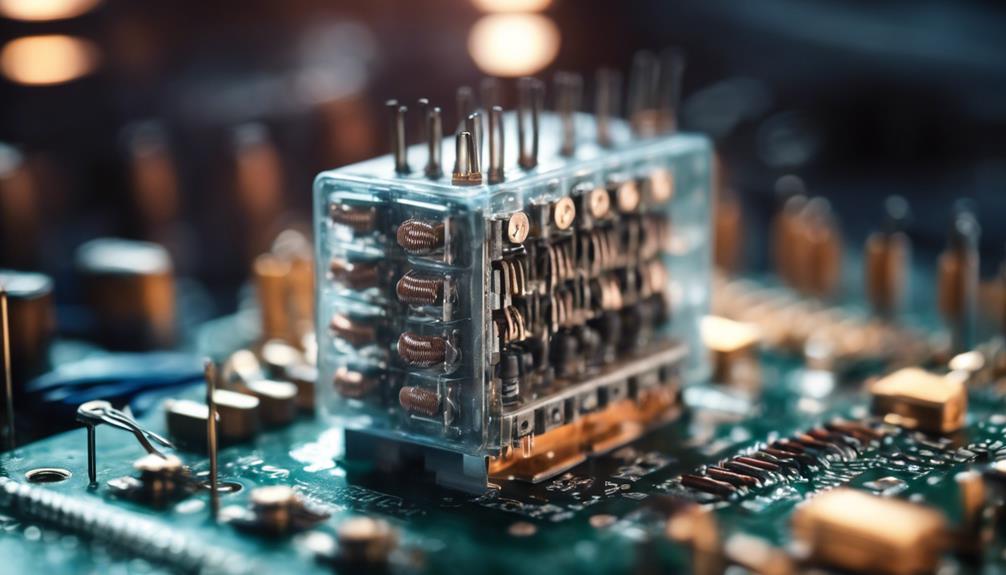
A latching relay maintains its position after removing the actuating power, ensuring that you don’t need continuous power to keep the circuit closed or open. This feature is due to magnetic bistability, which makes latching relays especially efficient for power conservation in systems where energy availability is limited or costly.
Magnetic bistability means the relay possesses two stable states, typically ‘set’ and ‘reset.’ When you apply a momentary pulse of electricity, the relay flips to the ‘set’ state and stays there even when the pulse ends. Another pulse, often of opposite polarity, must flip back to the ‘reset’ state. This switching mechanism is governed by the relay’s control logic, which dictates how input pulses affect the state of the relay.
Understanding the control logic is important because it determines how the relay integrates into wider circuits and reacts under various conditions. For instance, knowing whether your relay requires a positive pulse for setting and a negative one for resetting, or vice versa, affects how you design the control circuitry around the relay to achieve the desired electrical behavior in your application.
Basic Operation Principles
To understand how a latching relay functions, you must first grasp its basic operating principles. At its core, a latching relay is designed to maintain its state after being actuated, whether open or closed. This unique feature allows it to consume less power, making it ideal for energy-efficient applications.
The foundation of this relay’s operation lies in the magnetic force generated by coil activation. When you apply an electrical current to the coil, it creates a magnetic field. This field then moves a ferromagnetic armature that physically switches the relay from one position to another. Here’s the clever bit: once the desired position is achieved, you can remove the current, and the relay will stay in that last position without any additional power.
This behavior is due to a mechanical or magnetic latch that locks the armature. Using this latching mechanism, the relay avoids the continuous need for power to maintain its state, thereby reducing energy consumption. This feature is incredibly useful in scenarios where power availability is sporadic or conserving energy is critical. So, whenever you’re dealing with power-sensitive setups, a latching relay might just be your necessary component.
Types of Latching Relays

Understanding the basic operation principles paves the way for exploring the various types of latching relays available. These relays primarily differ in how they manage magnetic polarity and coil voltage to maintain their state.
First, there’s the single-coil latching relay. Here, a current pulse with one polarity sets the relay, and a pulse with the opposite polarity resets it. This type relies heavily on magnetic polarity to switch between states, using just one coil, making it efficient and straightforward.
Next, you’ve got the dual-coil latching relay. Unlike its single-coil counterpart, it uses two coils, one for setting and the other for resetting. Each coil needs only a current pulse at a standard polarity to operate. This separation can reduce wear on each coil and often allows for finer control over the switching process.
Finally, consider the voltage-sensitive latching relay. These are designed to respond to different levels of coil voltage, making them adaptable to various applications. They’re particularly useful where the control signal varies in voltage, not polarity.
Each type offers unique energy efficiency, control precision, or adaptability advantages. Choose based on what your specific setup requires.
Key Components and Design
Delving into the key components and design of latching relays, you’ll discover how each part plays a pivotal role in their functionality and efficiency. The coil and contact assembly are at the heart of these devices, which are essential for operation.
The coil in a latching relay is specifically crafted to manage power efficiently. Its design minimizes energy consumption, ensuring the relay can switch between states. Coil design is central to achieving the delicate balance between power usage and reliable performance.
Relay materials also play a significant role. These materials are selected based on their electrical conductivity, magnetic properties, and durability. High-quality materials ensure the relay operates reliably over various temperatures and environmental conditions.
Here’s a quick breakdown of these components:
| Component | Functionality |
|---|---|
| Coil Design | Optimizes power use and enhances switching efficiency |
| Contacts | Facilitates the flow of current, ensuring precision |
| Materials | Provides durability and reliable performance |
Understanding these elements helps you appreciate the intricate engineering behind latching relays and their critical role in various applications.
Energy Efficiency Benefits

Latching relays reduce energy consumption by maintaining their state without continuous power. This feature not only conserves energy but also greatly lowers power bills. By engaging a latching relay, you ensure that the device uses power only during the state change, not continuously. This can lead to substantial savings, especially in systems where relays are frequently engaged.
When you conduct a cost analysis, the benefits become even more evident. The initial cost of a latching relay might be higher than a standard relay, but the reduction in energy usage quickly offsets this. Over time, the savings in electricity costs contribute to a lower total cost of ownership. This is important in large-scale operations where multiple relays are in use.
Furthermore, the regulatory impact of using energy-efficient devices like latching relays can’t be ignored. Many regions have strict guidelines on energy consumption for commercial and industrial operations. By integrating latching relays into your systems, you’re not only complying with these regulations but often exceeding them. This compliance can prevent potential fines and support your company’s reputation as environmentally responsible. All these factors make latching relays attractive for anyone looking to enhance energy efficiency.
Common Applications
Investigating relays are commonly found in applications where maintaining a specific state without constant power is essential, such as in home security systems or industrial automation. These devices guarantee that your equipment runs smoothly and safely, adhering to critical safety considerations. For instance, in a power outage, a latching relay will maintain its position, preventing unexpected restarts or shutdowns that could lead to safety hazards.
Market demand for latching relays has increased as industries seek more reliable and energy-efficient solutions. These relays are integral in areas like renewable energy systems, where they help manage power flows from sources like solar panels or wind turbines efficiently.
Here’s a quick look at some typical applications:
| Application Area | Function | Importance |
|---|---|---|
| Home Security Systems | Maintain settings after loss | Safety during power outages |
| Industrial Automation | Control machinery states | Safety and operational efficiency |
| Renewable Energy Systems | Manage power flows | Efficiency in energy distribution |
| Telecommunications | Signal routing | Reliability in communication |
As you explore the world of latching relays, remembering these applications will help you grasp their value and impact across various sectors.
Installation and Wiring Guide

To properly install and wire a latching relay, follow these essential steps. First, make sure you’ve gathered all necessary tools. You’ll need wire strippers, screwdrivers, and a multimeter. Labeling materials are also wise to keep your connections clear.
Begin by turning off the power supply to avoid any electrical hazards. This is your most important safety precaution. Verify the power is off using a multimeter. Next, consult the relay’s wiring diagram. Each relay has specific connection points, so matching your wires to these points is crucial.
Carefully strip the wires to the recommended length, usually around 1/4 inch. Connect the wires to the corresponding terminals on the relay. If it’s a PCB relay, you might need a soldering iron to secure the connections. For screw terminals, a simple screwdriver will do. Tighten the connections, but ensure you don’t strip the screws.
Once all connections are secure, label each wire. This step will save you time during future maintenance or troubleshooting. Finally, turn the power back on and test the relay by activating it. Check for proper operation. If everything’s set up correctly, your relay should function seamlessly within your electronic or electrical system.
Maintenance and Troubleshooting
Regular maintenance and prompt troubleshooting can keep your latching relay performing at its best. You’ll want to inspect and clean your relay regularly to prevent dust and debris from compromising its functionality. Check for any signs of wear or damage that might impede performance. It’s also important to monitor the electrical connections for any looseness or corrosion, as these issues can lead to intermittent or complete relay failure.
For performance optimization, you should periodically test the relay under load conditions to ensure its reliability. This helps identify potential problems before they lead to failure. If you notice any irregular behavior or response times in your relay, it’s time for a more thorough investigation.
Regarding failure analysis, stay vigilant for common issues like coil failures or contact pitting. Use a multimeter to check the coil’s resistance levels, ensuring they align with the specifications. If you find discrepancies, the coil might need replacing. Additionally, the contacts should be examined for any excessive wear or erosion, which can severely affect the relay’s performance. Replacing worn or damaged contacts can restore functionality and extend the life of your relay. Remember, addressing issues early can save you time and prevent costly downtime.
Comparing Latching and Standard Relays
While maintaining your latching relay guarantees peak performance, understanding how it differs from standard relays can further enhance your system’s efficiency. Latching relays stand out primarily because they can maintain a contact position without continuous power, which isn’t the case with standard relays requiring constant energy to remain active.
This distinct functionality impacts both relay durability and switching speed. Since a latching relay doesn’t need constant power, it typically endures less wear and tear than its standard counterpart. This means you’ll likely see a longer lifespan from your latching relay, reducing the frequency and costs of replacements.
Additionally, latching relays’ inherent design allows for quicker switching speeds. They can change states instantly without needing continuous voltage, making them ideal for applications where rapid switching is critical. In contrast, standard relays may experience slight delays since they require power to initiate every switch, potentially slowing down operation.
Choosing between a latching and a standard relay depends on your specific needs. A latching relay might be the better choice if you want something that offers greater longevity and faster operation. However, consider each relay’s suitability based on your application’s power availability and switching requirements.
Innovations and Future Trends
Recent innovations in latching relay technology are setting the stage for exciting future automation and energy management trends. You’ll see how these developments can guarantee how you manage power and automate processes. With smart control integration, latching relays are now capable of more sophisticated interactions with building management systems. This means you’ll achieve more efficient energy usage and enhanced operational efficiency without constant manual oversight.
Furthermore, modular design advancements in latching relays ensure you can customize and scale your systems as never before. This adaptability lets you tailor energy solutions to your needs without compromising performance or reliability. Imagine being able to upgrade or modify your system components with minimal disruption to your operations. That’s what these modular designs offer.
Integrating IoT technology with latching relays promises even greater control and monitoring capabilities as you look ahead. You’ll save on energy costs and gain real-time performance insights into your systems. This convergence of reliability, efficiency, and intelligence in latching relay technology marks a significant leap forward, poised to revolutionize industries. Get ready to embrace these changes—they’re designed to make your life easier and your operations more sustainable.
Conclusion
In wrapping up, you’ve learned that latching relays aren’t only efficient and versatile. Whether you choose a single-coil, dual-coil, or voltage-sensitive model, you’re set for reduced energy use and reliable performance.
Remember, proper installation and regular maintenance are key to maximizing their benefits. As technology advances, stay tuned for innovations in relay design that’ll further enhance your setups.
Embrace these smart solutions to save energy and streamline your electrical systems.
FAQs
1. What is a latching relay?
A latching relay is a device that maintains its position after power is removed, eliminating the need for continuous power to keep a circuit open or closed. It achieves this through magnetic bistability, possessing two stable states, “set” and “reset”.
2. How do latching relays conserve energy?
Latching relays consume less power because they only require brief pulses of electricity to change states rather than continuous power. Once set, they remain in position without additional power, enhancing energy efficiency in various applications.
3. What are the advantages of using latching relays?
Latching relays offer several benefits, including reduced power consumption, longer lifespan due to less frequent switching, and precise control over circuit states. They are particularly useful when energy conservation and reliable circuit control are paramount.
Supporting Article
Applications for Latching Relays