Ward Leonard System: Working, Components & Uses
Imagine having the power to control motor speed with ease and precision. That’s what the Ward Leonard System offers: a groundbreaking method developed over a century ago. It’s not just about historical significance; this system laid the groundwork for modern control technologies. Why is it still relevant today, and how does it integrate into contemporary solutions? Let’s examine its enduring impact and explore its potential for future advancements.
Key Takeaways
- The Ward Leonard System, developed in 1891, is a motor speed control method using a motor-generator set.
- It allows precise motor speed adjustments by varying the voltage supplied to DC motors.
- The system is known for smooth speed control and regenerative braking capabilities.
- It played a crucial role in both military and civilian applications historically.
- Despite its bulkiness, it provides excellent speed regulation and efficiency up to 95%.
Historical Background and Development
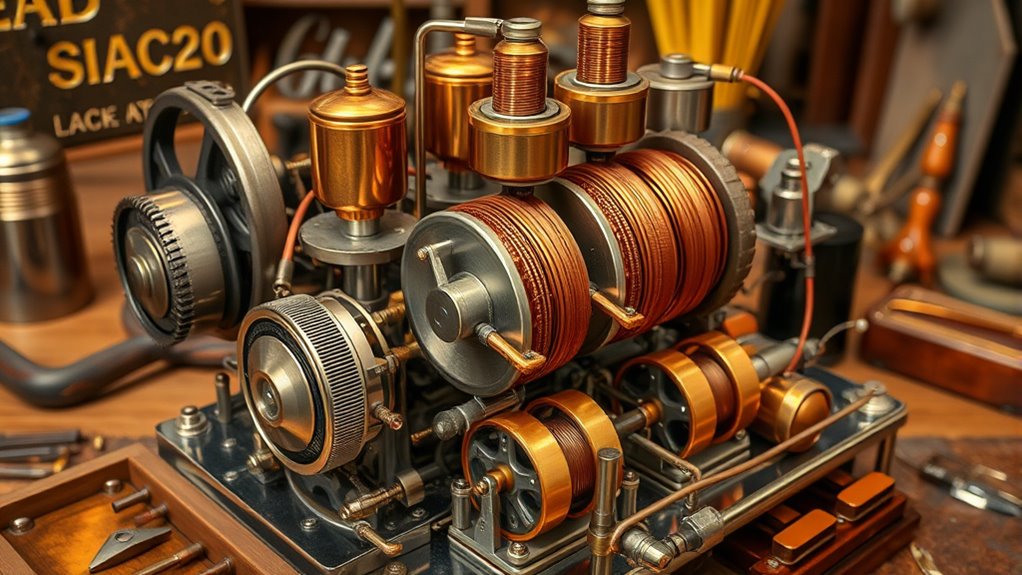
The Ward Leonard System revolutionized motor control when Harry Ward Leonard developed it in 1891, quickly catching the eye of the U.S. Navy. This speed control system, known as the Ward Leonard Method, utilized a DC motor to enhance maneuverability, first proving its worth on the USS Holland submarine.
Its historical background is rich in military applications, especially during World War I and World War II, where it was vital in anti-aircraft radar systems, such as the SCR-584.
Beyond military use, the system found its way into civilian technologies, including passenger lifts in large mines and moving sidewalks at the 1900 Paris Exposition.
Core Principles and Functionality
When exploring the core principles of the Ward Leonard System, you’ll find its genius lies in its ability to control motor speed with exceptional precision.
This method ingeniously manages the speed control of DC motors by adjusting the voltage supplied. At the heart of this system is a motor-generator set, where a driving motor powers a DC generator.
By varying the generator’s field winding current, you can finely tune the output voltage. This allows you to adjust the Ward Leonard speed smoothly from zero to full speed.
The system’s direct connection ensures that changes in generator voltage are immediately reflected in motor performance. It also features regenerative braking, converting kinetic energy back into electrical energy during deceleration, thereby enhancing overall efficiency.
Key Components and Configuration

Understanding the core principles of the Ward Leonard System reveals its brilliance in precise motor speed control. At its core, the system utilizes a DC motor driven by a separately excited DC generator. An AC induction or synchronous motor drives this generator, forming a robust configuration.
By regulating the field current of the generator, you can adjust its output voltage, which directly influences the speed of the connected DC motor. This setup allows for exceptional speed regulation.
A rheostat is included to fine-tune the motor voltage further, enhancing control precision. Additionally, the system supports bidirectional control, enabling the motor to rotate in either direction by altering the generator’s excitation current.
Incorporating a flywheel helps stabilize voltage fluctuations, boosting system performance and efficiency.
Technical Specifications and Operation
In the Ward Leonard System, you’ll find that speed control is achieved by manipulating the field current of the generator, which adjusts the voltage supplied to the DC motor.
The connection between the generator and motor allows for precise speed variations, thanks to the system’s rotating electrical machinery.
Speed Control Mechanism
The Ward Leonard system’s speed control mechanism stands out with its precision and flexibility. By employing a motor-generator set, the Ward Leonard system lets you control the speed of a DC motor by varying the output voltage of a separately excited DC generator.
This setup allows you to achieve precise speed control by adjusting the generator’s field current. You can enjoy smooth acceleration and deceleration, with a speed range from zero to normal operational levels.
The system keeps the DC motor’s field current constant during speed adjustments, ensuring stability. Additionally, the Ward Leonard system offers regenerative braking, which converts kinetic energy back into electrical energy during deceleration, making it an efficient choice for applications that require variable speed control.
Generator-Motor Connection
When exploring the generator-motor connection in the Ward Leonard system, you’ll find that the technical specifications highlight its efficiency and effectiveness.
The system connects a DC motor (M1) to a separately excited DC generator (G), allowing precise speed control. This is achieved by varying the generator’s output voltage, which is influenced by changes in its field windings. The motor’s speed is directly adjusted by manipulating the generator’s output voltage, making the connection highly responsive.
An AC motor (M2) drives the DC generator, converting mechanical energy into electrical energy for the DC motor. The motor’s field current remains constant for stable operation, while the generator’s field current variations enable effective speed control.
This direct connection ensures that changes in generator settings are reflected in motor performance.
Advantages and Benefits
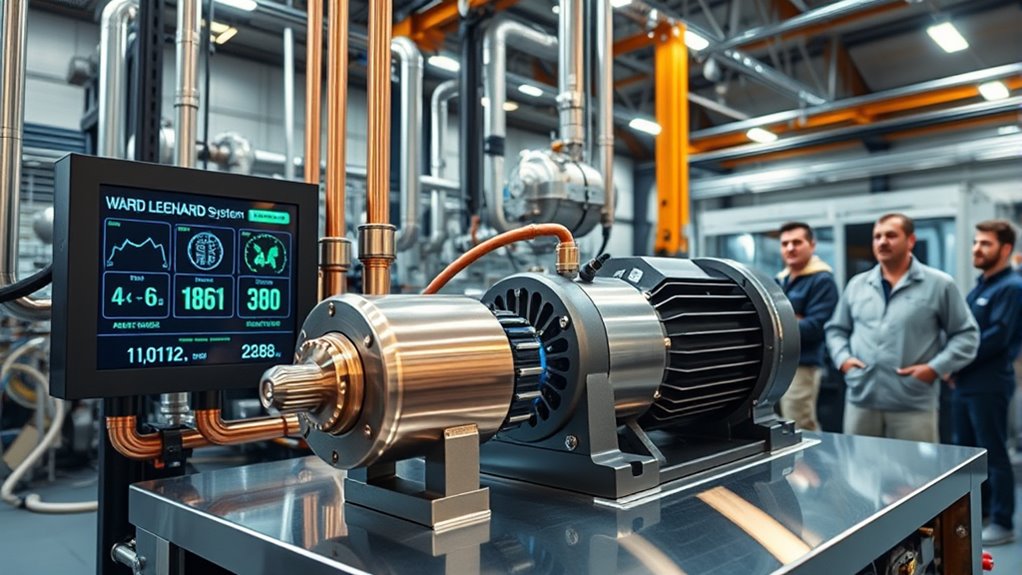
As you explore the Ward Leonard system, its advantages become immediately apparent, particularly in its ability to provide smooth and precise speed control over a vast range.
This system excels in applications that require precise speed adjustments, such as elevators and cranes. The Ward Leonard system guarantees smooth speed control while offering good speed regulation for DC motors, maintaining consistent performance under varying loads.
Its inherent regenerative braking capability allows energy recovery during braking, boosting overall efficiency. You’ll also appreciate the bidirectional control of motor rotation, enhancing flexibility in industrial settings.
Utilizing a combination of armature voltage and field flux control, the system achieves a maximum-to-minimum speed ratio of 20 to 40, making it ideal for high-performance applications.
Challenges and Limitations
While the Ward Leonard system offers significant advantages, it’s important to assess its challenges and limitations.
First, the high initial costs of the motor-generator set can be financially burdensome for many applications. You’ll need to take into account the larger floor space required, as the system’s bulk and weight may limit installation options.
Additionally, the system’s low efficiency, particularly when lightly loaded, leads to increased energy consumption and operating costs. This inefficiency mightn’t make it the best choice for all scenarios.
Frequent maintenance is another drawback, as it demands regular attention to guarantee the longevity and proper operation of its components, adding to ongoing expenses.
Finally, the noise generated during operation can be a significant issue in noise-sensitive environments.
Industrial Applications and Use Cases
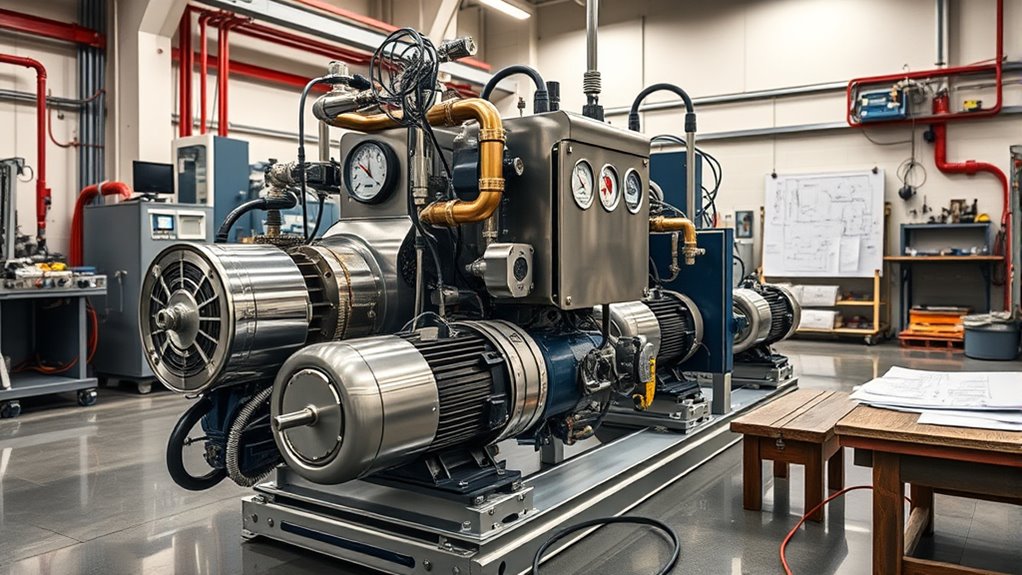
The Ward Leonard system finds its application in various industrial settings, delivering precision and control that many sectors rely on.
You see it in elevators, where motor speed control guarantees smooth and precise vertical transport. In steel rolling mills, it’s essential to regulate DC motors, shape metal with accuracy, and enhance production quality.
Mining operations utilize the system to manage conveyor belts and hoists, thereby boosting efficiency and safety.
Paper mills also benefit, as the system maintains uniform motor speeds for consistent output.
Cranes and electric excavators rely on the Ward-Leonard system for precise speed control during heavy lifting and material handling.
Across these applications, the system’s ability to precisely control motor speeds is invaluable.
Comparison With Modern Control Systems
When comparing the Ward Leonard System to modern control systems, significant differences in efficiency and performance become apparent.
Modern systems utilize advanced power electronics and solid-state technology, offering enhanced energy efficiency and lower maintenance costs.
These technological advancements also provide superior speed control and dynamic response compared to the older mechanical setups.
Efficiency and Performance Differences
Despite its historical significance, the Ward Leonard system falls short in efficiency when compared to modern control systems, such as Variable Frequency Drives (VFDs).
The Ward Leonard method experiences energy losses, especially when lightly loaded, due to its motor-generator set. VFDs, on the other hand, boast efficiency rates of 95% or more.
While the Ward Leonard method guarantees smooth speed control and is excellent for precise regulation, modern systems are more compact, require less maintenance, and reduce operational costs.
Additionally, modern systems offer a wider speed range and finer control, thereby enhancing performance in dynamic applications.
The Ward Leonard system’s bulky design demands more space, making VFDs a more attractive option where space and adaptability are constraints.
Technological Advancements and Integration
As technology has advanced, the Ward Leonard system, with its motor-generator setup from the 1890s, has been outpaced by modern control systems.
The Ward Leonard method offers smooth speed control and regenerative braking, but here’s how it compares to modern advancements:
- Efficiency: Modern control systems, such as those utilizing VFDs, offer higher energy efficiency compared to the Ward Leonard method.
- Maintenance: With fewer mechanical parts, modern systems require less maintenance.
- Compactness: Modern systems are more compact, making them ideal for space-constrained environments.
- Capabilities: They include real-time monitoring and advanced diagnostics, unlike the traditional Ward Leonard system.
Embracing these technological advancements means benefiting from enhanced reliability and integration, leaving the old methods behind.
Technological Innovations and Modifications
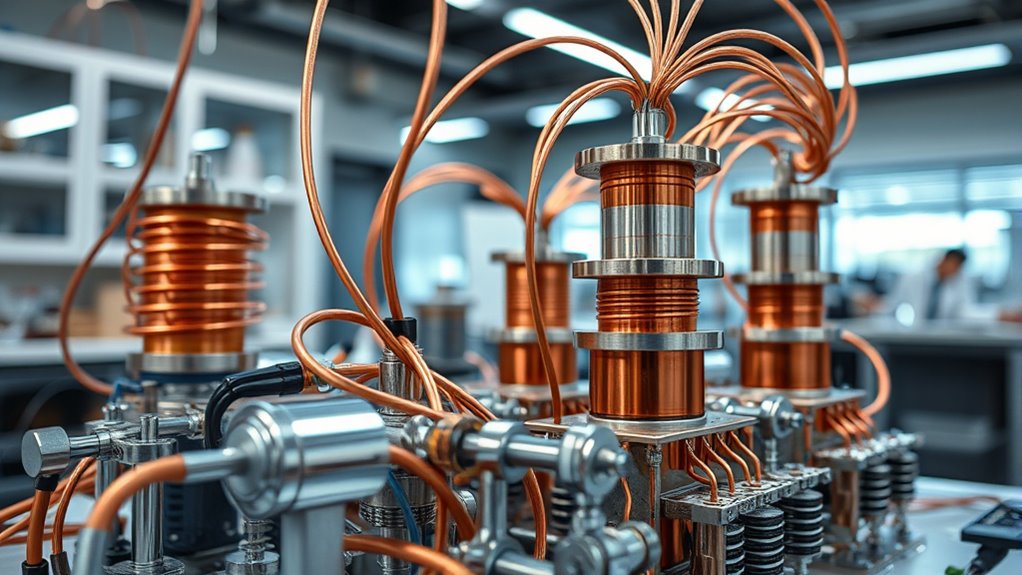
The Ward Leonard System revolutionized military technology with its pioneering innovations and modifications, setting a new benchmark in naval and military applications.
By introducing an advanced control method, it enabled precise regulation of a DC motor’s speed, marking a significant technological innovation.
It pioneered rheostat technology, essential for controlling battleship guns, and integrated speed and voltage regulators for submarines.
The Ward Leonard Ribohm, developed for the Army Signal Corps during World War I, enhanced electrical control.
Further modifications, such as the Ward Leonard Ilgner Control, incorporated wound-rotor induction motors, which boosted efficiency and stability.
Additionally, flywheel technology was introduced to stabilize voltage fluctuations, ensuring reliable performance under heavy and intermittent loading conditions.
These advancements cemented the system’s role in military marine technologies.
Future Prospects and Developments
You’ll find that advancements in motor technology are shaping the future of the Ward Leonard System, as it integrates with modern systems to boost performance.
By combining its classic design with cutting-edge electronic controls, you can achieve both precision and efficiency in demanding applications.
As industries push for smarter, more adaptable solutions, the Ward Leonard System’s evolution will likely guarantee its continued relevance.
Advancements in Motor Technology
Although motor technology has made significant advancements, future developments promise even greater enhancements, particularly in the integration of digital control systems.
You’ll find that the Ward Leonard Method could benefit from incorporating innovative solutions. Here’s why:
- Speed of the motor: Enhanced control systems provide precise control over motor speed, enhancing efficiency and performance.
- Electric motors: Superconducting materials and lightweight designs may lead to more compact, efficient motors, reducing energy losses.
- AI and machine learning: These technologies can dynamically adjust control parameters, optimizing the Ward Leonard system according to real-time demands.
- Hybrid systems: Combining Ward Leonard methods with advanced battery technologies could facilitate sustainable operations, making them particularly useful for electric vehicles and renewable energy applications.
These advancements can redefine how you use electric motors.
Integration With Modern Systems
As industries continue to evolve, integrating the Ward Leonard System with modern technologies becomes essential for maintaining a competitive edge. By merging the Ward Leonard Method of Speed with electronic control systems, you can enhance efficiency and precision in various applications. Hybrid solutions that combine this method with variable frequency drives (VFDs) offer significant improvements in energy efficiency and speed control.
Advancements in power electronics are leading to compact, flexible designs that merge the system’s robustness with the benefits of digital control. The demand for high-performance motor control solutions, particularly in sectors such as renewable energy and automation, is driving these innovations. Collaborating with OEMs could tailor solutions to meet specific needs, ensuring the Ward Leonard System remains relevant.
| Technology | Benefit |
|---|---|
| Electronic Control | Enhanced efficiency |
| Variable Frequency | Improved energy efficiency |
| Power Electronics | Compact and flexible designs |
| OEM Collaboration | Tailored sector-specific solutions |
Conclusion
You’ve explored the enduring relevance of the Ward Leonard System, appreciating its precise speed control and energy efficiency through regenerative braking. Despite modern advancements, it still provides a solid foundation for integrating cutting-edge electronic controls and hybrid solutions. While newer systems offer compactness and advanced technology, the Ward Leonard System’s legacy is its adaptability and reliability in high-performance applications. It’s a demonstration of innovation, and its influence will continue shaping future motor control solutions.
FAQs
1. What Is the Ward Leonard System?
You’re looking at a method to control DC motor speeds using a motor-generator set. It allows for precise speed adjustments by varying the generator output voltage, offering smooth operation and bidirectional control; however, it requires high initial costs and ongoing maintenance.
2. What Is the Ward Leonard System in Ships?
You’re looking at a motor-generator setup on ships that precisely controls motor speed and direction. It excels in maneuvering large vessels, supports energy efficiency through regenerative braking, and boasts a modular design for reliability across various vessel types.
3. What Are the Advantages of the Ward-Leonard Method?
You’ll appreciate the method’s smooth speed control, bidirectional motor capabilities, and energy efficiency through regenerative braking. It handles heavy loads well and improves power factor with an over-excited synchronous motor, significantly enhancing industrial performance.
4. What Is the Leonard Method?
You’re asking about the Leonard Method, which controls DC motor speed using a motor-generator set. It varies voltage for smooth speed changes, offers regenerative braking, and allows bidirectional control, though it can be costly and maintenance-heavy.