Types of Electrical Relays | Overview & Applications Explained
When you explore the world of electrical relays, you’ll encounter various types, each with unique functions. Electromechanical relays (EMRs) like SPST and SPDT are often used for handling high-voltage circuits and providing isolation, while solid-state relays (SSRs) offer fast switching without mechanical parts. Understanding these differences is essential for selecting the right relay for your needs. Are you ready to discover which type aligns best with your applications?
Key Takeaways
- Electromechanical relays (EMRs) are commonly used for high-voltage circuit management.
- Solid-state relays (SSRs) provide fast switching without mechanical parts.
- Single Pole Single Throw (SPST) relays manage simple on/off functions.
- Single Pole Double Throw (SPDT) relays switch between two output circuits.
- Relays are utilized in automotive, industrial, and household applications for safety and control.
What Are Electrical Relays?
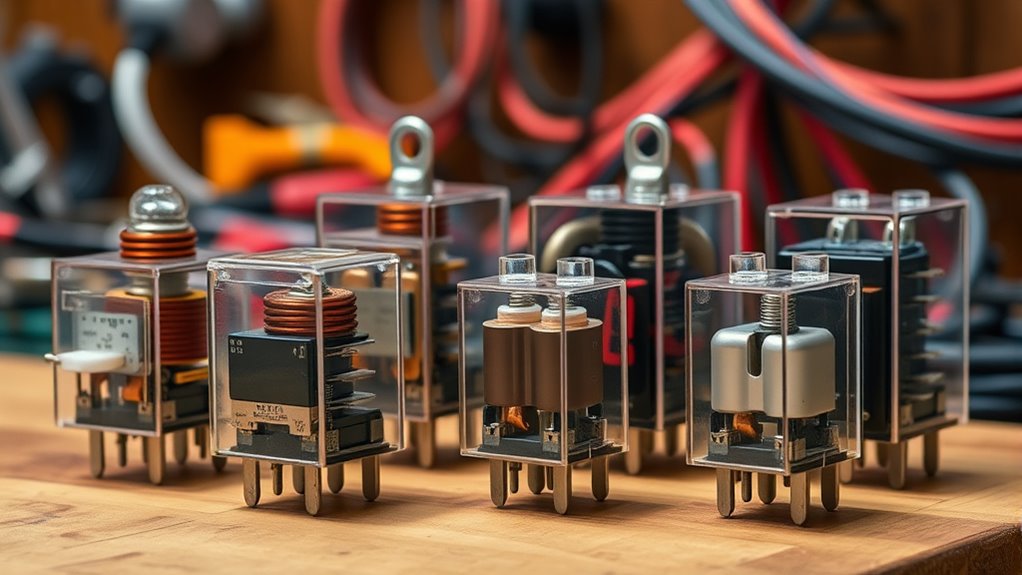
Electrical relays are essential components that act as electrically operated switches. They allow you to control high-voltage circuits with low-voltage signals, guarantee safety, and provide isolation between different voltage levels.
Using electromagnetic induction, a current through the control input (coil) creates a magnetic field, moving an armature that opens or closes contacts. This mechanism supports flexible circuit control with normally open (NO) and normally closed (NC) terminals.
Poles and throws, like SPST and SPDT, each catering to specific needs in automation systems, classify relays. In SPST, a single pole controls one circuit, while SPDT switches between two circuits.
Electrical relays, widely used in automotive systems, industrial automation, and household appliances, enhance the safety and efficiency of high-voltage circuits.
Working Principles of Relays
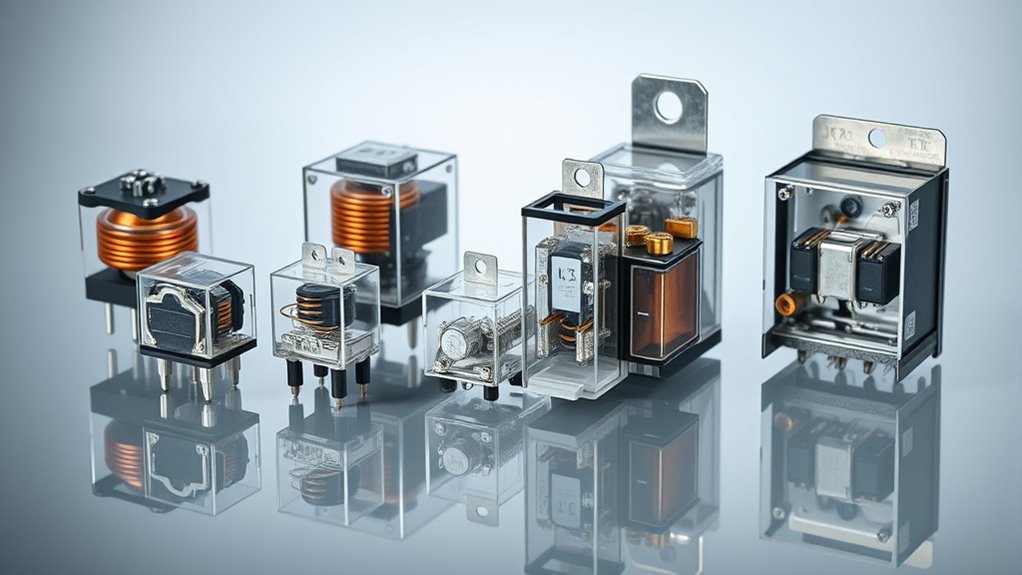
Understanding how relays work builds on the foundational knowledge of their function as switches. Relays rely on electromagnetic principles, where an energized coil creates a magnetic field, moving an armature to turn on or off connections within an electrical circuit.
You’ll control these connections using low-voltage signals sent to the coil terminals. In an SPDT relay, the common terminal connects to the normally closed terminal when de-energized and switches to the normally open terminal when energized. This rapid switching mechanism lets you control high-amperage devices with low-power signals, ensuring safety and efficiency.
While electromechanical relays use physical contacts, solid-state relays achieve the same control without moving parts. They offer different operational benefits but ultimately aim to manage electrical flow efficiently.
Types of Electromechanical Relays
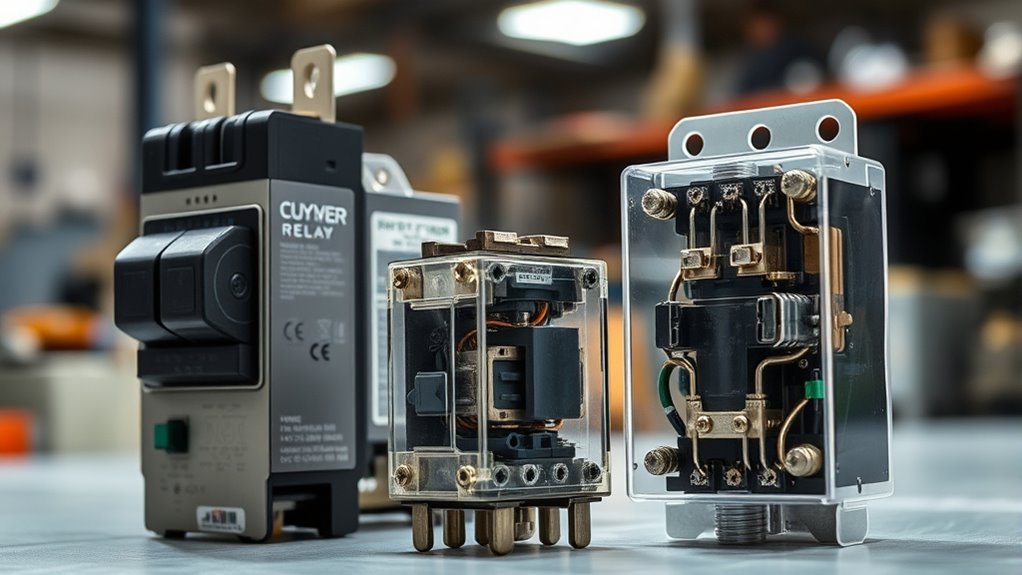
Electromechanical relays (EMRs) are versatile for controlling high-voltage circuits with low-voltage signals. They rely on an electromagnetic coil to open or close contacts, enabling you to manage powerful circuits with minimal input.
EMRs come in configurations like Single Pole Single Throw (SPST) and Single Pole Double Throw (SPDT), making them adaptable for various switching needs.
In industrial automation, EMRs are essential for providing electrical isolation between the control and high-voltage circuits, enhancing system safety.
However, be aware that the mechanical movement of contacts can cause contact wear and arcing, potentially affecting the relay’s lifespan. Despite this, their ability to handle currents from 10 to over 200 amps makes them a reliable choice for demanding electrical applications.
Applications of Electrical Relays
Having explored the configurations and capabilities of electromechanical relays, let’s see how electrical relays integrate into various applications to enhance functionality and safety.
Relays control electrical components like headlights and fuel pumps in automotive systems, boosting safety and performance.
Household appliances such as washing machines rely on relays to manage high-voltage circuits, guaranteeing reliable operation and energy efficiency.
Relays greatly benefit industrial automation. They control systems and machinery, supporting efficient processes under high electrical loads.
Relays provide essential protective measures in power generation by disconnecting circuits during faults and safeguarding equipment.
Meanwhile, relays assure operational safety and precise control in medical equipment critical for patient care.
Across these fields, relays are indispensable in maintaining effective and safe control systems.
Benefits and Limitations of Using Relays
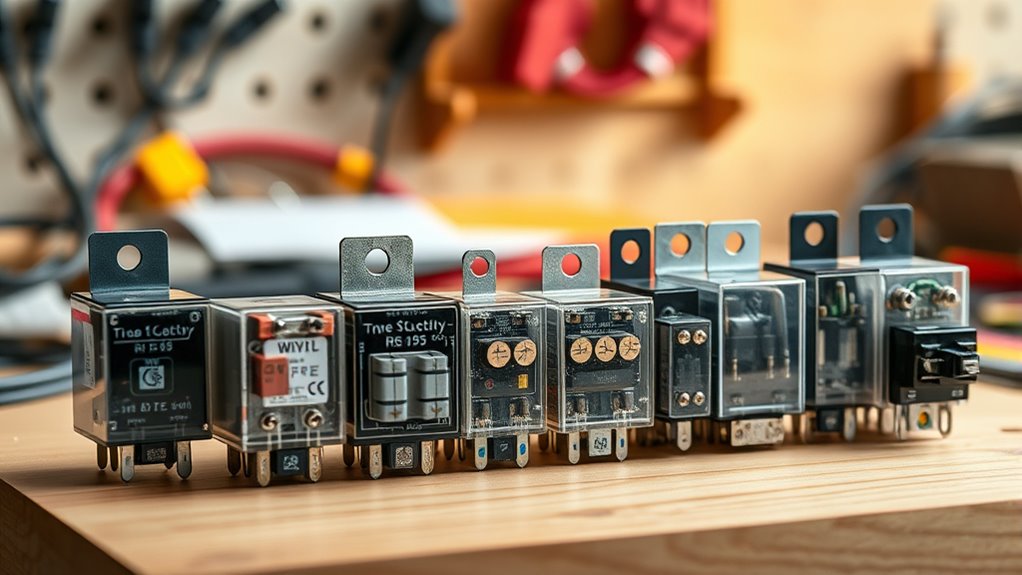
When integrating relays into electrical systems, you’ll discover they offer several benefits that enhance safety and efficiency. Relays provide electrical isolation, protecting low-voltage circuits from spikes. You can control high-amperage devices with low-power signals, cutting down on heavy-duty wiring and installation costs. Relays also minimize voltage drop, boosting performance. However, electromechanical relays can suffer from contact wear, limiting their operational life. Solid-state relays offer faster switching speeds and longer life but have higher costs and potential heat generation.
| Type of Relay | Benefits | Limitations |
|---|---|---|
| Electromechanical Relays | Electrical isolation, cost-saving | Contact wear, limited lifespan |
| Solid State Relays (SSRs) | Faster switching, longer life | Higher cost, heat generation |
| Both Types | Control high-amperage devices | None specific |
Conclusion
In exploring electrical relays, you’ve seen how they play an essential role in circuit management. Electromechanical relays (EMRs), like SPST and SPDT, offer robust solutions for high-voltage applications with vital isolation. Solid-state relays (SSRs) provide faster switching and less wear thanks to semiconductor technology. Each type has strengths and limitations, so choosing the right relay depends on your needs and your application’s demands.
FAQs
1. How Many Types of Electrical Relays Are There?
You might think there are just a few relays, but five main types exist: electromechanical, Solid-State, Reed, Thermal, and Latching. Each serves a unique purpose in controlling circuits and protecting electrical systems efficiently.
2. Which Relay Is Mostly Used?
You’re probably wondering which relay is most used. Electromechanical relays (EMRs) take the lead due to their versatility across various applications. They can switch low-voltage signals and control high-current circuits efficiently.
3. How Do I Know What Relay I Need?
To know what relay you need, check your circuit’s voltage and current, load type, and switching needs. Match these with the relay ratings. Consider response time, switching frequency, and extra features like coil suppression for peak performance.
4. What Are the Three Relays?
You’re asking about the three main types of relays: Electromechanical Relays (EMR), Solid State Relays (SSR), and Reed Relays. Each has unique characteristics and applications, so understanding their differences helps you choose the right one.