Induction Motor vs. Synchronous Motor: Key Differences Explained
When you’re exploring the world of AC motors, understanding the fundamental differences between induction motors and synchronous motors is essential. Both serve unique purposes, with induction motors being the go-to for everyday tasks and synchronous motors excelling in precision applications. But what exactly sets them apart, and how do you determine which motor suits your needs best? Let’s uncover the key distinctions and see where each motor truly shines. Learn more about Induction Motor vs. Synchronous Motor.
Key Takeaways
- Induction motors are self-starting and operate with variable speeds, while synchronous motors maintain a constant speed linked to the AC frequency.
- Synchronous motors require external DC for rotor excitation, whereas induction motors don’t need external excitation.
- Induction motors exhibit slip, whereas synchronous motors achieve zero slip, precisely matching stator and rotor speeds.
- Synchronous motors offer adjustable power factors and higher efficiency, especially at high loads, compared to induction motors.
- Induction motors are cost-effective and versatile, while synchronous motors are better for precise speed control applications.
Understanding AC Motor Functionality

When diving into the world of AC motors, you’ll discover they transform alternating current into mechanical energy through electromagnetic induction.
These motors consist of a stationary stator and a rotating rotor, which together create a rotating magnetic field.
Synchronous motors operate at a constant speed, precisely matching the frequency of the supply. They excel in power factor correction and maintain high efficiency. However, they require a starting mechanism.
Induction motors, on the other hand, are self-starting and work at variable speeds, influenced by the load. They generate torque using electromagnetic induction without needing external excitation.
While induction motors are versatile and suitable for various loads, they typically operate at lower efficiency and a lagging power factor compared to synchronous motors, which are ideal for applications requiring precise control.
Key Differences Between Induction and Synchronous Motors
Exploring the specifics of AC motor types reveals notable distinctions between induction motors and synchronous motors. A key difference lies in speed: synchronous motors maintain a fixed speed tied to the AC supply frequency, while induction motors experience slip, causing speed to vary with load. Synchronous motors require an external DC source for rotor excitation and aren’t self-starting, unlike induction motors, which start independently when power is applied to the stator. Efficiency is another factor; synchronous motors are generally more efficient, especially at high loads. Power factor also plays a role—synchronous motors can adjust it, whereas induction motors typically lag.
| Feature | Synchronous Motors | Induction Motors |
|---|---|---|
| Speed | Fixed Speed | Variable (Slip) |
| Starting Torque | Requires DC Excitation | Self-Starting |
| Power Factor | Adjustable (Leading/Lagging/Unity) | Typically Lagging |
| Efficiency | Higher at High Loads | Lower |
Characteristics of Synchronous Motors
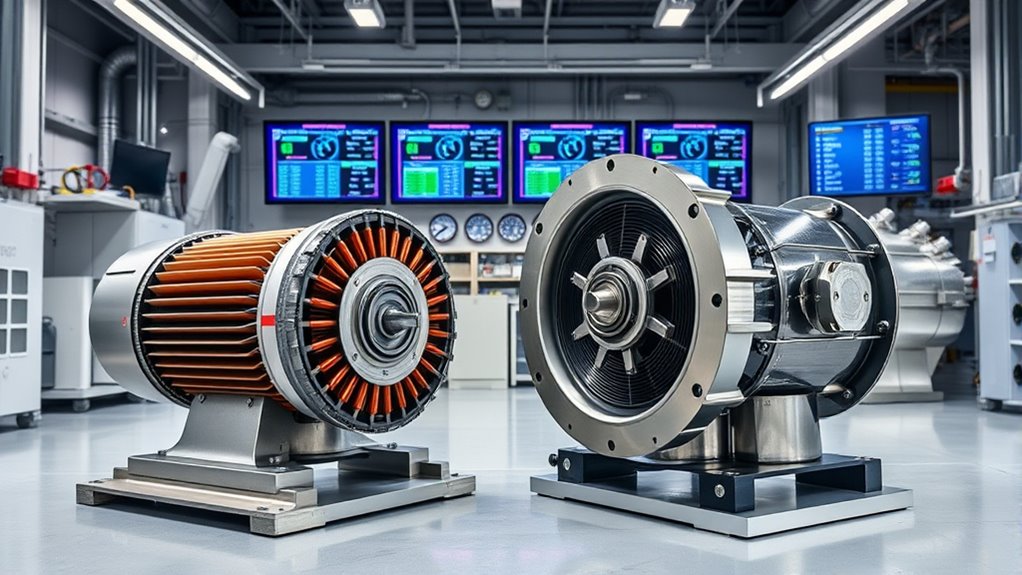
Although often overlooked, synchronous motors stand out due to their ability to maintain a constant speed directly tied to the AC power supply frequency and the number of poles in the stator winding.
These motors are classified as doubly excited machines because they require an external DC power source to create the magnetic field in the rotor. This setup guarantees that the rotor speed matches the stator speed perfectly, with no slip.
Synchronous motors offer high efficiency and can operate at a leading power factor, which can be adjusted by modifying the rotor excitation. They’re ideal for applications that demand precise speed control, such as power stations and manufacturing facilities.
With their consistent performance, synchronous motors provide reliable solutions across various industries.
Features of Induction Motors
Induction motors are the workhorses of the industrial world, relying on electromagnetic induction to generate torque. They’re designed to handle various mechanical loads and are self-starting, which means you don’t need external excitation to get them going. Induction motors typically come in two types: single-phase and three-phase, with the three-phase type being more common due to its higher efficiency and power characteristics.
Here’s a quick look at some key features:
| Feature | Description |
|---|---|
| Type | Three-phase, single-phase |
| Rotor Design | Squirrel-cage, wound |
| Self-starting | Yes |
| Power Factor | Typically lagging |
| Efficiency | High in three-phase motors |
The squirrel-cage design is particularly popular because it’s simple, robust, and requires minimal maintenance. However, they operate at a lagging power factor, which can affect efficiency.
Efficiency and Application Suitability

When considering motor efficiency and application suitability, it’s essential to understand the distinctions between induction motors and synchronous motors.
Synchronous motors generally offer higher efficiency, especially at high loads and speeds, by reducing losses in copper, iron, windage, and friction. They’re perfect for applications requiring constant speed and precise control, like power factor correction and large industrial processes. However, their complexity and cost make them ideal for specialized applications.
On the other hand, induction motors are favored for their self-starting capability and are more cost-effective for driving mechanical loads in residential and commercial settings.
Despite operating with a lagging power factor, they’re simpler, more durable, and easier to maintain, making them suitable for everyday use where high efficiency isn’t as vital.
Selecting the Right Motor for Your Needs
When you’re choosing between induction and synchronous motors, start by evaluating your specific application needs.
If you require constant speed and high efficiency, a synchronous motor may be your best option, while an induction motor is better suited for variable speed operations and simpler setups.
Additionally, consider the complexity and cost: induction motors are generally more economical and straightforward, whereas synchronous motors offer higher efficiency but come with increased costs and complexity.
Motor Selection Criteria
Selecting the right motor for your needs can be a straightforward process once you understand the key criteria involved. Start by evaluating the motor selection criteria, such as speed, power factor, and efficiency.
If you need constant speed, synchronous motors are your go-to choice, while induction motors offer variable speeds that decrease with load. For starting requirements, induction motors are self-starting, unlike synchronous motors, which need external help to reach synchronous speed.
Consider power factor needs; synchronous motors can operate at a leading, lagging, or unity power factor, which is useful for power factor correction, while induction motors typically lag. Efficiency is also essential; synchronous motors generally outperform induction motors under high load.
Finally, match the motor to your specific applications for ideal performance.
Application-Based Differences
Although choosing between a synchronous motor and an induction motor might seem complex, understanding their application-based differences can simplify the decision.
Synchronous motors are ideal for power generation and industrial processes that require precise speed control and constant torque. They excel in applications where power factor correction is essential, as they can operate with lagging, leading, or unity power factors, making them versatile for various electrical systems.
On the other hand, induction motors excel in general-purpose applications, such as household appliances, due to their self-starting capability and cost-effectiveness. For high-torque applications, wound-rotor induction motors outperform squirrel-cage designs.
Consider your budget and application needs; while synchronous motors offer precision, induction motors are often more economical, especially for commercial and residential settings.
Conclusion
When choosing between induction and synchronous motors, consider your specific needs. If you value simplicity and reliability for general tasks, go for an induction motor. It’s self-starting and durable, making it perfect for everyday applications. On the other hand, if precision and efficiency are essential under high loads, a synchronous motor is your best bet. Although it’s more complex and costly, it offers constant speed and precision, ideal for demanding industrial processes. Choose wisely based on your priorities!
FAQs
1. What Is the Difference Between an Induction Motor and a Synchronous Motor?
You might wonder about the difference. Synchronous motors maintain constant speed regardless of load, needing external excitation. Induction motors self-start, have speed variation under load due to slip, and don’t require rotor excitation.
2. What Are the Advantages of Synchronous Motors Over Induction Motors?
You’ll find synchronous motors offer constant speed, higher efficiency, and greater starting torque. They also provide power factor correction and require less maintenance. These advantages make them ideal for precise and demanding applications, enhancing overall system performance.
3. Why Is an Induction Motor Better?
You’ll find that induction motors offer cost efficiency and simplicity in design. They’re self-starting, robust, and operate well at high speeds. Their lagging power factor facilitates easy integration, requiring minimal maintenance and no complex controls.
4. What Is the Difference Between an Induction Motor and a Servo Motor?
You’ll find that induction motors utilize electromagnetic induction and are cost-effective for tasks that require constant speed. In contrast, servo motors offer high precision and dynamic control with feedback, making them ideal for applications such as robotics that require precise movements.