Buchholz Relay Working: Principle, Function & Applications
You’ve likely encountered the Buchholz Relay if you’re familiar with transformer safety. It’s an essential device that detects internal transformer faults early, preventing catastrophic damage. By monitoring gas and oil movement, it uses clever mechanics to trigger alarms or trip circuit breakers. But how exactly does it discern between minor and major issues? And why is regular maintenance so important? This is just the tip of the iceberg.
Key Takeaways
- The Buchholz Relay detects internal transformer faults by monitoring the movement of gas and oil.
- It employs upper and lower floats to trigger alarms and activate the circuit breaker.
- Mercury switches in the relay activate alarms and isolation mechanisms for fault management.
- Gas accumulation in the relay chamber triggers an alarm or a trip action.
- Regular maintenance is crucial for preventing false alarms and ensuring the reliability of the relay.
Understanding the Buchholz Relay
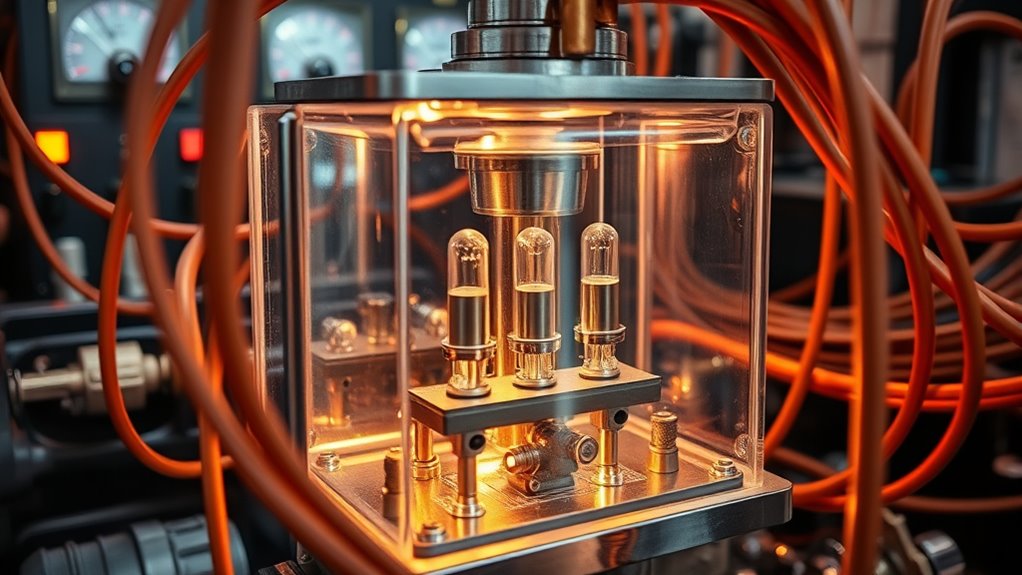
When it comes to safeguarding oil-filled transformers, the Buchholz relay plays a critical role in detecting internal faults. This mechanical safety device monitors the movement of gas and oil inside the transformer to identify issues early.
It uses two floats: the upper float sounds an alarm for minor faults by closing a mercury switch when gas accumulates. Meanwhile, the lower float trips the circuit breaker during severe faults. Gas generation correlates with fault severity, as the decomposition of transformer oil forms gases that rise, displacing oil within the relay chamber.
Positioned between the conservator and main oil tank, the Buchholz relay effectively monitors oil levels and gas accumulation. Regular maintenance and testing ensure its reliability, preventing false alarms caused by external influences or oil topping.
Key Components of a Buchholz Relay
A Buchholz relay is essential for monitoring oil-filled transformers, consisting of key components that guarantee its effectiveness.
During Buchholz Relay Operation, you’ll find two pivotal floats. The upper float, located in the metallic chamber, is responsible for detecting minor faults. When gas accumulation displaces the oil level, its mercury switch activates an alarm, notifying you of potential issues.
Meanwhile, the lower float is vital for handling severe faults. Its mercury switch is triggered by significant oil movement, closing the tripping circuit to isolate the transformer from the power supply. A baffle plate prevents false alarms from rapid oil movements.
Additionally, gas release pockets collect and allow analysis of gases from oil decomposition, offering insights into the transformer’s condition.
The Role of Buchholz Relay in Transformer Safety
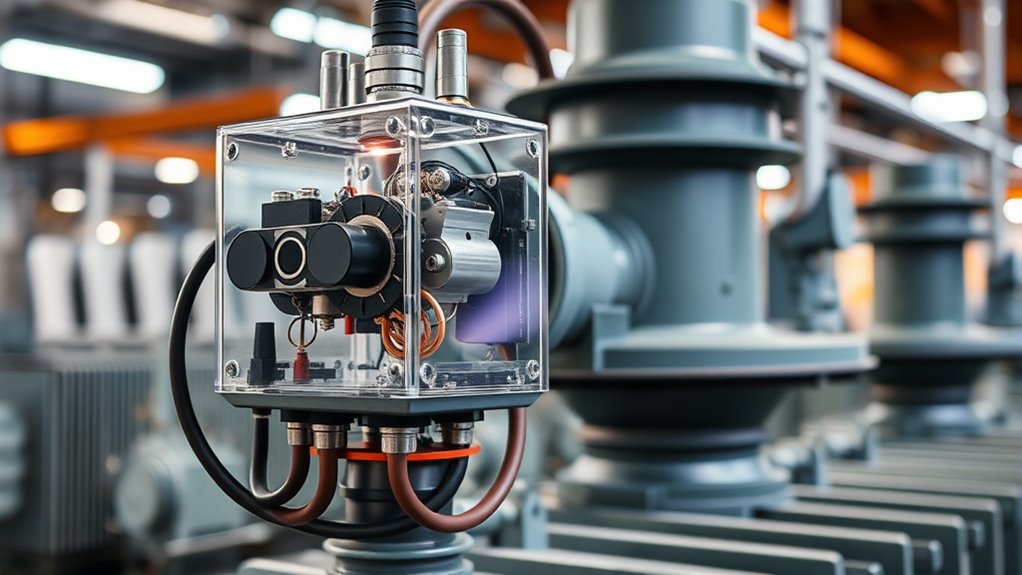
Although often overlooked, the Buchholz relay plays a crucial role in transformer safety by detecting internal faults early and preventing potential disasters.
As a critical safety device, it monitors transformer oil for signs of trouble, like gas bubbles indicating overheating or arcing. You’ll find that this relay is incredibly sensitive to changes in oil pressure, quickly triggering alarms or isolating the transformer when necessary. This proactive approach helps avoid catastrophic failures.
Regular maintenance and compliance with standards are crucial for reliability.
Here’s why Buchholz relays are indispensable:
- Detects early signs of internal faults through gas bubble formation.
- Triggers alarms for minor issues before they escalate.
- Isolates transformers during severe faults, preventing damage.
- Monitors oil levels to avoid overheating.
- Enhances overall transformer safety and operational integrity.
How a Buchholz Relay Detects Faults
As you explore understanding how a Buchholz relay detects faults, it is crucial to grasp its operation, which centers around gas bubble monitoring. In oil-filled power transformers, an electrical fault causes overheating, leading to gas accumulation in the relay chamber. This gas displaces oil, causing the upper float to drop and trigger a mercury switch, activating an alarm for minor issues. For severe faults, the rapid oil surge tilts the lower float, triggering another mercury switch to trip circuit breakers and isolate the transformer.
| Component | Function | Result |
|---|---|---|
| Upper Float | Detects minor gas accumulation | Activates the alarm through a mercury switch |
| Lower Float | Detects rapid oil surge | Trip circuit breakers |
| Gas Type Analysis | Identifies fault nature | Aids in preventative maintenance |
The Buchholz Relay’s precise detection helps prevent major transformer damage.
Gas Accumulation and Relay Activation

When you’re monitoring a transformer, gas bubbles in the oil can form and rise due to internal faults, which is where the Buchholz relay comes into play.
These gas bubbles accumulate in the relay chamber, displacing oil and triggering the alarm mechanism by lowering the upper float.
If the situation worsens, a more significant gas volume can activate the lower float, prompting the relay to trip the circuit breaker and isolate the transformer.
Gas Bubbles Formation
In a transformer, overheating or electrical faults can cause the oil to decompose, generating gas bubbles composed of hydrocarbons, CO2, and CO.
These gas bubbles indicate an internal fault and rise through the transformer oil to the Buchholz relay chamber. Here, the accumulation of gas displaces the oil, prompting the upper float to drop, which in turn activates a mercury switch.
This process is vital for alerting you to potential issues before they escalate.
Consider these points:
- Gas bubbles signal underlying issues within the transformer.
- Accumulation of gas can indicate the severity of an internal fault.
- Transformer oil plays a pivotal role in the relay’s operation.
- Mercury switches are essential for initiating safety protocols.
- Regular monitoring aids in early fault detection and prevention.
Activating Alarm Mechanism
Gas bubbles rising to the Buchholz relay chamber serve as the first signal of potential internal issues within the transformer. When gas accumulation occurs, it displaces the oil, causing the upper float to drop. This movement triggers a mercury switch within the Buchholz Relay, activating the alarm circuit.
This alarm mechanism is vital, alerting you to minor faults before they escalate into more significant issues. The prompt response time, as quick as 0.1 seconds, guarantees swift detection and management of transformer issues.
The gases, often hydrocarbons, CO2, and CO, are analyzed to assess the nature and severity of the fault. By monitoring the Buchholz Relay, you can maintain the transformer’s integrity, ensuring it operates smoothly and safely, and reducing the risk of more severe faults.
Relay Switch Triggering
As gas accumulates within the transformer, the Buchholz relay‘s design guarantees it doesn’t go unnoticed. The relay switch activates its upper float with minor gas accumulation, triggering an alarm.
For severe faults, rapid gas generation causes the lower float to trip the circuit breaker, isolating the transformer. This precise mechanism guarantees early fault detection, with response times as quick as 0.1 seconds.
- Sensitive Detection: The Buchholz Relay detects various gas types, including hydrocarbons, CO2, and CO.
- Mercury Switches: Both floats are linked to mercury switches for reliable responses.
- Dual Activation: Separate actions for minor and major faults enhance safety.
- Oil Movement: Gas buildup causes oil movement, activating the relay switch.
- Diagnostic Potential: Gas samples can be analyzed for further fault diagnostics.
Relay Operation During Transformer Faults
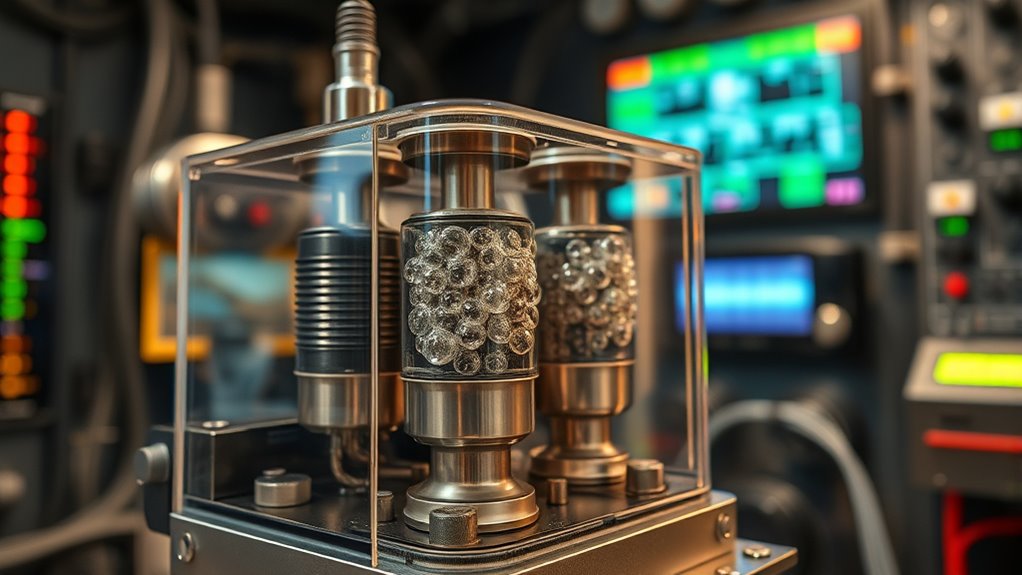
When transformer faults occur, you’ll rely on the Buchholz relay‘s gas detection mechanisms to identify issues promptly.
It activates alarms for minor faults and trips circuits for severe ones, ensuring quick intervention.
Regular maintenance and testing are essential to keep the relay operating effectively, especially since it doesn’t detect all fault types.
Fault Detection Mechanisms
Understanding the operation of a Buchholz relay during transformer faults is essential for effective fault detection. The Buchholz Relay monitors the insulating oil for gas accumulation.
During minor faults, gas bubbles rise, displacing oil and lowering the upper float, which triggers an alarm. In severe cases, an oil surge activates the lower float, tripping the circuit breaker to isolate the transformer.
By analyzing gas accumulation, you can determine the type and severity of the fault.
Here’s what you need to know:
- Minor Faults: Gas bubbles indicate minor issues, triggering alarms.
- Severe Faults: Oil surges trip circuit breakers, isolating faults.
- Regular Monitoring: Prevent false alarms from external influences.
- Sensitive to Oil Levels: Changes indicate possible faults.
- Indicator of Fault Severity: Gas production levels guide responses.
Alarm and Trip Activation
Imagine being able to respond to transformer faults with precision and speed. The Buchholz Relay makes this possible by alerting you to issues.
When gas accumulation occurs due to minor internal faults, the upper float drops, triggering an alarm. This signals the need for maintenance before issues escalate.
In contrast, severe faults cause a rapid oil surge that drops the lower float, activating the trip circuit to immediately isolate the transformer by tripping the circuit breaker.
The Buchholz Relay’s design guarantees quick detection, with activation times as fast as 0.1 seconds.
Maintenance Considerations
To guarantee the Buchholz relay operates effectively during transformer faults, regular maintenance is essential. The Buchholz Relay, a crucial safety device, depends on precise oil level management and timely gas assessments.
You should verify that accumulated gases are frequently tested; flammable gases indicate overheating, while air suggests potential leaks or low oil levels.
Maintenance checks must confirm that the relay’s floats move freely, as they react to changes in oil level.
- Test and analyze the accumulated gas for evidence of faults.
- Verify that floats move without obstruction to confirm proper functionality.
- Use mechanical locks during oil addition to prevent false alarms.
- Regularly check oil levels to maintain the relay’s efficacy.
- Ensure trained personnel reset the gas-actuated relay after trips.
Maintenance Protocols for Buchholz Relays
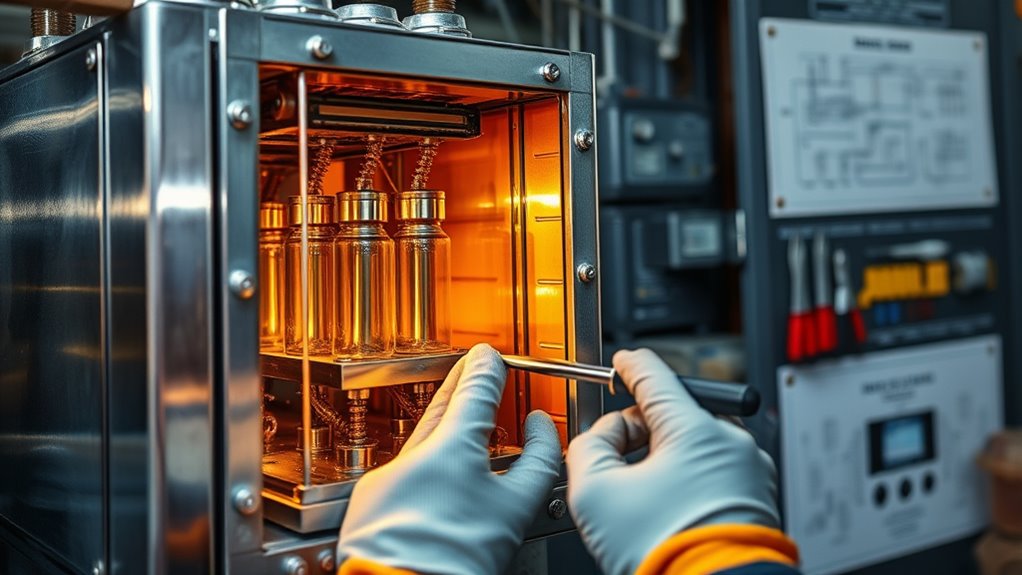
When maintaining Buchholz relays, regular checks are vital to guarantee their reliability and safety.
Start by conducting thorough inspections to spot leaks or physical damage. Pay close attention to the Buchholz Relay’s connections and verify they meet the DIN EN 50216-2 standard.
Don’t forget to sample gas from the test port. It helps identify internal faults or low oil levels, signaling when maintenance is needed.
Testing the functionality of the float switches is significant. They must respond accurately to changes in oil level.
After any relay tripping, remember to reset the relay to prevent false alarms.
This proactive maintenance approach will keep your relay in peak condition, ensuring maximum performance and avoiding disruptions during normal transformer operations.
Common Faults Identified by Buchholz Relays
Buchholz relays play an essential role in identifying common faults within transformers, ensuring timely interventions to prevent severe damage. They detect small electrical faults, such as eddy currents and overheating, often caused by the use of poor-quality insulating liquids.
When large faults occur, such as winding-winding short circuits, significant gas volumes trigger the relay’s lower float, activating the trip circuit. Gas accumulation in the relay signals oil decomposition, indicating potential faults.
Additionally, the Buchholz Relay identifies a reduction in insulating liquid levels, often caused by leaks, and activates an alarm.
- Eddy currents and overheating: Small electrical faults detected.
- Gas accumulation: Indicates oil decomposition and potential faults.
- Trip circuit activation: Triggered by large faults.
- Insulating liquid reduction: Caused by leaks, prompts alarm.
- Regular maintenance: Essential for accurate fault detection.
Comparison With Other Transformer Protection Devices
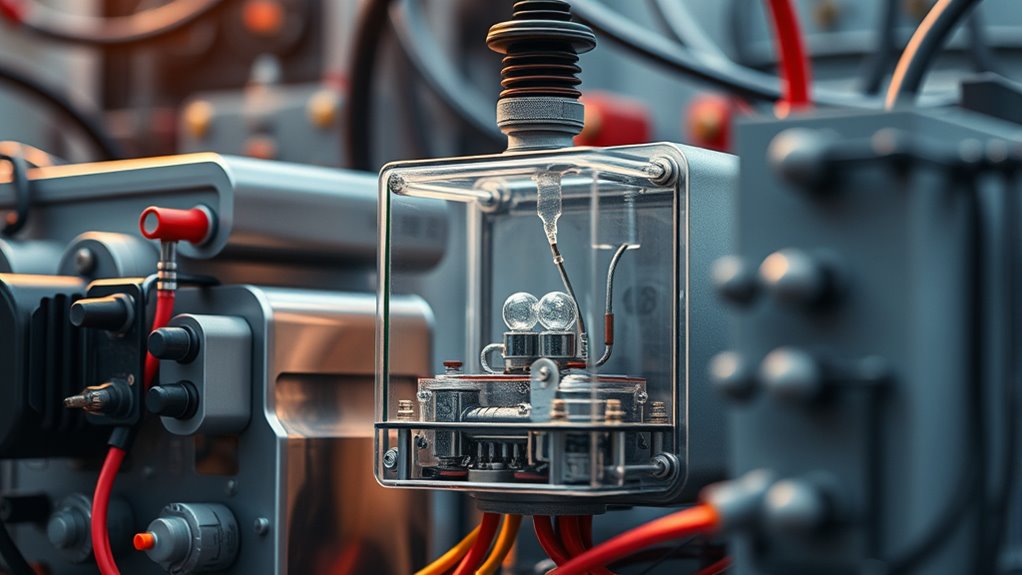
Having explored the common faults identified by Buchholz relays, let’s examine how these devices compare to other transformer protection alternatives.
A Buchholz Relay is a unique protective device for oil-immersed transformers, monitoring gas levels and oil movement to detect faults. It excels in identifying minor and severe electrical issues by measuring gas generation, unlike gas-actuated relays that only monitor gas levels.
In contrast to thermal relays, which respond to temperature fluctuations, Buchholz relays provide more extensive transformer protection by addressing internal conditions. They offer proactive maintenance alerts, unlike overcurrent relays that focus solely on current levels.
While Mho relays are for distance protection, Buchholz relays deliver localized monitoring, making them ideal for oil-immersed transformers, although they’re not suited for air-cooled variants.
Challenges and Limitations of Buchholz Relays
While Buchholz relays offer significant advantages for oil-immersed transformers, they also come with several challenges and limitations.
For starters, a Buchholz Relay is only applicable to oil-immersed systems, making it unsuitable for air-cooled or dry-type transformers. It primarily detects faults occurring inside, below the oil level, so issues above this level or in external connections may go unnoticed.
The minimum response time of 0.1 seconds can delay detection during rapid fault conditions. Additionally, false alarms may arise from external factors, such as air bubbles or non-fault-related oil movement, which can complicate the maintenance process.
Finally, Buchholz relays don’t protect connecting cables, necessitating additional protective mechanisms for thorough safety.
- Limited to oil-immersed transformers
- Can’t detect above oil level faults
- Potential for false alarms
- Delayed response time
- Requires additional protection mechanisms
Conclusion
You now have a solid understanding of the Buchholz Relay and its crucial role in transformer safety. By monitoring the movement of gas and oil, it quickly identifies and responds to internal faults, thereby minimizing damage risks. Regular maintenance is key to ensuring its reliability and effectiveness. While it’s a critical component, remember that it works best in conjunction with other protection devices. Despite some limitations, the Buchholz Relay remains an indispensable tool for safeguarding your transformers.
FAQs
1. What Is Buchholz Relay and How Does It Work?
You’re curious about a Buchholz relay? It’s a safety device in oil-filled transformers. It detects faults by monitoring the movement of gas and oil. When faults occur, they trigger alarms or trip circuits, protecting the transformer from damage.
2. How Does Buchholz Work?
You monitor gas accumulation from oil decomposition. When minor faults occur, an alarm triggers. Severe faults cause oil surges, tripping the circuit to isolate the transformer and prevent further damage. Gas sampling helps analyze fault severity, ensuring efficient protection of transformers.
3. Why Did Buchholz’s Relay Trip?
You saw the Buchholz relay trip because it detected gas accumulation from a fault or low oil levels. It responds to internal transformer issues, triggering an alarm or tripping the circuit breaker for safety.
4. What Does a Buchholz Relay Provide Warning Against?
You’re alerted to internal transformer faults, such as overheating or arcing. It detects gas from oil decomposition, warning you of minor issues with an alarm and severe faults by isolating the transformer. It also signals low oil levels.