Field Oriented Controls: Key to Motor Precision
If you’re looking to enhance motor efficiency and control, Field Oriented Control (FOC) is a technique you can’t overlook. By separating torque and magnetic flux management, FOC offers precise control over motor performance. This method not only improves efficiency but also boosts speed while reducing heat output. But how exactly does it work, and what makes it so effective for different types of motors? Let’s explore the intricacies of this advanced control strategy.
Key Takeaways
- FOC controls torque and magnetic flux in three-phase motors using Park and Clarke transformations for enhanced efficiency and precision.
- It enables independent control of torque and magnetic flux, improving motor performance and reducing energy loss.
- Real-time feedback of rotor position and currents is crucial for the optimal performance of FOC.
- FOC achieves up to 97% efficiency, significantly reducing energy costs and motor heat output.
- Future trends include sensorless techniques, IoT integration, and AI for adaptive control in FOC systems.
Understanding Field Oriented Control

When you investigate Field Oriented Control (FOC), you’re exploring a sophisticated method that precisely manages the torque and magnetic flux of three-phase Brushless DC motors.
FOC achieves torque control by transforming stator currents into orthogonal components using the Park and Clarke transformations. This conversion into a rotating coordinate system enables effective control of torque through the quadrature current and magnetic flux, achieved via the direct current.
FOC uses Park and Clarke transformations to master torque and magnetic flux control in a rotating coordinate system.
By setting the direct current component to zero, you can minimize unwanted torque, enhancing efficiency up to 97%. Real-time feedback of rotor position and current measurements is essential for maintaining peak performance.
In high-speed applications, FOC-driven motors can achieve impressive speeds, significantly surpassing those attained with traditional methods such as Hall-based commutation.
The Evolution of Vector Control
Despite initial challenges, vector control, also known as field-oriented control (FOC), has undergone considerable evolution since its inception.
Pioneered by K. Hasse and F. Blaschke in the late 1960s and early 1970s, vector control faced hurdles like higher costs and complexity compared to traditional DC drives.
However, advancements in computational power, particularly with microprocessors, have transformed motor control.
Werner Leonhard’s contributions further refined FOC techniques, paving the way for competitive AC motor drives.
By converting stator currents into orthogonal components, FOC enables AC motors to operate similarly to DC motors, thereby enhancing both performance and efficiency.
Today, with increased applicability, vector control has become a mainstay in industrial contexts, revolutionizing the approach to motor control.
Key Principles of FOC

To grasp the key principles of Field-Oriented Control (FOC), it’s essential to understand how it optimizes motor performance by utilizing two orthogonal current components: quadrature (Q) for torque and direct (D) for magnetic flux. FOC is designed to maximize torque while minimizing unwanted direct current components.
Field Oriented Control optimizes motor performance with quadrature for torque and direct for magnetic flux.
Here’s how it works:
- Coordinate Transformation: The Park and Clarke transformations convert three-phase currents into a two-dimensional d-q frame, simplifying rotor control.
- D Current Management: Setting the D current to zero enhances efficiency, preventing unnecessary torque and improving performance.
- Real-Time Feedback: Monitoring rotor position and current allows precise torque control and swift motor adjustments.
- Efficiency Boost: FOC can boost motor drive efficiency to 97%, especially in high-speed applications.
Understanding these principles enhances your grasp of FOC’s effectiveness.
Technical Aspects of FOC Implementation
Building on the foundational principles of Field-Oriented Control (FOC), let’s examine the technical aspects of its implementation.
FOC transforms three-phase motor currents into a (d,q) coordinate system using Park and Clarke transformations. This enables precise, independent control of torque and magnetic flux, thereby enhancing motor performance. The d-axis component manages the rotor flux linkage, while the q-axis component controls the torque.
To achieve this, real-time feedback of motor currents and rotor position is essential. This feedback enables the FOC algorithm to adjust voltage outputs and meet desired current values efficiently. The control algorithm runs every pulse-width modulation (PWM) cycle, requiring robust processor performance to handle the complexities of real-time control.
This guarantees peak motor efficiency, especially in high-speed applications.
Advantages of FOC in Motor Control

With Field Oriented Control, you’ll notice a significant boost in motor efficiency, reaching up to 97% in certain applications by optimizing torque and flux control.
It enables you to precisely manage torque generation, resulting in smoother operation and reduced energy loss.
FOC also enhances speed management, achieving higher speeds than traditional methods, making it ideal for applications requiring efficient and responsive motor control.
Enhanced Motor Efficiency
Although traditional motor control methods have served well in various applications, Field-Oriented Control (FOC) steps in to revolutionize motor efficiency, achieving levels of up to 97%.
FOC optimizes the motor drive by decoupling torque and flux control, thereby minimizing direct current components and enhancing performance.
You’ll find that FOC provides:
- Energy Savings: It reduces energy consumption considerably compared to traditional methods.
- Dynamic Performance: Effective management of torque and speed enables faster acceleration and deceleration.
- High-Speed Operation: FOC enables Brushless DC motors to reach speeds up to 29,310 RPM, outperforming Hall-based methods.
- Heat Reduction: By allowing variable torque adjustments, FOC lowers heat output, preventing overheating and prolonging motor lifespan.
Implementing FOC guarantees your motor operates at peak efficiency.
Improved Torque Control
Field Oriented Controls extends its advantages beyond energy savings to enhance torque control in motor operations greatly.
By separating the control of torque and magnetic flux, FOC enables more precise management of motor torque compared to traditional methods. It does this by maximizing quadrature current and minimizing direct current, boosting motor efficiency to impressive levels—up to 97% in certain applications.
FOC also enables rapid torque adjustments, with response times as quick as 5-10 milliseconds, markedly improving dynamic performance. This technique provides smoother operation and superior torque control across a wide range of speeds, making it particularly effective for high-performance motors, such as Permanent Magnet Synchronous Motors (PMSM).
With FOC, you’re optimizing both speed and efficiency, elevating your motor’s performance.
Precise Speed Management
Thanks to its ability to decouple torque and flux currents, Field-Oriented Control (FOC) excels in precise speed control for motor operations.
It enables rapid and accurate adjustments, achieving efficiency levels of up to 97%. You’ll notice reduced energy consumption and lower operational costs, especially at higher speeds.
Here’s how FOC benefits you:
- Rapid Response: Torque and speed adjustments are achieved within 5-10 milliseconds, enhancing motor responsiveness.
- Optimal Performance: By maintaining a zero direct current (D), FOC minimizes unwanted torque components, reducing overheating risks.
- Dynamic Adaptability: Real-time feedback mechanisms allow motors to adapt to load changes, ensuring consistent performance.
- Energy Efficiency: High efficiency at various speeds reduces energy consumption, resulting in cost savings.
With FOC, precise speed management becomes a reality.
FOC in Industrial Applications

You’ll find that Field-Oriented Controls (FOC) significantly enhances motor efficiency, achieving up to 97% efficiency in high-speed applications, such as conveyors.
This precise control over torque is essential for rapid acceleration and deceleration, making it ideal for robotics and CNC machines.
Enhanced Motor Efficiency
When it comes to maximizing motor efficiency in industrial applications, Field Oriented Control (FOC) stands out as a game-changer.
By achieving motor drive efficiencies of up to 97%, FOC enhances performance with lower energy consumption. It allows precise torque control, which is essential in various industrial applications.
Here’s how FOC boosts motor efficiency:
- Higher Efficiency: FOC can achieve up to 97% motor efficiency, resulting in reduced energy costs.
- Dynamic Performance: Fast acceleration and deceleration improve automation processes.
- Reduced Heat Output: Variable torque commands cut heat, extending motor life and lowering maintenance costs.
- Increased Speed: Brushless DC motors can reach speeds of up to 29,310 RPM, outperforming traditional systems.
Incorporating FOC not only improves operational efficiency but also boosts productivity across manufacturing environments.
Precision in Control
In industrial applications, precision in control is essential, and Field Oriented Control (FOC) excels by delivering that precision through decoupled control of torque and magnetic flux.
FOC enhances control systems by using orthogonal current components to maximize efficiency and torque generation. You’ll find that FOC achieves up to 97% efficiency in motor drive applications, making it ideal for high-speed operations.
It reduces heat output in closed-loop systems, ensuring sustainable operation. Rapid torque and flux adjustments, achieved within 5-10 milliseconds, enable dynamic performance essential for automation and robotics.
By utilizing real-time rotor position data, FOC effectively applies voltages to motor phases, aligning rotor and stator magnetic fields.
With Clarke and Park transformations, FOC simplifies three-phase motor control, offering precise torque management.
Real-Time Performance
How does Field Oriented Control (FOC) transform real-time performance in industrial applications?
It greatly enhances motor efficiency by precisely managing torque and speed.
With FOC, a motor controller utilizes real-time feedback of current and rotor position to dynamically adjust voltages, thereby optimizing torque and minimizing energy losses.
This real-time capability brings impressive improvements:
- Efficiency Boost: Achieve up to 97% efficiency in specific cases.
- Quick Response: Torque and flux adjustments occur within 5-10 milliseconds.
- Speed Advantage: Drive motors 64% faster compared to traditional methods.
- Versatility: Maintain high performance across PMSMs and AC induction motors.
These features make FOC an ideal choice for industries demanding fast, responsive motor control.
It’s a game-changer in enhancing real-time performance.
FOC Techniques for Different Motor Types
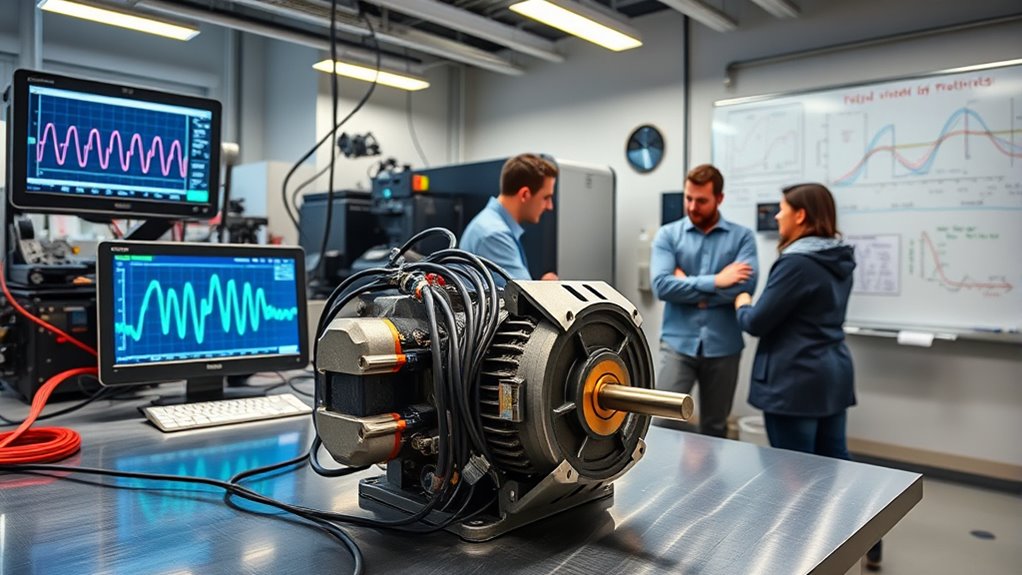
Although Field-Oriented Control (FOC) techniques can be applied across various motor types, they shine particularly brightly in specific applications.
While FOC can be applied broadly, it excels in certain motor applications.
For Permanent Magnet Synchronous Motors (PMSM), FOC provides precise torque control across a wide speed range by transforming stator currents into a d-q reference frame. This enhances performance and efficiency greatly.
When dealing with AC induction motors, FOC decouples torque and flux control, which boosts efficiency and dynamic response in industrial settings. Using these control techniques, you’ll notice improved performance and adaptability.
In the domain of stepper motors, FOC reduces heat output and increases accuracy by adjusting torque command values, especially during high-speed operations.
Clarke and Park transformations are crucial here, as they convert three-phase currents into orthogonal components, facilitating simplified control and enhanced efficiency.
Real-Time Feedback and Sensorless FOC
When it comes to Field-Oriented Control (FOC), real-time feedback is crucial for ensuring accurate torque and flux control. You can rely on sensorless techniques to estimate rotor position and stator currents without the need for physical sensors, which simplifies the system and reduces costs.
The success of this approach hinges on the accuracy of the sensorless feedback algorithm, which uses mathematical models to interpret stator current measurements.
Here’s how it works:
- Measure Stator Currents: Real-time current sensing captures the necessary data.
- Apply Clarke and Park Transformations: Convert three-phase currents into a two-dimensional vector.
- Estimate Rotor Position: Utilize sensorless techniques for precise control.
- Adjust Torque and Flux: Achieve rapid adjustments within 5-10 milliseconds for ideal performance.
Performance Enhancement With FOC

Building on the foundation of real-time feedback and sensorless techniques, Field Oriented Control (FOC) propels motor drive systems to new levels of efficiency and performance. By enhancing motor drive efficiency, FOC can achieve an impressive 97% efficiency in specific applications, especially at higher speeds. This is evident in laboratory tests where a blower spindle reached a remarkable 29,310 RPM using FOC, compared to just 17,895 RPM with Hall-based commutation. FOC minimizes direct current while maximizing quadrature current, notably boosting the rotational torque of Brushless DC motors. With variable torque command capabilities, closed-loop stepper drives produce less heat and perform better. FOC’s benefits extend to high-performance applications by providing faster acceleration and deceleration.
| Feature | Traditional Method | FOC Method |
|---|---|---|
| RPM (Blower Spindle) | 17,895 | 29,310 |
| Efficiency | Lower | Up to 97% |
| Torque Management | Less Optimized | Enhanced |
Future Trends in Field Oriented Control
You’re about to discover how sensorless techniques and IoT integration are transforming the future of Field-Oriented Control.
By reducing the need for physical sensors, FOC systems will become more compact and cost-effective, all while maintaining high performance.
Meanwhile, IoT connectivity will enable smarter systems that use cloud computing for real-time monitoring and predictive maintenance, ensuring minimal downtime and peak efficiency.
Advances in Sensorless Techniques
While the complexity and cost of traditional Field Oriented Control (FOC) systems have often been a barrier, advances in sensorless techniques are changing the game. You can now estimate rotor position and speed using algorithms like Extended Kalman Filters, thereby improving motor performance without the need for additional sensors.
This means:
- Reduced Complexity: Sensorless techniques simplify systems, cutting costs and making FOC accessible for a wider range of applications.
- Enhanced Torque Control: Accurate rotor position estimation enables rapid torque adjustments within milliseconds.
- Increased Reliability: Error margins in rotor position estimation are now under 5%, boosting efficiency.
- Real-Time Adaptation: Machine learning and AI integration enable adaptive control, optimizing performance under different loads.
These innovations are vital for electric vehicles and industrial automation, where space and budget are significant.
Integration With IoT Technologies
Imagine a future where Field Oriented Control (FOC) systems are seamlessly integrated with Internet of Things (IoT) technologies, revolutionizing how you monitor and control motor performance.
IoT sensors provide real-time feedback on rotor position and current, enabling adaptive FOC algorithms to dynamically optimize motor performance. With cloud-based platforms, you can access motor data remotely, enabling you to make informed decisions without being on-site.
This integration enhances predictive maintenance by using machine learning to anticipate failures, reducing downtime and maintenance costs.
Additionally, FOC combined with IoT technologies supports smart grids and energy-efficient systems, improving load management and integrating renewable energy sources.
This leads to more sustainable and efficient motor operations, ensuring your systems run smoothly and cost-effectively.
Conclusion
You’ve now grasped the fundamentals of Field Oriented Control and its transformative impact on motor efficiency. By decoupling torque and flux, FOC offers precise, real-time management of motor performance. Its application spans various motor types, providing enhanced speed, reduced heat, and impressive operational efficiency. As technology advances, FOC will continue to evolve, promising even greater improvements in motor control. Stay tuned to these developments, as they’ll shape the future of efficient motor management.
FAQs
1. What Is Meant by Field-Oriented Control?
You can independently control torque and magnetic flux in three-phase AC motors. By transforming stator currents into a rotating frame, you can maximize torque and minimize unwanted currents, thereby achieving high efficiency. Use mathematical transformations for real-time adjustments and precise control.
2. What Is FOC Used For?
You use FOC to enhance motor performance and efficiency, achieving up to 97% efficiency. It’s essential for precise torque control, improving response and dynamics in high-speed applications like electric vehicles, industrial machinery, and robotics.
3. What Is the Difference Between Field-Oriented Control and DTC?
You’re comparing FOC and DTC: FOC transforms currents for precise control, while DTC directly handles torque and flux. FOC’s smoother but complex; DTC’s quicker with more ripple. Choose based on your need for precision or speed.
4. What Is the Use of Field Control?
You’re using field control to optimize motor performance, enhancing efficiency and precision. It enables fast response times, making it ideal for high-demand applications such as electric vehicles and robotics, where maintaining control and efficiency is crucial.