Types of Protective Relays: Functions & Applications
When you explore the world of protective relays, you’ll quickly realize their importance in ensuring the safety and reliability of electrical systems. From the classic electromechanical relays to the advanced digital types, each has its unique role. Ever wondered how distance, overcurrent, and differential relays protect your equipment while minimizing downtime? Understanding these can transform how you approach electrical safety. Curious about how they work? There’s much more to uncover.
Key Takeaways
- Electromechanical relays use electromagnetic forces and are reliable for both AC and DC power sources.
- Static relays utilize semiconductor components for precise and rapid fault detection, eliminating the need for moving parts.
- Digital relays leverage microprocessors for advanced analysis, customizable settings, and remote monitoring.
- Distance protection relays detect faults by measuring the voltage-to-current ratio and determining the impedance for accurate fault location.
- Overcurrent relays activate when the load current exceeds the set values, offering instantaneous or definite-time protection.
Electromechanical Relays

Although electromechanical relays may seem like outdated technology, they remain a staple in power systems due to their exceptional reliability. You’ll find these protection relays using electromagnetic forces created by operating coils to open or close contacts. This mechanism guarantees effective fault detection by mechanically displacing armatures or disks.
Their robust design allows them to work seamlessly with both AC and DC power sources, making them versatile across various systems.
One of the key advantages is their adjustable operating characteristics. You can customize time delays and pickup levels, tailoring them to specific applications and protection schemes. This customization is vital for maintaining system integrity.
Adjustable settings ensure relays meet specific needs, vital for system integrity and reliability.
While newer relays offer advanced functionality, electromechanical relays remain reliable in many settings, underscoring their enduring value.
Static Relays
While electromechanical relays have their place, static relays represent a significant advancement in protective relay technology. By utilizing semiconductor components such as thyristors and transistors, static relays offer faster operation and enhanced reliability.
They excel in measurement and control within electrical systems by processing analog input signals, enhancing fault detection with precision and sensitivity. Without moving parts, they require less maintenance and exhibit greater durability, especially in industrial power systems.
Static relays are adept at implementing multifunctional protection strategies, allowing a single device to manage various protective functions, such as overcurrent protection, voltage regulation, and frequency monitoring.
Their versatile application in modern electrical protection schemes underscores their importance in maintaining reliable and efficient power system operations.
Digital Relays

Embracing the advancements in modern technology, digital relays revolutionize protective relay systems by leveraging microprocessors to analyze electrical signals with precision and speed.
With digital protective relays, you gain advanced protective functions and precise fault detection, ensuring your power system protection is both reliable and efficient. These relays manage multiple protection schemes simultaneously, offering you unmatched flexibility and adaptability in complex electrical settings.
Thanks to programmable logic, you can customize settings for specific applications, enhancing performance while enjoying improved sensitivity.
Their communication capabilities enable seamless remote monitoring and integration into larger systems, such as SCADA, keeping you informed and in control.
Distance Protection Relays
When it comes to safeguarding transmission lines, distance protection relays are your go-to solution, operating based on the voltage-to-current (V/I) ratio to detect and respond to faults.
These relays measure impedance to pinpoint fault locations, ensuring reliable detection of faults. They classify protection into three zones: Zone 1 offers instantaneous protection, swiftly responding to nearby faults. Zone 2 employs time delay protection for more distant issues, while Zone 3 provides backup protection for faults beyond the primary zone.
The operating principle hinges on recognizing impedance drops during faults, triggering a response when thresholds are breached.
Modern distance protection relays feature advanced capabilities, including communication, self-monitoring, and multiple setting groups, thereby enhancing their adaptability to diverse operational conditions.
Overcurrent Relays
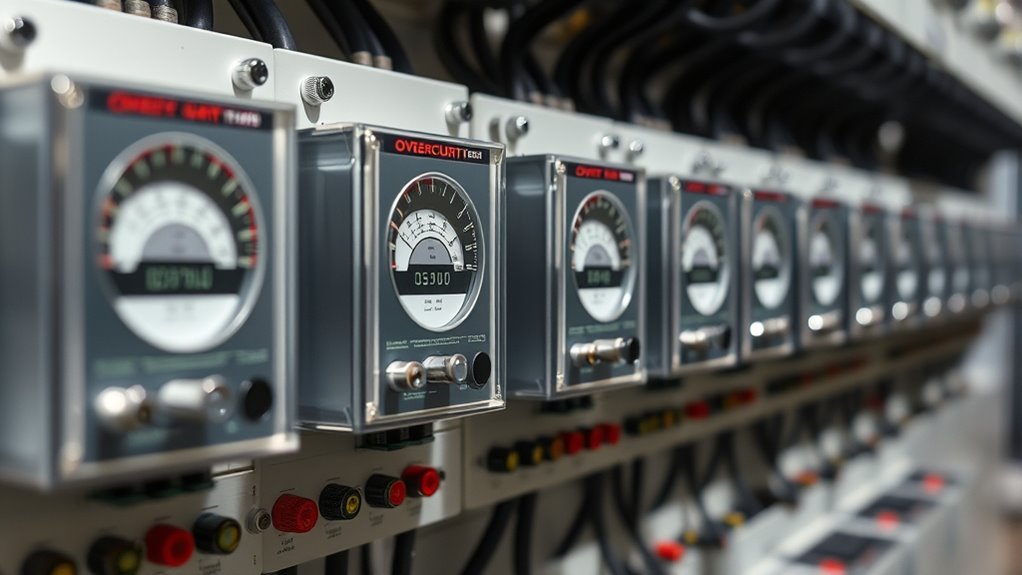
Overcurrent relays are essential for maintaining the safety and reliability of electrical systems, as they activate when the load current exceeds a set pickup value. These relays provide vital protection against overloads and short circuits, ensuring your equipment stays safe.
They’re divided into two main types: instantaneous overcurrent (IOC) relays, which trip immediately, and definite time overcurrent (DTOC) relays, which delay before tripping. You’ll find them identified by ANSI device numbers 50 for IOC and 51 for DTOC, which makes categorizing them straightforward.
Overcurrent relays serve various applications like transformer protection, motor protection, and feeder protection. Additionally, IDMT relays, influenced by source and feeder impedance, offer performance characterized by IEC standard 60255-151, enhancing system reliability and safeguarding against potential faults.
Differential Relays
Differential relays are a crucial component in safeguarding electrical equipment by quickly detecting internal faults. They operate by comparing the current entering and leaving a protected zone. When there’s a discrepancy indicating an internal fault, these protective relays trigger a trip signal. This action activates the circuit breaker, effectively isolating the faulted section.
You’ll appreciate their high sensitivity and fast response times, which are crucial for preventing damage to critical equipment, such as transformers and generators.
Differential relays fall into categories like percentage differential relays and biased differential relays. These types adjust their sensitivity based on load current, reducing nuisance tripping.
Conclusion
In the world of electrical systems, understanding the types of protective relays is essential for ensuring safety and reliability. You’ve explored electromechanical, static, and digital relays, each offering unique benefits for fault detection and response. Distance, overcurrent, and differential relays offer specialized protection, enabling the quick isolation of issues and minimizing downtime. By selecting the appropriate relay for each situation, you can effectively safeguard your equipment, ensuring that your electrical systems run smoothly and efficiently.
FAQs
1. How Many Types of Protection Relays Are There?
When considering protection relays, four main types can be identified: electromechanical, static, digital, and numerical. Each type offers unique features and advantages, ensuring your electrical system functions safely and efficiently by preventing faults.
2. What Are the Three Types of Relays?
You’re asking about the three types of relays. They are electromechanical, static, and digital relays. Each type has unique characteristics: electromechanical involves moving parts, static uses semiconductors, and digital employs microprocessors for advanced functionality.
3. What are Protection 50 and 51?
You use 50 protection for instant fault clearing when the current exceeds a set limit, while 51 protection incorporates a delay, allowing you to coordinate with other devices to avoid unnecessary trips during overloads or longer faults. Coordination is key.
4. What Are the 5 Different Types of Relay PPT?
You’re looking for a presentation on relays. Focus on electromechanical, static, digital, overcurrent, and distance relays. Highlight the unique features and benefits of each type. Tailor your content for clarity and engagement to guarantee your audience stays interested.