Difference Between Overcurrent and Undervoltage
When you’re dealing with electrical systems, understanding overcurrent and undervoltage is essential. Overcurrent happens when the current surpasses safe levels, risking overheating and damage. Undervoltage, on the other hand, occurs when voltage falls too low, potentially causing operational issues. Both situations can jeopardize your equipment’s performance. But what exactly causes these conditions, and how can you protect your systems from them? Let’s delve into the complexities of these electrical challenges.
Key Takeaways
- Overcurrent refers to excessive current flow, while undervoltage refers to an insufficient voltage supply.
- Overcurrent can cause overheating and fires, whereas undervoltage can lead to equipment malfunctions.
- Overcurrent protection utilizes breakers and relays, while undervoltage protection employs undervoltage relays.
- Overcurrent results from overloads or short circuits; undervoltage stems from high demand or long transmission drops.
- Overcurrent damages by excess heat; undervoltage stresses equipment by increased current draw.
Understanding Overcurrent
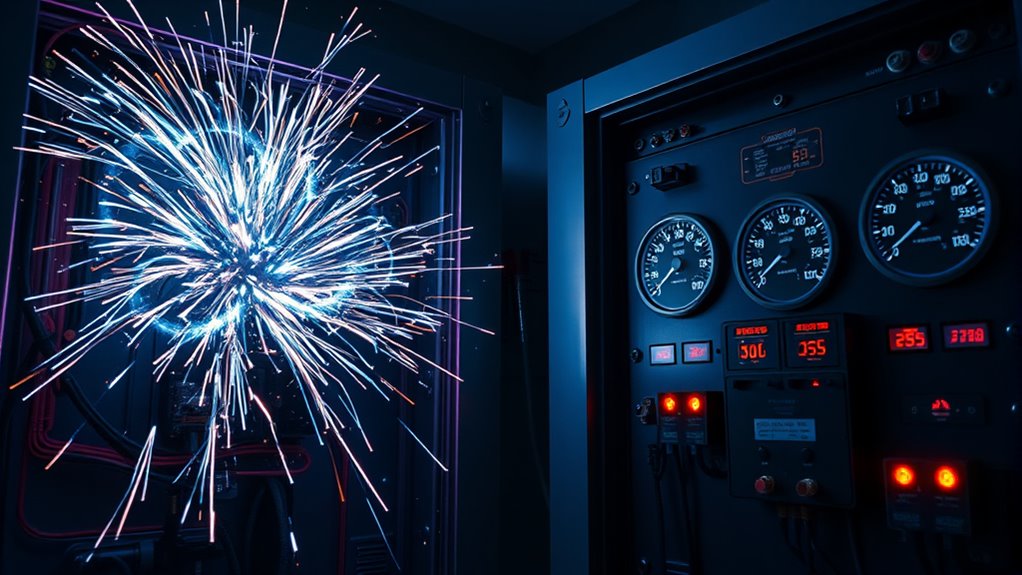
Understanding overcurrent is essential for anyone dealing with electrical systems. When overcurrent occurs, it means the current surpasses the desired level, often due to overloads or short circuits. These situations can lead to excessive current, posing dangers such as fires or equipment damage.
Circuit breakers play a crucial role in overcurrent protection by interrupting the flow of excessive current and preventing potential hazards.
In overload conditions, a component draws more current than it can handle, leading to overheating. Meanwhile, short circuits cause excessive current with minimal voltage across the load, demanding immediate attention.
Thermal-magnetic circuit breakers are particularly effective, providing dual protection by addressing both overload and short-circuit scenarios. Hence, understanding overcurrent is key to maintaining safe electrical systems.
Exploring Overcurrent Protection
When it comes to keeping electrical systems safe, overcurrent protection is vital. You need to guard against excessive currents that can damage equipment. Overcurrent relays and protection relays are your first line of defense, detecting current flow issues and acting swiftly.
Devices like thermal-magnetic circuit breakers offer dual protection: they quickly trip for short circuits and delay for overloads. This guarantees your system is secure against sudden surges and prolonged excessive currents.
Selecting the right protection devices is essential. You’ll want to set them to trip at specific current levels, with instant actions for severe surges and time-delayed responses for sustained overcurrent.
Don’t overlook your system’s characteristics and expected fault currents. Properly chosen overcurrent protection keeps everything running smoothly.
Delving Into Overload and Its Implications
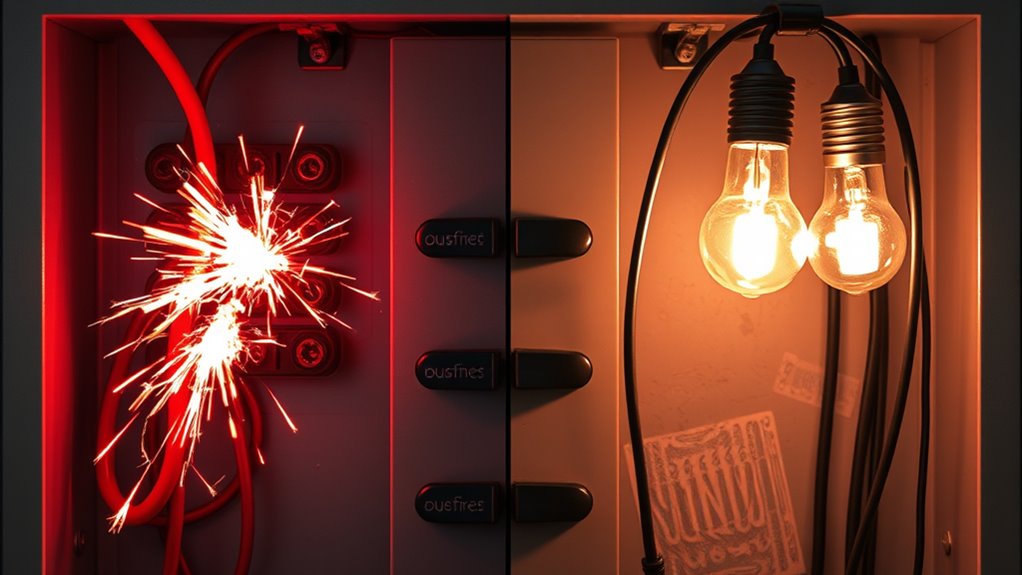
When you encounter a circuit overload, it’s often due to a load drawing more current than it’s designed to handle, which can strain your electrical system.
This not only risks overheating and damaging equipment but also increases the chance of electrical fires.
To prevent such issues, ensure that protective devices are properly rated and understand the load characteristics of your system.
Causes of Circuit Overload
Though often overlooked, circuit overload is a critical issue that arises when the connected load demands more current than the circuit can handle. This usually happens when you plug in devices that exceed the circuit’s rated capacity.
Imagine using a 1.5 kW appliance on a circuit designed for only 1 kW. Such actions lead to excessive current flow, which causes overheating and damage.
Sometimes, the misuse of circuit breakers with ratings higher than the wiring can safely handle exacerbates the problem. This allows unsafe current levels to continue without tripping.
Continuous overload can cause insulation failure and equipment malfunctions. To protect your system, implement proper overload protection, such as thermal-magnetic circuit breakers and overload relays, which prevent damage and ensure safety.
Impacts on Electrical Systems
As electrical systems face overload conditions, the impacts can be both immediate and far-reaching.
Overloading occurs when devices draw more current than they’re designed to handle, leading to overheating and potential damage. This situation can trip circuit breakers or activate an overcurrent relay, which interrupts the flow to protect your power systems.
Consider these risks:
- Increased chance of electrical fires: Overheating wires and components can ignite.
- Equipment failure: Exceeding the rated capacity can lead to damage to the insulation or breakdown.
- Low voltage conditions: Excessive current demand can reduce system voltage.
- System downtime: Frequent tripping of protection devices disrupts operations, causing significant disruptions.
Prolonged overloads not only damage equipment but also compromise safety, underscoring the importance of understanding these impacts for effective system management.
Overload Prevention Methods
In combating the dangers of overload, implementing effective prevention methods is essential for ensuring the safety and longevity of your electrical systems.
Overload occurs when your devices draw more current than they’re rated for, risking overheating and damage. To protect against this, consider using slow-blow circuit breakers and overload relays, which activate when the current exceeds 120%-160% of the rated capacity.
Thermal-magnetic circuit breakers offer dual protection by combining immediate magnetic response and prolonged thermal protection. Proper sizing of circuit breakers is vital; matching them to the wire capacity prevents unsafe current and voltage from compromising your power supply.
Unpacking Overload Protection Mechanisms
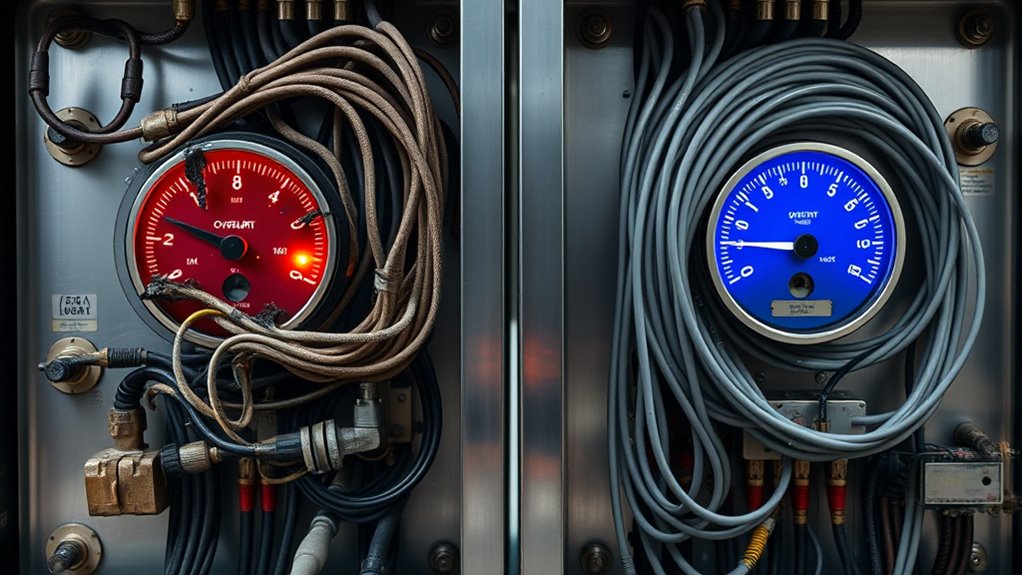
Exploring overload protection mechanisms reveals their essential role in safeguarding electrical systems. They guarantee that the current to flow stays within safe limits under varying conditions. When the current exceeds 120%-160% of the rated capacity, these mechanisms trip the circuit, protecting your power sources and equipment from damage.
Here’s how they work:
- Thermal-magnetic circuit breakers: These devices utilize thermal protection for prolonged overloads and magnetic tripping for instantaneous overcurrent conditions.
- Slow-blow circuit breakers: Designed to handle brief current surges while protecting against sustained overloads, perfect for motors.
- Overload relays Are Adjustable to specific settings based on the equipment’s rated current, tailoring protection to the load’s demands.
- Regular testing and maintenance: Essential to guarantee reliability and prevent overheating or equipment damage by confirming proper operation.
Defining Overvoltage and Its Effects
When the voltage supplied to your electrical system exceeds the safe threshold, you encounter overvoltage, a condition that can lead to significant issues. With your equipment
Overvoltage occurs when the supply voltage surpasses 110% of what your devices can handle. For example, if a 230 V AC appliance receives more than 250 V, it risks overheating and insulation failure, which can cause equipment malfunction or damage.
Overvoltage can result from lightning strikes, switching surges, or insulation failures in electrical systems.
To mitigate these effects, consider implementing protective measures. Devices such as voltage-dependent resistors (VDRs), avalanche diodes, and gas discharge valves can manage voltage spikes, thereby safeguarding your equipment.
Ensuring effective overvoltage protection is crucial for maintaining the operational integrity of your devices and preventing costly repairs or replacements.
Examining Overvoltage Protection Strategies
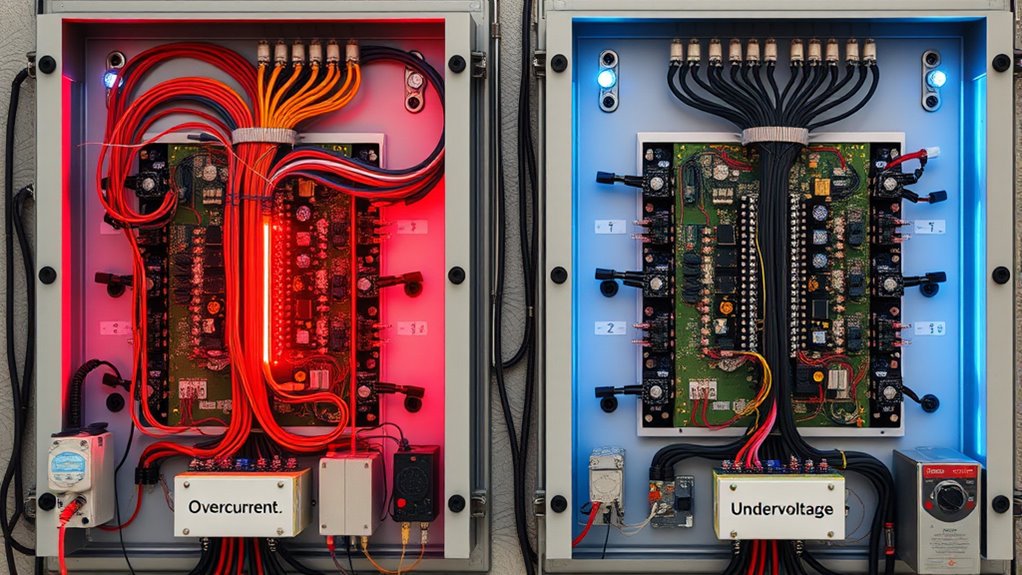
When protecting your equipment from overvoltage, consider effective measures such as voltage-dependent resistors (VDRs) and surge protectors.
These devices work by absorbing and redirecting excess voltage to keep your systems safe from spikes.
Regularly maintaining and testing these protective systems guarantees they respond swiftly to transient events, minimizing the risk of damage.
Overvoltage Protective Measures
Although overvoltage conditions can pose significant risks to electrical systems, implementing effective protective measures can mitigate these threats.
By integrating protective devices, you can safeguard against voltage spikes that might otherwise damage sensitive components.
Consider these essential strategies:
- Voltage Dependent Resistors (VDRs): These devices help absorb excess energy during overvoltage events.
- Gas Discharge Valves: They provide a path for current to bypass critical equipment safely, ensuring its protection.
- Lightning Rods: Essential for redirecting voltage spikes caused by lightning strikes away from your systems.
- Arcing Horns: Used on transmission lines to manage excess voltage and maintain operational integrity.
Voltage Spike Mitigation Techniques
Protecting electrical systems from overvoltage conditions involves more than just installing protective devices; it requires a strategic approach to managing voltage spikes effectively.
Overvoltage protection strategies include using voltage-dependent resistors (VDRs) and gas discharge valves to clamp spikes, thereby preventing damage to sensitive electrical equipment.
Implement surge protective devices (SPDs) to absorb and redirect excess energy, safeguarding electronics from transient spikes that could lead to electrical equipment failures.
Lightning rods offer passive protection, diverting strikes to the ground and minimizing surges in buildings.
Arcing horns can be installed on power lines and transformers, providing a low-resistance path for excess current during spikes, thereby preventing voltage drops.
Regular maintenance and testing ensure these systems operate reliably, preventing catastrophic disruptions.
Distinguishing Undervoltage Scenarios
If you’ve ever experienced electrical issues at home or work, you know how problematic undervoltage can be. It occurs when the voltage falls below 90% of the nominal level, which can lead to equipment malfunctions.
Unlike overcurrent, which involves excessive current draw, undervoltage can sneak up unexpectedly due to:
- Overloaded power sources
- Voltage drops in long transmission lines
- Sudden load demand increases
- Continuous operational challenges
In AC induction motors, undervoltage can result in excessive current draw, leading to overheating and potential damage.
To protect your equipment, protective relays, like the undervoltage relay (27), are vital. They detect low voltage and automatically disconnect affected devices to prevent damage.
Continuous undervoltage can significantly impact efficiency, particularly in sensitive equipment such as generators and motors. Identifying these scenarios guarantees you’re ready to tackle them effectively.
Conclusion
You’ve now got a solid grasp of how overcurrent and undervoltage can impact your electrical systems. Overcurrent, with its risks of overheating and damage, requires robust protection, such as circuit breakers and fuses. Undervoltage, on the other hand, can cause operational hiccups and increased current draw, especially in motors. By implementing appropriate protective measures for both conditions, you guarantee your systems run smoothly and safely, minimizing potential failures and maintaining operational integrity.
FAQs
1. What Is Overcurrent and Undervoltage?
You’re dealing with overcurrent when a circuit’s current surpasses its capacity, risking damage. Undervoltagoccurs when the voltage drops below a safe level, resulting in instability. Protect circuits with breakers and relays to maintain safe electrical conditions.
2. What Is the Difference Between Overcurrent and Undercurrent?
When comparing overcurrent and undercurrent, remember that overcurrent involves excessive current flow, which can cause potential damage, while undercurrent is less common, indicating an insufficient current that affects device performance. Recognize their distinct impacts to guarantee proper electrical system protection.
3. What Is Considered Undervoltage?
You consider undervoltage as a drop in supply voltage below 90% of the nominal level. For instance, if your 230V appliance receives less than 207V, it’s experiencing undervoltage, which can lead to operational issues and potential equipment damage.
4. What Is the Main Difference Between Overload and Overcurrent?
You need to know that overload is a specific type of overcurrent where devices draw more current than they’re rated for. Overcurrent includes any excess current, like short circuits, not just prolonged overloads.