Working Principle of Pv Cell | A Complete Overview
Imagine exploring the intriguing world of photovoltaic cells, where sunlight is transformed into electricity. At the heart of this process is the photovoltaic effect, a phenomenon that energizes electrons in silicon, the primary material used in these cells. As photons strike, they create electron-hole pairs, setting the stage for the generation of electricity. The interplay of light, temperature, and material properties holds secrets waiting to be uncovered, offering you insights into harnessing solar power efficiently.
Key Takeaways
- Photovoltaic cells convert sunlight into electricity using the photovoltaic effect in semiconductor materials.
- Photons energize electrons in the semiconductor, creating electron-hole pairs necessary for current flow.
- The p-n junction separates charges, enabling efficient electron flow to metal contacts and generating electricity.
- Light absorption efficiency is enhanced by anti-reflective coatings, which reduce reflection and increase the capture of photons.
- The cell’s efficiency is influenced by light intensity, temperature, and the quality of the semiconductor material.
Structure and Components of Photovoltaic Cells

When exploring photovoltaic (PV) cells, you’ll find that they’re primarily constructed from semiconductor materials, with silicon being the most prevalent.
These cells feature a critical p-n junction formed by doping silicon with impurities. The structure comprises an emitter layer of n-type silicon, which provides extra electrons, and a base layer of p-type silicon, which creates holes.
To improve light absorption, an anti-reflective coating is applied, minimizing sunlight reflection.
Metal contacts are essential because they collect electrons, facilitating the flow of electric current. The front contact allows light to enter, while the back contact ensures current conduction.
A back surface field (BSF) further enhances charge collection efficiency. Together, these components create a highly efficient system, maximizing the energy captured by photovoltaic cells.
The Photovoltaic Effect: Basics and Mechanism
The photovoltaic effect converts light into electricity through the unique properties of semiconductor materials, such as silicon. When photons hit the photovoltaic cell, they energize electrons in the semiconductor, creating mobile charge carriers.
The p-n junction, with its built-in electric field, separates these charge carriers: electrons head to the n-type layer, while holes move to the p-type layer. This separation generates an electric current, which can be used when the cell is connected to a circuit.
Factors such as light intensity, temperature, and semiconductor quality impact energy and conversion efficiency.
Key points:
- The photovoltaic effect utilizes semiconductor properties.
- Photons initiate charge carrier movement.
- P-n junction directs electrons and holes.
- Electric current is produced for external use.
- Efficiency hinges on external conditions and material quality.
Light Absorption and Electron-Hole Pair Generation
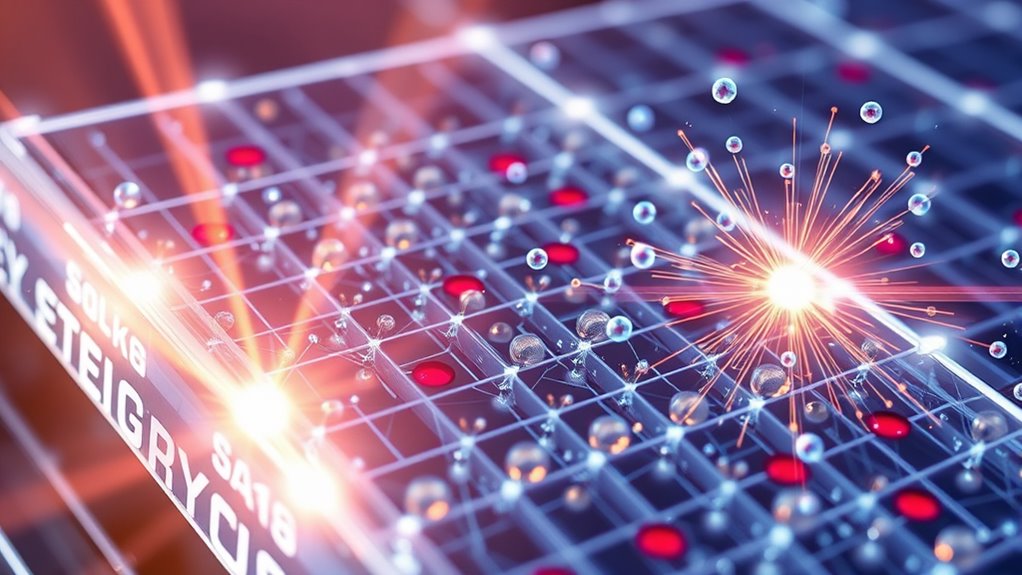
As sunlight streams onto a photovoltaic cell, energy transfer occurs, freeing electrons from their atomic bonds within the semiconductor material. When photons hit the silicon, they cause light absorption, creating electron-hole pairs essential for electric current flow.
The semiconductor’s p-n junction plays a crucial role by utilizing its electric field to separate these pairs, thereby enhancing efficiency by preventing recombination. The efficiency of this process hinges on the properties of the semiconductor material, with monocrystalline silicon outperforming polycrystalline or thin-film types.
Under ideal conditions, these cells generate a substantial number of electron-hole pairs, resulting in a maximum open-circuit voltage of approximately 0.7 V. Ultimately, effective light absorption and pair generation are fundamental to the photovoltaic cell’s performance.
Charge Separation and Current Flow
Now that electron-hole pairs are generated, the photovoltaic cell relies on efficient charge separation to convert sunlight into usable electricity.
The p-n junction in the semiconductor material creates an internal electric field. This field pushes electrons toward the n-type layer and holes toward the p-type layer, ensuring effective charge separation.
As electrons move to the metal contacts on the n-side, an electric current flows once the cell is connected to an external circuit, contributing to the cell’s output power.
Consider these key points:
- Photovoltaic cells depend on the p-n junction for charge separation.
- The internal electric field separates electrons and holes.
- Electric current flows when electrons reach the metal contacts.
- Output power is tied to successful current flow.
- Light intensity impacts the efficiency of this process.
Influence of Temperature and Light Intensity on Performance
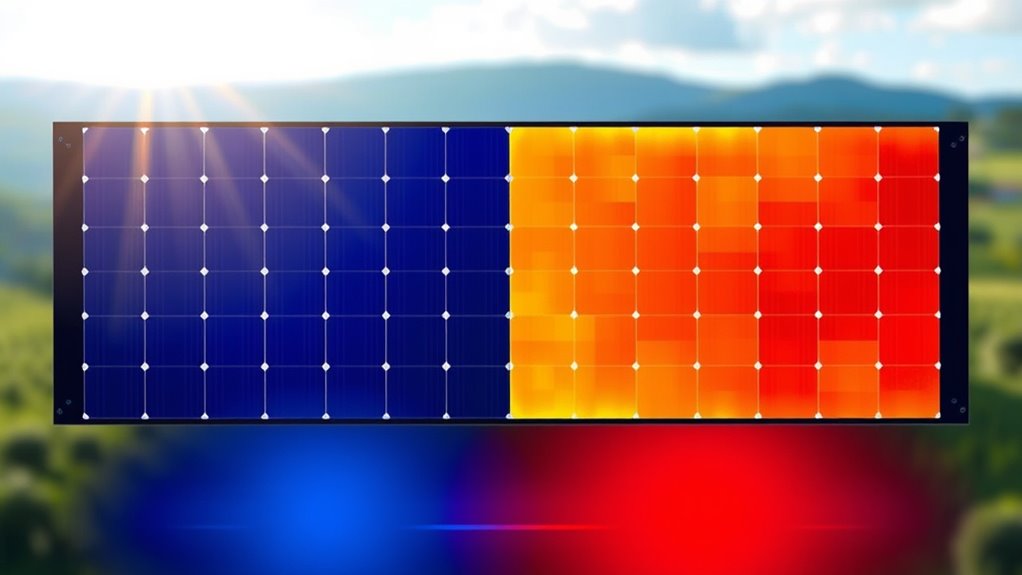
When considering the performance of photovoltaic cells, temperature and light intensity play essential roles in determining their efficiency. As temperature rises, the efficiency of PV cells typically declines, affecting power output. Expect a drop of about 0.4% to 0.5% per °C, which can considerably impact current generation in hot conditions.
Light intensity is equally vital; under standard solar irradiance of 1000 W/m², PV cells achieve maximum power output. However, lower light intensities, such as those on cloudy days, reduce voltage and energy conversion efficiency. While the relationship between light intensity and output current is mostly linear, it might saturate at high intensities.
Among PV cells, monocrystalline types often boast better performance and efficiency in varying temperature and light conditions.
Electrical Characteristics and Efficiency Metrics
Understanding the electrical characteristics and efficiency metrics of photovoltaic (PV) cells is essential for enhancing solar power systems.
You’ll want to focus on these key aspects:
- Efficiency typically ranges from 15% to 25%, with high-end monocrystalline cells reaching 26.6% efficiency under ideal conditions.
- Open-circuit voltage (Voc): For silicon-based solar cells, it usually exceeds 0.7 V.
- Short-circuit current (Isc): Can reach up to 9.75A, indicating the maximum current generated.
- Fill factor (FF): Represents the ratio of maximum power output to Voc and Isc, typically between 0.7 and 0.85.
- Temperature coefficient: Performance decreases by 0.2% to 0.5% per degree Celsius increase.
Maximizing efficiency involves tracking the maximum power point (MPP) to guarantee the system operates at peak performance despite varying conditions.
Advanced Technologies and Innovations in PV Cells
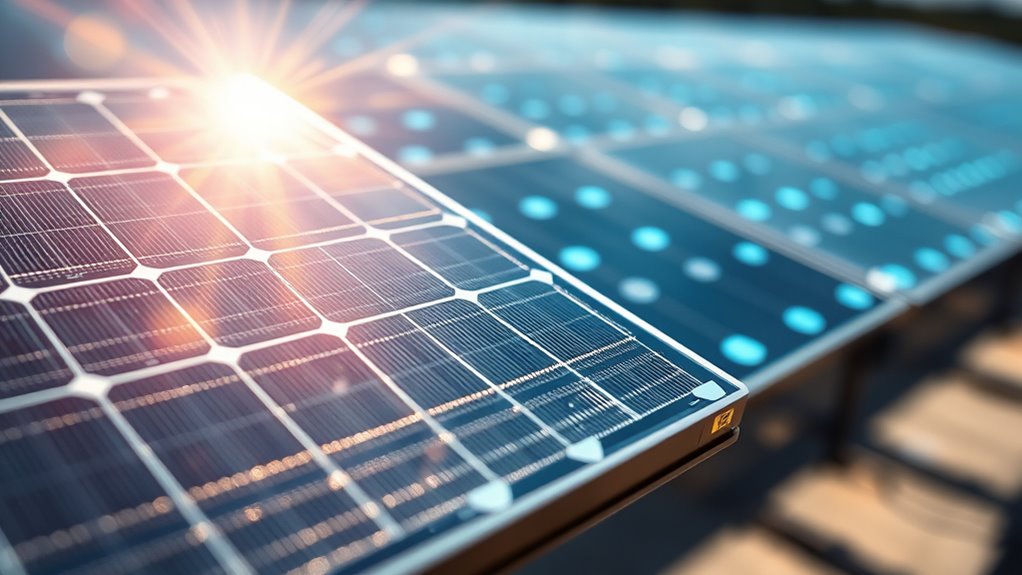
You’re about to explore exciting advancements in PV cell technology, where perovskite cells are pushing boundaries with efficiencies of up to 23.7%.
Multi-junction cells take it further by capturing more sunlight and exceeding 50% efficiency, promising significant power boosts.
Organic photovoltaic innovations, despite their lower efficiency, offer cost-effective and flexible solutions, making them ideal for a wide range of applications.
Perovskite Efficiency Advancements
Although traditional silicon solar cells have long dominated the market, perovskite solar cells are making significant strides in the field of photovoltaic technology due to their remarkable advancements in efficiency.
These cells have achieved efficiencies exceeding 25% in lab settings, showcasing their potential in solar energy conversion. The unique crystal structure enables efficient light absorption and excellent charge carrier mobility, both of which are crucial for achieving high efficiencies. Additionally, they can be produced using low-cost materials, reducing production costs.
Consider these exciting developments:
- Efficiencies exceeding 25% in lab settings
- Efficient light absorption and charge carrier mobility
- Significant reduction in production costs
- Stability improvements, maintaining over 80% initial efficiency
- Tandem configurations with silicon for over 30% efficiency
Perovskite cells hold promise for a bright future in solar energy.
Organic Photovoltaic Innovations
While traditional photovoltaic technologies have made significant strides, organic photovoltaics (OPVs) are emerging as a promising alternative.
You’ll find that OPVs utilize organic materials, achieving lab efficiencies around 10%. Their lightweight and flexibility make them perfect for portable electronics and building-integrated photovoltaics. Thanks to low-cost production, these cells offer economic advantages.
Innovations in charge transport and light absorption have led to the use of non-fullerene acceptors, enhancing performance and stability. Tandem organic cells, which combine organic and inorganic materials, reach efficiencies exceeding 18%, leveraging a broader sunlight spectrum.
Researchers are working on extending operational lifetimes, with some studies showing potential for over 10 years. OPVs represent a significant leap forward in photovoltaic technology.
Multi-Junction Cell Potential
Exploring the potential of multi-junction cells offers a fascinating perspective on the future of photovoltaic technology.
You’ll find that these cells consist of multiple layers of semiconductor materials, each fine-tuned to absorb different wavelengths of sunlight. This setup significantly enhances efficiency compared to single-junction cells.
Multi-junction cells can achieve theoretical efficiency limits of over 50%, with real-world examples hitting around 48% under concentrated sunlight. They utilize a mix of silicon and III-V semiconductors to capture a broader spectrum of light, enhancing energy conversion rates.
- Advanced designs incorporate tandem structures for better efficiency.
- Ideal for high-performance applications, such as space exploration.
- Suited for concentrated solar power systems.
- Optimize energy conversion by stacking cell layers.
- Expand the spectrum of light absorption for maximum output.
Conclusion
You’ve seen how photovoltaic cells convert sunlight into electricity through the photovoltaic effect. Light absorption creates electron-hole pairs, and the cell’s internal electric field separates these charges, generating current. Efficiency can be affected by temperature and light intensity; however, ongoing innovations are continually improving performance. By understanding these principles, you can appreciate the technology’s potential and its evolving role in sustainable energy. As advancements continue, PV cells will become even more integral to our energy solutions.
FAQs
1. What Is the Working Principle of Photovoltaic Cells?
You’ll find that photovoltaic cells convert light into electricity through the photovoltaic effect. They create electron-hole pairs in silicon, separate charges via an electric field, and generate direct current, achieving over 20% efficiency under sunlight.
2. How Do PV Cells Work Step by Step?
You’re curious about PV cells. First, they absorb sunlight, energizing electrons. Then, the electric field separates electron-hole pairs. Electrons flow to the metal contacts, creating an electric current. Finally, this current powers devices or charges batteries.
3. What Is the Basic Principle of a Solar PV System?
You harness sunlight using a solar PV system based on the photovoltaic effect. Sunlight excites electrons in the semiconductor, creating an electric current when connected to a circuit, providing a renewable energy source for various applications.
4. What Is the Working Principle of Photovoltaic Cells? PDF?
You’d explore a PDF detailing the working principle of photovoltaic cells, focusing on how they convert sunlight into electricity. It’d explain electron movement in semiconductor materials, describing key factors like efficiency, voltage, and current impacts.