Function of a Stator in Electrical Machines
Imagine you’re exploring the fascinating world of electrical machines, where the stator plays a pivotal role in transforming electrical energy into mechanical motion. This stationary component generates a rotating magnetic field, working hand-in-hand with the rotor to create the motion you see. But what’s the magic behind its operation, and how does it achieve such high efficiency? There’s more to uncover about this essential component of modern technology.
Key Takeaways
- Stators produce a rotating magnetic field that interacts with the rotor, generating mechanical motion.
- They transform electrical energy into mechanical motion via electromagnetic induction and alternating current.
- Laminated electrical steel sheets in stators minimize energy losses and boost efficiency.
- Stators are vital for generating torque and performance in industrial machinery.
- Advanced stator designs in renewable energy systems enhance efficient energy conversion.
Definition and Role of a Stator
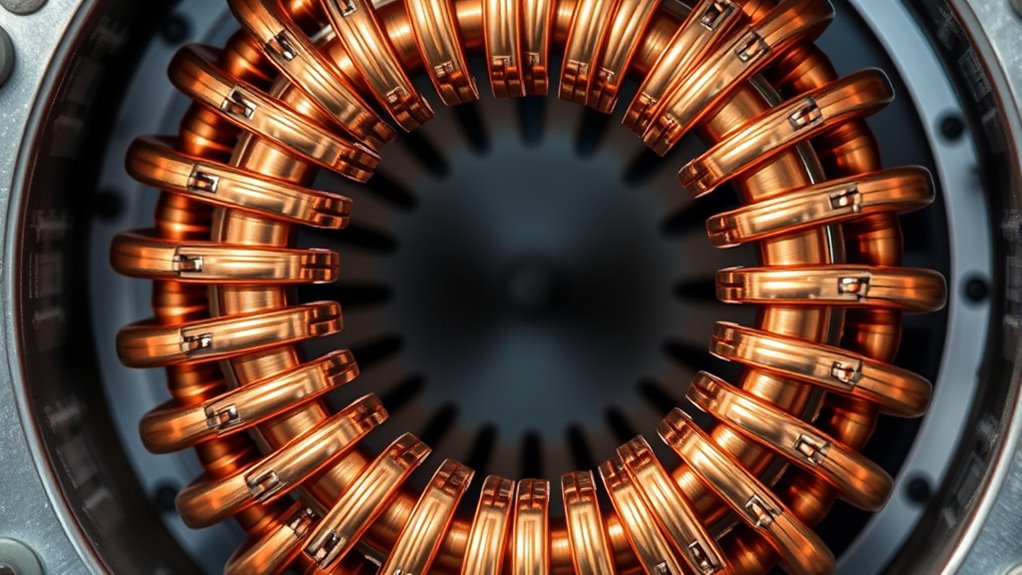
The stator, a crucial component of any electric machine, remains stationary while performing its primary function of generating a rotating magnetic field. This magnetic field interacts with the rotor, generating mechanical motion.
You’ll find that the stator’s design, made of laminated electrical steel sheets, is critical for minimizing energy losses and enhancing efficiency. When connected to an AC power source, the insulated copper or aluminum windings within the stator generate the necessary magnetic field to keep the system moving smoothly.
Its efficiency can reach up to 95%, markedly influencing the electric machine’s overall performance. Proper insulation and cooling systems in the stator are essential, preventing overheating and ensuring reliability.
The stator’s role is indispensable, as it maximizes efficiency and ensures the longevity of your machine.
Historical Development of Stators
Even though the concept of electromagnetism predates modern technology, the historical development of stators truly began with Michael Faraday’s groundbreaking experiments.
In 1821, Faraday’s discovery of electromagnetic induction paved the way for the practical application of stators in electric motors. This pivotal moment enabled early inventors, such as William Sturgeon, to create some of the first electromagnetic motors, underscoring the crucial role of stators in electric machinery.
As time progressed, the evolution of stator technology saw remarkable advancements in materials and designs, boosting efficiency and performance.
Core Components of a Stator

Understanding the core components of a stator is crucial for comprehending how electric machines operate. At the heart of the stator is the core, made from laminated electrical steel sheets. These laminations reduce energy losses from eddy currents, boosting efficiency. The windings, typically insulated copper or aluminum wires, are vital to performance. They’re carefully arranged in slots within the core to optimize magnetic field generation. Advanced insulation materials protect these windings from electrical short circuits and mechanical stress, ensuring durability.
To maintain performance, effective cooling systems are non-negotiable. Whether using air, water, or oil, cooling helps keep the stator from overheating, thereby enhancing its longevity.
| Component | Function |
|---|---|
| Core | Minimizes energy losses and enhances efficiency |
| Windings | Influences performance and generates magnetic fields |
| Cooling | Dissipates heat to maintain performance and longevity |
Electromagnetic Principles in Stator Functionality
When you plunge into the electromagnetic principles of a stator, you’ll uncover how it transforms electrical energy into mechanical motion. The stator operates on electromagnetic induction, where alternating current (AC) flows through its windings, creating a rotating magnetic field.
This magnetic field is essential for interacting with the rotor, leading to an induced electromotive force (emf) that generates torque, driving the motor’s rotation.
Faraday’s Law of Electromagnetic Induction explains this process: a changing magnetic field within a coil induces a current, which is fundamental to the stator’s function in both motors and generators.
The stator’s core, made from laminated silicon steel, minimizes energy loss due to eddy currents, thereby boosting efficiency. Properly insulated windings maintain the integrity of the electromagnetic field, preventing short circuits that can occur under high voltage.
Technological Advancements in Stator Design
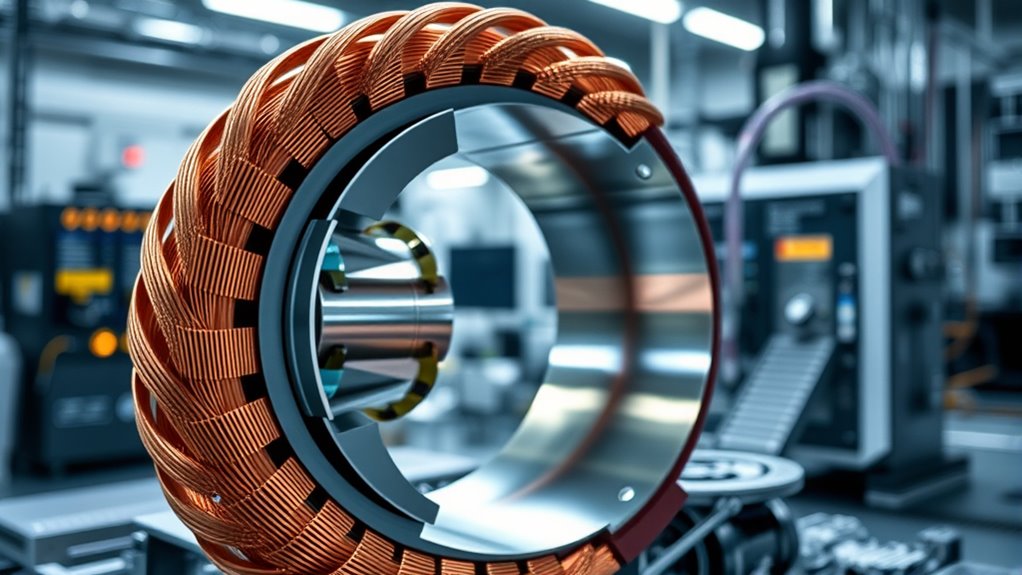
As technology advances, the design of stators in electrical machines is undergoing a significant transformation, with a focus on enhancing efficiency and sustainability.
You’re now seeing technological advancements like PCB Stator Technology, which utilizes conventional PCB materials to enhance energy efficiency, achieving impressive mid-90s efficiency levels.
The introduction of high-performance materials, such as amorphous steel and nanocrystalline alloys, cuts core losses and enhances magnetic properties.
With 3D printing, you can achieve greater precision in stator designs, thereby slashing production costs and customizing solutions to meet specific needs.
Innovations in insulation materials have enhanced stator durability, enabling them to withstand higher thermal and electrical stress.
Additionally, PrintStator software enables engineers to optimize designs by simulating and refining configurations for peak performance before production begins.
Stator Types and Classifications
When exploring stator types, you’ll notice variations in their physical construction, such as salient pole and cylindrical designs, each suited for different speed applications.
You can also examine the winding arrangement options, such as concentrated and distributed windings, which significantly impact the motor’s performance.
Understanding these classifications helps you select the appropriate stator for your specific electrical machine needs.
Physical Construction Variations
Although stators serve the fundamental role of housing the windings and providing a magnetic path in electrical machines, their physical construction can greatly vary, leading to different classifications.
You’ll find stator cores often utilize laminated construction to minimize energy losses from eddy currents, enhancing machine efficiency.
Stators are classified into two main designs: salient pole and cylindrical. Salient pole stators, with their prominent poles, excel in low-speed applications, while cylindrical ones are ideal for high-speed operations.
Additionally, AC machine stators typically feature cylindrical tubes with coil slots, whereas DC machines have cylindrical steel armatures with internal pole pieces.
The choice of stator construction not only affects efficiency but also influences torque generation and operational speed in electric motors and generators.
Winding Arrangement Options
While stators in electrical machines play a crucial role in housing windings and providing a magnetic path, their winding arrangements offer distinct classifications that impact performance. You can choose between concentrated windings, where coils occupy limited space and are ideal for high torque at low speeds, and distributed windings, which spread the coils over multiple slots and are suited for high-speed operations. This choice affects efficiency, performance, and even manufacturing complexity.
Here’s a quick comparison:
| Winding Arrangement | Characteristics |
|---|---|
| Concentrated Windings | High torque, low speed, simpler design |
| Distributed Windings | Uniform field, high speed, smooth run |
Concentrated windings simplify the design and reduce material usage, while distributed windings provide smoother operation and lower cogging torque, thereby enhancing overall performance. Choose wisely based on your application needs.
Applications of Stators in Electric Motors
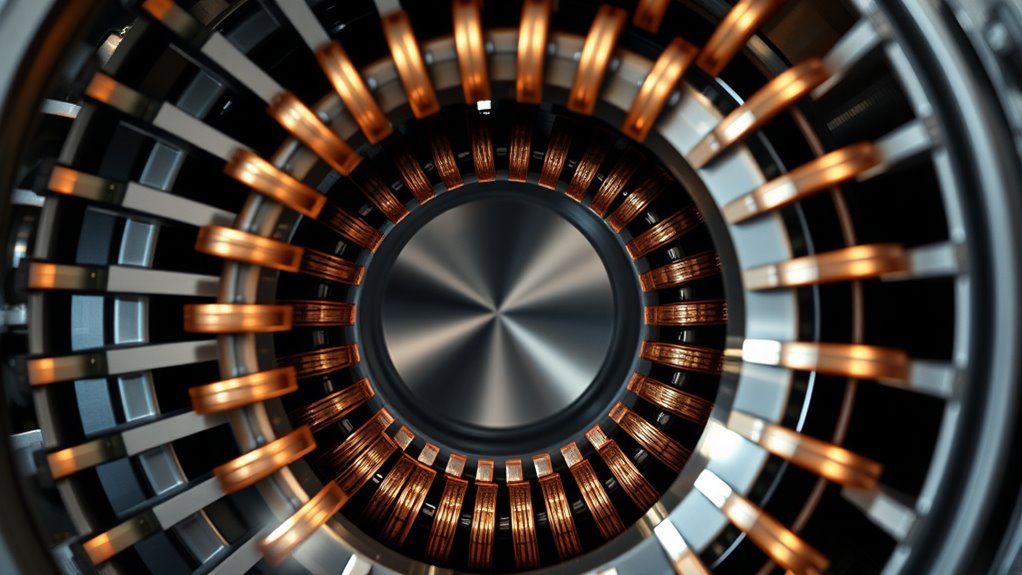
When considering the role of stators in electric motors, consider how they enhance efficiency in electric vehicles, enabling longer drives with reduced energy consumption.
In industrial settings, stators precisely drive machinery, ensuring peak performance and lower operational costs.
They’re also a key component in renewable energy systems, helping to convert wind and solar power into reliable electricity with minimal losses.
Electric Vehicle Efficiency
In the domain of electric vehicles, the stator’s design plays a pivotal role in enhancing efficiency and performance. Stators generate rotating electromagnetic fields, producing the torque needed for propulsion. This directly impacts electric vehicle efficiency by optimizing energy consumption.
With advanced stator designs, like high-efficiency windings, you can enjoy longer driving ranges. PCB stator technology integration has pushed efficiency levels into the mid-90s, greatly reducing energy consumption and enhancing sustainability.
Additionally, stators minimize energy losses and maintain performance consistency with optimized cooling systems. The quality of stator design affects motor characteristics, influencing acceleration and responsiveness.
Industrial Machinery Performance
Because stators are pivotal in generating rotating magnetic fields, they’re directly responsible for the torque and performance of industrial machinery.
High-efficiency stator designs can achieve over 90% efficiency, enhancing the operational performance of your industrial equipment while reducing energy consumption. By using advanced materials like laminated silicon steel, stators greatly reduce energy losses through heat, ensuring your machinery runs reliably and efficiently.
A customized stator design can be tailored to fit specific operational needs, whether it’s for conveyor systems or robotic arms, optimizing performance across diverse applications.
Regular maintenance is key—keeping your stators in top condition prevents issues like overheating and insulation failure, ultimately extending the lifespan and maintaining the efficiency of your electric motors in industrial settings.
Renewable Energy Systems
Although often overlooked, stators play a crucial role in renewable energy systems, ensuring efficient energy conversion and enhancing overall system performance.
In wind turbines, stators generate the rotating magnetic field fundamental for transforming mechanical energy from the wind into electrical energy. This conversion is critical for harnessing wind power effectively.
In solar inverters, stators convert the direct current (DC) from photovoltaic cells into alternating current (AC), making it suitable for the electrical grid. The efficiency of stators in these applications often exceeds 90%, optimizing energy conversion.
Advanced designs using materials like amorphous steel reduce energy losses, improving thermal management and system sustainability.
In electric vehicles, stators enable efficient energy transfer from battery storage to electric motors, promoting sustainability in transportation.
Impact of Stators on Energy Efficiency
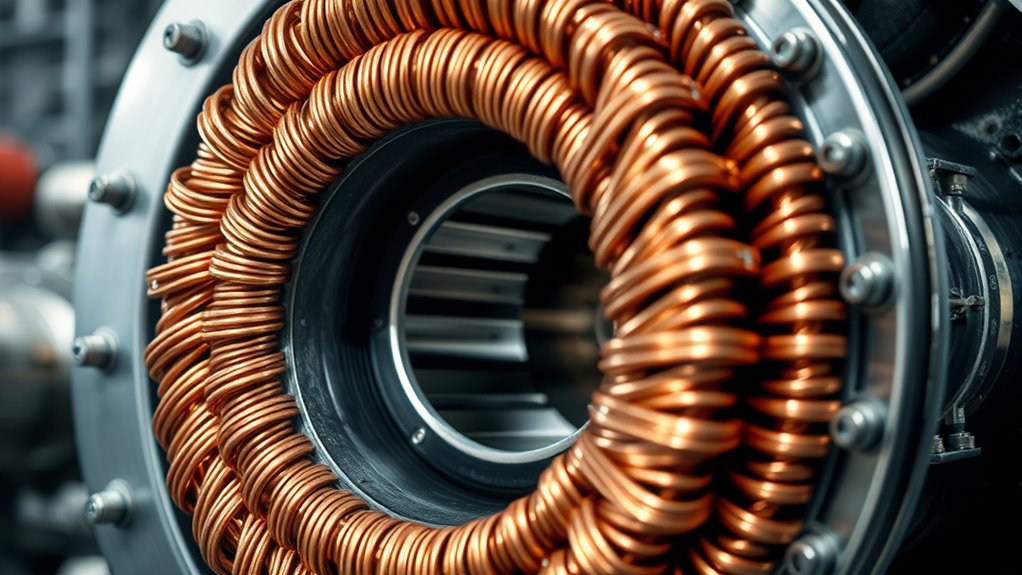
By generating a rotating magnetic field, stators play a pivotal role in boosting energy efficiency within electrical machines. They optimize interaction with the rotor, minimizing energy losses during conversion processes.
You can see significant enhancements with advanced stator designs using laminated silicon steel and high-performance insulation materials, which reduce core losses by up to 30%.
To maximize efficiency, consider these innovations:
- PCB Stator Technology: Achieve lightweight designs with energy efficiency levels in the mid-90s.
- Customized Stator Designs: Tailor them to specific applications to maximize energy utilization and cut operational costs.
- Regular Maintenance: Monitor for overheating and check insulation integrity to sustain high efficiency and extend machine life.
Common Issues and Solutions in Stator Operation
When operating electrical machines, encountering issues with stators isn’t uncommon, yet being proactive can considerably minimize disruptions.
Overheating is a common problem, often caused by excessive current, inadequate cooling, or poor ventilation. This can lead to insulation failure, causing short circuits and efficiency loss. To combat overheating, consider implementing advanced cooling systems, such as liquid cooling, which can significantly enhance stator longevity under high-load conditions.
Insulation failure also occurs due to thermal degradation, electrical stress, or mechanical damage. Regular maintenance is key to preventing mechanical wear caused by continuous operation, vibrations, or misalignment.
Additionally, use sensors to monitor temperature and vibration levels. These measures facilitate the early detection of potential issues, enabling timely maintenance and enhancing operational reliability.
Future Trends in Stator Technology
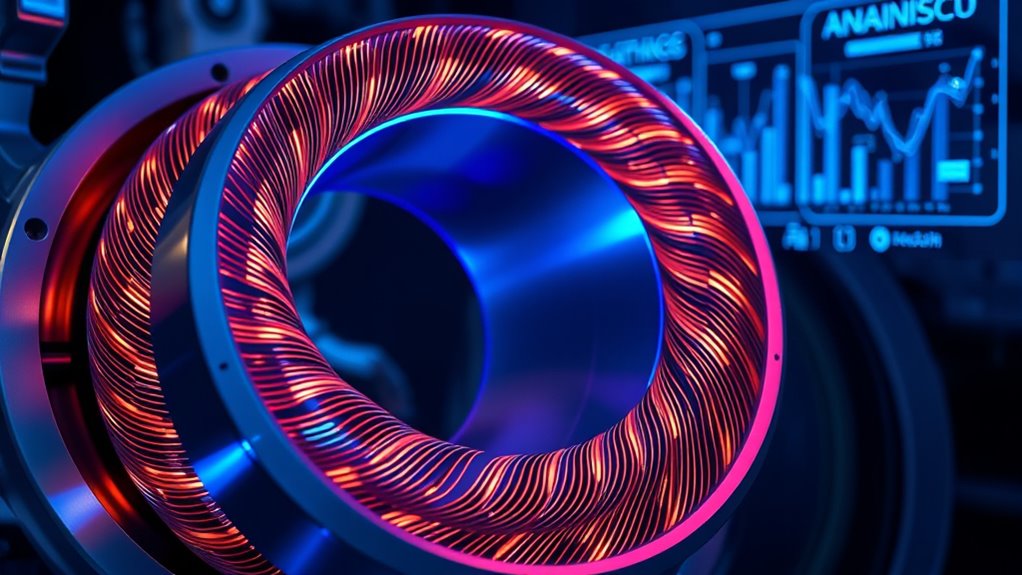
You’re about to witness exciting developments in stator technology, with a strong focus on sustainability and advanced materials.
PCB Stators promise to cut raw material use by up to 80%, aligning with green goals, while new materials like amorphous steel boost efficiency.
These innovations not only enhance performance but also reduce costs, setting the stage for a more efficient and sustainable future in electrical machines.
Sustainable Stator Innovations
As the electric motor industry evolves, sustainable stator innovations are at the forefront of transforming our approach to energy efficiency and resource conservation.
You’ll find high-efficiency electric motors benefiting from PCB Stators, which slash raw material usage by up to 80%. This technology considerably reduces energy losses due to its streamlined design.
Furthermore, the PrintStator software plays a pivotal role in optimizing stator designs, ensuring peak efficiency. By embracing these advancements, carbon footprints shrink, and energy consumption drops.
Here are three key points to reflect on:
- Efficiency Boost: Innovations now push efficiency into the mid-90s range.
- Resource Savings: PCB Stators drastically cut down raw material needs.
- Educational Support: Resources are available to help you adopt these technologies.
Advanced Material Applications
Building on the momentum of sustainable innovations, advanced material applications are reshaping the future of stator technology.
You’re seeing a rise in the use of advanced materials, such as amorphous steel and nanocrystalline alloys, which minimize energy losses and enhance magnetic performance, particularly in high-frequency applications.
Composite materials are becoming increasingly essential due to their high strength-to-weight ratios, making them ideal for use in electric vehicles.
Innovations in insulation materials, particularly advanced polymers, are enhancing thermal resistance and mechanical strength, extending stator longevity.
PCB Stator Technology is optimizing designs, slashing raw material usage by up to 80% while maintaining efficiency.
Additionally, with 3D printing, you gain design flexibility and precision, enabling the creation of complex geometries that enhance cooling and performance.
These trends are revolutionizing stator technology.
Conclusion
In understanding stators, you’ve explored their pivotal role in transforming electrical energy into mechanical motion with impressive efficiency. By examining their historical development, core components, and electromagnetic principles, you’ve gained insight into how they’ve evolved and continue to advance. Stators not only enhance energy efficiency but also drive innovation in electric motors. As technology progresses, you’ll witness even greater strides in stator design, ensuring their continued impact across various applications and industries.
FAQs
1. What Is the Main Function of the Stator?
You need to know that the stator’s main function is to generate a rotating magnetic field with AC in its windings. This action is crucial for electric motors and generators, as it significantly impacts efficiency and performance by interacting with the rotor.
2. What Is the Job of a Stator?
You need to understand that the stator’s job is to create a rotating magnetic field by using AC. This field induces motion in the rotor, converting electrical energy into mechanical energy, which is essential for motor operation.
3. What Is the Stator of an Electric Machine?
You’re asking about the stator, which is the stationary part of an electric machine. It includes a core and windings that create a magnetic field, essential for converting electrical energy into mechanical power in motors and generators.
4. What Is the Difference Between a Rotor and a Stator?
You know the rotor spins, converting electrical energy into motion, while the stator stays put, creating a rotating magnetic field. The rotor involves less insulation, but the stator’s cooling system is more efficient and easier to maintain.