Advantages of Using a Compound Generator
When you think about the benefits of using a compound generator, you’ll discover that its superior voltage stability, efficient load handling, and magnetic field compensation mechanisms make it a standout choice. These features guarantee a reliable power supply for sensitive equipment and critical operations. Additionally, its versatile applications across various industries showcase its flexibility and reliability. But what truly distinguishes a compound generator, especially regarding minimized voltage fluctuations and ease of maintenance? Let’s delve into how these advantages can impact your operations and why this type of generator might be the best choice.
Key Takeaways
- Compound generators provide stable voltage output under varying load conditions.
- They enhance load-handling efficiency through combined parallel and series windings.
- Magnetic field compensation maintains consistent output voltage despite load changes.
- They are suitable for sensitive equipment requiring minimal voltage fluctuations.
- Maintenance is straightforward, ensuring reliability and a long operational lifespan.
Voltage Stability
Regarding voltage stability, compound generators outperform series or shunt generators by a large margin. The secret to this superior performance lies in their unique design, which combines parallel and series windings in the field circuit. This combination is key to maintaining constant voltage output across various load conditions.
The series winding works alongside a parallel winding to adjust the field current automatically, ensuring the voltage remains stable even when the load fluctuates. This automatic adjustment is particularly beneficial in cumulatively compiled generators, which excel at stabilizing voltage under varying loads.
You won’t have to worry about significant voltage drops when the load increases, as these generators are designed to counteract such changes effectively.
Although all generators experience some fluctuations, compound generators provide a more stable voltage output from no-load to full-load conditions. This is achieved through a balanced magnetic field, a direct result of their smart design.
Load Handling Efficiency
Load-handling effectiveness in compound generators is one of their standout features, thanks to the smart interplay between parallel and series windings. You’ll find that compound generators maintain a stable voltage output even when dealing with varying loads. This is essential for efficient operation, especially in applications where the load changes frequently.
The combination of parallel and series field windings is vital to managing these load changes effectively. Parallel (or shunt) windings help maintain a consistent voltage, while series windings adjust to the fluctuating load by increasing the series field current. This cumulative effect boosts the generator’s ability to handle increased load without compromising performance.
When load changes occur, compound generators excel by balancing magnetic field strengths. This means steady voltage output regardless of load conditions, which contrasts sharply with single-winding generators, which often struggle to maintain efficiency under varying loads.
With compound generators, you’re looking at improved efficiency and reliability in handling different load conditions.
Magnetic Field Compensation

Magnetic field compensation in compound generators is pivotal in stabilizing output voltage. By effectively managing magnetic fields, these generators guarantee that the output voltage remains nearly constant, even when load conditions vary. You’ll find that cumulatively compounded generators are particularly adept at this, as they increase the series field current with load changes, helping maintain voltage fluctuations.
The proper design of compound generators allows for adjustments in the magnetic field strength, which is key to sustaining a stable output voltage. When the load on the generator changes, the compensation mechanism kicks in, adjusting the magnetic fields to counteract any potential voltage drop or rise. This reliability is one of the standout benefits of using compound generators.
Here’s a quick overview to illustrate how magnetic field compensation works:
| Load Condition | Series Field Current | Output Voltage |
|---|---|---|
| Low Load | Low | Stable |
| Medium Load | Medium | Stable |
| High Load | High | Stable |
As you can see, despite varying load conditions, the output voltage remains stable due to the adjustments in the series field current.
Versatile Applications
Compound generators are incredibly versatile because they can provide stable voltage output even under varying load conditions. They’re perfect for applications where load fluctuations can otherwise disrupt voltage stability. This makes them indispensable in manufacturing, automotive, and telecommunications, where consistent and reliable voltage is essential.
Stable Voltage Output
Compound generators excel at maintaining stable voltage output by combining series and shunt field windings. This dual-winding setup helps uphold consistent voltage levels, making these generators ideal for various applications where voltage stability is essential. The field winding arrangement in compound generators guarantees that voltage fluctuations are minimized, which is vital for sensitive equipment and machinery.
You might be wondering why stable voltage output is so important. Here are three key reasons:
- Consistency for Sensitive Equipment: Sensitive equipment, like medical devices and precision instruments, rely on stable voltage to function properly. Any fluctuation can lead to malfunctions or inaccuracies, which can be costly or hazardous.
- Industrial Applications: Voltage fluctuations can disrupt operations in industries such as manufacturing and telecommunications, leading to downtime and financial losses. Compound generators’ stable voltage output ensures smooth and reliable operation.
- Reliable Electrical Systems: Consistent voltage means fewer electrical issues and a longer equipment lifespan for any electrical system in a commercial or residential setup. This reliability directly benefits the compound generator’s field winding design.
Load Handling Capability
While preserving stable voltage output is a standout feature of compound generators, their load-handling capacity is equally impressive. These generators can efficiently supply electricity to large motors and heavy electrical devices, making them essential in industrial settings.
Their high-load handling capacity ensures the generator can seamlessly adapt even when power requirements fluctuate, providing a consistent and reliable electricity supply.
If your industry deals with varying loads, you’ll appreciate how compound generators can accommodate these changes without compromising performance. This adaptability is vital for operations that experience frequent surges in power demand. By reducing fluctuations, compound generators help maintain the stability of your electrical systems, which can protect your equipment and minimize downtime.
Furthermore, their versatile load-handling capacity makes them suitable for various applications. Whether you’re powering manufacturing equipment, construction tools, or other heavy-duty machinery, a compound generator delivers the steady power output you need.
This reliability makes them a top choice for any dependable electricity supply application. So, if you’re looking for a generator that can handle diverse and demanding electrical loads, a compound generator is the way to go.
Reduced Voltage Fluctuations
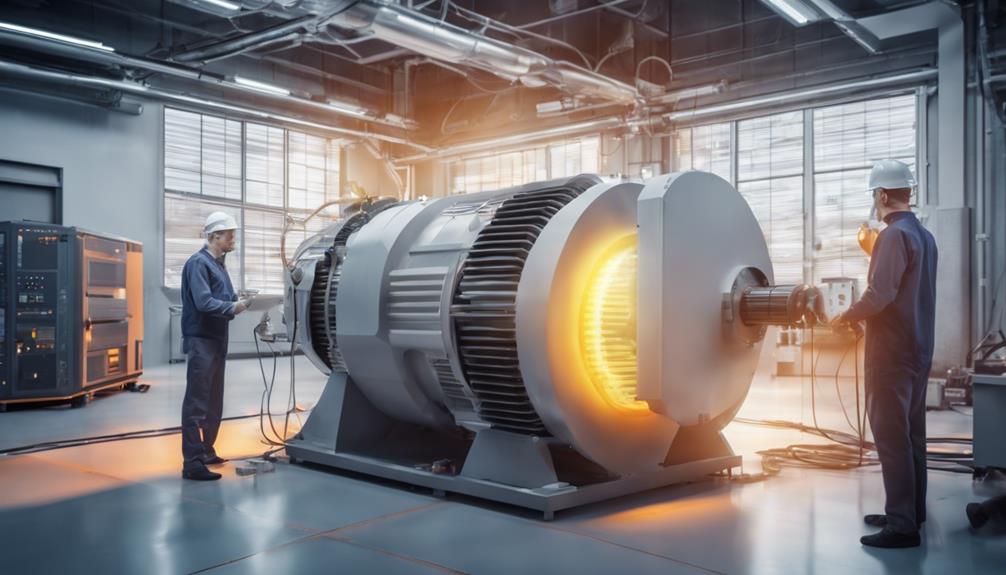
Compound generators offer a significant advantage in reducing voltage fluctuations, thanks to their unique design that combines series and shunt windings. This combination stabilizes the output voltage, guaranteeing that it remains relatively constant from no-load to full-load conditions.
These generators can effectively manage voltage stability by integrating both series and parallel field windings, making them ideal for applications requiring consistent and stable voltage output.
Here are three key ways compound generators achieve reduced voltage fluctuations:
- Balanced Field Windings: The parallel shunt winding and series field winding complement each other, providing a balanced approach to voltage regulation. This synergy helps steady the output voltage, even as the load changes.
- Adaptive Load Response: As the load on the generator increases, the series winding ensures that the output voltage remains stable by adjusting the current through the series field. This adaptability minimizes fluctuations, providing reliable power across varying loads.
- Stable Performance: Compound generators are designed to maintain a consistent output voltage, essential for sensitive equipment and applications that can’t tolerate significant voltage variations.
Cumulatively-Compounded Benefits
Building on the reduced voltage fluctuations discussed earlier, cumulatively-compounded generators offer further advantages by providing stable voltage output under varying loads. This type of generator maintains a consistent voltage level, which is essential for applications requiring reliable performance.
Cumulatively compounded generators increase the series field winding current as the load increases. This mechanism guarantees that the magnetic field strength remains nearly constant, compensating for variations and maintaining a stable voltage output. Properly designed, these generators minimize output voltage fluctuations from no-load to full-load conditions, ensuring your equipment runs smoothly and efficiently.
Here’s a quick overview of the key benefits of cumulatively compounded generators:
| Benefit | Description |
|---|---|
| Stable Voltage Output | Maintains consistent voltage under varying loads. |
| Increased Series Field Current | Adjusts current to sustain a nearly constant magnetic field. |
| Minimized Voltage Fluctuations | Reduces fluctuations from no-load to full-load conditions. |
| Common Applications | Ideal for systems requiring consistent and reliable voltage output. |
Differential-Compounded Usage
Differential-compounded generators are the go-to choice when generators are needed for unique situations requiring specialized magnetic field configurations. These generators create opposing magnetic fields, essential for certain applications. While their usage is limited and they don’t offer stable output voltage, they’re designed for those specific needs where other types won’t work.
Specialized Application Needs
Differentially commutated generators excel in specialized applications where opposing magnetic fields are necessary. They are unique because they incorporate both series and shunt windings, designed to counteract each other’s effects. This intricate design isn’t common and is used for specific needs, making differential-compounded generators a specialized solution in electrical engineering.
Why You Might Need a Differential-Compounded Generator:
- Specialized Output Characteristics: Since the series field and shunt windings diminish each other’s impact, the generator produces unique output characteristics. This is vital in applications where standard voltage stability isn’t required or desired.
- Opposing Magnetic Field Requirements: A differential-compounded generator can meet that need if your application necessitates an environment where opposing magnetic fields are essential. Its design specifically caters to such requirements.
- Limited Application but Targeted Solutions: While not widely discussed due to their limited use, differential-compounded generators provide targeted solutions for niche applications. These generators could be your go-to option when your project has unique electrical requirements.
Opposing Magnetic Fields
Differential-compounded generators stand out due to their unique ability to create opposing magnetic fields, a feature that proves indispensable in specific applications. In these generators, the fields oppose each other’s effects, making them suitable for niche uses where this characteristic is required.
When you look at the design, you’ll notice that the magnetic fields are wound to counteract each other. The generator’s internal workings are intentionally set up to produce opposing fields. While this might seem counterintuitive, it’s precisely what makes these generators valuable in specialized scenarios.
However, one downside is that you won’t achieve output voltage stability with these generators. The opposing fields’ nature means they can’t maintain a steady voltage output, limiting their practical applications.
This instability is why differential-compounded generators aren’t widely discussed or used in general electrical engineering. Despite the lack of voltage stability, they’re tailored for specific tasks where the opposing magnetic fields can be an advantage.
Design Considerations
Designing a compound generator necessitates thoughtful consideration to guarantee peak performance and stable voltage output. Your primary goal is to stabilize voltage under varying load conditions, which is achieved by integrating both series and shunt field windings. Proper design considerations are fundamental to ensure that these windings’ magnetic fields complement each other, maintaining a consistent voltage level.
Here’s what you should focus on:
- Magnetic Field Coordination: Ensure that the series and shunt field windings are designed to work in harmony. This balance minimizes voltage fluctuations as load conditions change. The series field current increases with load for cumulatively compounded generators, balancing the overall magnetic field strengths.
- Load Characteristics: Understand the load characteristics you’re working with. Differential-compounded generators are ideal for specialized applications requiring opposing magnetic fields. Knowing your specific needs will guide you in selecting the appropriate type of compound generator.
- Voltage Regulation: Aim for optimal voltage control without sacrificing efficiency. The right design will help you achieve stable voltage output, essential for reliable performance across various load conditions.
Focusing on these design considerations will help you maximize the advantages of using a compound generator and ensure stable and efficient operation.
Maintenance and Reliability
As you focus on the design aspects of compound generators, paying attention to their maintenance and reliability is equally important. These generators are known for their straightforward construction, which makes maintenance tasks easy and doesn’t require specialized skills. You won’t need to worry about complex procedures; regular checks and routine care are sufficient to keep them running smoothly.
Another significant advantage is reliability. Compound generators provide a constant voltage output, making them ideal for applications with a stable power supply. This reliability means you can count on them for consistent performance, reducing the risk of unexpected downtimes.
Here’s a quick comparison to highlight the ease of maintenance and reliability:
| Aspect | Compound Generators | Other Generators |
|---|---|---|
| Maintenance Complexity | Low | Varies (often higher) |
| Skills Required | Basic | Sometimes specialized |
| Voltage Stability | High (constant output) | Varies |
| Application Suitability | Critical power supply needs | Depends on type |
| Lifespan with Care | Long | Varies |
Compounding generators can have a long operational lifespan with proper care and regular maintenance. Their simple design and reliable performance make them a solid choice for many power generation needs. Focusing on regular upkeep will [GUARANTEE] make them a dependable part of your power system.
Comparison With Other Generators
Comparing different types of generators reveals why compound generators stand out. Compared to series and shunt generators, compound generators offer several advantages, making them a superior choice for many applications.
- Stable Voltage Output: Unlike series generators, which struggle to maintain a steady voltage, compound generators provide a more consistent voltage output. This stability is pivotal for applications where varying loads are common.
- Balanced Benefits: Compound generators combine the best of both worlds. They incorporate the robustness of series generators and the fine control of shunt generators, giving you a harmonized solution that works well in diverse conditions.
- Critical Industrial Use: Because they can maintain stable voltage through the combination of parallel and series field windings, compound generators are ideal for industries where voltage stability is non-negotiable. Think of manufacturing plants or data centers—anywhere reliable power is essential.
Conclusion
When selecting a compound generator, you choose top-notch voltage stability and efficient load handling. Its magnetic field compensation and versatile applications across different industries will benefit you. Decreased voltage fluctuations and reliable performance make it perfect for sensitive equipment. With simple maintenance, you’ll find it a trustworthy choice. Compared to other generators, a compound generator’s design considerations guarantee excellent voltage control and magnetic field coordination, making it a great investment for consistent power output.
FAQs
1. What Is the Advantage of a Compound Wound Generator?
A compound wound generator offers efficiency benefits like stable voltage output under varying loads. It combines the advantages of a series and shunt generator, minimizing voltage fluctuations, making it ideal for applications needing a consistent voltage supply.
2. What Are the Advantages of a Compound Motor?
Compound motors offer a great efficiency comparison. They provide high starting torque and excellent speed regulation. These motors are versatile and ideal for electric vehicles and industrial machinery. They’re reliable under varying load conditions.
3. What Is the Necessity of a Compound Generator?
You need a compound generator for stable voltage output in critical applications. Its regulation methods, with series and shunt field windings, effectively minimize voltage fluctuations, ensuring consistent performance even with load changes.
4. What Is the Disadvantage of a DC Compound Generator?
When considering the disadvantages of a DC compound generator, you’ll notice voltage fluctuations and reduced efficiency compared to other generators. They can’t work with transformers, limiting their versatility. Consider these factors in your comparison.