What Is an Induction Motor? Working, Types, and Applications
When you think of electric motors, you might picture an induction motor, a marvel of engineering that harnesses the power of electromagnetic induction. These motors are everywhere, driving everything from your refrigerator to massive industrial machines. What’s fascinating is the simplicity and elegance of their operation. But what exactly makes these motors so reliable and efficient? There’s more to uncover about their mechanics and applications that might surprise you.
Key Takeaways
- An induction motor generates electromagnetic torque through the interaction of the stator and rotor via a rotating magnetic field.
- The rotor speed of an induction motor always lags behind the stator’s magnetic field due to slip.
- Induction motors are categorized into single-phase and three-phase types, suitable for various power needs.
- Squirrel-cage and slip-ring are the two primary rotor designs in induction motors, impacting their torque characteristics.
- Induction motors are widely used in industrial and household applications due to their efficiency and reliability.
Historical Development and Key Milestones
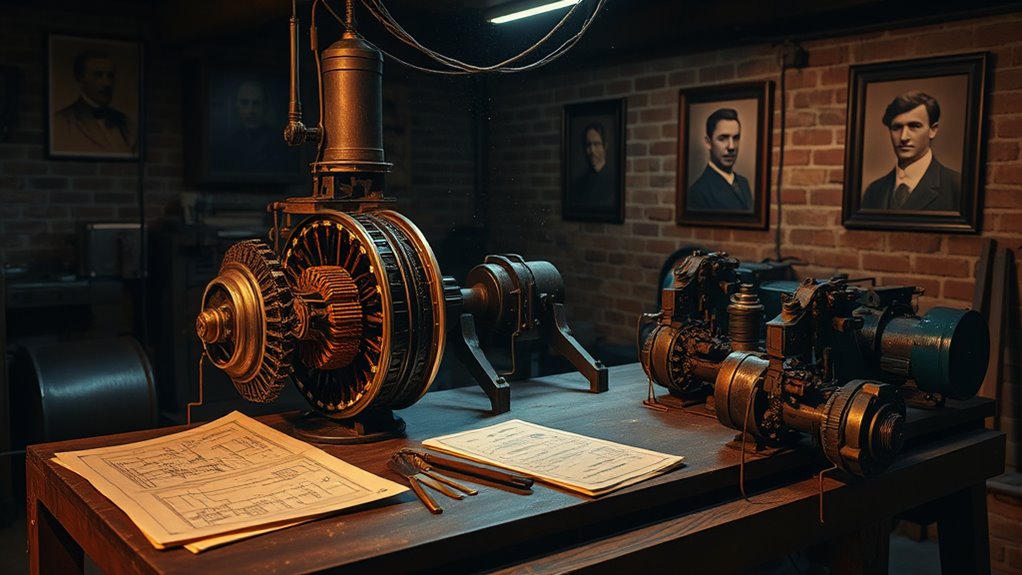
Although the concept of rotating magnetic fields was initially introduced by François Arago in 1824, it wasn’t until 1879 that Walter Baily demonstrated the first primitive induction motor, marking a significant moment in motor technology.
You see, this early innovation laid the foundation for the evolution of electric motors. In 1885, Galileo Ferraris showcased the first AC polyphase induction motor, further advancing the development of these motors.
Nikola Tesla’s 1887 U.S. patents played an essential role in making AC motor systems commercially viable. By 1892, Westinghouse had achieved the first practical induction motor, and a cross-licensing agreement with GE in 1896 solidified the foundation for modern electric motor technology.
Each of these milestones brought induction motors closer to their current form.
Fundamental Working Principle
You’re about to explore how induction motors generate electromagnetic torque through the interaction between the stator and rotor.
When alternating current flows through the stator winding, it creates a rotating magnetic field that induces a current in the rotor.
This induced current produces its magnetic field, and the interaction between these fields generates the torque necessary for the rotor to turn.
Electromagnetic Torque Generation
When delving into the fundamental working principle of electromagnetic torque generation in induction motors, you’ll find that it’s all about the interaction of magnetic fields.
Through electromagnetic induction, the stator’s rotating magnetic field induces currents in the rotor. This interaction generates torque, a force causing the rotor to spin.
The rotor speed, however, always lags behind the stator’s magnetic field due to a phenomenon called slip. This slip is essential for continuous torque generation, ensuring the motor functions efficiently.
The opposing magnetic fields from the stator and rotor solely create torque. Factors like rotor resistance, slip, and motor design play significant roles in determining the overall performance, affecting critical aspects such as starting and breakdown torque.
Stator and Rotor Interaction
Building on the principles of electromagnetic torque generation, the interaction between the stator and rotor forms the core of an induction motor’s operation.
The stator creates a rotating magnetic field, which induces rotor current through electromagnetic induction. This current generates its magnetic field in the rotor.
However, the rotor’s magnetic field lags behind the stator’s magnetic field due to slip, the difference in speed between the stator’s synchronous speed and the rotor’s actual speed.
Slip is essential because it allows the rotor to produce torque by trying to catch up with the stator’s rotating field.
While higher slip increases torque, it can decrease efficiency, so maintaining ideal slip levels is key to ensuring the motor’s effective operation.
Induced Current Mechanism
To grasp the fundamental working principle of an induction motor, it’s vital to understand the induced current mechanism at play. When alternating current flows through the stator, it generates a rotating magnetic field.
This magnetic field cuts through the rotor, inducing an electric current within its conductors. The induced current in the rotor then creates its magnetic field, which interacts with the stator’s magnetic field. This interaction results in torque, causing the rotor to spin.
However, the rotor never quite catches up to the stator’s rotating magnetic field speed, creating a phenomenon known as slip. Slip is significant as it allows continuous torque generation.
Unlike some other motors, induction motors need only a single power supply, thanks to the efficient induced current mechanism.
Types of Induction Motors
When exploring the types of induction motors, you’ll find they’re mainly divided into single-phase and three-phase categories, each with unique characteristics.
Single-phase motors, like split-phase and capacitor-start, cater to smaller power needs, while three-phase motors, such as squirrel-cage and slip-ring, excel in industrial settings.
The rotor design also differs, with squirrel-cage motors having shorted rotor bars and slip-ring motors using external resistors for improved starting torque.
Single-phase Motor Variants
Although single-phase induction motors are widely used, they aren’t self-starting and need a little help to get going. When connected to a single-phase supply, these motors often use additional components to initiate operation.
A popular variant is the capacitor-start induction motor, which uses a starting capacitor to provide the torque needed to begin rotating. This makes it ideal for applications with higher loads.
Another type, the capacitor-run induction motor, includes both starting and running capacitors for enhanced efficiency.
If you’re dealing with lighter applications, the split-phase motor is a solid choice, utilizing two windings to create the necessary phase difference.
For simpler, low-power needs, shaded pole induction motors are often used. Their straightforward design suits small fans and appliances well.
Three-phase Motor Types
While single-phase induction motors have their place, three-phase induction motors dominate industrial applications due to their efficiency and self-starting ability.
These motors are categorized into squirrel cage motors and slip ring motors. Squirrel cage motors, the most common type, feature a rotor with conductive bars shorted at both ends. This design guarantees simplicity and reliability, making them ideal for various uses without needing external components.
In contrast, slip ring motors have rotor windings connected to external resistances. This setup allows you to control starting torque and slip, which is essential for applications requiring high starting torque.
Both motor types operate at synchronous speed, with rotor speed lagging to create the slip necessary for efficient torque production.
Rotor Design Differences
Understanding the types of three-phase induction motors involves exploring the rotor designs that define their functionality.
You’ll find two primary designs: squirrel cage rotor and slip ring type. The squirrel cage rotor is favored for its simple, robust construction. It has conductive bars shorted at both ends, offering low cost, durability, and minimal maintenance. It’s perfect for general applications.
On the other hand, the slip ring type allows for external resistors, giving you improved starting torque and speed control, ideal for high-torque needs.
The rotor design impacts torque characteristics considerably—squirrel cage motors typically have lower starting torque, while slip ring motors provide higher torque due to adjustable resistance.
Each design’s variations affect slip, efficiency, and performance.
Synchronous Speed and Slip
The concept of synchronous speed is vital to understanding how induction motors operate. Synchronous speed (n_s) is the speed of the motor’s rotating magnetic field, calculated using n_s = (120 * f) / p. However, the rotor never quite reaches this speed due to slip, which is essential for generating torque. Slip (s) measures the difference between synchronous speed and rotor speed (n_r), expressed as s = (n_s-n_r) / n_s.
Here’s a quick comparison:
| Term | Description |
|---|---|
| Synchronous Speed | Speed of the magnetic field (n_s) |
| Rotor Speed | Actual speed of the rotor (n_r) |
| Slip | Difference between n_s and n_r, significant for torque |
| Normal Slip | Typically ranges from 0% to 5-8% |
| Torque | Produced by the interaction of rotor and stator fields |
As load increases, slip rises, boosting torque to maintain function.
Torque Characteristics and Performance Metrics
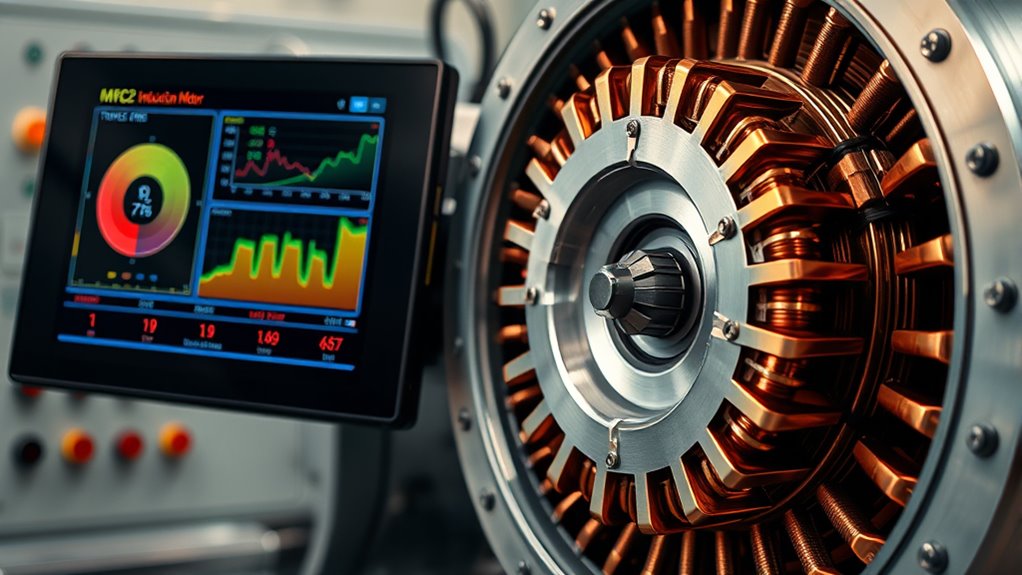
Induction motors have intriguing torque characteristics that play a crucial role in their performance and functionality.
You’ll notice that the breakdown torque, the maximum torque before stalling, can be as high as 175% to 300% of the rated torque. When starting from a standstill, the locked-rotor torque ranges from 75% to 275%, providing the initial push.
The slip, the difference between synchronous speed and rotor speed, typically hovers around 0% to 5% at full load, directly affecting torque output. Observing a speed-torque curve helps you understand how torque changes with speed.
With full-load efficiency between 85% and 97%, these motors are quite effective. Efficiency impacts performance metrics, but losses from friction and core issues can still occur.
Efficiency and Technological Advancements
While induction motors are already known for their high efficiency, continuous advancements in technology are pushing these efficiencies even further. Induction motors typically achieve full-load efficiency between 85-97%, but developments like variable-frequency drives (VFDs) are enhancing performance.
VFDs let you precisely control motor speed and torque, making operations more efficient under varying load conditions. This technology accounts for 30-40% of new motor installations, showing its growing importance.
Additionally, innovations in squirrel-cage rotor designs and advanced modeling techniques, like the Steinmetz equivalent circuit, have greatly improved efficiency. Energy efficiency legislation also encourages the use of higher-efficiency motors, further driving technological advancements.
These improvements not only reduce losses but also guarantee better performance and energy savings in various applications.
Applications and Control Mechanisms
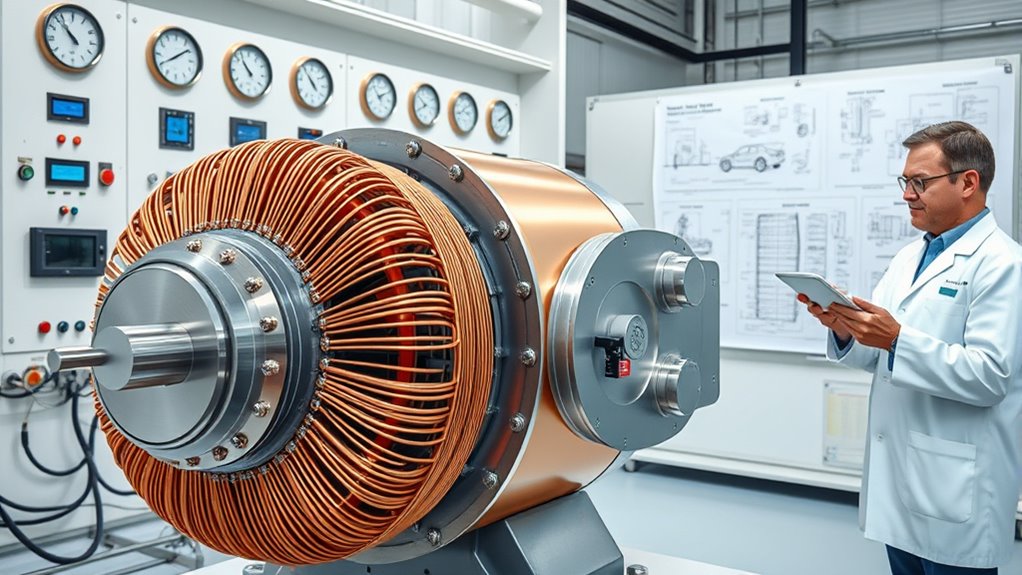
Though they may seem unassuming, induction motors are the backbone of both industrial and household applications. Their reliability in converting electrical energy to mechanical energy makes them ideal for industrial uses like pumps, compressors, conveyors, and fans.
In households, single-phase induction motors power appliances like mixers and air conditioners, while three-phase motors handle high-power needs in industrial settings.
You can control the speed of induction motors efficiently with Variable-Frequency Drives (VFDs). These drives allow precise speed control and torque management based on load requirements. Importantly, induction motors are self-starting, enhancing their convenience.
Advanced techniques like field-oriented control have further improved their adaptability, making them suitable for a wide range of applications. Whether at home or in industry, these motors deliver dependable performance.
Standards and Regulatory Guidelines
When considering the deployment of induction motors, it’s vital to adhere to established standards and regulatory guidelines to guarantee peak performance and safety.
Compliance begins with the NEMA MG-1 standard, confirming your induction motors meet the required performance and efficiency levels for industrial applications. If you’re using NEMA Design B motors, these guidelines are significant for maintaining operational reliability.
The IEC also offers key standards, like IEC 60050, which defines important terms and classifications. Premium-efficiency motors are often mandated by energy legislation, pushing for designs that surpass standard efficiency.
To promote safety, adhere to standards from Underwriters Laboratories (UL) and the Canadian Standards Association (CSA). Staying updated with these evolving standards guarantees your motors meet current technological and environmental expectations.
Conclusion
You’ve now got a solid grasp of induction motors, from their historical development to their vital role in various applications. These motors, with their self-starting capabilities and minimal maintenance needs, offer efficiency and durability. Understanding synchronous speed, slip, and torque characteristics helps you appreciate their performance. Plus, knowing about standards and control mechanisms guarantees you’re aware of industry expectations. Embrace the technological advancements and efficiency improvements that make induction motors a staple in both household and industrial settings.
FAQs
1. What Is an Induction Motor in Simple Words?
You’d describe an induction motor as an electric device that converts electricity into movement using magnetic fields. It has a stationary part creating the magnetic field and a rotating part that follows it, making it efficient and dependable.
2. What Is the Difference Between an Induction Motor and a Normal Motor?
You notice that induction motors use electromagnetic induction, eliminating brushes and commutators, which reduces maintenance. They suit industrial needs with efficiency and durability. Normal motors rely on direct current for precise control, making them ideal for specific applications.
3. How to Tell if a Motor Is an Induction Motor?
Check for a single power supply connection and no external excitation system. Notice the absence of brushes or commutators. Confirm asynchronous operation by measuring rotor speed, and look for a high power factor and characteristic torque-speed curve.
4. What Is the Difference Between a DC Motor and an Induction Motor?
You differentiate a DC motor from an induction motor by noting that DC motors use brushes and commutators and require regular maintenance. In contrast, induction motors operate brushless, are maintenance-free, and achieve higher efficiency in industrial applications.