What Is a Solenoid in Physics? Definition, Function & Applications
In physics, you’re likely to encounter a solenoid as a fascinating device that converts electrical energy into mechanical motion. It’s fundamentally a coil of wire, often wrapped around a core, that creates a magnetic field when current flows through it. The strength of this field depends on the number of turns in the coil and the magnitude of the current. Solenoids play an essential role in everyday technology, from cars to medical devices, sparking curiosity about their diverse applications.
Key Takeaways
- A solenoid is a coil of wire that generates a magnetic field when an electric current flows through it.
- Solenoids convert electrical energy into mechanical motion via electromagnetic principles.
- The magnetic field inside a solenoid is uniform and stronger with a ferromagnetic core.
- The magnetic field strength of a solenoid depends on current and coil turns density.
- Solenoids are used in various technologies, including medical devices and automotive systems.
Understanding the Structure of a Solenoid

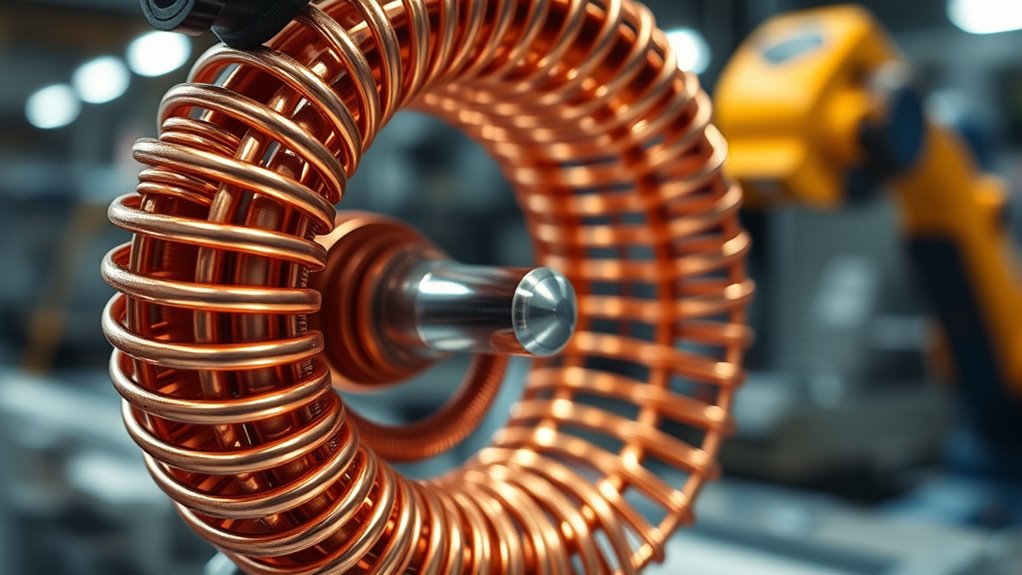
A solenoid is a cylindrical coil of wire that generates a magnetic field when an electric current flows through it.
You’ll find that this coil is typically made of tightly wound copper wire, which maximizes electrical energy efficiency and enhances the strength of the magnetic field. The number of turns in the coil, or turn density, is crucial for determining the strength of the magnetic field. More turns mean a more intense field.
Additionally, the solenoid’s housing, often made of materials such as iron or steel, increases permeability, thereby concentrating the magnetic field. This setup effectively transforms electrical energy into a powerful magnetic force.
The geometry, including length and cross-sectional area, further influences the solenoid’s magnetic properties, optimizing its performance.
Principles of Magnetic Field Generation
When electric current flows through a solenoid’s helical coil, it generates a magnetic field whose strength depends on both the current and the number of turns per unit length.
Inside the solenoid, the magnetic field is uniform and parallel to the axis. You can determine the direction of this field using the right-hand rule: curl your fingers in the direction of the current, and your thumb points to the magnetic field lines.
The solenoid’s magnetic flux density increases with the presence of a ferromagnetic core, which enhances the core’s permeability and boosts the magnetic field strength.
This increased magnetic flux is more effective than in an air-core solenoid, concentrating the magnetic field within the desired area.
Calculating the Magnetic Field of a Solenoid

Understanding how to calculate the magnetic field of a solenoid is essential for grasping its operation in various applications.
You can use the formula ( B = mu_0 n I ) to find the magnetic field strength, where ( mu_0 ) is the permeability of free space, ( n ) is the number of turns per unit length, and ( I ) is the current flowing through the solenoid.
The magnetic field is strongest and nearly uniform inside, while outside, it’s negligible.
For a solenoid of finite length, approximate ( B ) using ( B approx mu_0 frac{N I}{L} ).
This magnetic field can exert a mechanical force, mimicking the effect of a bar magnet.
Types and Configurations of Solenoids
Even though solenoids vary in their configurations, they all harness the power of electromagnetism to produce magnetic fields.
You can classify them mainly into two types: infinite solenoids, which theoretically extend infinitely in length, and finite continuous solenoids, which have a set length. Infinite solenoids are prized for their ability to generate a uniform magnetic field, while finite ones require considerations of end effects in their magnetic field properties.
Solenoid configurations can be cylindrical or non-cylindrical, affecting how magnetic fields distribute. Including ferromagnetic materials in the core can enhance magnetic strength.
When it comes to inductance, the diameter-to-length ratio in short solenoids plays a vital role in calculations, impacting their efficiency and performance in real-world applications.
Applications and Uses in Technology
You’ll find solenoids at the heart of many modern technologies, from medical devices to automotive systems.
In medical equipment such as MRI machines and ventilators, they ensure precise control of fluids and mechanical movements.
Meanwhile, in your car, solenoids manage critical tasks in starters and fuel injectors, highlighting their importance in both health and transportation sectors.
Solenoids in Medical Devices
In the field of medical technology, solenoids are game changers, powering essential devices that save lives and enhance patient care.
Solenoids are used in MRI machines to create a strong and uniform magnetic field inside, vital for imaging. In portable MRI scanners, non-cylindrical solenoids enhance imaging capabilities and reduce costs.
Solenoid valves regulate blood flow in medical devices, such as dialysis machines and ventilators, ensuring precise control over fluid dynamics.
For cancer treatment, targeted magnetic fluid hyperthermia systems employ solenoid arrays to produce localized heating, effectively targeting tumors.
Additionally, in wireless power transfer applications, solenoids improve the efficiency of energy transfer, facilitating advancements in non-invasive treatments and diagnostics.
Solenoids’ versatility and precision make them indispensable in modern medical technology.
Automotive Solenoid Applications
While advancements in automotive technology continue to evolve, solenoids remain crucial in numerous vehicle systems. A solenoid converts electrical energy into mechanical force by harnessing the power of a magnetic field. When current flows, the solenoid generates this magnetic field, facilitating various functions across automotive systems:
- Starters: Solenoids act as crucial electromechanical switches, engaging the starter motor to kickstart your engine.
- Fuel Efficiency: In fuel injectors, solenoids precisely control fuel delivery, thereby optimizing engine performance and conserving energy.
- Transmission Systems: Solenoids regulate the flow of transmission fluid, ensuring smooth gear shifts and enhancing driving comfort.
These applications underscore the solenoid’s integral role in modern vehicles, demonstrating its ability to convert electrical energy into mechanical action efficiently.
Industrial Solenoid Usage
Although solenoids might seem like simple devices, they play a pivotal role in industrial settings by controlling the movement of fluids and facilitating precise mechanical actions.
You’ll find solenoids converting electrical energy into mechanical movement, making them essential in industrial applications. They regulate fluid control in systems like irrigation and beverage filling machines.
In automotive technology, they act as electromechanical switches to start engines. Solenoids also enhance industrial automation, ensuring precise actions in conveyor systems, robotics, and assembly lines.
Their electromagnetic force is harnessed in medical devices like MRI machines and ventilators, aiding in controlled mechanical actuation.
Additionally, solenoids play a vital role in locking mechanisms, providing efficient locking and releasing functions in electronic door locks and security systems.
Role of Solenoids in Modern Devices

Solenoids likely surround you without you even realizing it, as they play a crucial role in modern devices across various fields.
In your car, solenoids ensure the smooth operation of starters and fuel injectors, while in medical devices, they regulate critical functions such as blood flow in dialysis machines.
These electromechanical actuators convert electrical energy into precise mechanical motion, making them indispensable in both everyday technology and critical healthcare applications.
Electromechanical Actuation Applications
In today’s rapidly advancing technological landscape, solenoids are indispensable components in electromechanical actuation applications. They effectively convert electrical energy into mechanical movement by creating a magnetic field when current flows through a solenoid. This capability is harnessed in various devices that convert energy, ensuring precise operations.
Consider these significant applications:
- Automated Locking Mechanisms: Solenoids lock and release doors by transforming electrical energy into mechanical action.
- Fluid Control Systems: Solenoid valves in industries like beverage production and HVAC regulate liquid and gas flow efficiently.
- Automotive Systems: Solenoids are essential in car starters and fuel injectors, ensuring peak engine performance through strong magnetic fields.
Medical and Automotive Uses
Solenoids play a pivotal role in both the medical and automotive industries, demonstrating their versatility and reliability.
In medical devices, solenoids play a vital role in MRI machines, where they generate strong magnetic fields for imaging purposes. You’ll also find them in ventilators, where they control airflow and pressure through valves. Dialysis machines benefit from solenoids by regulating blood flow, ensuring patients receive safe treatments.
In the automotive sector, solenoids convert electrical energy into mechanical motion. They’re essential in starter motors, engaging the starter gear with the engine’s flywheel for smooth ignition.
Solenoid valves precisely control fuel flow in injection systems, enhancing engine performance. Additionally, solenoids secure access in electronic door locks and automated locking mechanisms, providing reliable control in modern vehicles.
Conclusion
You’ve now got a clear understanding of what a solenoid is and how it works in physics. By wrapping a coil of wire around a core, you can generate a powerful magnetic field that converts electrical energy into mechanical motion. With this knowledge, you can appreciate the diverse types and configurations of solenoids and understand their vital role in modern technology. From medical devices to cars, solenoids are essential for efficient control of movement and fluid flow.
FAQs
1. What Is the Simple Definition of a Solenoid?
You’re wondering about solenoids? Picture a coil of wire that creates a magnetic field when current flows through it. It converts electrical energy into mechanical work, utilizing moving parts such as plungers. It’s widely used in various applications.
2. What Is the Purpose of a Solenoid?
You’ll find that a solenoid’s purpose is to convert electrical energy into mechanical movement. By adjusting the current, you can control the magnetic field for precise actuation, making it essential in devices from automotive starters to medical equipment.
3. How Do Solenoids Work in Physics?
You’ll find that solenoids work by allowing electric current to flow through a wire coil, which creates a magnetic field. This field can move a plunger, transforming electrical energy into mechanical work, which is useful in devices such as valves and locks.
4. What Is a Solenoid in a Magnetic Field?
You encounter a solenoid in a magnetic field, which acts as a device that generates a nearly uniform field inside. It utilizes coiled wire and electric current, with the field strength dependent on the current and coil density. Outside, the field’s minimal.