Differences Between Electromagnetic and Solid-State Relays
When you’re exploring the world of relays, it’s essential to understand the stark contrasts between electromagnetic relays (EMRs) and solid-state relays (SSRs). You’ve got EMRs relying on mechanical parts, which can wear out over time, while SSRs use semiconductors for a more durable solution. But there’s more to these differences than meets the eye, especially when considering performance and applications. What’s the real impact on your projects?
Key Takeaways
- Electromagnetic Relays (EMRs) use mechanical movement, while Solid-State Relays (SSRs) rely on optical semiconductors for switching.
- SSRs offer faster switching speeds and longer lifespans due to the absence of mechanical parts.
- EMRs are prone to arcing and contact bounce, whereas SSRs eliminate these issues with no physical contacts.
- SSRs require effective thermal management due to significant heat generation, unlike the cooler operation of EMRs.
- SSRs have higher upfront costs but lower maintenance expenses and longer-term reliability compared to EMRs.
Understanding Electromagnetic Relays
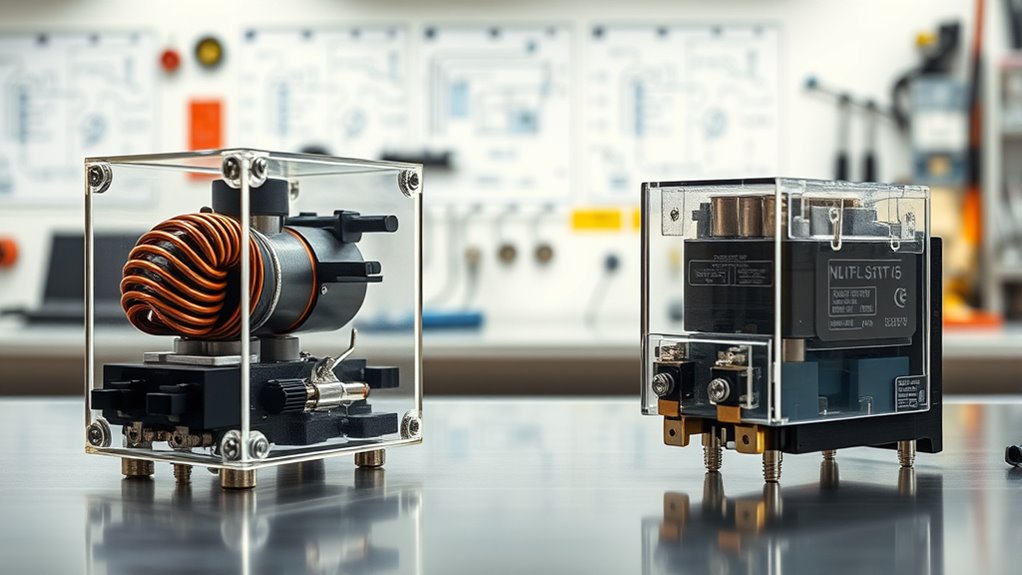
Electromechanical relays (EMRs) are fascinating devices that use electromagnetism to control the flow of electricity. When you energize the coil of wire, it creates a magnetic field that pulls the armature, causing the mechanical switch to move and the contacts to connect. This action allows electricity to flow, making these electromagnetic relays perfect for handling high starting currents, which are common in motors and transformers.
The audible click you hear signals the contacts making or breaking their connection. This characteristic sound is both a sign of operation and a reminder of the mechanical nature of EMRs.
Despite their usefulness, these relays tend to wear out more quickly due to mechanical movement. Issues like arcing and contact oxidation can also affect their performance over time.
Exploring Solid-State Relays
While electromechanical relays have their merits, solid-state relays (SSRs) offer a modern alternative that utilizes optical semiconductors, such as diodes, triacs, and transistors, for switching.
SSRs excel in high-speed and frequent switching applications due to their rapid on/off capabilities. Unlike electromechanical relays, SSRs operate without moving parts, resulting in silent operation and enhanced lifespan by reducing wear and tear.
However, to manage the heat generated during operation, especially under high power loads, SSRs require heat sinks. Thermal management is essential, as SSRs can produce significant heat.
Additionally, be mindful of the small leakage current that occurs when SSRs are open, which may impact sensitive applications; electromechanical relays, on the other hand, provide better electrical isolation.
Operational Mechanisms of EMRs and SSRs
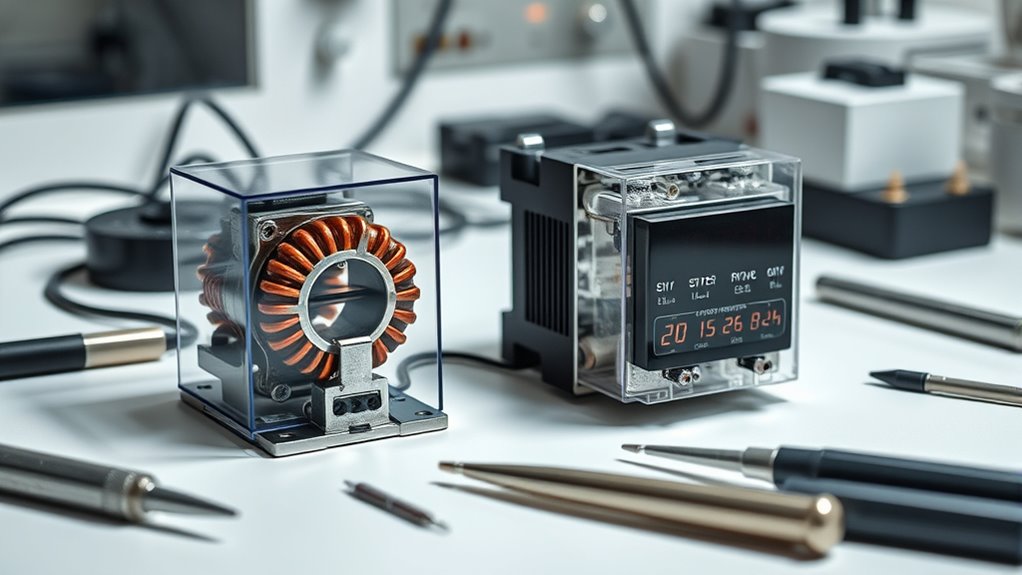
When delving into the operational mechanisms of EMRs and SSRs, it’s crucial to understand their fundamental differences.
Electromechanical relays (EMRs) rely on an electromagnet to move an armature, which physically opens and closes contacts. This movement generates audible clicks and involves moving parts, leading to wear over time. Physical contacts can degrade due to arcing and sparking, which can affect their lifespan.
In contrast, solid-state relays (SSRs) employ optical semiconductors. An input signal activates an internal LED, which triggers a photodiode, thereby switching on a semiconductor without requiring mechanical movement.
SSRs, as a result, have no moving parts, which contributes to a longer lifespan and eliminates contact bounce issues. Their switching speed is considerably faster than EMRs, as SSRs change states almost instantaneously.
Performance and Reliability Comparison
Although both electromechanical relays (EMRs) and solid-state relays (SSRs) serve the same fundamental purpose, they diverge considerably in performance and reliability.
SSRs excel with high speed and frequent switching, as they operate without mechanical parts. This gives them a longer lifespan and enhanced electrical endurance, making them more reliable, especially in demanding environments.
EMRs, on the other hand, suffer from mechanical wear, impacting their longevity and output reliability.
Here’s what you need to remember:
- SSRs switch faster due to a lack of mechanical movement.
- Higher electrical endurance in SSRs makes them more suitable for harsh conditions.
- The lifespan of SSRs often surpasses that of EMRs.
- The absence of arcing or sparking enhances reliability in SSRs.
- EMRs wear out due to the presence of moving parts.
Heat Generation and Thermal Management
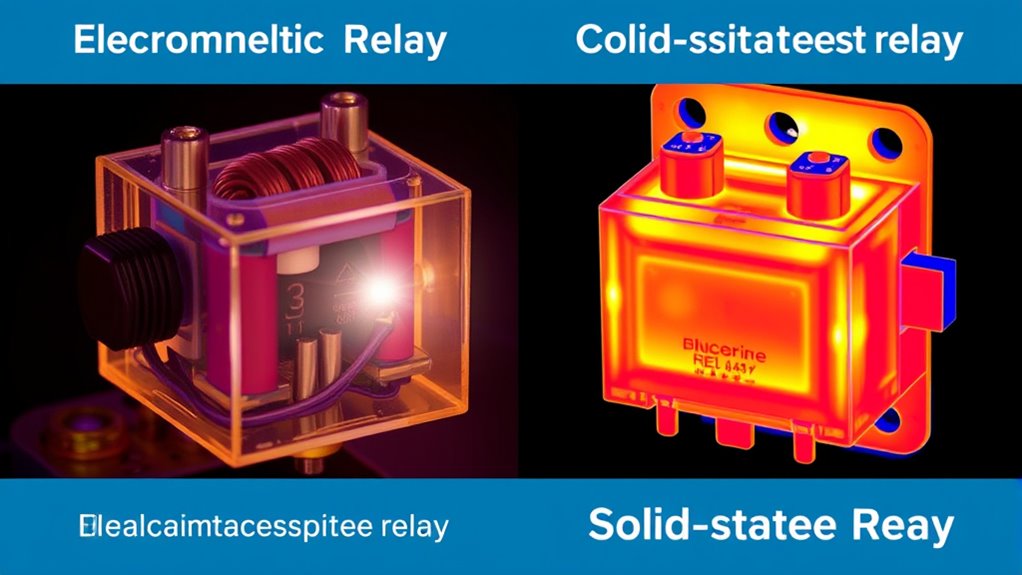
As you explore the differences between solid-state relays (SSRs) and electromechanical relays (EMRs), you’ll find that heat generation plays a significant role in their operation.
SSRs, with their semiconductor components, generate substantial heat during use. This heat is managed through the use of heat sinks, which are essential for effective thermal management. Without proper cooling, the power dissipation of SSRs can lead to temperature rises, impacting their lifespan and operational reliability.
In contrast, EMRs produce less heat thanks to their mechanical movement, eliminating the need for additional cooling solutions. This stable operation under load makes EMRs more suitable for applications where excessive heat generation is a concern, ensuring they maintain reliable performance without the burden of thermal management.
Cost Analysis and Total Cost of Ownership
Understanding the cost dynamics of solid-state relays (SSRs) versus electromechanical relays (EMRs) is essential for making informed purchasing decisions.
While SSRs often have a higher initial installation budget, their longer lifespan and reduced maintenance needs can greatly lower the total cost of ownership (TCO) over time.
Conducting a thorough cost analysis will help highlight how indirect costs, such as downtime and warranty, impact your budget.
Consider these factors in your decision-making process:
- Initial cost: SSRs cost more upfront.
- Lifespan: SSRs last longer, reducing replacement frequency.
- Maintenance: SSRs require less upkeep, saving time and money.
- Downtime: Less frequent failures with SSRs mean less operational disruption.
- TCO analysis tools: Utilize calculators to gauge lifetime costs accurately.
Balancing these aspects guarantees a financially sound relay choice.
Application Suitability and Use Cases
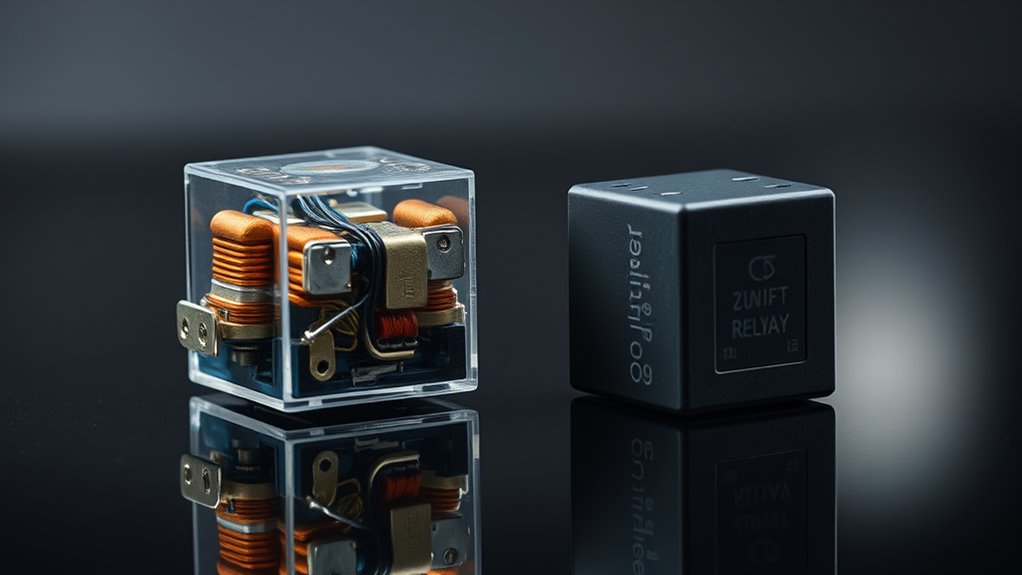
When choosing between solid-state relays (SSRs) and electromechanical relays (EMRs), the suitability of the application plays a significant role in your decision.
SSRs are perfect for high-speed applications, especially where sensitive automation is involved. Their rapid switching and resistance to mechanical wear make them ideal for environments with PLCs and HMIs. They’re also great in hazardous settings prone to vibration or moisture.
However, if you’re dealing with budget constraints, EMRs are more affordable upfront. They excel in applications requiring high starting amps, such as motors, thanks to their robust contacts.
While SSRs need heat sinks for large current loads, EMRs can operate without extra cooling.
Advantages and Limitations of EMRs
While choosing relays, you’ll find that electromechanical relays (EMRs) offer distinct advantages.
They’re ideal for handling high starting currents, making them perfect for motors and transformers. The tactile click sound of EMRs provides reassuring feedback, indicating that they’re operating correctly.
EMRs are also cost-effective, often being less expensive upfront, which is great if you’re working with a tight budget. Plus, they can withstand voltage spikes due to their robust mechanical contacts, ensuring durability in fluctuating conditions.
Here’s a quick summary of why you might prefer EMRs:
- Handle high starting currents for motors and transformers.
- A tactile click sound provides audible operation feedback.
- Cost-effective choice for budget-conscious projects.
- Withstand voltage spikes without damage.
- Produce less heat, reducing thermal concerns.
Advantages and Limitations of SSRs
When considering solid-state relays, you’ll notice that they boast impressive performance and longevity due to their lack of moving parts.
However, managing the heat they generate is essential, as they can become quite hot during operation.
This means you’ll need to ensure proper thermal management, such as using heat sinks, to maintain optimal functionality.
Performance and Longevity
Solid-state relays (SSRs) excel in performance and longevity, offering several advantages over traditional electromechanical relays (EMRs). Their high speed enables faster switching, making them ideal for applications where a quick response is essential.
SSRs boast a longer operational lifespan, exceeding 10 million cycles, thanks to the absence of mechanical wear and tear. This results in enhanced reliability, especially in demanding environments where shock and vibration are factors.
Unlike EMRs, SSRs don’t have physical contacts, eliminating issues such as arcing and contact bounce, which further enhances their performance.
Here’s why you might prefer SSRs:
- High-speed switching for fast applications
- Longer lifespan due to no mechanical wear
- Greater reliability in tough conditions
- No arcing issues
- Resistant to shock and vibration
Thermal Management Challenges
Despite their impressive performance and longevity, SSRs come with their own set of challenges, particularly in managing heat. SSRs generate considerable operational heat, making thermal management essential to maintaining their reliability.
Without proper heat sinks, SSRs can overheat, leading to decreased switching reliability and potential failure. You’ll need to consider additional cooling solutions, such as fans, to manage the high heat these devices generate.
Compared to Electromechanical Relays (EMRs), SSRs dissipate more heat, which can be problematic in applications with limited space for heat sinks.
Failure to address these thermal management issues can result in overheating, which significantly impacts the SSR’s reliability and lifespan. Proper thermal management guarantees your SSRs perform at their best, avoiding premature failures and maintaining system integrity.
Conclusion
When choosing between electromagnetic relays (EMRs) and solid-state relays (SSRs), consider the specific needs of your application. EMRs, with their mechanical components, may wear over time but often come at a lower initial cost. Meanwhile, SSRs offer greater reliability and faster response times, though they require effective heat management. Ultimately, if you prioritize durability and performance in demanding environments, SSRs are the better choice. However, for simpler applications, EMRs might suffice.
FAQs
1. What is the Difference Between Electromagnetic and solid-state relays?
You notice electromagnetic relays click as they use moving parts, while solid-state relays operate silently with semiconductors. EMRs handle higher currents without leakage; SSRs last longer but may leak small currents in sensitive applications.
2. What Are the Differences Between the Two Types of Relays?
You’ll find electromagnetic relays use moving parts and make noise, while solid-state relays operate silently with semiconductors. Solid-state relays switch faster, last longer, but may leak current. Electromagnetic ones handle high currents more effectively and are less costly.
3. What Makes a Solid State Relay Different From a Normal Relay?
You’ll find that solid-state relays have no moving parts, providing silent operation and a longer lifespan. However, they generate more heat and have issues with leakage current. Unlike normal relays, they need heat sinks for cooling during operation.
4. What Is the Main Advantage of State Relays Over Electromechanical Relays?
You’ll find the main advantage of solid-state relays is their durability. They’ve got no moving parts, ensuring a longer lifespan and reducing maintenance. Plus, they switch faster, enhancing performance and reliability in various applications.