Understanding Type 1 and Type 2 Superconductors
Superconductivity, a phenomenon that allows electric current to flow without resistance can potentially revolutionize the future of our energy systems. If you’ve ever looked at your electricity bill and felt your heart drop, you’ll understand why this is exciting news. In an era where the power demand is steadily increasing, superconductors may hold the key to ultra-efficient energy distribution. In this blog post, we are diving into two main categories of this groundbreaking technology: Type 1 and Type 2 Superconductors. Discover their unique characteristics, differences, and real-world applications as we unlock the immense potential these game-changers exhibit in our world immersed in technology. The future of energy could well be superconductive — prepare to be electrified!
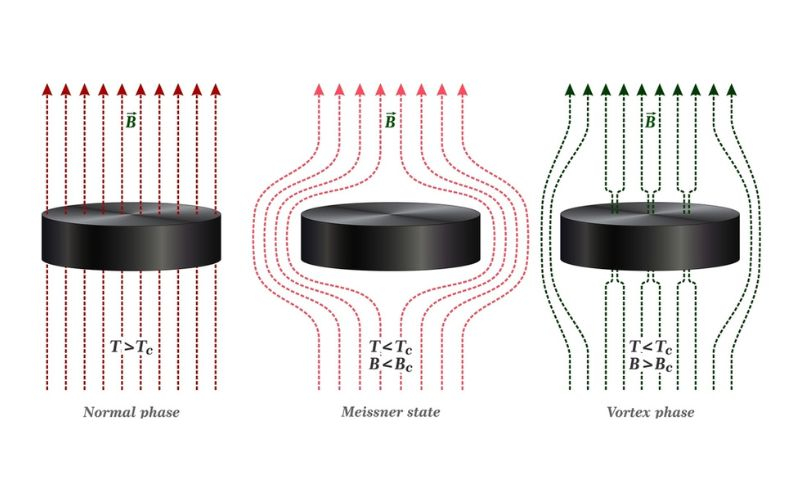
Type 1 and Type 2 superconductors differ in their response to magnetic fields. Type 1 superconductors expel all magnetic flux when a magnetic field is applied, while Type 2 superconductors allow partial magnetic flux penetration. This distinction arises from differences in their coherence length and London penetration depth. Understanding these differences is crucial for researchers and engineers working with superconducting materials.
Classification of Superconductors
Superconductors are materials that have zero electrical resistance and expel magnetic flux from their interiors. They can be categorized broadly into Type I and Type II. The classification is based on the behavior of a superconductor in an external magnetic field.
This article will explore the differences between these superconductors and their respective applications. Let’s begin with Type I Superconductors.
Type 1 Superconductors
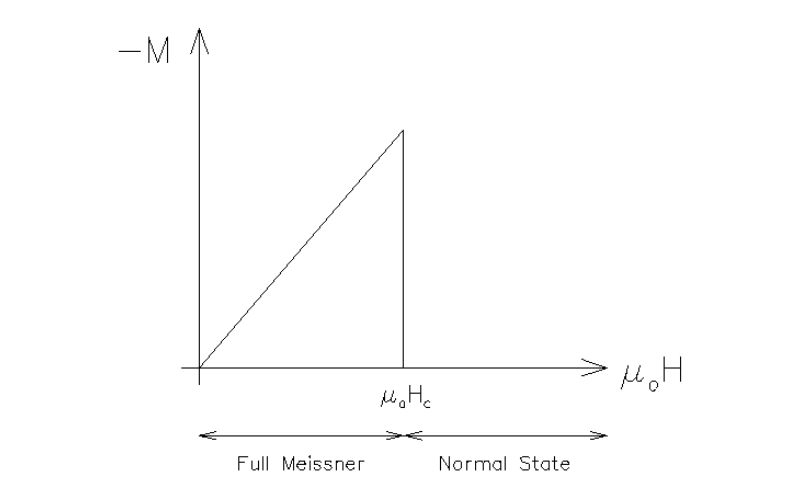
Type I superconductors were the first to be discovered, and they are usually pure metals such as aluminum, lead, or mercury. When an external magnetic field is applied, these superconductors sharply transition from the superconducting state to the normal (resistive) state. At a certain value of the magnetic field (called the critical field), Type I superconductors undergo a phase transition and revert to their resistive state, thereby expelling all magnetic flux.
For example, lead has a critical field of 0.08 tesla at 4 K. If we apply a magnetic field beyond this critical value at the low temperature of 4 K, lead will lose its superconductivity and become conductive again.
Characteristics of Type I superconductors
One significant characteristic of these superconductors is that they completely repel any magnetic field except for a tiny border of a few nanometers where flux tubes occur at critical fields. Due to their lack of tolerance to high magnetic fields, type I superconductors find applications mainly in instances where low-temperature environments are necessary — like in NMR spectroscopy machines, particle accelerators, and MRI scanners.
While Type I superconductors’ applications require extremely low-temperature environments and low magnetic fields surrounding them, this situation is not ideal as it limits their functioning. In contrast, many modern uses for superconductive technology require aspects of high-kilotesla magnetic fields. This is where Type II superconductors become relevant.
Type I superconductors, such as aluminum, lead, and mercury, transition sharply from the superconducting state to the normal state when exposed to an external magnetic field beyond their critical field. These superconductors completely expel magnetic flux except for a small border where flux tubes occur. Due to their intolerance to high magnetic fields, Type I superconductors are mainly used in low-temperature environments for applications like NMR spectroscopy machines, particle accelerators, and MRI scanners. However, Type II superconductors are more suitable with the increasing need for high magnetic fields in modern superconductive technology.
Type 2 Superconductors

Superconductors can be classified into two types: Type I and Type II. Type II superconductors are perhaps more exciting as they can conduct electricity without resistance at higher temperatures in a magnetic field stronger than a certain critical value. They are more complex than Type I superconductors and exhibit a mixed state between lower and upper critical fields, allowing partial magnetic flux penetration. This state consists of bundles of flux filaments surrounded by circulating vortices of screening current.
Think of it like swimming in a pool. While it’s impossible to swim through solid walls, like hitting the bottom of the pool, you can still swim without encountering any resistance once in deeper waters.
- It’s found that all Type I superconductors are pure elemental metals, while most of the Type II superconductors are composite or alloyed materials.
- Type I superconductors transition abruptly from their normal state to a zero-resistance state at low temperatures, whereas Type II superconductors transition gradually.
- Data suggests that approximately 50% of the periodic table elements exhibit type I superconductivity under atmospheric pressure.
Understanding Superconductor Properties
Impact of Magnetic Field
Superconductivity is a fascinating field of research that deals with materials that can conduct electricity without resistance. Two types of superconductors exist: type 1 and type 2. While type 1 superconductors are limited to a certain magnetic field range, type 2 superconductors can withstand much higher magnetic fields.
Role of Temperature
Real-World Superconducting Materials
The critical temperature (Tc) is another fundamental difference between the two superconducting types. Type 1 materials have a unique value for Tc, which varies from one substance to another due to differences in crystal structures and metal bonding types. In contrast, Type II includes high-temperature superconductors (HTS), with some reaching temperatures exceeding -110 Celsius degrees.
It’s worth noting that redesigning existing materials would be insufficient in creating high-temperature materials without careful attention to their structural changes and other properties, such as coherence length. Therefore, continuous research aims to understand this complex issue for commercial applications.
Future Developments in Superconductor Tech
Superconductors are materials with precisely zero electrical resistance. This property enables the creation of powerful electromagnets, making superconductors instrumental in various fields like medicine, energy, and transportation. However, not all superconductors are created equal, and key differences exist between them. The two broad classifications are Type 1 and Type 2 superconductors.
In contrast, Type 2 superconductors feature complex crystalline structures with multiple components like niobium-titanium alloys or ceramics like yttrium-barium-copper oxide (YBCO). They possess two critical magnetic field strengths known as Hc1 and Hc2. Hc1 marks the initial stage of flux penetration, where Type 2 temporarily loses its superconducting properties. However, as the external field strength keeps increasing, a completely unaffected Type 2 core appears, thus ensuring high-temperature flux pinning. These materials work at higher temperatures and stronger magnetic fields than Type 1, therefore finding more practical industrial applications.