Understanding the Remarkable Properties of Superconductors
Superconductors are a fascinating material class that has intrigued scientists and engineers for decades. These materials exhibit unique properties, making them crucial in various scientific, medical, and technological applications. In this article, we will delve into the properties of superconductors, exploring their incredible capabilities and their impact on our world.
What are Superconductors?
Before we dive into their properties, let’s define what superconductors are. When cooled below a critical temperature, superconductors can conduct electric current with zero electrical resistance. This phenomenon was first discovered in 1911 by Heike Kamerlingh Onnes when he observed mercury’s sudden loss of electrical resistance at extremely low temperatures.
Key Properties of Superconductors
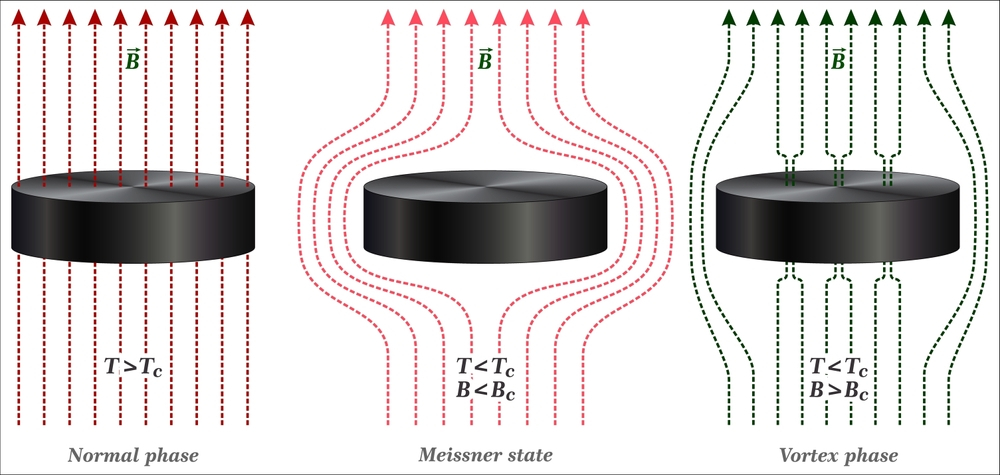
Superconductors exhibit several remarkable properties that set them apart from conventional materials:
Zero Electrical Resistance
Superconductors, at their critical temperature, have zero electrical resistance. This means that electrical current can flow through them without any energy loss due to resistance, making them highly efficient conductors.
Magnetic Field Expulsion (Meissner Effect)
When a superconductor transitions into its superconducting state, it expels all magnetic fields. This phenomenon, known as the Meissner effect, results in the superconductor levitating above a magnet—a stunning demonstration of its unique properties.
Perfect Diamagnetism
Superconductors are perfect diamagnets, meaning they repel magnetic fields with exceptional strength. This property has important applications in magnetic levitation (Maglev) trains, where superconducting magnets enable frictionless and high-speed transportation.
Critical Temperature
Each superconductor has a specific critical temperature below which it becomes superconducting. Some superconductors require extremely low temperatures, close to absolute zero (-273.15°C or -459.67°F), while others have higher critical temperatures that make them more practical for various applications.
Flux Pinning
Superconductors can “trap” magnetic flux lines within their structures, a phenomenon known as flux pinning. This property is vital in creating stable superconducting materials and devices, such as superconducting wires for MRI machines.
High Current Density
Superconductors can carry extremely high current densities, making them ideal for applications requiring powerful electromagnets, such as particle accelerators and MRI scanners.
Quantum Mechanical Phenomena
Quantum mechanical phenomena govern the behavior of superconductors. The condensation of electron pairs into a coherent quantum state, known as Cooper pairs, underpins the absence of resistance and other superconducting properties.
Applications of Superconductors

The unique properties of superconductors have led to a wide range of practical applications:
- Medical Imaging: Superconducting magnets are crucial in MRI machines, providing high-resolution images for medical diagnosis.
- Power Transmission: Superconducting power cables can transmit electricity with minimal loss over long distances, revolutionizing the efficiency of electrical grids.
- Particle Accelerators: Superconducting magnets are essential in constructing particle accelerators like the Large Hadron Collider (LHC) at CERN, enabling the study of fundamental particles.
- Quantum Computing: Superconducting qubits are used in quantum computers due to their long coherence times and controllability.
- Transportation: Maglev trains use superconducting magnets for frictionless, high-speed travel.
- Scientific Research: Superconductors facilitate cutting-edge research in various fields, from condensed matter physics to astrophysics.
The Future of Superconductors

As we look ahead, the field of superconductivity holds immense promise for further advancements and innovations. Scientists and engineers continually explore new materials and applications to bring superconductors closer to everyday use. Here are some exciting developments on the horizon:
High-temperature superconductors (HTS)
One of the most significant breakthroughs in recent years has been the discovery of high-temperature superconductors, often abbreviated as HTS. Unlike conventional superconductors that require extremely low temperatures, HTS materials can maintain their superconducting state at significantly higher temperatures, though still below room temperature. This development can make superconductivity more practical for various applications, including power transmission and transportation.
Fault Current Limiters
Superconducting fault current limiters (SFCLs) are devices that utilize the unique properties of superconductors to protect electrical grids from short circuits and overloads. These devices detect and react to faults within microseconds, preventing power outages and equipment damage. SFCLs are increasingly being deployed in electrical grids to enhance their reliability.
Superconducting Energy Storage
Superconducting magnetic energy storage (SMES) systems store electrical energy as a magnetic field in a superconducting coil. These systems can discharge energy rapidly and efficiently, making them valuable for grid stabilization, renewable energy integration, and uninterruptible power supplies.
Quantum Computing and Superconductors
The world of quantum computing is closely intertwined with superconductors. Quantum computers rely on superconducting qubits to perform complex calculations at speeds unimaginable with classical computers. As quantum computing technology advances, it could revolutionize cryptography, materials science, and optimization.
Practical Challenges
While the potential applications of superconductors are vast, several challenges remain to be addressed:
- Cost: Superconducting materials often require expensive cooling systems to maintain low temperatures. Reducing these costs is a crucial goal for broader adoption.
- Fragility: Many superconductors are brittle and can be damaged easily, limiting their use in some applications.
- Materials Discovery: Researchers continually search for new materials with higher critical temperatures and improved properties.
- Commercialization: Scaling up the production of superconducting materials and devices for widespread use remains a significant challenge.
- Integration: Incorporating superconductors into existing infrastructure and technology can be complex and costly.
Conclusion
FAQs
Can superconductors work at room temperature?
No, superconductors require specific low temperatures to achieve their superconducting state. While some newer materials have higher critical temperatures, none operate at room temperature.
What is the most common type of superconductor?
The most common type of superconductor is known as a “Type II” superconductor. These materials have a mixed state where some magnetic flux can penetrate, allowing for practical applications.
Are there any disadvantages to using superconductors?
Yes, there are limitations to superconductors. They require cryogenic cooling, making them expensive to operate. Additionally, they are brittle and can be damaged easily, which can be a drawback in certain applications.