Exploring Advance Speed Control Methods of DC Shunt Motor
In electrical engineering, DC shunt motors have long been recognized for their versatile applications and robust performance—one crucial aspect in harnessing their full potential lies in effectively controlling their speed. The ability to regulate the rotational speed of a DC shunt motor opens up a wide array of possibilities across various industries, from industrial machinery to electric vehicles.
Methods for Speed Control
The following methods can achieve speed control of a DC Shunt motor;
-
Flux Control Method
-
Armature control Method and
-
Voltage Control Method
Flux Control Method

This method is very frequently used because it is very simple and economical. In this method, the speed control can be achieved by varying the flux Φ because the motor speed N ∝ (1/ Φ), and therefore, it is named the flux control method. An adjustable resistance is connected in series along with the shunt field winding, as shown in the figure. This adjustable resistance is also known as shunt field rheostat. This shunt field rheostat moderates the shunt current and the flux. As a result, we can only increase the speed beyond the rated speed of the motor. Normally, it allows the momentum to grow at a ratio of 3:1. Varied speed choices tend to create instability and meager commutation.

Armature Control Method
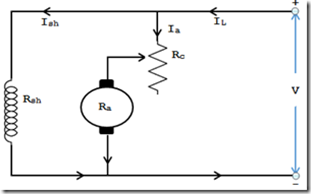
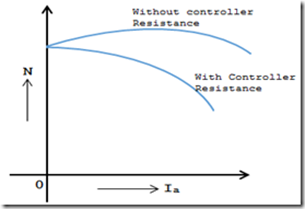
In this method,d speed control can be achieved by varying voltage across the armature and the back EMF. This is obtained by connecting an adjustable resistance in series using the armature shown in Fig. This adjustable resistance is also known as controller resistance Rc.
N∝ {v-Ia(Ra+Rc)}
Armature Reaction in DC Motor
Armature reaction is a significant phenomenon in DC motors, influencing their overall performance and operation. When current flows through the armature winding, a magnetic field is generated, interacting with the main magnetic field produced by the field winding. This interaction, known as the armature reaction, leads to several effects. Firstly, it distorts the main magnetic field, altering the flux density distribution within the motor. This distortion results in a shift in the neutral plane, where commutation occurs, leading to potential issues such as sparking and brush wear.
Voltage Control Method
In this process, the supply voltage providing the field current differs from that which delivers the armature. This technique can avoid the drawback of meager speed regulation and efficiency, as seen in the armature control method. However, this method is fairly expensive, so it is used for bigger motor sizes where efficiency is given priority.
Speed control of the DC Shunt Motor using the voltage control method can be achieved in two ways. They are;
- Multiple Voltage control
- Ward-Leonard System.
Multiple Voltage Control Method
Ward-Leonard System

Characteristic of DC Shunt Motor
DC shunt motors possess unique characteristics that make them widely employed in various applications. One of their notable features is their relatively constant speed regulation over a wide range of loads. The speed of a shunt motor is governed by the back electromotive force (EMF) generated in the armature winding. As the load on the motor increases, the armature current rises, causing a drop in the armature voltage and, hence, a decrease in the back EMF. This reduction in back EMF results in a slight decrease in speed, maintaining a stable speed regulation.
Moreover, DC shunt motors exhibit excellent starting torque, allowing them to start efficiently under heavy loads. This is attributed to the high torque generated by the parallel combination of the armature and field windings. Additionally, these motors offer a wide range of speed control, allowing precise adjustments to meet specific application requirements. Overall, the characteristic traits of DC shunt motors, including their stable speed regulation, high starting torque, and versatile speed control, make them a preferred choice for numerous industrial and commercial applications.
FAQs
What are the basic principles behind speed control in a DC shunt motor?
The equation governs the speed of a DC shunt motor:
N=V−IaRakΦN = frac{V – I_a R_a}{k Phi}
Where:
- NN is the speed of the motor.
- VV is the applied voltage.
- IaI_a is the armature current.
- RaR_a is the armature resistance.
- kk is a constant.
- ΦPhi is the magnetic flux produced by the field winding.
From this equation, it is evident that the speed of a DC shunt motor can be controlled by varying the armature voltage VV, the armature resistance RaR_a, or the field flux ΦPhi. The primary methods of speed control include armature control, field control, and voltage control.
What is armature control in a DC shunt motor?
Armature Control Method:
- Principle: The speed of the motor is controlled by varying the resistance in the armature circuit. Adding an external resistor in series with the armature reduces the voltage across the armature, which in turn decreases the motor speed.
- How It Works:
- When an external resistance is added in series with the armature, the voltage drop across the resistance increases as the armature current flows through it. This reduces the effective voltage across the armature, which decreases the speed of the motor.
- The speed can be adjusted by varying the value of the external resistance, allowing for finer control.
- Advantages:
- Simplicity: The armature control method is simple and easy to implement.
- Cost-Effective: It requires minimal additional components, making it a cost-effective solution for speed control.
- Disadvantages:
- Power Losses: The method introduces power losses due to the external resistor, reducing overall efficiency.
- Limited Speed Range: This method is more effective for speed control below the rated speed. The speed cannot be increased beyond the rated speed using this method.
What is field control in a DC shunt motor?
Field Control Method:
- Principle: The speed of the motor is controlled by varying the magnetic flux ΦPhi produced by the field winding. This is achieved by adjusting the field current through a variable resistor connected in series with the field winding.
- How It Works:
- By increasing the resistance in the field circuit, the field current decreases, reducing the magnetic flux ΦPhi. According to the speed equation, as the flux decreases, the motor speed increases.
- Conversely, decreasing the field resistance increases the flux, which reduces the motor speed.
- Advantages:
- Wide Speed Range: The field control method allows for a wide range of speed control, including speeds above the rated speed.
- Efficiency: This method is more efficient than armature control, as it does not introduce significant power losses.
- Disadvantages:
- Weakening of Field: Excessive weakening of the field can lead to instability in the motor operation and reduce the torque generated by the motor.
- Reduced Torque: As the speed increases with the reduction of flux, the torque generated by the motor decreases, which may not be suitable for high-torque applications.
What is voltage control in a DC shunt motor?
Voltage Control Method:
- Principle: The speed of the motor is controlled by varying the supply voltage VV applied to the armature while keeping the field voltage constant. This method is typically used in applications requiring smooth and precise speed control.
- How It Works:
- By varying the armature voltage, the speed of the motor can be adjusted. A higher voltage increases the speed, while a lower voltage decreases it.
- This method can be implemented using a variable power supply or a thyristor-controlled rectifier to adjust the voltage supplied to the armature.
- Advantages:
- Precise Control: Voltage control allows for precise and smooth speed adjustments, making it suitable for applications requiring fine speed control.
- High Efficiency: Since the armature resistance is not increased, there are minimal power losses, leading to higher efficiency.
- Disadvantages:
- Cost: Implementing voltage control can be more expensive due to the need for additional equipment like variable power supplies or electronic controllers.
- Complexity: The setup is more complex compared to armature or field control methods.
What are the applications of different speed control methods in DC shunt motors?
The choice of speed control method depends on the specific application and requirements:
- Armature Control:
- Applications: This method is commonly used in applications where speed needs to be controlled below the rated speed, such as in industrial machines, hoists, and cranes.
- Field Control:
- Applications: Field control is used in applications requiring a wide range of speed control, including speeds above the rated level. It is commonly used in machine tools, fans, blowers, and conveyors.
- Voltage Control:
- Applications: Voltage control is preferred in applications where smooth and precise speed control is essential. This includes applications like elevators, printing presses, and paper mills, where speed accuracy is crucial.
How do I choose the best speed control method for a DC shunt motor?
Choosing the best speed control method depends on several factors:
- Desired Speed Range:
- Consideration: Field control or voltage control may be more suitable if you need to control the speed over a wide range, including above the rated speed. For speed control below the rated speed, armature control could be sufficient.
- Torque Requirements:
- Consideration: Avoid excessive field weakening in the field control method if maintaining high torque is critical. Voltage control can offer better torque maintenance across a wider speed range.
- Efficiency:
- Consideration: For applications where efficiency is important, voltage control or field control are better options due to their lower power losses compared to armature control.
- Cost and Complexity:
- Consideration: Armature control is the simplest and most cost-effective method but may not offer the same level of control as voltage control. Consider your budget and the complexity of the system when choosing a method.
- Application Specifics:
- Consideration: The specific requirements of the application, such as the need for precise speed control, the nature of the load, and the operating environment, should guide the selection of the appropriate speed control method.
By understanding the different methods for controlling the speed of a DC shunt motor and their applications, you can choose the most suitable method for your specific needs.