Flux to Force: Unveiling Back EMF DC Motor Impact
At the heart of this journey lies the dynamic interplay between magnetic fields and conductors, a dance that gives rise to the remarkable Back EMF phenomenon. As we delve deeper, we’ll discover how this counteracting force is integral to motor behavior and efficiency. From generators transforming motion into energy to motors converting electrical energy into action, we’ll witness electromagnetism’s dual role in shaping our technological landscape.
Back EMF in DC Motors: Counter Voltage

As soon as the armature of a DC motor revolves under the impact of the driving torque, the armature conductor moves over the magnetic field. Thus, e.m.f. is induced in them as in a generator—the induced e.m.f. Acts opposite to the applied voltage V (Lenz’s law) and is referred to as back or counter, e.m.f. Eb. The back e.m.f. Eb = (PΦZN/60A) is always a smaller value than the applied voltage V, though this distinction is little once the motor is running under normal conditions.
Electro Motive Force and Potential Difference
Electromotive Force: Catalyst of Current
Electromotive Force, often abbreviated as EMF, is a driving force responsible for initiating and maintaining the flow of electric current in a circuit. Despite its name, EMF isn’t a force but a voltage measurement. It represents the energy conversion per charge unit as it travels through a course. EMF is essential in overcoming resistance and establishing a current flow, often from energy sources like batteries, generators, or solar cells.
Potential Difference: Energizing Flow
Potential Difference, also known as Voltage, measures the electrical potential energy difference between two points in a circuit. The force propels charges from a point of higher potential to a point of lower potential, facilitating the flow of electric current. This difference in electric potential is responsible for creating the push that drives electrons along conductive paths, enabling the generation of useful work, such as powering devices and systems.
Understanding the Relationship
EMF and Potential Difference are related but distinct concepts. While EMF initiates the current flow, Potential Difference maintains and directs this flow. EMF is the driving force, while Potential Difference is the effect of this driving force in action. Think of EMF as the push that starts a car rolling downhill and the Potential Difference as the car’s velocity as it travels down the slope.
Applications in Circuits and Devices
EMF is often used in circuits to describe the Voltage created by energy sources, while Potential Difference characterizes the voltage drop across components like resistors, capacitors, and inductors. In practical terms, understanding both concepts is crucial for engineers and technicians when designing and analyzing electrical systems, ensuring energy is efficiently transferred, and devices function as intended.
A Dual Role: Generator and Motor Dynamics
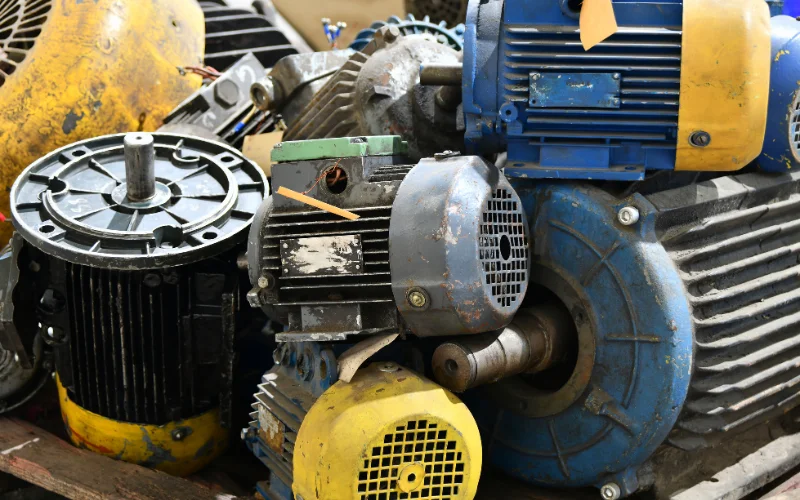
As the armature conductor traverses the magnetic field lines during rotation, a parallel to the workings of a generator emerges. An electromagnetic field is induced within the armature conductors, giving rise to an Electromotive Force. This induced EMF, in essence, acts as an opposing force, creating a counteracting effect to the initially applied Voltage, as dictated by Lenz’s law.
Generators: Transformation of Motion into Energy
In the world of generators, the dual role phenomenon unveils itself as the transformation of mechanical motion into electrical energy. When a generator’s rotor is turned, either through automated means like turbines or by harnessing other forms of power, the magnetic field interacts with the conductors in the rotor. This interaction induces a voltage, creating an electromagnetic force (EMF) across the generator’s terminals. Here, the device takes on its generator role, converting kinetic energy into electrical energy ready for transmission and utilization.
Conversion of Electrical Energy into Motion
Transitioning to the motor context, the same dual role phenomenon is reversed. Now, the device operates as a motor, utilizing electrical energy to generate motion. An electrical current flows through the motor’s coils, creating a magnetic field. This magnetic field then interacts with the field of permanent magnets or electromagnets, resulting in a rotational force known as torque. This torque sets the motor’s rotor into motion, converting electrical energy into mechanical movement.
Unified by Electromagnetism
The dual role of generators and motors finds its unity in the principles of electromagnetism. In both cases, the interplay between magnetic fields and conductors gives rise to Voltage and current. This unity forms the backbone of electrical machines, enabling energy transfer between mechanical and electrical domains.
Implications and Applications
Understanding this dual role has profound implications for various industries. Engineers and scientists harness this phenomenon to design devices that drive power generation, transportation systems, industrial machinery, and more. The principles behind this duality enable the creation of energy-efficient technologies that underpin our modern way of life.
Back EMF Emerges
This counteracting EMF called Back EMF or Counter EMF (Eb), embodies a crucial aspect of DC motor behavior. Mathematically, it is expressed as Eb = (PΦZN/60A), where P represents the number of poles, Φ signifies the magnetic flux, Z is the number of armature conductors, N denotes the speed of rotation, and A stands for the number of parallel paths within the armature.
An Intriguing Dynamic: Impact on Motor Performance
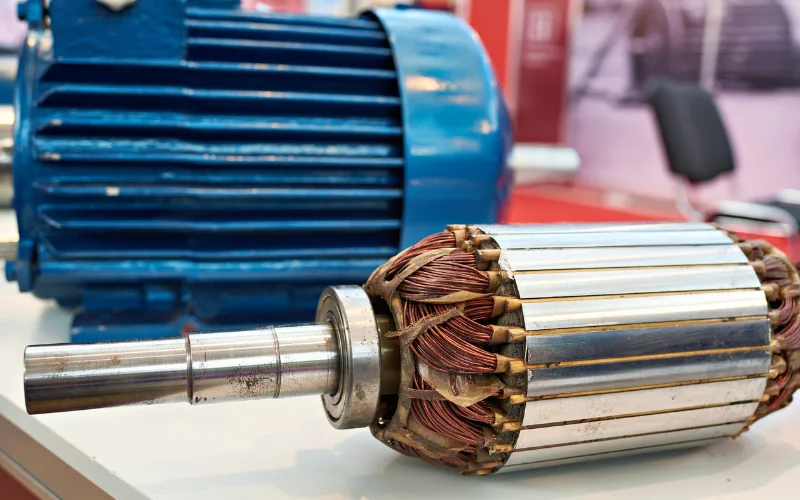
The relationship between the applied Voltage (V) and Back EMF (Eb) shapes the overall performance of the DC motor. As the motor accelerates, Eb increases due to the higher rate of magnetic flux linkage. According to the equation V- Eb, this results in a diminished net voltage across the engine. Consequently, the motor current decreases, aligning with Ohm’s law (I = V/R) and contributing to efficient motor operation.
Within the realm of electric motors lies an intriguing dynamic that intricately influences their performance, efficiency, and behavior. This dynamic revolves around the concept of Back Electromotive Force (EMF), an essential phenomenon pivotal in motor dynamics.
Understanding Back EMF
Back EMF, also known as Counter EMF, arises from the interaction between a rotating armature and the magnetic field within a motor. As the armature spins, it cuts through the magnetic flux lines, inducing a voltage in the conductors. This induced Voltage opposes the applied Voltage that drives the motor, according to Lenz’s law.
A Self-Regulating Mechanism
The impact of Back EMF on motor behavior becomes particularly apparent in its influence on the overall circuit dynamics. As the motor accelerates, the rate of change of magnetic flux linkage intensifies, leading to a stronger Back EMF. This counter voltage subtracts from the externally applied Voltage, reducing the net Voltage across the motor. Consequently, the motor’s current, governed by Ohm’s law, decreases proportionally, acting as an automated mechanism that prevents excessive current surges as speed increases.
Efficiency and Performance Gains
The intriguing dynamic created by Back EMF holds significant implications for motor efficiency and performance. By naturally limiting the current, Back EMF prevents overheating and energy wastage in the motor. This inherent regulation ensures stable operation and optimal energy utilization, contributing to the motor’s longevity and overall efficiency.
Tailoring Motors for Specific Needs
Engineers harness the understanding of Back EMF to design motors that align with specific application requirements. Engineers can fine-tune motor characteristics such as speed regulation, torque output, and power efficiency by factoring in Back EMF during the design phase. This customization enables motors to excel in diverse industries, from manufacturing and robotics to automotive and renewable energy systems.
Innovating Through Understanding and Control
Understanding Back EMF is integral to engineering efficient and responsive DC motor systems. Engineers harness this phenomenon to optimize motor behavior, especially in applications demanding precise control and speed regulation. By factoring in Back EMF, motor designs can be tailored to achieve desired performance characteristics while minimizing energy loss.
Precision through Control
Understanding doesn’t just lead to optimization; it empowers unprecedented control. The ability to manipulate variables based on insights allows for the orchestration of systems with unparalleled precision. In the context of motors, the awareness of Back EMF’s role facilitates the creation of control strategies that regulate speed, torque, and energy consumption. Engineers can ensure that engines adapt to changing conditions through sophisticated feedback mechanisms and advanced algorithms while maintaining their desired performance levels.
Enabling Breakthroughs Across Industries
The synergy between understanding and innovation reverberates across industries. In manufacturing, optimized motors lead to increased production efficiency and reduced downtime. Robotics benefit from precise control mechanisms, enabling machines to mimic human-like motions with enhanced accuracy. Energy sectors embrace energy-efficient motors that reduce consumption and contribute to sustainability efforts.
Challenges and Uncharted Terrain
While innovation through understanding has unlocked remarkable achievements, challenges remain. The intricate interplay of electromechanical systems often leads to complex behaviors that demand sophisticated approaches. Striking the balance between theoretical insights and practical applications can be delicate, requiring interdisciplinary collaboration and continuous refinement.
Conclusion
As we conclude this exploration, we recognize that Back EMF’s impact extends beyond DC motors. It resonates with the broader principles of electromagnetism, offering lessons in self-regulation, equilibrium, and the intricate interplay of energy and motion. The journey from flux to force, guided by Back EMF, is a testament to the elegance of natural laws and the boundless possibilities they unlock. As we move forward, this newfound insight ignites our collective passion for harnessing electromagnetism’s hidden symphonies, propelling us toward a future where innovation and understanding harmonize for the betterment of our technological world.