Shell Type Transformers | Efficient Power Solutions
If you’re exploring efficient power solutions, shell-type transformers might interest you. They encase their windings within the core, offering a unique design that enhances magnetic shielding and minimizes electromagnetic interference. This configuration boosts efficiency and provides remarkable mechanical strength, making these transformers reliable even under fluctuating loads. You’re likely curious how these attributes translate into real-world applications and their impact on power distribution. Could these transformers redefine the standards of urban power systems? Let’s examine their role and potential benefits in modern infrastructure.
Key Takeaways
- Shell-type transformers have a core surrounding windings, enhancing magnetic shielding and efficiency.
- They have superior short-circuit strength and reliability and are suitable for demanding industrial applications.
- E and L-shaped laminations in the core reduce core losses and boost efficiency.
- They are ideal for urban distribution due to their compact design and reduced electromagnetic interference.
- They offer extended service life through robust design, maintaining structural integrity under stress.
UnderstandingShell-Typee Transformers

Understanding the intricacies of shell-type transformers is fundamental to grasping their role in modern electrical systems. These transformers utilize a core surrounding the windings, offering superior magnetic shielding. This design minimizes electromagnetic interference, enhancing efficiency and making shell-type transformers ideal for high-performance applications.
The core’s construction with E and L-shaped laminations provides mechanical strength and a closed magnetic path. This configuration guarantees that magnetic flux is channeled efficiently, thereby reducing core losses and improving overall efficiency.
Shell-type transformers rely on the arrangement of the high-voltage (HV) and low-voltage (LV) windings. They’re typically arranged in a sandwich configuration, with the HV coils nestled between two LV coils. This setup uses conductor materials more efficiently and provides advantages over traditional core-type transformers.
The compactness and reduced leakage flux make these transformers suitable for distribution, especially in constrained urban environments. Shell-type transformers, which focus on reliability and safety through enhanced insulation and core shielding, guarantee greater reliability, which is fundamental for high-voltage applications where safety is paramount.
Core Design and Structure
When exploring the unique attributes of shell-type transformers, one can’t overlook the intricacies of their core design and structure. The core is ingeniously constructed using E and L-shaped laminations, which are pivotal in minimizing core losses and boosting efficiency.
This core design features three limbs. The central limb carries the entire magnetic flux, while the two side limbs handle half. Thus, the transformer’s magnetic flux distribution is improved.
The configuration of shell-type transformers facilitates the flow of magnetic flux through two closed paths within the core. This design greatly reduces core losses, setting it apart from other types like core-type transformers. Furthermore, the shorter magnetic path means these transformers require less magnetizing current, resulting in higher efficiency.
The core design of shell-type transformers provides substantial mechanical strength and efficiency. It shields the winding structure from shocks, enhancing resilience during short-circuit conditions.
This sturdy construction extends the transformer’s lifespan and guarantees reliable performance under varying electrical loads. Shell-type transformers are, therefore, a preferred choice for many electrical applications.
Key Components Overview
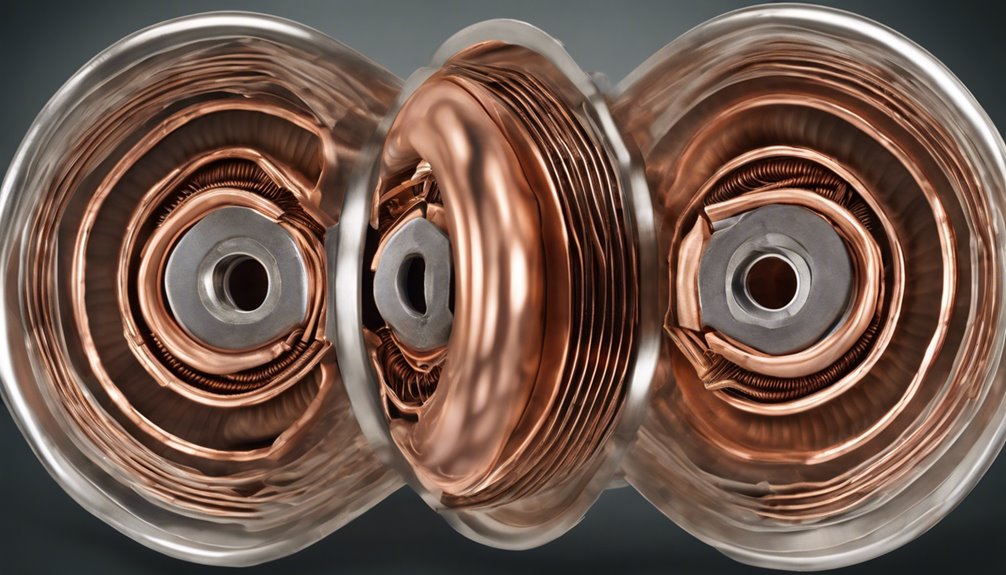
As you explore the key components of a shell-type transformer, focus on the core and winding structures that enhance magnetic efficiency and reduce energy loss.
Notice how insulation materials are essential in maintaining electrical safety by separating the windings and ensuring reliable performance.
Understanding these elements helps you appreciate the intricate design that optimizes functionality and safety.
Core and Windings Structure
The core’s structure is vital in a shell-type transformer, utilizing E and L-shaped laminations to form three limbs. The core’s central limb is fundamental as it carries all the magnetic flux, while the side limbs manage half the flux. This design enhances mechanical strength and reduces core losses, making it efficient and reliable.
The windings also play a significant role; they alternately have a high-voltage stage (LV) and low-voltage around the core. In this shell-type, confisheconfig shell-type thels are sandwiched between two LV coils. This arrangement guarantees that the primary and secondary coils are effectively layered, optimizing the magnetic flux flow and minimizing the material needed.
Due to its complexity, this unique winding configuration requires less conductor material than core-type transformers and careful insulation. The central limb’s support for the windings guarantees efficient magnetic flux management, boosting the transformer’s performance and efficiency.
Additionally, this setup enhances the transformer’s ability to withstand electromagnetic forces during short circuits, providing greater reliability and performance under fluctuating load conditions. Understanding these core and winding structures lets you appreciate shell-type transformers’ advantages in various applications.
Insulation and Safety Measures
Understanding the core and winding structures lays the foundation for appreciating the importance of insulation and safety measures in shell-type transformers. Insulation is essential for electrical safety, employing materials like paper or oil to separate windings and prevent short circuits effectively. Given the complex arrangement of windings in shell-type transformers, enhanced insulation layers are critical. Proper management is key to avoiding layer-to-layer failures and ensuring the transformer’s safety and efficiency.
High-voltage bushings play a central role by providing safe external connections while maintaining insulation integrity. They’re fundamental for handling the elevated voltages these transformers often deal with. Additionally, core shielding greatly reduces electromagnetic interference, bolstering safety and making these transformers ideal for high-voltage applications.
It can’t be overstated. How important it is to maintain and inspect insulation integrity regularly. Over time, insulation may degrade, leading to potential catastrophic failures if not addressed. Consistent maintenance can extend the transformer’s life, guaranteeing long-term reliability and performance.
In high-voltage environments, maintaining insulation integrity isn’t just a recommendation but a necessity for safety and operational efficiency. Always prioritize these measures to safeguard both the equipment and the environment it’s placed in.
Efficiency and Compactness
Shell-type transformers stand out in energy distribution with their remarkable efficiency and compact design. Their laminated steel core creates a closed magnetic loop that minimizes energy losses and effectively confines magnetic flux. This design guarantees lower core losses, directly boosting efficiency and making it a smart choice for energy transfer. Their compactness is a game changer, especially in urban power distribution systems where space is at a premium. They fit snugly into tight spaces by reducing leakage flux without compromising performance.
Also, shell-type transformers excel in high voltage and power applications due to their superior electromagnetic shielding. This minimizes the risk of interference from external noise, guaranteeing reliable operation. Imagine the satisfaction of knowing your transformer is running efficiently, with minimal energy waste. Here’s a glance at their impressive features:
| Feature | Benefit |
|---|---|
| Laminated Steel Core | Improved energy efficiency |
| Compact Design | Ideal for space-constrained areas |
| Electromagnetic Shielding | Reduced interference risk |
| Lower Core Losses | Enhanced energy transfer |
These attributes make shell-type transformers not just a choice but necessary for efficient and compact energy solutions.
Mechanical Strength Benefits
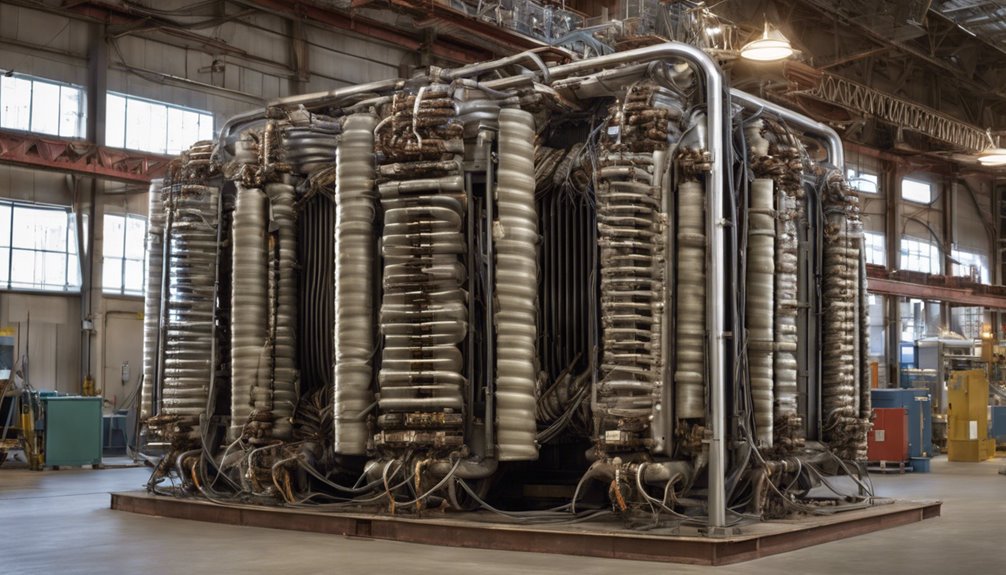
Beyond their efficiency and compactness, you’ll appreciate shell-type transformers’ mechanical strength benefits. Their robust core design provides significant mechanical strength, allowing them to withstand external forces and vibrations while keeping the windings unharmed. This is particularly important when faced with short-circuit conditions, where the risk of winding movement can compromise operational integrity.
Fortunately, shell-type transformers are designed to handle these high-stress scenarios gracefully.
Here’s why shell-type transformers stand out:
- Enhanced Stability: The three-limb configuration guarantees that the central limb carries all the magnetic flux while the side limbs bolster the structure, providing exceptional stability.
- Superior Short-Circuit Strength: Due to their sturdy construction, shell-type transformers boast superior short-circuit strength compared to core-type transformers, making them ideal for demanding industrial applications.
- Increased Reliability: These transformers minimize insulation failures with enhanced mechanical support, improving reliability even under fluctuating load conditions.
- Extended Service Life: Their ability to maintain structural integrity under stress extends their service life, offering a durable and dependable solution.
Noise Reduction Capabilities
Reducing operational noise is a standout feature of shell-type transformers, making them a preferred choice in noise-sensitive areas. The compact core design plays a vital role, as it reduces leakage flux, a major contributor to noise. You’ll appreciate the benefits of the laminated steel used in the core construction. It effectively dampens sound by minimizing magnetostriction—a phenomenon that can increase noise levels. This results in a quieter operation overall.
Another advantage of shell-type transformers is their mechanical strength. They minimize vibrations during operation, ensuring low noise levels. These transformers excel in urban installations where noise can be a major concern. Sound insulation materials are typically incorporated around the core and windings, enhancing their quiet performance.
Here’s a quick comparison to highlight these features:
| Feature | Benefit | Impact on Noise |
|---|---|---|
| Compact Core | Reduces leakage flux | Lowers operational noise |
| Laminated Steel | Minimizes magnetostriction | Dampens sound |
| Mechanical Strength | Reduces vibrations | Quieter performance |
| Sound Insulation | Enhances quiet operation | Ideal for urban installations |
Choosing shell-type transformers means prioritizing a quieter, more efficient operation in any environment.
Applications in Power Distribution
Shell-type transformers are essential in power distribution networks. They step down high-voltage electricity for residential, commercial, and industrial applications. They guarantee efficient energy transfer and safety, making them crucial components in various settings.
These transformers are particularly useful in urban areas where space is limited. Their compact design minimizes leakage flux and reduces electromagnetic interference.
Here’s why shell-type transformers are indispensable in power distribution:
- Compact Design: Their small footprint is perfect for urban installations, maximizing space while minimizing electromagnetic interference.
- Mechanical Strength: They offer superior mechanical strength, which enhances reliability in environments with fluctuating loads and potential short-circuit conditions.
- Low Voltage Applications: These transformers efficiently step down high voltage for low voltage applications, guaranteeing energy is safely and effectively delivered to end-users.
- Noise Reduction: Lower operational noise levels are ideal for installations in noise-sensitive areas.
Incorporating shell-type transformers into renewable energy systems like solar and wind farms guarantees efficient energy transfer and integration into the power grid.
Their versatility and reliability make them a go-to choice for modern power distribution needs.
Industrial and Renewable Use
Shell-type transformers emerge as indispensable tools for efficient power management when exploring the industrial and renewable sectors. These transformers deliver reliable power to machinery and manufacturing processes in industrial applications. Their robust construction guarantees high mechanical strength, greatly reducing the risk of damage from electromagnetic forces. This reliability is imperative for maintaining continuous industrial operations without unexpected downtimes.
Shell-type transformers are equally important in renewable energy systems like wind and solar farms. They facilitate voltage transformation and regulation, allowing for the seamless integration of generated power into the grid. This capability is fundamental, given the variable outputs typical of renewable sources.
Another advantage of shell-type transformers is their compact design, especially in industrial settings where space is often limited. Their space-saving nature allows for efficient installations without sacrificing performance.
Additionally, these transformers are well-suited for environments that experience fluctuating load conditions. Their exceptional reliability guarantees consistent performance, which is particularly beneficial in renewable energy applications that require high short-circuit strength.
Maintenance and Lifespan
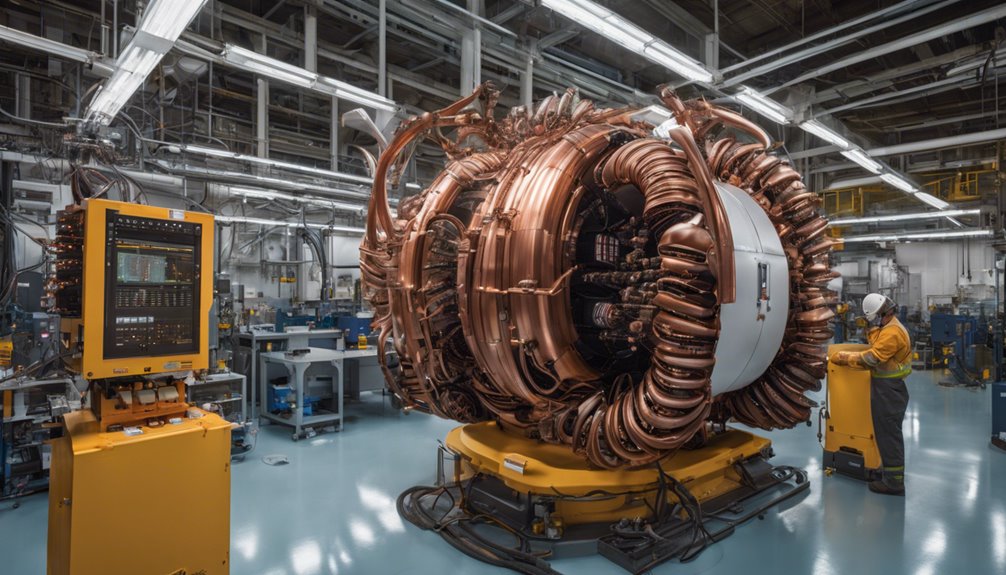
To guarantee that your shell-type transformer runs smoothly and lasts, you must conduct regular inspections that target oil levels and insulation integrity.
These checks prevent failures and extend the transformer’s lifespan well beyond the typical 20 to 30 years.
Regular Inspection Importance
Regular inspections are essential for guaranteeing that your shell-type transformer operates at its best and remains reliable throughout its lifespan. By identifying potential issues such as oil leaks and insulation degradation early on, you can prevent them from escalating into considerable failures.
A well-planned maintenance schedule, including regular inspections, is imperative to extending the operational life of your transformer, allowing it to perform reliably for 20 to 30 years.
To enhance the lifespan and reliability of your shell-type transformer, focus on these key areas:
- Oil Levels and Leaks: Regularly monitor oil levels to prevent overheating and electrical short-circuits. Spotting leaks early guarantees the cooling system remains efficient.
- Insulation Integrity: Check insulation materials for signs of degradation, which can compromise the transformer’s safety and efficiency.
- Bushing and Cooling System: Inspect the integrity of the bushings and the cooling system. These components are essential for operational safety and efficiency.
- Winding Configuration: Due to the complex winding configuration, meticulous inspection is necessary to detect inner winding defects. For thorough maintenance, outer windings might need to be removed.
Implementing these steps in your maintenance schedule will greatly boost your transformer’s reliability, keeping it in top condition.
Extending Operational Life
To extend the operational life of your shell-type transformer, focus on meticulous maintenance and timely upgrades. Start with regular inspections to monitor oil levels and guarantee insulation integrity. This will catch potential issues before they become significant problems, maintaining the transformer’s performance and extending its lifespan beyond 20 to 30 years.
Maintenance is vital, especially given the complex winding configuration of shell-type transformers. Skilled technicians are necessary for effective repairs and servicing. They play a pivotal role in checking for moisture in insulation materials and confirming the integrity of bushings, which are essential for enhancing reliability.
Don’t underestimate the importance of your cooling system. Regularly monitor it to verify efficient heat dissipation, prevent overheating, and maintain ideal operating conditions. Proper cooling reduces the heat generated, which can otherwise degrade insulation and shorten your transformer’s operational life.
Comparing Core and Shell Designs
The choice between core and shell-type transformers hinges on their distinct structural designs and applications. Core-type transformers have a magnetic circuit of two vertical limbs and two horizontal yokes. In contrast, shell-type transformers boast a central limb flanked by two outer limbs. This design difference allows shell types to complete the magnetic circuit more compactly.
Core-type designs have windings surrounding the core, while shell types have the core enveloped by the windings. This configuration offers better support against electromagnetic forces and enhances the efficiency of shell types in low-voltage applications.
- Core type transformers: Easier dismantling for maintenance due to their simpler winding structure.
- Shell-type transformers: More complex winding, making repairs trickier but offering reduced copper and core losses.
- Magnetic circuit efficiency: Shell-type transformers use E, L, and T-shaped laminations, contributing to their higher efficiency.
- Application suitability: Core types excel in high-voltage scenarios, whereas shell types shine in low-voltage settings.
Ultimately, your choice between these two designs depends on your specific needs for efficiency, maintenance ease, and voltage application. Each offers unique strengths tailored to different operational demands.
Conclusion
You’ve seen how shell-type transformers offer superior efficiency and reliability. Their unique core design encases the windings, reducing electromagnetic interference and energy losses. These transformers’ compact form and robust three-limb configuration provide excellent mechanical strength and short-circuit resistance. They’re perfect for urban power distribution and various industrial applications, including renewable energy. By understanding their advantages, you can appreciate their role in delivering efficient, long-lasting power solutions for diverse needs.
FAQs
1. What Is the Difference Between Core Type and Shell Type?
You’re comparing core-type and shell-type transformers. Focus on core geometry, magnetic flux paths, and winding arrangement. Core types offer easier maintenance, while shell types excel in efficiency. When choosing, consider manufacturing techniques and application suitability.
2. What Are the 3 Types of Transformers?
You’ll find core, auto, and distribution transformers when discussing power transformer types. Each has unique design principles that affect efficiency, electrical isolation techniques, and applications. Magnetic circuit analysis helps optimize these transformers for various applications.
3. What Are Closed Core and Shell Type Transformers?
C-losed-coursee transformers include a shell structure that enhances magnetic coupling and transformer efficiencInterwinconfiguration efficiency action, leading to better performance reliability in high-voltage applied compact high-voltages-voltages.
4. What Are the Compact Open-Course Transformers?
You’re exploring limb construction features, focusing on transformer design principles. The central limb handles all magnetic flux, while the side limbs share half each. Insulation materials and limb dimensions impact efficiency optimization techniques, effectively optimizing magnetic flux paths.