Unraveling the Laws of Magnetic Circuit
Magnetism has been a captivating force since ancient times, with early civilizations intrigued by lodestones’ properties and using magnetic compasses for navigation. However, it was not until the 16th century that William Gilbert’s pioneering work established magnetism as a science. His influential book, “De Magnete,” laid the foundation for understanding the magnetic field and its behavior. Since then, the study of magnetism has evolved, leading to the discovery of essential laws and principles that govern magnetic circuits and their applications in various technological advancements.

Magnetic Circuit Calculations
The magnetic circuit forms the backbone of numerous electrical and electronic devices, enabling the efficient transmission and utilization of magnetic energy. Unraveling the fundamental laws governing the magnetic circuit is crucial to understanding and optimizing these systems. It stated that the laws governing the steady flow of electricity in a course may readily be modified. To be at once applicable to the magnetic circuit. Thus
Magnetomotive Motive Force = Flux x Reluctance
F= Φ x S

Corresponding exactly to Electromotive Force = Current x Resistance
Reluctance = (length/area) x (1/Permeability)
= l/Aμ
For a magnetic of a uniform sectional area corresponding exactly to
Resistance = (length/area) x (1/conductivity)
It is often convenient to calculate in terms of unit dimensions. We then have
m.m.f per unit length = Flux x Reluctance per unit length
= (Flux/area) x (l/permeability)
= Flux density x (l/permeability)
Magnetic Field Intensity H = B/μ
This corresponds exactly to the,
For a material carrying a uniform distributed flux and of length l, then the total m.m.f is then equal to the m.m.f per unit length x l
i.e. F=Hl or AT=Hl
For dealing with the magnetic circuit in which the flux has to permeate several different portions in seconds, the methods employed for coping with series electric circuits can at once be applied, the total reluctance being the sum of the values for the various portions. Normally, the importance of the reluctance are only of a moment in so far as it permits a deal to be determined for the m.m.f required to establish a given flux in the circuit. It is often the simplest method to determine this value of the total m.m.f by summing the values of m.m.f necessary to establish the flux through the various parts of the circuit. This is exactly in line with calculating the total voltage drop in an electric circuit by summing the voltage drop values in the various parts.
Thus the total value of the m.m.f facing around a complete magnetic is given by
AT (or) F = ∫Hdl
Or where the circuit consists of some homogeneous parts, each of uniform cross-section and length l1, l2 etc.
Total m.m.f F (or) AT = Σ Hl = H111 + H2l2 + ….
= Φ [S1 + S2 + ….]
If the values for the area and permeability of the various portions of the circuits are, respectively, A1, μ1, etc., the total m.m.f becomes
AT (or) F = (B1/μ1)l1 + (B2/μ2)l2 + …..
Where B1 = Φ/A1 etc
Occasionally it is convenient to express the fundamental law of the magnetic circuit in the form.
Flux = magnetomotive force x Permeance
Permeance is nothing but the reciprocal of the reluctance to deal with paths in parallel; the total Permeance is the sum of the values for the individual paths.
The main difference between electric and magnetic calculations arises from the fact that the resistance of an electric circuit is not directly dependent upon the values of the reluctance of a magnetic substance but is dependent to an enormous extent upon the value of the flux permeating it.
The Magnetic Field and Magnetic Flux
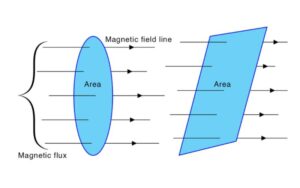
Understanding the magnetic field is crucial to comprehend how magnets interact with each other and with other objects. The concept of the magnetic field is visually represented through Faraday’s lines of force, which indicate the direction and strength of the magnetic field. Magnetic flux, the measure of a magnetic field passing through a surface, is crucial in understanding magnetic interactions. Calculating magnetic flux is essential for various applications, particularly in magnetic circuits and transformers.
Ampère’s Circuital Law
André-Marie Ampère’s contributions revolutionized the understanding of electromagnetism. His experiments with current-carrying conductors led to the formulation of Ampère’s Circuital Law, which establishes the relationship between magnetic fields and electric currents. The law provides a fundamental tool for analyzing magnetic circuits and calculating the magnetic field produced by current-carrying conductors. Ampère’s Circuital Law laid the groundwork for future advancements in electromagnetism.
Magnetic Induction and Faraday’s Law
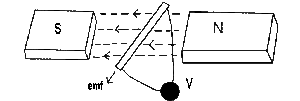
Michael Faraday’s groundbreaking experiments on electromagnetic induction marked a turning point in electromagnetism. Faraday’s Law states that a changing magnetic field induces an electromotive force (emf) in a conductor. This discovery paved the way for developing inductive components, such as transformers and inductors, essential in modern electrical systems.
The B-H Curve and Hysteresis
The B-H curve represents the relationship between magnetic induction (B) and magnetic field strength (H) in a magnetic material. Understanding the B-H curve is essential for predicting the behavior of magnetic materials under varying magnetic fields. Hysteresis refers to the phenomenon where a magnetic material retains residual magnetism even after removing the applied magnetic field. This behavior leads to energy losses in magnetic circuits, and minimizing hysteresis effects is crucial for efficient operation.
Magnetic Circuit Analysis

Magnetic circuits can be analyzed using principles analogous to electrical circuits. Models and equivalent courses simplify complex magnetic systems, making studying and understanding their behavior easier. Parameters such as magnetic field strength, magnetic flux, and magnetic reluctance are calculated to evaluate and optimize magnetic circuits. Kirchhoff’s laws, borrowed from electrical circuit analysis, are applied to magnetic circuits for solving practical problems.
Applications of Magnetic Circuits
Magnetic circuits find a wide range of applications in modern technology. Electric motors and generators utilize magnetic circuits to convert electrical energy into mechanical work and vice versa. Using principles like the Hall effect, magnetic sensors find applications in various industries, including automotive, medical, and consumer electronics. Magnetic shielding is essential for protecting sensitive electronic devices from electromagnetic interference (EMI) caused by external magnetic fields.