Mpcb Electrical | Motor Protection Circuit Breakers
If you’re curious about how to protect your electric motors from overloads and short circuits, it’s time to explore Motor Protection Circuit Breakers (MPCBs). These devices are essential for maintaining the health and efficiency of your motor systems. By understanding how MPCBs operate and their key features, you’ll gain valuable insights into safeguarding your equipment. But what sets MPCBs apart from other protection devices, and how do you choose the right one for your needs?
Key Takeaways
- MPCBs are designed to protect electric motors against overloads, short circuits, and phase imbalances.
- They use thermal and magnetic mechanisms to detect and respond to electrical faults.
- MPCBs have adjustable settings for customized thermal overload protection tailored to specific motor needs.
- They are cost-effective and user-friendly, with simpler installation compared to MCCBs.
- MPCBs are ideal for low-power motor circuits with current ratings from 0.1A to 63A.
Understanding Motor Protection Circuit Breakers
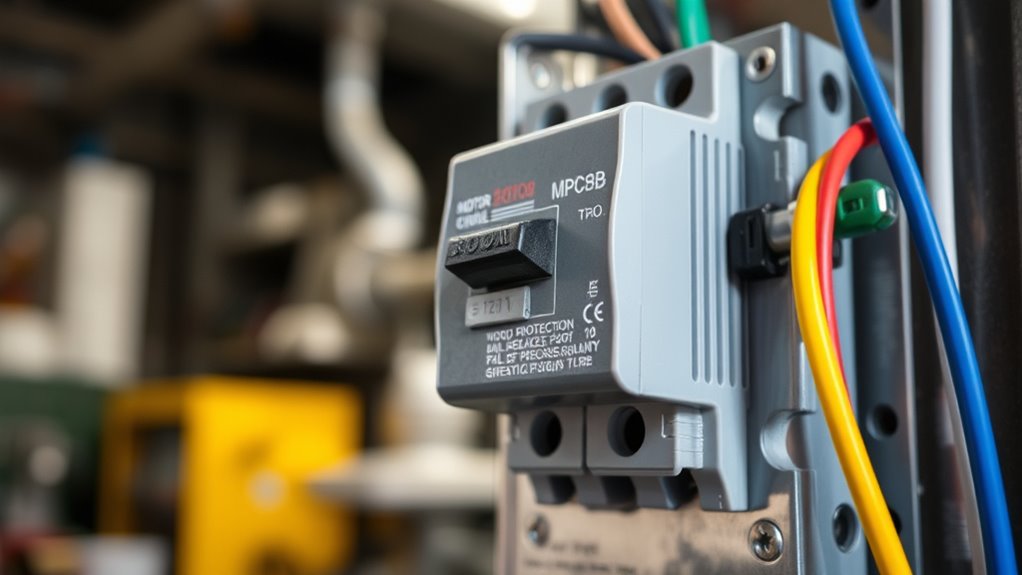
When it comes to safeguarding your electric motors, Motor Protection Circuit Breakers (MPCBs) are indispensable.
As a vital electrical protection device, an MPCB offers extensive motor protection by guaranteeing your motors are shielded from overloads and short circuits. It achieves this through a dual-action principle, providing thermal protection for overload protection and magnetic protection for short-circuit protection.
You’ll need to select the right MPCB based on your motor’s current ratings to prevent both under- and over-protection. These devices are adept at detecting phase loss and imbalances, promptly isolating the motor to avert damage.
With various types available, including thermal, magnetic, and electronic models, MPCBs guarantee your motors run smoothly and last longer.
Key Functions of MPCBs
Although often overlooked, the key functions of Motor Protection Circuit Breakers (MPCBs) are essential in maintaining the longevity and efficiency of your motors.
These devices provide extensive motor protection by offering overload protection, which trips the circuit when excessive current is detected, thereby preventing thermal damage. MPCBs also provide short-circuit protection, instantly disconnecting to safeguard against high-current faults.
Phase failure detection ensures your motor is protected from overheating due to phase loss or imbalance. With adjustable settings for thermal overload protection, you can tailor the MPCB to your motor’s specific needs.
Additionally, the restart lockout mechanism prevents immediate reactivation after a fault, thereby enhancing safety and reliability. All these features combine to offer robust electrical protection, guaranteeing your motors run smoothly and reliably.
Working Principle of Motor Protection Circuit Breakers
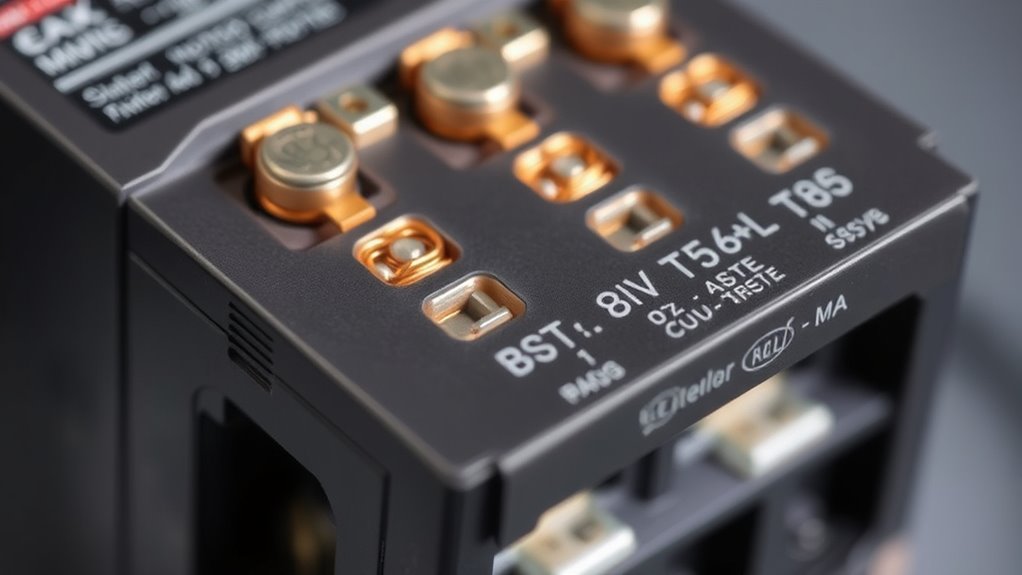
You’re about to explore how Motor Protection Circuit Breakers (MPCBs) safeguard motors using a dual-action protection mechanism.
They employ both thermal and magnetic protection to effectively handle overloads and short circuits.
Additionally, MPCBs feature phase detection, which automatically disconnects the motor during phase imbalances, ensuring enhanced safety and reliability.
Dual-Action Protection Mechanism
Motor Protection Circuit Breakers (MPCBs) employ a dual-action protection mechanism to safeguard electric motors effectively. This system combines thermal protection and magnetic protection within the protection circuit breaker to combat electrical faults.
Thermal protection utilizes a bi-metallic strip, tripping the breaker when the motor overheats due to overloads. Meanwhile, magnetic protection kicks in instantly during short circuits, employing an electromagnet to disconnect power and prevent immediate damage.
You’ll find that this thorough protection guarantees reliable motor operation by addressing both overloads and short circuits. Additionally, although not the primary focus here, MPCBs incorporate phase detection to enhance their protective capabilities.
Ultimately, this dual-action mechanism extends motor longevity and minimizes the risk of operational failures in your motor-driven equipment.
Phase Detection and Safety
When it comes to safeguarding electric motors, the phase detection mechanism in Motor Protection Circuit Breakers (MPCBs) plays an essential role. MPCBs monitor current in each phase, identifying imbalances that can threaten motor health. If a phase failure occurs, the MPCB swiftly disconnects the motor, preventing overheating due to increased current in the remaining phases. This phase detection ensures motor protection by tripping the circuit when imbalances exceed predetermined thresholds, thereby providing both thermal and magnetic protection.
| Function | Purpose | Outcome |
|---|---|---|
| Phase Detection | Identify imbalances | Safeguard the motor |
| Thermal Protection | Prevent overheating | Enhance electrical safety |
| Magnetic Protection | Respond to faults | Preserve motor integrity |
With phase detection, MPCBs enhance electrical safety and prolong motor life, making them indispensable in any motor-driven system.
Types and Features of MPCBs
When choosing MPCBs, you’ll encounter options like Thermal Magnetic and Electronic types, each offering distinct advantages.
Thermal Magnetic MPCBs combine thermal overload and magnetic short-circuit protection, making them versatile for various motor applications.
On the other hand, Electronic MPCBs provide enhanced control and diagnostics, adapting easily to varying operational conditions.
Thermal Magnetic Protection
Although motor protection is essential in industrial applications, understanding the nuances of Thermal Magnetic Protection in Motor Protection Circuit Breakers (MPCBs) can elevate your system’s reliability.
An MPCB utilizes thermal magnetic protection to address overload conditions and short circuits efficiently. It detects phase imbalances, safeguarding motors from overheating. The thermal component allows for time to dissipate loads, while the magnetic element acts instantly during short circuits.
Adjustable MPCBs enable you to set thermal trip limits tailored to your motor’s specific needs, accommodating various inrush currents. Conforming to international standards such as IEC 60947-4, these breakers ensure reliable safety in motor applications.
Electronic Control Capabilities
To enhance motor protection and system efficiency, electronic Motor Protection Circuit Breakers (MPCBs) offer advanced control and diagnostic capabilities. They utilize electronic components for precise control, allowing for accurate fault detection.
With programmable settings, you can adjust trip parameters for overload and short circuit protection, making them suitable for various motor applications. Here’s what you can expect from electronic MPCBs:
- Real-time Monitoring: Built-in communication capabilities for seamless integration and performance tracking.
- Quick Response: Faster tripping times reduce the risk of motor damage during electrical faults.
- Phase Monitoring: Detects phase failure and imbalance to maintain motor health.
- Customizable Protection: Adjustable settings allow you to tailor protection levels to specific operational conditions.
These features guarantee your motors remain efficient and well-protected.
Guidelines for Sizing and Selecting MPCBs

Sizing and selecting Motor Protection Circuit Breakers (MPCBs) are vital steps in guaranteeing your motor’s longevity and efficiency. Start by checking the motor’s nameplate for rated power and current. MPCB models enable you to select protection that prevents both under- and over-protection. Consider the inrush current at startup; many MPCBs have adjustable settings for this. Confirm the voltage rating matches the motor’s. Evaluate operational conditions and environmental factors, such as temperature and humidity. Regularly update MPCB settings to ensure optimal motor protection.
| Consideration | Importance |
|---|---|
| Rated Power and Current | Essential for proper protection, circuit breaker sizing |
| Voltage Rating | Must match the motor’s nameplate voltage |
| Adjustable Settings | Accommodate inrush current |
| Operational Conditions | Affect MPCB performance |
| Environmental Factors | Influence longevity and efficiency |
Comparing MPCBs and MCCBs: Key Differences
When it comes to safeguarding electrical systems, understanding the differences between Motor Protection Circuit Breakers (MPCBs) and Molded Case Circuit Breakers (MCCBs) is essential.
An MPCB is a protection circuit breaker specifically designed for motor protection, safeguarding against overloads, short circuits, and phase failures. In contrast, MCCBs are versatile, covering a wide range of electrical applications by handling larger fault currents and providing adjustable trip settings.
Here are the key differences:
- Protection Focus: MPCBs provide precise thermal and magnetic protection for motors, whereas MCCBs are suitable for a broader range of applications.
- Current Rating: MPCBs handle 0.1A to 63A; MCCBs suit higher power needs.
- Cost: MPCBs are more cost-effective for motors, while MCCBs are more expensive due to their added versatility.
- Installation: MPCBs are simpler to install compared to MCCBs.
Conclusion
In choosing the right Motor Protection Circuit Breaker, you’ll guarantee your motors are safeguarded against overloads and short circuits. By understanding their key functions and working principles, you’ll appreciate their role in maintaining efficient and reliable operations. Remember to consider the types, features, and appropriate sizing to match your motor’s specific needs. Unlike MCCBs, MPCBs offer a cost-effective solution specifically tailored for motor protection, making them an essential component of your electrical system.
FAQs
1. What Is MPCB Electrical?
You’re wondering about MPCB Electrical, right? It’s a device that protects motors from overloads and short circuits. It guarantees safe operation by disconnecting power during faults, using thermal and magnetic mechanisms. It’s essential for motor-driven systems.
2. What Is the Difference Between MCBP and MCCB?
You should know that MPCBs protect motors specifically, featuring thermal and magnetic safety, while MCCBs offer adjustable protection for various circuits. MPCBs are cost-effective for motor use, whereas MCCBs are suited to broader industrial needs with higher fault current capabilities.
3. Which Is Better, Mpcb or Thermal Overload Relay?
You’re comparing MPCBs and thermal overload relays. Choose MPCBs for extensive motor protection and simplified installation. They offer integrated short circuit and overload protection, adjustable settings, and enhanced safety features. Thermal overload relays focus mainly on overload protection.
4. What Can Mpcb Protect Against?
You can rely on MPCBs to protect against overloads, short circuits, phase loss, and phase unbalance. They trip circuits during faults, preventing motor damage, with features such as thermal protection and a manual restart lockout to enhance safety.