Oil Circuit Breakers: Benefits, Types, and Maintenance Explained
You can’t overlook the importance of oil circuit breakers when dealing with high-voltage systems. These devices use insulating oil to cool and quench arcs that form during electrical faults, ensuring reliable performance and efficient arc interruption. You’ll find that there are different types, such as Bulk Oil and Minimum Oil circuit breakers, each with its own set of benefits and drawbacks. But how exactly do these systems work, and what makes them a practical choice despite concerns about oil leakage and maintenance costs? Let’s explore further to see why they’re still widely used.
Key Takeaways
- Oil circuit breakers use insulating oil to cool and quench electrical arcs during faults.
- There are multiple types, including bulk oil and minimum oil circuit breakers.
- They provide reliable performance and effective arc energy absorption under extreme conditions.
- Maintenance of oil quality is crucial to prevent carbonization and maintain dielectric strength.
- Despite higher costs, they are practical for high-voltage systems and have relatively straightforward maintenance.
Construction
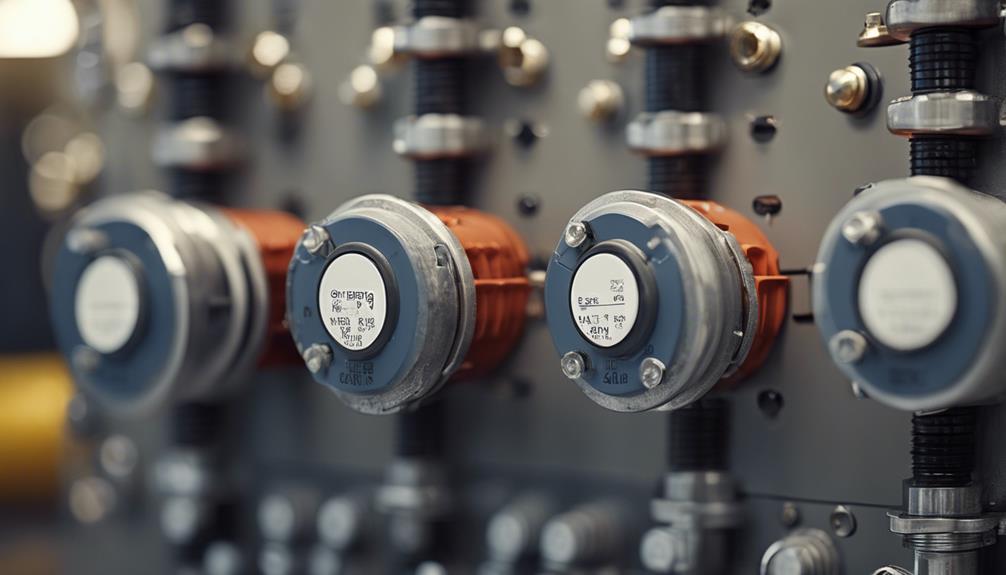
Oil circuit breakers typically feature current-carrying contacts enclosed in a robust metal tank filled with insulating oil. The tank’s primary role is to house and insulate these electrical contacts while also serving as an arc extinguishing medium. When an arc forms, the insulating oil is critical in cooling and quenching it, guaranteeing the circuit breaker functions effectively.
Inside the tank, you’ll find sophisticated components designed for arc control, such as arc splitter ducts. These ducts help manage the arc by splitting and cooling it, improving the breaker’s efficiency. Additionally, an air pad at the top of the tank absorbs shocks and controls displaced oil during operation, adding another layer of stability and safety.
The metal tank is securely bolted to handle vibrations and mechanical stresses interrupting high currents. Gas outlets are strategically placed in the tank cover to facilitate the removal of gases generated during the arcing process, preventing pressure buildup and ensuring safe operation. This thorough design ensures that the oil circuit breaker remains reliable and robust, able to withstand the demands of high-voltage environments.
Working Principle
When an arc forms between the contacts, the insulating oil vaporizes, creating a hydrogen gas bubble that aids in quenching the arc. This process is vital for the efficient operation of an oil circuit breaker.
The arc’s intense heat causes the insulating oil to vaporize rapidly, producing a hydrogen gas bubble. This expanding bubble increases pressure, which helps deionize the medium between the contacts.
The deionization process is essential because it raises the medium’s dielectric strength, facilitating arc interruption. The oil properties are pivotal here, as they guarantee the arc is quenched effectively during fault conditions. When the dielectric strength increases, the arc is interrupted more quickly and efficiently, preventing damage to the circuit.
In essence, an oil circuit breaker leverages the properties of insulating oil to provide reliable circuit protection. Extinguishing the arc swiftly minimizes the risk of extended electrical faults.
Combining the hydrogen gas bubble and the insulating oil’s properties ensures that the circuit breaker operates effectively, safeguarding your electrical systems under various fault conditions. This working principle underscores the importance of oil in maintaining circuit integrity and reliability.
Types of Oil Circuit Breakers

Understanding the different types of oil circuit breakers is essential for selecting the right one for your specific electrical needs. These breakers vary in design and functionality, each catering to unique requirements.
- Bulk Oil Circuit Breakers: These use a large quantity of insulating oil for arc extinguishing and insulation, making them suitable for high-voltage applications. The oil’s high dielectric strength guarantees efficient operation.
- Plain Break Oil Circuit Breakers: These breakers have a simple construction and feature a dome-shaped chamber filled with oil to extinguish arcs. They’re straightforward and reliable but mightn’t handle high currents as effectively.
- Arc Control Oil Circuit Breakers: These address the challenge of long arc lengths under high currents. Variants like self-blast and forced-blast oil circuits provide enhanced arc control. Plain and cross-jet techniques are employed to manage arc extinction efficiently.
- Low-oil circuit Breakers, also known as Minimum-Oil Circuit Breakers, operate with minimal oil usage, reducing maintenance, space, weight, and fire risks compared to bulk oil breakers. They provide an efficient and safer alternative for lower-voltage applications.
Each type offers distinct advantages, and understanding these differences can help you make an informed choice for your electrical systems.
Bulk Oil Circuit Breaker
Bulk Oil Circuit Breakers play an important role in arc extinguishing and insulation in high-voltage applications. These breakers use a large quantity of oil to make the system effective. The tank size is critical and is held at ground potential. The amount of oil used can vary depending on the system voltage. The oil serves as the arc extinguishing medium and quenches the arc quickly when the breaker operates.
During normal operation, the Bulk Oil Circuit Breaker maintains two contacts within an insulating chamber filled with oil. When a fault occurs, these contacts separate, and an arc forms between them. The oil surrounding the contacts absorbs the arc’s energy, cooling and extinguishing it efficiently.
Oil not only quenches the arc but also provides insulation between the live components and the grounded tank. This dual function makes Bulk Oil Circuit Breakers popular for high-voltage applications. They’re based on the oil medium, ensuring reliable performance and safety.
Minimum Oil Circuit Breaker
Minimum Oil Circuit Breakers (MOCBs) use a fraction of the oil that Bulk Oil Circuit Breakers require, making them more efficient in space and maintenance. A MOCB’s oil tank is mounted on a porcelain insulator, which helps it occupy noticeably less space. The arc chamber within a MOCB is enclosed in bakelite paper, which contributes to its compact design. These features make MOCBs ideal for applications where space and weight conservation are important.
Here are the key advantages of using MOCBs:
- Reduced Oil Usage: Unlike bulk oil circuit breakers, MOCBs require minimal oil for arc extinguishing, resulting in lower operational costs and easier handling.
- Smaller Footprint: MOCBs’ compact design ensures they occupy less space, making them perfect for installations with limited space.
- Lower Maintenance: With reduced oil usage and a smaller footprint, MOCBs demand less maintenance, saving you time and resources.
- Space and Weight Conservation: MOCBs are designed to be space-efficient and lighter, which facilitates easier installation and transportation.
Using MOCBs can enhance efficiency in your electrical systems by offering a streamlined solution that emphasizes reduced oil usage and lower maintenance needs.
Maintenance
Regular maintenance tasks, such as checking contacts and monitoring dielectric oil levels, are essential to guaranteeing that your MOCBs continue to function efficiently.
Start by inspecting the contacts for wear and tear. Over time, carbon deposits can accumulate on the contacts, reducing the breaking capacity of your circuit breaker. Clean these deposits meticulously to maintain peak performance.
Next, focus on the dielectric oil. This oil plays a critical role in insulating and cooling the internal parts of the breaker. Regularly check and replace the oil to preserve its dielectric strength. Low oil levels can compromise the breaker’s efficiency, so verifying oil levels should be a routine part of your maintenance schedule.
Additionally, inspect the tripping mechanisms. These must be in perfect working order to ensure the breaker operates reliably during fault conditions.
Verifying the integrity of the internal parts is also essential. Any degradation can affect the MOCB’s overall safety and functionality.
Advantages

Why choose oil circuit breakers over other types? They offer several compelling advantages, making them a top choice for high-voltage applications.
- High Dielectric Strength: Oil circuit breakers have excellent dielectric strength, making them an effective insulating medium. This high dielectric strength guarantees reliable performance even under extreme conditions.
- Effective Arc Energy Absorption: The oil used in these breakers can absorb arc energy efficiently. When an arc forms, the decomposed oil helps absorb and dissipate this energy, facilitating quick and effective arc extinction.
- Reduced Fire Risk: Oil circuit breakers present a lower fire risk than other circuit breakers. The oil acts as a quenching medium, helping to cool and extinguish arcs without igniting, improving overall safety.
- Relatively Straightforward Maintenance: Maintenance of oil circuit breakers is relatively straightforward. This simplicity in upkeep reduces maintenance costs and increases reliability over time.
These four key benefits make oil circuit breakers a robust choice for managing high-voltage systems. Their ability to absorb arc energy, high dielectric strength, and reduced fire risk ensures they’re effective and safe. The straightforward maintenance requirements make them a practical option for long-term use.
Disadvantages
While oil circuit breakers have many advantages, they also have disadvantages. One of the primary concerns is the significance of oil leakage and spillage during operation or maintenance. This poses environmental hazards and can lead to significant cleanup costs. Additionally, the carbonization of oil due to arcing can reduce its dielectric strength, necessitating frequent replacements or treatments.
Maintaining oil quality is vital to guarantee the circuit breaker’s proper functioning. Over time, oil can decompose, leading to the formation of explosive mixtures with air. This potential hazard requires stringent safety measures to prevent accidents. Another downside is the higher cost of oil circuit breakers compared to other types. This increased expense is largely due to the need for regular oil-related maintenance and the implementation of robust safety protocols.
Moreover, oil circuit breakers demand diligent monitoring and maintenance to prevent degradation. This ongoing need for attention can be both time-consuming and costly. The risk of oil spillage adds another layer of complexity, requiring specialized handling and disposal procedures.
While oil circuit breakers offer reliable performance, their disadvantages, including higher costs and maintenance requirements, can’t be overlooked.
Conclusion
In summary, oil circuit breakers are reliable and efficient for high-voltage systems. Their construction and working principle guarantee effective arc interruption, while types like Bulk Oil and Minimum Oil cater to different needs.
Maintenance is straightforward despite some concerns about oil leakage and carbonization. Overall, energy absorption and reduced fire risk advantages make oil circuit breakers a practical choice for managing electrical faults in high-voltage systems.