Common Transformer Types Explained: A Beginner’s Guide
When it comes to transformers, understanding the different types and their applications can make a big difference in both industrial and residential settings. You’ll encounter liquid-filled transformers, which are ideal for outdoor use, and dry-type transformers, which are perfect for indoor use. Beyond these, there are pad-mount, pole-mount, and substation transformers, each serving a unique purpose. Curious about how these transformers work and which one might suit your needs best?
Key Takeaways
- Liquid-filled transformers utilize dielectric fluid for superior cooling and insulation, making them ideal for outdoor applications.
- Dry-type transformers are safe for indoor use, requiring minimal maintenance due to air cooling and the absence of fluid leaks.
- Padmount transformers are tamper-proof, stepping down voltage for residential and commercial use, with locked access doors for protection.
- Substation transformers step down high voltages for distribution, utilizing external cooling systems, and are designed to handle substantial loads.
- Autotransformers adjust voltage with a single winding, providing step-up and step-down transformations, but lack electrical isolation.
Liquid-Filled Transformers

Although different transformer types serve various needs, liquid-filled transformers stand out for their cooling and insulating capabilities.
You’ll find they excel in power distribution because they efficiently dissipate heat using dielectric fluid. This feature boosts their reliability, especially in overload scenarios common in heavy industrial applications.
Their rugged design means they’re built to withstand harsh conditions, including environmental factors like flooding, making them ideal for outdoor applications.
Whether it’s a padmount, pole mount, substation, or submersible transformer, these types are specially crafted to meet distinct power distribution demands.
Sealed tanks further protect them from environmental challenges, ensuring durability and effective operation.
If you’re looking for transformers that combine reliability with robust performance, liquid-filled options are your best choice.
Dry-Type Transformers
Dry-type transformers offer a reliable solution for indoor applications, eliminating the need for dielectric fluid by using natural convection to cool their windings. With an insulation class rating around 220 degrees Celsius, they’re perfect for commercial and industrial settings.
Here’s why you should consider them:
- Safety: Unlike liquid-filled alternatives, dry-type transformers have no risk of fluid leaks, enhancing safety.
- Maintenance: They require less upkeep, thanks to their simple design, making them cost-effective over time.
- Environmental Impact: Since they involve no fluids, they pose minimal environmental risks, promoting sustainability.
You’ll find low-voltage, medium-voltage, and cast-coil transformers to meet various demands.
Their reliability makes them ideal for installations where consistent performance is essential, while their design minimizes their environmental footprint.
Padmount Transformers
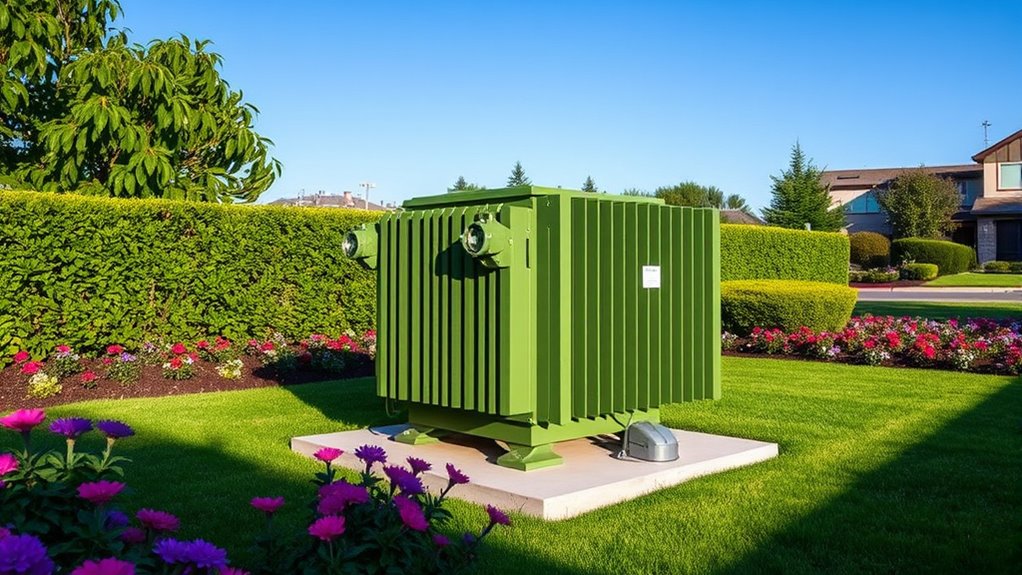
When considering transformers for outdoor use, you’ll find that padmount transformers offer practical solutions for public spaces.
They’re designed with tamper-proof, low-profile enclosures that not only guarantee safety but also blend seamlessly into urban environments.
These transformers efficiently step down high voltage from distribution lines to levels suitable for residential and commercial use, making them essential for community infrastructure.
Tamper-Proof Design Features
Because security is paramount in public and outdoor installations, padmount transformers boast a robust tamper-proof design.
These transformers guarantee reliable power distribution with their secure construction and protective features. They’re built to withstand environmental damage and prevent unauthorized access.
Here are some key features that make them secure:
- Locked Access Doors: The locked doors protect internal components, guaranteeing that only authorized personnel can access them for maintenance or adjustments.
- Durable Enclosures: These tamper-proof enclosures prevent vandalism and shield the transformers from environmental hazards, such as water and debris.
- Efficient Voltage Step-Down: Padmount transformers efficiently manage voltage step-down for residential and commercial applications, allowing for seamless and reliable power distribution.
Economic Public Space Solutions
Padmount transformers provide an economical and efficient solution for public spaces thanks to their robust design and low-profile appearance. They’re perfect for outdoor applications in urban areas, seamlessly blending into the environment with their typically green color. These transformers are essential for power distribution, stepping down voltage levels from 4 kV to 34.5 kV to a secondary voltage of 120 V to 480 V.
| Feature | Benefit |
|---|---|
| Dielectric Fluid | Enhances cooling and insulation |
| Rugged Design | Withstands harsh weather |
| Tamper-Proof | Reliable in public spaces |
Housed in a sealed tank filled with dielectric fluid, padmount transformers boast excellent insulation, making them effective under overload conditions. Their rugged design guarantees they endure harsh weather and vandalism, providing reliable power distribution in urban and suburban areas.
Voltage Step-Down Applications
Although they mightn’t always be noticed, padmount transformers play an essential role in delivering safe and efficient power to urban and suburban areas.
These voltage step-down transformers are essential for power distribution, converting high voltages (5 kV to 35 kV) to secondary voltages such as 120/240V for homes and businesses. Their low-profile enclosure is tamper-proof and often painted green to blend in with its surroundings.
Consider these key features:
- Three-phase applications: Padmount transformers can be banked for both single-phase and three-phase applications, providing flexibility in power distribution.
- Dielectric fluid: This sealed tank design uses dielectric fluid for effective cooling, boosting performance under overload conditions.
- Durability and efficiency: Their design ensures longevity in service, effectively handling various electrical demands.
With these attributes, they’re a smart choice for modern infrastructure.
Substation Transformers

Substation transformers play a crucial role in electrical power systems by stepping down high-voltage levels, typically ranging from 69 kV to 500 kV, to more manageable levels for distribution and use. These transformers support electrical transmission by integrating seamlessly into distribution systems, often housed in dedicated substations. Designed for durability, they utilize external cooling systems and are usually oil-filled to enhance cooling and insulasetup enabsetup enablesmus to handle substantial loading pacitiis crucial focrucial forr power gand ensurand ensuringia reliableble supply to consumers.
| Feature | Description | Benefit |
|---|---|---|
| High Voltage | 69 kV to 500 kV | Efficient electrical transmission |
| Cooling SystemsExternally | l, oil-filled | Effective heat dissipation |
| Insulation | Robust design | Enhanced overload handling |
| Loading Capacities | Extended | Supports heavy industrial loads |
| Power Generation | Significant role | Reliable electricity supply |
These factors make substation transformers indispensable in modern energy networks.
Pole Mount Transformers
Pole mount transformers are essential components in residential power distribution, efficiently stepping down high-voltage electricity from distribution lines to usable levels for homes and businesses.
You’ll find these transformers mounted on utility poles, featuring a compact design that blends into the environment, often in neutral colors. They’re built for outdoor conditions, featuring durable enclosures that protect against moisture and temperature changes.
Consider these key points:
- Voltage Ratings: Typically, they transform a 7.2 kV primary to a 120/240 V secondary, which is ideal for typical residential needs.
- Three-Phase Applications: You can connect these transformers in parallel to handle larger electrical loads, providing balanced power.
- Compact and lightweight, their design ensures easy installation and maintenance, making them a practical choice for residential areas.
Low-Voltage Dry-Type Transformers
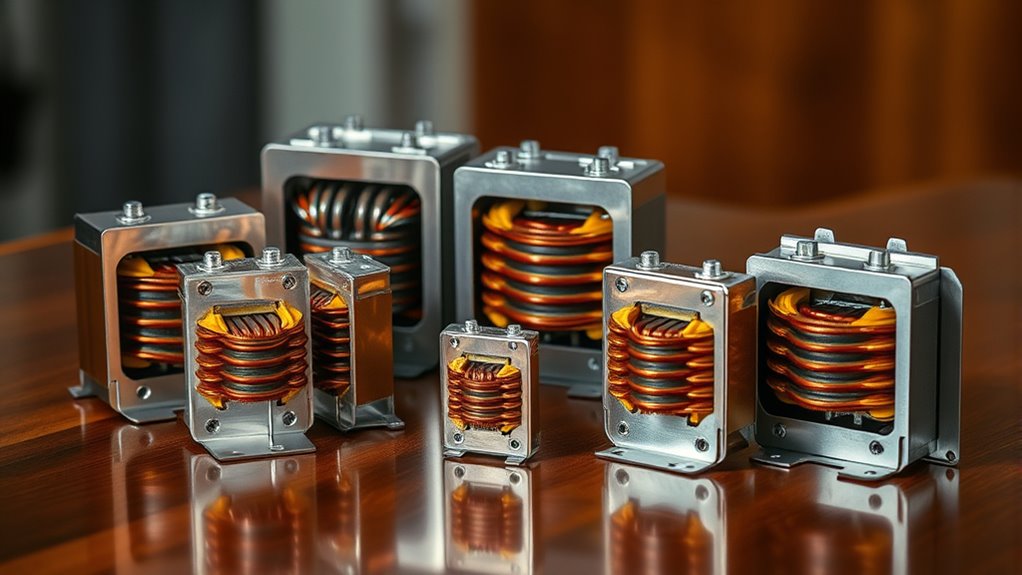
When considering transformers for indoor applications, low-voltage dry-type Transformers stand out due to their lack of fluid containment, which reduces the risk of leaks.
These transformers are ideal for commercial buildings as they handle voltages of 600 volts and below, providing reliable and safe power distribution.
With their high thermal endurance and reliance on natural convection cooling, they ensure efficient operation in lighting, HVAC systems, and other applications.
Indoor Application Suitability
Although various transformers are designed for specific environments, low-voltage dry-type Transformers excel in indoor settings.
These transformers are ideal for power distribution in indoor applications, efficiently supplying electrical loads such as lighting and HVAC systems. They utilize natural convection for cooling, eliminating the need for fluids and reducing maintenance needs.
Their insulation class rating of approximately 220 degrees Celsius ensures reliable performance without risk of fluid leaks.
Here are some key benefits:
- Safety: With no fluid containment, they minimize fire hazards and environmental concerns.
- Efficiency: Operating effectively in ventilated spaces, they handle higher average winding temperature rises.
- Versatility: Suitable for various electrical loads, they’re ideal for HVAC systems and more.
Choose these transformers for trustworthy indoor power solutions.
Commercial Building Use
In commercial buildings, low-voltage dry-type Transformers are a top choice thanks to their efficiency and safety. They’re rated at 600 volts and below, making them perfect for low-voltage electrical distribution systems commonly found in commercial settings.
These transformers are widely used to deliver stable power to lighting, HVAC systems, and various types of machinery. Natural convection cooling eliminates the need for fluid containment, making it an ideal solution for indoor applications where space and safety regulations are a concern.
With an insulation class of around 220 degrees Celsius, these transformers can handle higher temperatures, ensuring reliability even under demanding conditions.
Additionally, their dry-type design minimizes environmental impact, as they don’t use insulating fluids that could potentially leak. This ensures they comply with strict safety and environmental regulations, providing peace of mind in commercial buildings.
Medium Voltage Dry-Type Transformers
Medium-voltage dry-type transformers are essential in industrial settings where safe and efficient power distribution is critical.
These transformers, with voltage ratings ranging from 1 kV to 35 kV, integrate seamlessly into your electrical distribution equipment. The air cooling method, relying on natural convection, guarantees operational efficiency without the need for liquid insulation, making them ideal for indoor use.
You’ll appreciate their high secondary voltage stability, even during load fluctuations.
Consider these benefits:
- Compliance with Industry Standards: Guarantees safety and reliability, meeting IEEE and IEC guidelines.
- Space Optimization: Designed in a unit substation style, they maximize space and functionality.
- Enhanced Stability: Maintains consistent voltage levels, essential for sensitive industrial applications.
These features make them indispensable for robust power distribution systems.
Autotransformers
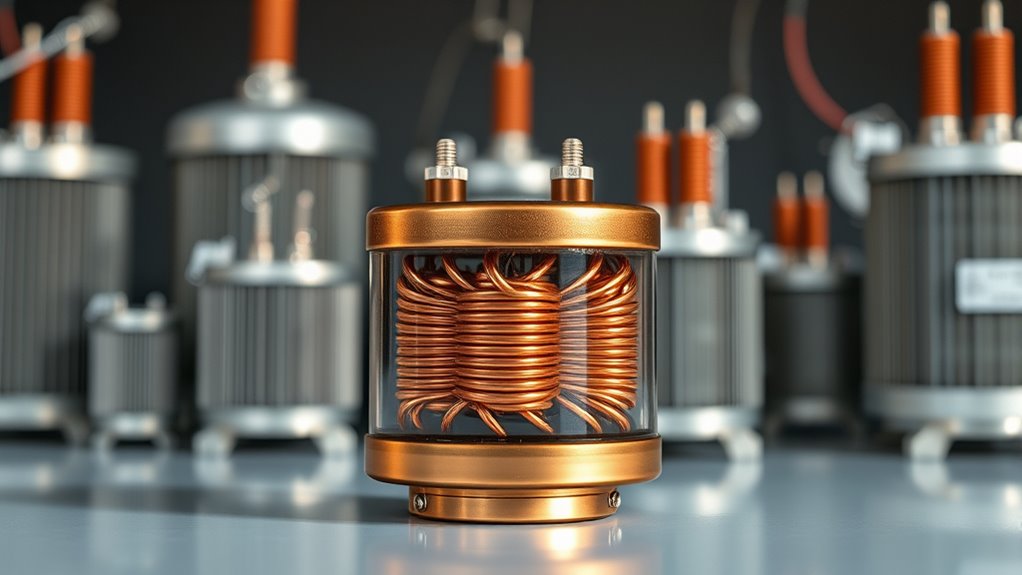
While Medium Voltage Dry-Type Transformers excel in handling higher voltage levels with safety and stability, autotransformers offer a unique advantage in applications where compactness and cost-effectiveness are key.
Autotransformers utilize a single winding acting as both the primary and secondary windings. This design allows for voltage adjustment through a tap point, making them ideal for low-voltage applications and scenarios such as induction motor starters.
They efficiently provide step-up and step-down voltage transformations, typically with a ratio not exceeding 3:1. Unlike traditional transformers, they lack electrical isolation, which can be a safety concern.
However, their lower losses and higher efficiency make them suitable for settings where space and cost are critical considerations. They’re available in single-phase and three-phase configurations.
Drive-Isolation Transformers
Drive-isolation transformers play a crucial role in ensuring the smooth operation of motor drives and protecting sensitive electronic equipment.
They’re specifically designed for environments where motor drives are prevalent, combining standard isolation transformer features with the ability to handle heavier loading profiles and higher harmonics. With separate primary and secondary windings, these transformers provide robust electrical isolation between circuits, which is crucial for achieving clean power and minimizing electromagnetic interference.
Key features include:
- Load Imbalance Management: A larger 200% rated neutral conductor addresses potential load imbalances, which are particularly significant in industrial environments.
- Electrostatic Shields: These minimize electromagnetic interference, improving overall system performance.
- Reliability: Drive-isolation transformers enhance reliability, protecting sensitive equipment and ensuring your systems run smoothly.
Implementing them in your setup guarantees cleaner and more reliable power distribution.
Conclusion
Now that you’ve explored the various transformer types, you’re equipped to choose the right one for your needs. Liquid-filled transformers are ideal for outdoor applications, while dry types are safer for indoor use. Pad-mount and pole-mount transformers efficiently bring high voltage down for residential areas, and substation transformers handle high-voltage distribution. For specialized uses, low and medium-voltage dry-type and autotransformers offer enhanced performance. With this knowledge, you can guarantee peak performance and safety in any setting.
FAQs
1. What Are Different Types of Transformers?
You’ll encounter various transformer types. Liquid-filled transformers, such as padmount and pole mount, are designed for outdoor use. Dry-type transformers, such as cast coil, are suitable for indoor settings. Specialized ones, such as variable autotransformers, cater to specific needs, ensuring optimal performance.
2. What Is the Most Common Type of Transformer?
You’re likely referring to the laminated core transformer. It’s the most common type due to its efficiency in minimizing eddy current losses, making it ideal for electric power transmission and various household appliances.
3. What Is the Difference Between Type 1 and Type 2 Transformers?
You’re comparing Type 1 and Type 2 transformers. Type 1 handles lower voltages and simpler designs, while Type 2 suits higher voltages, more complex configurations, and better cooling. Type 2’s efficiency excels due to advanced insulation and heavy-duty optimizations.
4. How to Tell What Type of Transformer?
Check the label for its specific use case. Inspect the design: sealed tanks indicate a liquid-filled unit; no fluid means a dry-type unit. Note the mounting style and voltage rating. Core material and construction offer additional clues for identification.