Basics of Electromagnetic Fields: Key Concepts Explained
Electromagnetic fields, integral to our world, emerge from electric and magnetic interactions, underpinning much of modern technology. You might wonder how static charges and moving currents create these invisible forces, influencing everything from wireless communication to industrial machinery. Maxwell’s equations offer a mathematical framework for understanding these phenomena. Curious about how this all ties together and impacts daily life? There’s much more to uncover in the domain of electromagnetic fields. Learn more about the Basics of Electromagnetic Fields.
Key Takeaways
- Electromagnetic fields are composed of electric and magnetic fields, governed by Maxwell’s equations.
- Stationary charges create electric fields, while moving charges generate electric and magnetic fields.
- The right-hand rule determines the direction of the magnetic field around current-carrying wires.
- Electromagnetic induction involves inducing an electric current by changing magnetic fields in a conductor.
- Field strength and direction depend on current magnitude, conductor configuration, and surrounding medium properties.
Understanding Electromagnetic Fields

When you plunge into the domain of electromagnetic fields, you’ll discover that they form a fundamental part of our physical world. Electromagnetic fields consist of electric and magnetic fields, intricately connected and governed by Maxwell’s equations.
A stationary electric charge creates solely an electric field. However, when charges move, they generate electric and magnetic fields, showcasing the essence of electromagnetism. This dynamic interaction is beautifully explained by Faraday’s Law of Induction, where changes in electric fields induce magnetic fields and vice versa.
The strength and direction of these fields depend on the magnitude of the electric current, the configuration of the conductor, and the properties of the surrounding medium. These fields are essential in communication systems and MRI, proving their pivotal role in modern life.
The Role of Electric and Magnetic Fields
When you explore the dynamics of electric fields, you’ll see that stationary charges create these fields, while moving charges introduce magnetic fields, highlighting their interconnected roles.
Using the right-hand rule, you can determine the direction of a magnetic field around a current-carrying wire, where the field is strongest near the wire.
As Faraday’s Law describes, the interaction between changing electric and magnetic fields is essential, forming the backbone of technologies like electric generators and wireless communication.
Electric Field Dynamics
Although it might initially seem complex, understanding electric field dynamics begins with recognizing how electric and magnetic fields interact. An electric field arises around electric charges, exerting a force to influence nearby charges. This field’s strength diminishes with distance from the charge.
When these charges move, they generate a magnetic field that wraps around the path of the charge, forming concentric loops with maximum strength near the source. A changing magnetic field can, in turn, induce an electric field, reflecting their mutual relationship as articulated in Maxwell’s equations.
This dynamic interaction is key to how electromagnetic waves propagate, allowing energy to travel through space. By grasping these concepts, you’ll appreciate these fields’ fundamental role in the universe.
Magnetic Field Generation
As you explore magnetic field generation, you’ll discover how electric currents are central to this phenomenon. When an electric current flows through a wire, it creates a magnetic field that forms circular loops around it.
Using the right-hand rule, you can determine the field’s direction—your thumb points in the direction of the current, and your curled fingers show the magnetic field’s path. Ampère’s Law tells us that the magnetic field around a loop is proportional to the current passing through it. This highlights the strong bond between electric currents and magnetic fields.
Electromagnetic induction occurs when a changing magnetic field induces an electric current in a conductor. Maxwell’s equations elegantly describe these interactions, demonstrating how electric and magnetic fields influence each other.
Field Interactions Overview
Electric and magnetic fields are intimately connected and play key roles in electromagnetism. When stationary charges are present, they produce an electric field.
However, once these charges start moving, they generate electric and magnetic fields, emphasizing their interconnected nature. This dynamic relationship is captured in Maxwell’s equations, which describe how a changing electric field can induce a magnetic field and vice versa.
These interactions allow electromagnetic fields to propagate as waves, carrying energy through space. Electrical currents produce strong magnetic fields near the wire, following the right-hand rule to determine direction.
This mutual induction is essential in devices like transformers and generators, where electric and magnetic fields work together to convert energy between forms.
Historical Insights Into Electromagnetism
While electromagnetism might seem modern, its roots stretch back to ancient times. Around 600 BCE, Thales of Miletus first explored static electricity, sparking humanity’s curiosity about electric phenomena. In the 18th Century, scientists laid the foundation for understanding electric charge interactions and forces. In 1831, Michael Faraday’s experiments revealed that a changing magnetic field could induce an electric current, marking a pivotal moment in electromagnetic studies. Later, in 1861, James Clerk Maxwell synthesized existing knowledge into his famous equations, explaining how electromagnetic fields interact and propagate.
Here’s a quick look at some historical milestones:
| Year | Milestone |
|---|---|
| 600 BCE | Thales explores static electricity |
| 18th Century | Principles of electric charge interaction Century |
| 1 | Faraday’s magnetic field induction experiments |
| 1861 | Maxwell’s synthesis of electromagnetic knowledge |
| 19th Century | Collaborative advancements in electromagnetism theory |
Key Equations and Theories

Delving into the domain of electromagnetism, you’ll encounter Maxwell’s equations, which form the backbone of electromagnetic theory. These four equations capture the essence of how electric and magnetic fields interact.
Gauss’s Law relates electric flux and charge, showing how electric fields emerge from charges. Gauss’s Law of magnetism guarantees that magnetic field lines always loop, indicating that no magnetic monopoles exist.
Faraday’s Law explains how changing magnetic fields induce electromotive force, laying the groundwork for electric generators. Ampère’s Law highlights the link between magnetic fields and electric currents, demonstrating their interdependence in circuits.
Together, these equations describe electromagnetic fields, leading to a deeper understanding of electromagnetic waves and light propagation, vital for modern technology and scientific exploration.
Creating Magnetic Fields With Electric Currents
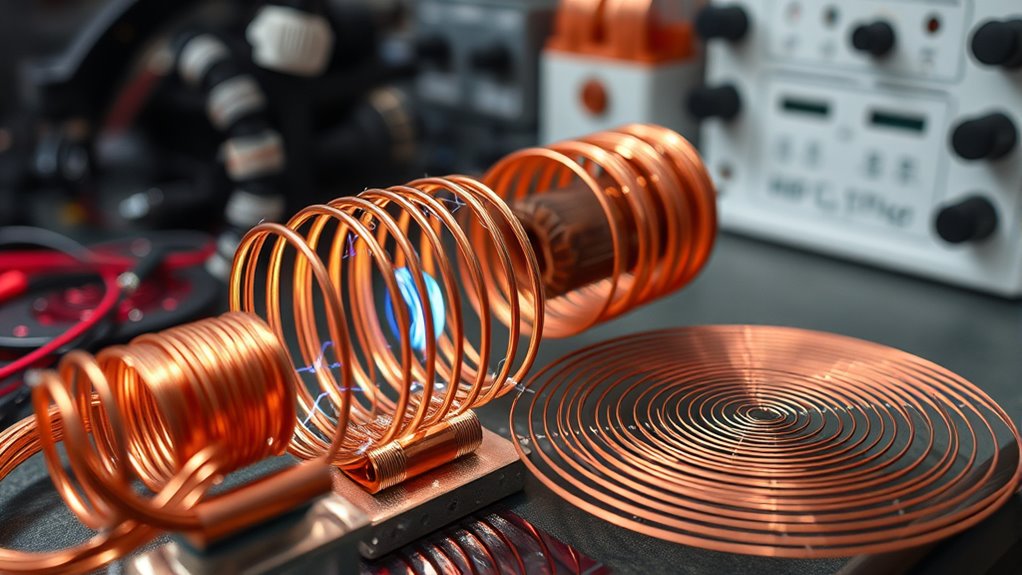
When an electric current passes through a wire, it generates a magnetic field that forms loops around the wire, a phenomenon central to understanding current-induced field dynamics.
By applying Fleming’s Right-Hand Rule, you can easily determine the direction of this magnetic field.
Current-Induced Field Dynamics
As you explore the fascinating world of electromagnetic fields, you’ll find that electric currents play an essential role in creating magnetic fields.
When an electric current flows through a wire, it generates a magnetic field in circular loops. You can determine the field’s direction using the right-hand rule: point your thumb in the current direction, and your fingers will curl in the direction of the magnetic field lines.
According to Ampère’s Law, this magnetic field is proportional to the electric current, meaning stronger currents produce more intense fields. Such fields are vital in the operation of electromagnets, which power devices like electric motors and transformers and influence nearby magnetic materials and currents.
Wire Magnetic Loops
A single wire carrying an electric current creates a fascinating phenomenon: magnetic fields form circular loops around it. The current’s flow determines the magnetic field’s direction, and you can visualize this using the right-hand rule. Just point your thumb in the current’s direction, and your fingers will show the loops’ path.
The magnetic field is strongest near the wire and weakens as you move away. By increasing the electric current, you amplify the field’s strength. When you coil multiple loops of wire, the magnetic field intensifies, concentrating in the coil’s center.
This principle is essential for technologies like inductors and transformers. Additionally, the interaction of these fields with external ones can generate motion, which is foundational for electric motor operation.
Fleming’s Right-Hand Rule
Fleming’s Right-Hand Rule is a handy tool for understanding how electric currents interact with magnetic fields. Using your right hand, you can easily determine the direction of the induced current when a conductor moves within a magnetic field.
Point your thumb in the direction of motion, your index finger in the direction of the magnetic field, and your middle finger will show you the direction of the induced current. This rule is essential for visualizing electromagnetic interactions, especially in devices like electric generators, where mechanical motion turns into electrical energy.
Induction and Electric Current Generation

When you move a magnet near a coil of wire, you’ll witness the fascinating phenomenon of electromagnetic induction, where a changing magnetic field generates an electric current in the conductor.
This process, explained by Faraday’s Law, shows how an induced current emerges when the magnetic field around a coil of wire changes. The induced electromotive force (emf) is directly proportional to the rate of change of the magnetic flux through the loop.
Pioneers like Joseph Henry and Michael Faraday demonstrated that simply moving a magnet near a coil can produce a measurable electric current.
You can determine the direction of this induced current using Fleming’s Right-Hand Rule. By understanding these principles, you can grasp the basics of generating electricity through motion and magnetic fields.
Factors Influencing Magnetic Flux
Understanding the factors influencing magnetic flux is essential for mastering the principles of electromagnetism. The strength of the magnetic field (B) directly impacts the magnetic flux, with stronger fields leading to increased flux through a given area.
The loop area (A) is significant too, as larger areas capture more magnetic field lines, boosting the flux. The angle (θ) between the magnetic field lines and the normal to the loop surface also plays a key role. Maximum magnetic flux occurs when the field is perpendicular to the loop (θ = 0°).
Mathematically, magnetic flux (Φ) is expressed as Φ = B × A × cos(θ). Faraday’s Law of Induction describes changes in field strength, loop area, or angle that induce electromotive force.
Applications in Modern Technology

Having explored the factors influencing magnetic flux, it’s clear that electromagnetic fields play a vital role in modern technology.
Electric and magnetic fields are at the heart of communication systems, enabling wireless transmissions for devices like smartphones and Wi-Fi routers. This technology relies on electromagnetic radiation to transmit data efficiently.
In the medical sector, Magnetic Resonance Imaging (MRI) uses powerful electromagnetic fields to generate detailed images of your body’s internal structures, aiding diagnostics.
Electromagnetic fields are also essential in electronics, where electrical current flows through circuits, powering computers and home appliances.
In addition, these fields drive industrial machinery such as motors and generators, converting electrical energy into mechanical energy.
With 5G networks, high-frequency electromagnetic fields promise faster, more reliable connectivity.
Health and Safety Considerations

As we explore health and safety considerations regarding electromagnetic fields (EMF), it’s crucial to recognize that exposure levels can considerably impact health outcomes. Factors like frequency, intensity, and duration play a critical role.
Lower frequencies and intensities, like those from everyday appliances, are generally safer. However, higher frequencies, such as ultraviolet light and gamma rays, pose significant health risks.
Epidemiological studies hint at links between long-term EMF exposure, like from power lines, and increased health effects, though this remains debated. The International Agency for Research on Cancer classifies extremely low-frequency magnetic fields as possibly carcinogenic. Consequently, caution is warranted.
Organizations like the WHO stress the importance of research in establishing safety standards. Understanding dose-response relationships helps assess potential health implications and informs guidelines for safer EMF exposure.
Conclusion
You’ve now grasped the basics of electromagnetic fields and their essential technological roles. Electric and magnetic fields, guided by Maxwell’s equations, drive innovations from wireless communication to power generation. You can appreciate their profound impact by considering their evolution, understanding how electric currents create magnetic fields and inductance, and their effects. Remember, while these fields offer incredible benefits, health and safety should be considered in their applications. Embrace this knowledge as a foundation for exploring further advancements.
FAQs
1. What Are the Concepts of Electromagnetic Field?
You’ll find that electromagnetic fields combine electric and magnetic fields, interacting through waves. Static charges create electric fields, while moving charges generate magnetic ones. Their interplay allows electromagnetic waves to propagate, influencing the world around you.
2. What Are the Basics of Electromagnetism?
You need to grasp how electric and magnetic fields interact. Understand Maxwell’s equations, the right-hand rule, and electromagnetic induction. Recognize how moving charges create fields and how these fields propagate as energy waves through space.
3. What Are the 7 Types of Electromagnetic?
You’re curious about the seven types of electromagnetic waves. They include radio waves, microwaves, infrared, visible light, ultraviolet, X-rays, and gamma rays. Each type varies in wavelength and frequency and serves different applications in technology and science.
4. What Is the Electromagnetic Field Explained Simply?
You see an electromagnetic field when electric charges move. It’s where electric and magnetic forces interact. Picture it as invisible waves that carry energy, governed by Maxwell’s equations, impacting everything from your Wi-Fi to medical scans.