

Differences Between Solenoids and Coils: A Detailed Comparison
When you’re exploring the domain of solenoids and coils, you’ll find fascinating distinctions in their design and purpose. Solenoids, with their helical structure and core, are masters of converting electrical energy into linear motion. Coils, however, are simpler loops of wire, focused on generating magnetic fields. The unique capabilities of each component open doors to a wide array of applications. Curious about how these differences impact their real-world uses? Let’s uncover more.
Key Takeaways
- Solenoids integrate mechanical components for linear movement, while coils generate magnetic fields without direct mechanical output.
- Coils are ideal for generating magnetic fields in sensors and transformers, whereas solenoids actuate mechanisms like valves and plungers.
- Solenoids create more uniform magnetic fields due to their extended shape, unlike coils, which have less uniform fields.
- Solenoids can handle both AC and DC power, while coils depend on the specific application for power type.
- Coils emphasize magnetic properties, while solenoids focus on converting electrical energy into mechanical movement.
Understanding Solenoids and Coils
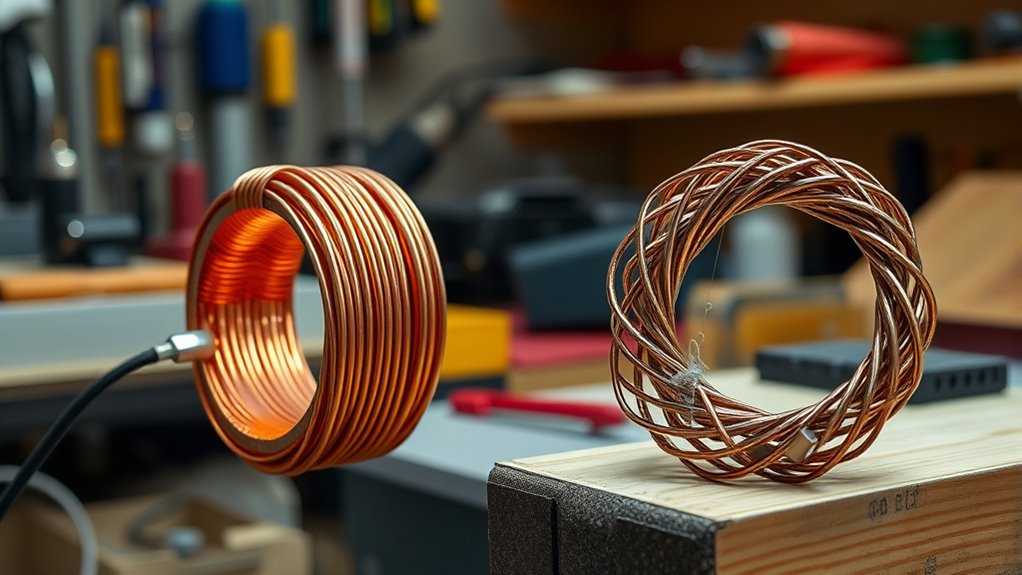
When you explore the world of electromagnetism, you’ll encounter both solenoids and coils, each with unique characteristics and applications.
A coil is a simple wire loop that generates a magnetic field when an electrical current passes through it. In contrast, a solenoid is a helical coil with a core, boosting its magnetic field strength.
Solenoids are particularly versatile because they can convert electrical energy into linear mechanical movement. This capability is essential in devices like solenoid valves, where the movement of a magnetic plunger controls fluid flow.
Solenoids are integral in automation, offering precise control over mechanical systems. While coils can stand alone, solenoids integrate more complex mechanical components, making them indispensable in various technological applications.
Magnetic Field Equations for Coils and Solenoids
Though they might seem similar, the magnetic field equations for coils and solenoids highlight their distinct functionalities.
When dealing with coils, the magnetic field equation (B_coil = mu N I / 2a) shows you that it depends on the coil’s radius (a), number of turns (N), and the current (I). Coils work best with short lengths or single-turn loops.
On the other hand, the solenoid’s magnetic field equation (B_solenoid = mu N I / L) emphasizes its dependence on the solenoid’s length (L) and the number of turns, providing a more uniform field inside.
This difference stems from their unique geometrical configurations, with coils resembling loops and solenoids resembling extended cylinders.
Understanding these equations is key to applying electromagnetic theory correctly.
Functionality and Applications of Solenoids
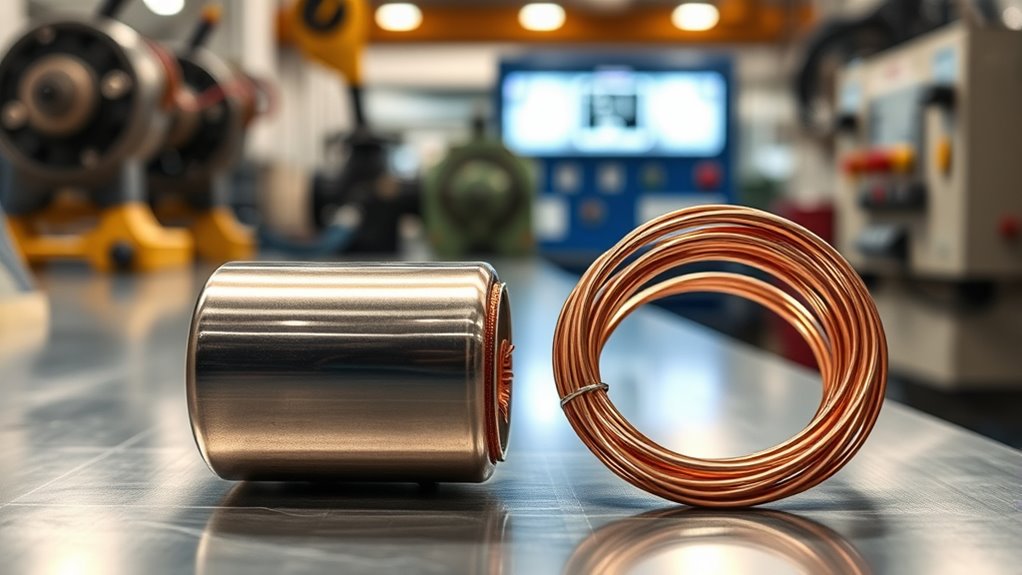
Solenoids are versatile electromechanical devices that transform electrical energy into linear mechanical motion, making them indispensable in various applications such as valves, locks, and automotive ignition systems.
When a solenoid generates a magnetic field, it actuates a plunger or piston, converting energy into mechanical action. This ability to exert force with precision makes solenoids vital for control systems, providing reliable operation in automation and fluid control.
In industrial settings, solenoids manage fluid flow in pneumatic and hydraulic systems, enhancing efficiency and precision. Applications like valves benefit from solenoids by enabling smooth and controlled fluid movement.
In healthcare, solenoids guarantee accurate dosing and flow control in medical devices, meeting stringent safety standards while automating critical processes. Their adaptability guarantees that solenoids remain essential across diverse fields.
Types of Solenoids and Their Uses
Building on their wide-ranging applications, different types of solenoids cater to specific needs, optimizing performance in various scenarios.
You’ll find linear solenoids generating a pushing or pulling force, perfect for vehicle ignition systems. For fluid control, proportional solenoids provide precise adjustments by varying the excitation current, making them ideal for hydraulic systems and robotics.
AC-laminated solenoids are your go-to for reducing stray currents, commonly used in locks and medical devices. Meanwhile, DC C-frame solenoids deliver precise control in gaming equipment and circuit breakers.
Latching solenoids, with their energy-efficient design, maintain position without continuous power, which is great for temperature-sensitive applications.
In aerospace, solenoids enhance reliability in propulsion, release, and landing gear mechanisms.
Electromagnetic Principles of Coils
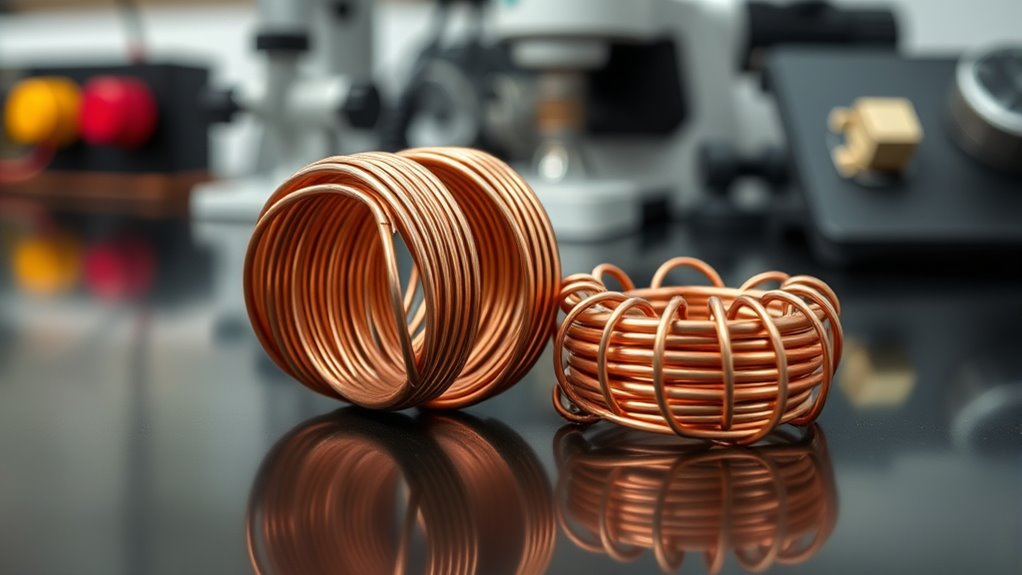
When exploring electromagnetic principles, coils stand out due to their ability to generate a magnetic field as electrical current flows through them. Each loop of wire in a coil contributes to an electromagnetic field, enhancing the overall magnetic energy.
As the excitation current passes through, the magnetic field becomes more concentrated within the coil, while outside, it weakens. This inherent property is essential for applications like inductors and transformers, where magnetic energy conversion and storage are fundamental.
In solenoid coils, the Biot-Savart law helps calculate the magnetic field by considering the coil’s shape and proximity. The radius of the coil influences magnetic field strength, showing how distance affects it.
Coils, consequently, play a key role in harnessing electromagnetic principles efficiently.
Differences in Design and Operation
Design and operation set solenoids and coils apart in distinct ways. Solenoids, with their specific solenoid design, generate magnetic fields when an electric current flows through them. They often feature iron cores and create linear mechanical movement through a moving plunger. Coils, however, can vary in shape and aren’t limited to generating linear motion. Instead, they adapt to different configurations for magnetic applications.
| Aspect | Solenoids | Coils |
|---|---|---|
| Magnetic Field | Depends on length and turns (Ampere’s) | Influenced by radius and distance (Biot-Savart) |
| Design | Includes a moving plunger for motion | Simple wire winding, no inherent movement |
| Application | Linear mechanical movement | Versatile electromagnetic roles |
Understanding these nuances helps you choose the right component for your needs.
Industry Applications of Solenoids and Coils
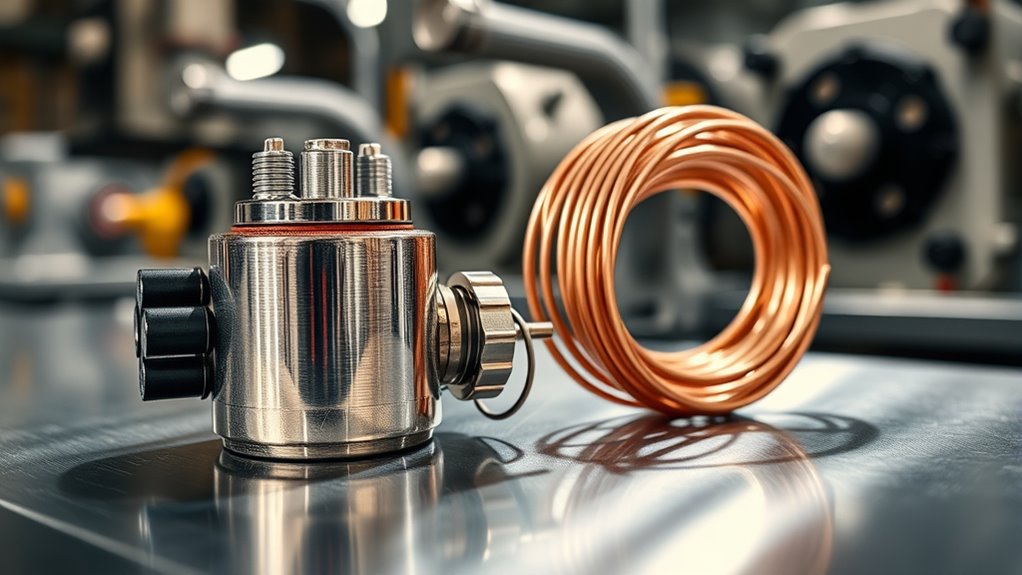
You’ll find solenoids playing an essential role in both industrial automation and automotive systems.
In factories, they regulate fluid flow and direction, boosting both efficiency and safety.
Meanwhile, in your car, solenoids manage the starting mechanisms and locking devices, ensuring smooth and reliable operation.
Industrial Automation Uses
In countless industrial automation settings, solenoids and coils play essential roles due to their unique capabilities. A solenoid depends on its ability to control pneumatic and hydraulic systems, which are vital for industrial equipment. It can precisely regulate fluid flow and actuator movements, guaranteeing efficient operation using AC power. Coils, fundamental in electromagnetic devices, are integral to relays and contactors, enabling automated control systems to switch circuits on and off effectively. You’ll find solenoids in assembly lines, enhancing efficiency by actuating components like grippers. Meanwhile, coils in sensors and actuators offer accurate operational monitoring.
| Application | Function |
|---|---|
| Solenoids | Control fluid flow with precision |
| Coils | Switch electrical circuits |
| Assembly Lines | Actuate mechanical components quickly |
| Robotics | Enable precise movements |
| Sensors & Actuators | Guarantee accurate monitoring |
Automotive System Applications
While modern vehicles rely heavily on advanced technologies, solenoids and coils remain essential in ensuring seamless operation. A solenoid is a type of electromechanical device important for managing current flow to ignition systems, which is fundamental for starting engines. Its magnetic pull is indispensable in starter motors, acting as a switch to engage the motor when you turn the ignition.
Additionally, solenoids enhance vehicle security by enabling electronic locking systems, allowing you to lock and access doors easily.
In air conditioning systems, Solenoid Valve Coils regulate refrigerant flow, maintaining comfort by controlling temperatures. Furthermore, in fuel injection systems, solenoids precisely deliver fuel, optimizing engine performance.
- Starter motors: Engage the motor with magnetic pull
- Door locks: Enable electronic security
- Fuel systems: Optimize fuel delivery
Selecting the Right Component for Your Needs
How do you choose between solenoids and coils? First, consider your application’s needs. Solenoids are perfect if you require mechanical movement or fluid control, like in valve operations. They offer versatility in power systems, available in both AC and DC types.
On the other hand, if your focus is on generating a magnetic field without direct mechanical output, coils are your go-to. They excel in sensors, inductors, and transformers.
Next, assess the component’s configuration. Solenoids, being long coils with many turns, enhance magnetic field strength for dynamic tasks. Coils, however, can vary from single-turn loops to intricate designs, focusing on specific magnetic properties.
Always analyze the specific role the component will play in your system to guarantee peak performance.
Conclusion
When choosing between solenoids and coils, consider your specific needs. Solenoids are perfect if you need linear mechanical movement, thanks to their helical design and core. They’re ideal for automation and valve control. On the other hand, if you’re looking to generate or transform magnetic energy without mechanical output, coils are your go-to. They excel in applications like sensors and inductors. Understanding these differences helps you select the right component for peak performance.
FAQs
1. Is a Coiled Wire a Solenoid?
You might think a coiled wire is a solenoid, but it isn’t always. A solenoid needs a specific design, including a closed loop and core, to generate a strong, uniform magnetic field when energized.
2. What Is the Difference Between a Solenoid and a Voice Coil?
When you’re looking at a solenoid and a voice coil, know that solenoids generate linear motion with a ferromagnetic core. In contrast, voice coils convert electrical signals into sound using a permanent magnet, delivering precise audio control.
3. Is an Ignition Coil a Solenoid?
You might wonder if an ignition coil is a solenoid, but it’s not. Ignition coils boost voltage for sparks in engines, while solenoids convert electrical energy into motion. They serve distinct functions within different mechanical systems.
4. How Are Electromagnets Different From Solenoids?
You’ll find that electromagnets use an iron core to boost magnetic strength, while solenoids generally don’t. Electromagnets produce temporary fields for quick changes, whereas solenoids convert electricity into motion, often without needing a core.
