Exploring Different Types of Transformers: A Quick Guide
When you think about transformers, it’s important to understand that they come in various types, each designed to meet specific needs. Each type has unique characteristics, whether dealing with power transformers for high-voltage transmission or distribution transformers for local power delivery. Instrument transformers, for example, are vital in measuring electrical parameters, while isolation transformers enhance safety by separating circuits. You might wonder how core materials like iron, ferrite, or air impact performance or why single-phase and three-phase transformers are suited for different applications. There’s much more to explore, especially considering how these types interplay in real-world scenarios.
Key Takeaways
- Iron core transformers are efficient for power distribution due to their high energy transfer capabilities.
- Ferrite core transformers are ideal for high-frequency applications with minimal losses and excellent magnetic properties.
- Air core transformers are beneficial where weight and size are critical, as they operate without a physical core.
- Toroidal core transformers offer superior performance, minimal leakage inductance, and reduced electromagnetic interference.
- Single-phase and three-phase transformers, respectively, cater to residential, commercial, and industrial power needs.
Power Transformers

Power transformers are essential for converting electricity from low and high currents to high and low currents in high-voltage transmission networks. When you look at the backbone of our electrical infrastructure, you’ll see that power transformers play an important role in stepping up voltage levels. This process is necessary for efficient long-distance power transmission, ensuring electricity can travel from generation sites to where it’s needed without significant loss.
These transformers handle large power capacities, which are important for maintaining grid stability and reliability. By converting low voltage to high voltage, power transformers link electricity generation systems to primary distribution grids, effectively bridging the gap between power plants and end consumers. This connection is crucial for distributing electricity over vast distances, ensuring that even remote areas have access to power.
Power transformers stand out in high-voltage applications because they ensure that electricity generation systems can efficiently supply the grid. Their ability to step up voltage levels makes long-distance transmission feasible, reducing energy loss and enhancing overall efficiency.
Distribution Transformers
Distribution transformers play a pivotal role in transferring electrical energy from primary distribution circuits to the secondary circuits that serve homes, businesses, and industrial facilities. These transformers guarantee electricity is efficiently delivered to end consumers across various settings, maintaining a reliable power distribution network.
Distribution transformers come in multiple sizes and configurations to meet specific power distribution needs. They’re essential in maintaining voltage regulation, thereby preventing damage to electrical appliances and ensuring consistent power quality. Additionally, they help minimize power losses, making the electrical grid more efficient.
Common applications of distribution transformers include:
- Residential areas: Guaranteeing homes receive the proper voltage for safe and efficient electricity use.
- Commercial buildings: Providing stable power to businesses for smooth operation.
- Industrial settings: Supporting large-scale operations with consistent power supply.
- Substations and pole-mounted installations: Facilitating power distribution across the electrical grid.
Instrument Transformers

Instrument transformers are essential for accurately measuring electrical parameters and ensuring the safety of power systems. They’re designed to step down high currents to manageable levels for your measuring instruments. This way, you can safely and accurately monitor electrical parameters without risking damage to your equipment.
There are two main types of instrument transformers: current transformers (CTs) and voltage transformers (VTs. CTs are specifically used for measurement, transforming high currents into lower, standardized values. This is pivotal for protection and control within electrical systems, as it guarantees that the measuring instruments can handle the current without overloading.
On the other hand, VTs are used for voltage measurement, stepping down high voltages to safer levels. Both types of instrument transformers play a critical role in maintaining system reliability. They help monitor electrical parameters with high accuracy, which is essential for the overall health of the power system.
Isolation Transformers
Isolation transformers frequently provide a critical layer of protection by ensuring no direct electrical connection between their primary and secondary windings. These transformers are essential for any Electrical and Electronics applications where safety and signal integrity are paramount. By incorporating a physical barrier between the windings, isolation transformers can prevent high voltage from directly affecting low voltage circuits.
These transformers are available in single-phase and three-phase models, catering to various system requirements. Their ability to transform all incoming voltage ensures consistent levels on the secondary side, making them versatile for different applications. Whether you’re dealing with high- or low-voltage scenarios, isolation transformers offer significant advantages.
Here’s why isolation transformers stand out among different transformer types:
- Safety: They provide electrical isolation, protecting against voltage spikes and reducing the risk of electric shock.
- Noise Reduction: They minimize noise interference, which is essential for sensitive electronic equipment.
- Ground Loop Prevention: They help break ground loops, which can cause unwanted noise and potential damage.
- Versatility: Suitable for both high- and low-voltage applications, fitting various needs in Electrical and Electronics systems.
Autotransformers

In contrast to isolation transformers, autotransformers use a single winding to step up and down voltage efficiently. This single-winding design makes autotransformers more compact and cost-effective, especially in 600 volts or less low-voltage applications low-voltage applications. Autotransformers are a great choice if you’re looking for a transformer that can handle step-up and step-down tasks without needing separate windings.
Autotransformers are available in three-phase and single-phase models, making them versatile enough to meet various power requirements. Whether dealing with three-phase or single-phase power, these transformers can efficiently manage your voltage needs. They’re particularly useful for induction motor starters, where precise voltage adjustments are essential for smooth motor operation.
The compact nature of autotransformers allows them to fit easily into smaller spaces, a significant advantage in installations where space is at a premium. Additionally, their cost-effective design means achieving the desired voltage conversion without incurring high costs. Autotransformers use single winding to simplify changing voltage levels, making them an efficient and practical choice for various electrical applications.
Step-Up and Step-Down Transformers
On the other hand, step-down transformers focus on reducing high primary voltage to a lower secondary voltage, which is important for various applications, including residential and commercial use.
Autotransformers contain only one winding and are versatile and commonly used for step-up and step-down applications. They are available in three-phase and single-phase models and are typically used in low-voltage applications, around 600 volts or less. They’re particularly suitable for induction motor starters, providing a cost-effective solution for these specific needs.
Here’s a quick look at their key functions:
- Step-up transformers: Increase voltage levels for long-distance transmission.
- Step-down transformers: Reduce primary voltage for everyday use.
- Autotransformers: These are useful for step-up and step-down in low-voltage applications.
- Single-phase models: Commonly used in residential and small commercial settings.
Core Material Types
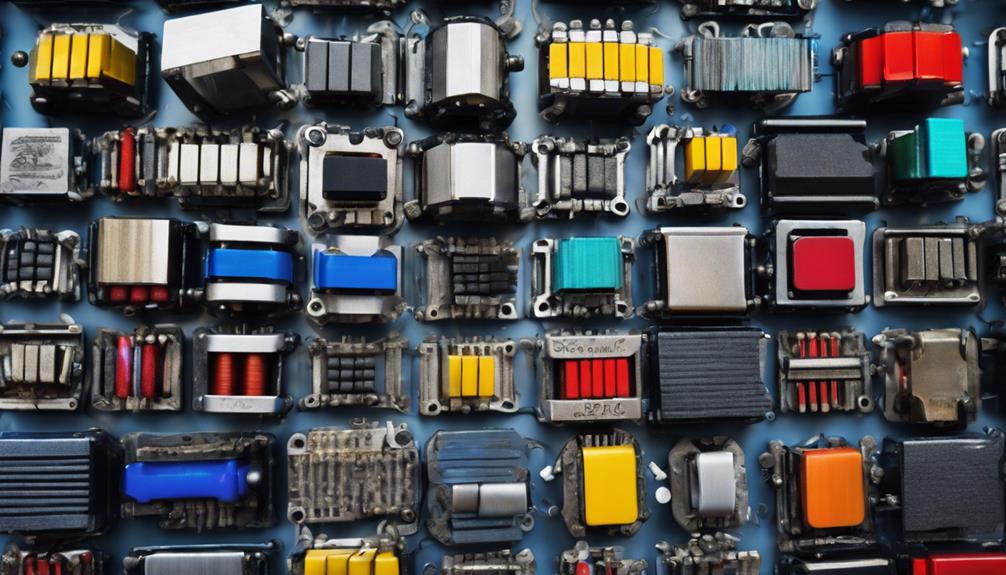
Transformers’ efficiency and performance hinge greatly on the type of core material used. Iron core transformers, for instance, utilize soft iron plates, which boast high magnetic properties and ensure efficient energy transfer. Due to their robustness and reliability, these transformers are commonly used in power distribution.
Ferrite core transformers, on the other hand, shine in high-frequency applications. Their core material offers low losses and excellent magnetic permeability, making them ideal for electronics and communication devices where efficiency and performance are critical.
Air core transformers are unique as they operate without a physical core material, relying solely on air for flux linkage. While they offer less efficiency than other core material types, they’re beneficial in applications where weight and size are significant constraints, such as in certain RF and wireless technologies.
Lastly, toroidal core transformers provide superior electrical performance with minimal leakage inductance. Their doughnut-shaped core reduces electromagnetic interference and enhances energy transfer efficiency, making them suitable for precision equipment and audio applications.
Single-Phase and Three-Phase Transformers
When comparing single-phase and three-phase transformers, understanding their distinct roles in power distribution and industrial applications is essential.
Single-phase transformers are typically used in residential settings and light commercial applications due to their efficiency in handling single-phase AC voltage. They’re compact and cost-effective, making them ideal for smaller-scale power distribution needs.
On the other hand, three-phase transformers are indispensable for large-scale power transmission and industrial applications. These transformers consist of three primary and three secondary windings, providing a balanced power output for powering heavy machinery and industrial processes.
Here’s a quick comparison to help you understand the differences:
- Single-phase transformers are perfect for residential settings and light commercial use.
- Three-phase transformers are suited for large-scale power transmission and industrial applications.
- Single-phase transformers are more compact and cost-effective, fitting well in smaller, localized settings.
- Three-phase transformers provide the balanced power necessary for heavy machinery and high-power industrial applications.
Choosing the right transformer depends on your specific power needs, whether you need it to efficiently handle single-phase AC voltage for residential areas or the robust power distribution required for industrial and heavy machinery operations.
Conclusion
You can make informed choices for your specific needs by understanding the various types of transformers.
Each type has a unique purpose, from power and distribution transformers to isolation and autotransformers.
Whether you’re dealing with single-phase or three-phase systems or considering core materials like iron, ferrite, or air, there’s a transformer designed for your application.
So, next time you select a transformer, you’ll know exactly what to look for!
FAQs
1. What are the main types of transformers?
The main types of transformers include power, distribution, isolation, and instrument transformers. Each type serves a specific function in electrical systems, from voltage regulation to protection and measurement.
2. What are power transformers used for?
Power transformers increase or decrease voltage levels in high-voltage transmission networks. They are essential for efficient long-distance power transmission and are typically found in power plants and substations. Power transformers handle large amounts of electrical power and operate at high efficiency.
3. What are distribution transformers and their applications?
Distribution transformers lower the voltage for safe use in residential, commercial, and industrial settings. They step down the voltage from the power lines to the levels various electrical devices and systems require. These transformers are commonly found on utility poles, underground distribution systems, and near buildings.
4. How do isolation transformers work?
Isolation transformers provide electrical isolation between the primary and secondary windings, protecting against electric shocks and reducing noise in sensitive equipment. They are used in medical devices, laboratory equipment, and industrial control systems where safety and signal integrity are critical.