Mastering Voltage Regulation: A Dive into Buck-Boost Converters
In the dynamic landscape of electronic systems, the buck-boost converter emerges as a versatile and indispensable component, navigating the complexities of voltage regulation. This article explores buck-boost converters, unveiling their unique dual functionality to step up or down the input voltage. From the intricacies of working modes to practical applications and essential design considerations, we delve into the core elements that make buck-boost converters pivotal in modern power electronics.
What is a Buck-Boost Converter?
At its essence, a buck-boost converter is a DC-DC converter that performs the dual role of stepping up (boost) or stepping down (buck) the input voltage to provide a regulated output voltage. This unique ability makes it a cornerstone in various electronic systems and devices.
Understanding the Working Principle

A buck-boost converter regulates the output voltage by adjusting the duty cycle of the switch within the circuit. It operates in two distinct modes, each playing a crucial role in its functionality.
Mode I: Switch is ON, Diode is OFF
In this mode, the switch within the circuit is turned on, allowing current to flow through the inductor. Simultaneously, the diode is in the off state, preventing reverse voltage. This configuration leads to a reduction in output voltage, characterizing the buck operation.
Mode II: Switch is OFF, Diode is ON
Contrastingly, during this mode, the switch is turned off. Having stored energy during the switch-on period, the inductor releases it into the circuit. Simultaneously, the diode is turned on, facilitating current flow in a single direction. This results in an increased output voltage, defining the boost operation.
Key Components
To comprehend the modes fully, let’s delve into the key components of a buck-boost converter:
- Inductor: This component stores energy during the switch-on time and releases it during the switch-off time, playing a pivotal role in the conversion process.
- Switch: Controls the energy flow between the input and output by alternately turning on and off, determining whether the converter operates in a buck or boost mode.
- Diode: Allows current to flow in one direction only, preventing reverse voltage and ensuring the unidirectional movement of energy.
- Capacitor: Smoothens the output voltage by storing and releasing charge, contributing to the stability of the converter’s output.
Applications of Buck-Boost Converters
Buck-boost converters find applications across diverse fields due to their unique capabilities. Here are some prominent areas:
Battery-Powered Devices
In portable electronic devices where battery voltage fluctuates, buck-boost converters ensure a stable and consistent voltage supply, extending battery life.
Renewable Energy Systems
The integration of fluctuating solar or wind power into the electrical grid is facilitated by buck-boost converters, making them crucial in renewable energy applications.
LED Drivers
Buck-boost converters are employed in lighting systems to maintain a constant and optimal LED voltage, ensuring efficient and reliable illumination.
Design Considerations
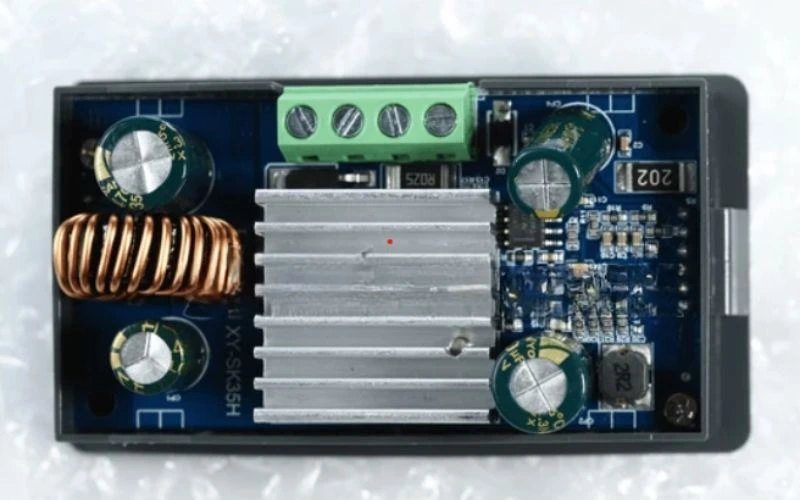
Designing a buck-boost converter requires a meticulous approach, considering various factors influencing its performance and efficiency.
Duty Cycle Control
Efficient voltage regulation necessitates careful duty cycle control, balancing the switch’s on-time and off-time.
Inductor Selection
Choosing the right inductor is paramount to minimize energy losses and achieve the desired output voltage. Factors such as inductance value and saturation current must be considered.
Output Voltage Ripple
Reducing output voltage ripple enhances the stability and reliability of the buck-boost converter. Effective filtering mechanisms, including proper capacitor selection, are vital.
Advantages of Buck-Boost Converters
Understanding the advantages of buck-boost converters underscores their significance in the realm of power electronics:
- Wide Input Voltage Range: Buck-boost converters can operate over a broad input voltage range, offering flexibility in various applications.
- Efficiency: With proper design, these converters can achieve high efficiency, minimizing energy losses during voltage conversion.
- Compact Size: Their compact nature makes buck-boost converters ideal for space-constrained applications.
Advanced Operating Modes

Beyond the fundamental modes of operation, advanced buck-boost converters may incorporate additional modes, enhancing their adaptability to diverse scenarios.
Mode III: Continuous Conduction Mode (CCM)
In CCM, the inductor current never reaches zero during the switching cycle. This mode offers improved efficiency but requires more complex control circuitry.
Mode IV: Discontinuous Conduction Mode (DCM)
In DCM, the inductor current drops to zero during a portion of the switching cycle. This mode simplifies control circuitry but may result in a higher output voltage ripple.
Understanding these advanced modes gives engineers the tools to fine-tune buck-boost converters for specific applications.
Conclusion
FAQs
How does a buck-boost converter differ from other DC-DC converters?
A buck-boost converter offers step-up and step-down capabilities, allowing it to regulate the output voltage in either direction. This dual functionality distinguishes it from traditional converters like the buck or boost, providing enhanced flexibility for voltage regulation in diverse applications.
What challenges are associated with buck-boost converter design?
Designing a buck-boost converter poses various challenges, including managing high peak currents during switching, minimizing electromagnetic interference to ensure compatibility with surrounding electronics, and addressing efficiency concerns—especially crucial at extreme input voltage ranges. Overcoming these challenges requires careful consideration of component selection and circuit optimization.
Can a buck-boost converter be used in automotive applications?
Buck-boost converters find widespread use in automotive systems. Their ability to accommodate varying voltage levels from the vehicle’s electrical system makes them ideal for stabilizing voltage supply. Whether for powering electronic control units or supporting diverse in-car electronics, buck-boost converters play a crucial role in enhancing the reliability and efficiency of automotive electrical systems.