Safeguarding Bus Zone Protection and Tackling Busbar Faults
Bus zone protection is critical in ensuring the reliable and uninterrupted flow of electrical power within complex power networks. At the heart of these protection schemes lies the busbar, a vital component that connects multiple incoming and outgoing transmission lines. However, just like navigating a bustling city with its various modes of transportation – cars, buses, bikes, and pedestrians – busbars are susceptible to faults due to insulation failure and mechanical issues.
This article delves into the significance of bus zone protection in safeguarding power networks and investigates the common causes behind busbar faults. By examining the parallel between busbars and the intricate dynamics of a city, power system engineers and operators can gain valuable insights into enhancing network reliability, minimizing downtime, and effectively mitigating potential disruptions. Join us as we explore the critical aspects of bus zone protection and uncover the underlying reasons for busbar faults.
Need for Bus Zone Protection

Busbar protection or bus zone protection includes, besides the bus itself, apparatuses such as circuit breakers, disconnecting switches, instruments, transformers, etc. Though bus zone faults are rare, experience shows that bus protection is highly desirable in large and important stations.
Moreover, the need for bus zone protection is highly felt because the level of the fault at the busbar is very high, and the spots on the busbar cause a discontinuance of power to a large portion of the system. A bus fault tends to be appreciably more severe concerning personnel safety, system stability, and damage to the equipment.
The desirable features of bus zone protection include the following:
-
High speed (less than three cycles)
-
Stability for external faults
-
Discrimination between faults in its protective zone and faults elsewhere.
-
Freedom from unwanted operation
-
No operation due to CT saturation or power swing
-
Separate control of the trip circuit of each circuit breaker
-
Inter-lock over current protection to trip generator unit if bus-zone shelter operates.
-
Non-auto reclosure, no single pole tripping of circuit breakers for bus fault.
Causes of Busbar Faults
-
Failure of support insulator resulting in earth faults
-
Flashover across support insulator, causing flashover due to over-voltage.
-
Heavily polluted insulator, causing flashover due to overvoltage
-
Failure of other connected equipment
-
Earthquake, mechanical damages
-
Foreign objects accidentally falling across fault current
-
Errors in the operation and maintenance of the switchgear
Clearing busbar faults requires opening all the circuit branching from the faulted bus zone or busbar section.
Bus Zone Protection by Differential Principle
A simple differential protection scheme is shown in the figure below. It is based on the simple circulating current principle that during normal load conditions or external fault conditions, the sum of currents entering the bus equals the sum of the currents leaving the busbars, i.e., I1 + I2 = I3 + I4 + I5.
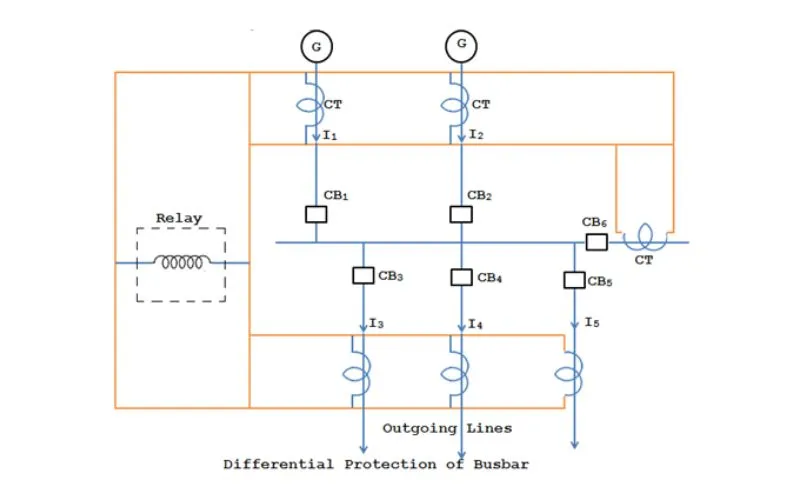
Hence, no current will flow through the relay and not operate. If any fault, either a phase-to-phase or phase-to-earth fault occurs in the systems, the sum of these currents will not be zero, and some current will flow through the relay and cause the relay to operate and isolate the faulty section. Wind in the relay indicates a fault within the protected zone. It initiates the opening of the generator breakers CB1 and CB2 and each line breaker CB3, CB4, and CB5, including the bus breaker CB6.
In this type, the busbars can be sectionalized to identify the fault in that section.
The main drawback with this type of differential protection is the difference in the magnetic conditions of the iron-cored CTs (current transformer), which may result in the false operation of the relay at the time of an external fault. Even with identical CTs having large iron cores to avoid saturation with maximum fault currents, the DC transient component presents difficulty because of its slow decay. Biasing of differential relays considerably improves stability but is not a complete solution. It can be seen that a high-impedance bus differential relay can discriminate between internal and external faults better than the usual low-impedance relay. In other words, the ratio of the relay current during an internal responsibility to the relay current during an external mark is greater if the relay impedance is higher.
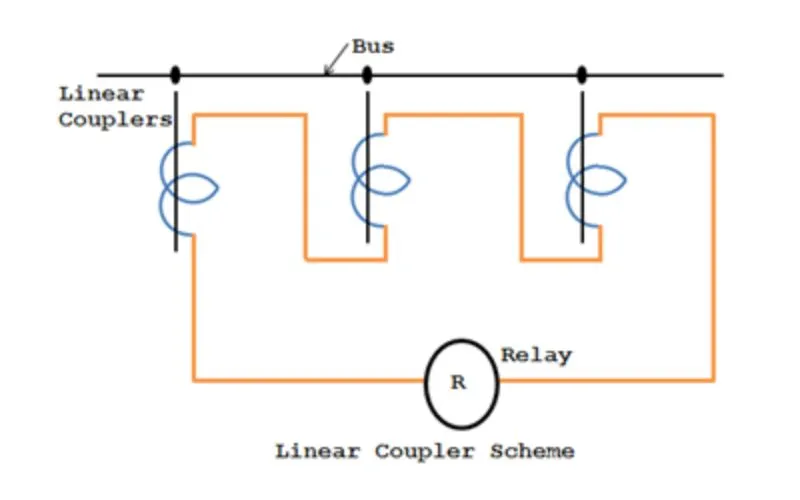
A special type of CT having no iron core, also known as the linear coupler, is sometimes employed to overcome the difficulties of an iron-cored CT. In the case of a linear coupler, the secondary voltage is proportional to the primary current; the secondary windings of all couplers on the same bus section are connected in series to the relay, as shown in the figure. The sum of their voltage outputs equals the vector sum of the voltages in the circuits connected to the busbars.
Conclusion
In conclusion, safeguarding bus zone protection and addressing busbar faults is paramount for maintaining the reliability and efficiency of power systems. Robust protection schemes and advanced technologies are crucial in detecting and mitigating weaknesses. Power system operators need to prioritize the maintenance and monitoring of busbars, investing in necessary equipment and training. By continually enhancing bus zone protection and adopting proactive fault management strategies, the power industry can ensure an uninterrupted electricity supply and improve the resilience of modern power systems in the face of evolving challenges.
Related Article
FAQs
What is bus bar protection, and why is it important?
Bus bar protection refers to the measures taken to safeguard bus bars, which are the conductive bars used to distribute electrical power within a substation or switchyard. It is crucial to protect bus bars because faults or failures in these components can lead to significant disruptions in the power supply and potential damage to equipment.
What are the different types of bus bar protection schemes?
Several bus bar protection schemes are available, including differential protection, high-impedance protection, and overcurrent protection. Each project has advantages and is suitable for different applications based on fault types, system voltage levels, and operational requirements.
How does differential protection work for bus bars?
Differential protection compares the currents entering and leaving the protected bus zone. If the winds do not balance within specified tolerances, it indicates a fault within the site. This scheme relies on current transformers and protection relays to detect and isolate faults accurately, ensuring the integrity of the bus bar system.
What are the key considerations for selecting a bus bar protection scheme?
When selecting a bus bar protection scheme, several factors should be considered. These include the system voltage level, the number and arrangement of bus bars, the fault current levels, the desired operating time, the reliability requirements, and the overall cost-effectiveness of the protection scheme.
How are bus faults detected using bus bar protection schemes?
Bus faults are detected by monitoring the currents flowing into and out of the protected bus zone. If there is an imbalance between the incoming and outgoing currents, it indicates a fault. The protection relays, configured with appropriate pickup settings and time delays, detect these imbalances and initiate the necessary actions to isolate the faulted section and restore system stability.