What Is Rogowski Coil? Working Principle, Uses & Benefits
You’re likely curious about the Rogowski coil, a fascinating device for measuring alternating current. It’s a flexible, non-intrusive tool that wraps around live conductors, providing information without interfering with the circuit. Its design guarantees precise measurements, thanks to its high linearity and broad frequency response. But how exactly does it work, and why is it favored in industrial applications? There’s much more to uncover about this innovative technology.
Key Takeaways
- A Rogowski coil is a type of flexible current transformer used for measuring AC through electromagnetic induction.
- It outputs a low-voltage AC signal proportional to the rate of change of current, requiring an integrator circuit.
- The coil’s non-magnetic, helical wire design allows easy installation around conductors without circuit disconnection.
- Its air core ensures high linearity and prevents saturation, making it suitable for high-speed transient measurements.
- Rogowski coils are ideal for applications with rapidly changing signals due to their broad frequency response and lightweight design.
Understanding the Rogowski Coil

Although it might sound complex, understanding the Rogowski coil is straightforward once you grasp its basic principles.
This flexible current transformer is designed for accurate current measurement, especially with alternating current (AC). It operates using electromagnetic induction, producing an output voltage that is proportional to the rate of change of current. This output is a low-voltage AC signal, typically ranging from 2mV to 500mV per 1000 amps. To convert this into a usable current measurement, you’ll need an integrator circuit.
The Rogowski coil’s non-magnetic, helical wire design guarantees easy installation around live conductors without disconnection. Its high linearity and broad frequency response make it ideal for measuring rapidly changing signals.
With its non-intrusive design, it’s perfect for power monitoring and fault detection.
Historical Development and Origins
You’ll find the roots of the Rogowski coil in 1887 when Arthur Prince Chattock introduced it for measuring magnetic fields.
Fast forward to 1912, Walter Rogowski and W. Steinhaus provided a definitive description that laid the groundwork for its modern applications.
Over time, the Rogowski coil has evolved, becoming a staple in industrial settings for non-intrusive current measurements.
Chattock’s Initial Concept
In 1887, Arthur Prince Chattock introduced a groundbreaking concept for measuring magnetic fields, which would form the foundation for the development of the Rogowski coil.
As you explore Chattock’s initial idea, you’ll discover its pivotal role in revolutionizing current measurement. This innovation laid the groundwork for non-intrusive techniques that have become indispensable in electrical engineering.
Here’s how Chattock’s concept set the stage:
- Magnetic Fields Focus: Provided a new approach to understanding and measuring magnetic fields.
- Non-Intrusive Method: Pioneered a technique that didn’t disrupt existing systems.
- Foundation for Rogowski Coil: Established principles for future enhancements.
- Relevance in Electrical Engineering: Influenced modern practices with its enduring principles.
Chattock’s vision continues to impact the field today.
Rogowski and Steinhaus Contribution
The Rogowski coil owes much of its development to the collaborative efforts of Walter Rogowski and W. Steinhaus. In 1912, they provided a definitive design and operational description of the Rogowski coil in the journal Elektrotechnik.
By building on earlier methods of current measurement, they introduced a more flexible and precise non-intrusive measurement technique. This innovative approach enabled the accurate measurement of flexible current without directly interfering with the circuit.
Their work significantly advanced electrical engineering practices by enhancing the measurement of currents, leading to wider adoption in various applications. The Rogowski coil’s high accuracy and wide frequency response quickly gained it popularity, distinguishing it from traditional devices and marking a pivotal point in the evolution of current measurement technology.
Evolution in Industrial Applications
Building on the foundation laid by Rogowski and Steinhaus, the Rogowski coil found its way into industrial applications with remarkable efficiency. This evolution stemmed from its non-intrusive nature and precision in current measurement.
You can appreciate its seamless integration into various environments due to its unique air core design. Here’s how it transformed industrial settings:
- Precision Welding: The coil’s accuracy guarantees high-quality welding by precisely monitoring current.
- Power Monitoring: It’s invaluable in tracking power usage and efficiency in factories.
- Fault Detection: Quickly identifies electrical faults, preventing costly downtimes.
- Design Flexibility: Its adaptability enables use in a wide range of applications, from traditional factories to modern setups.
The Rogowski coil has certainly revolutionized industrial applications, continually evolving to meet contemporary needs.
Technical Characteristics and Functionality
When exploring the technical characteristics and functionality of a Rogowski coil, you’ll find its operation hinges on electromagnetic induction. The voltage induced in the coil is directly proportional to the rate of change of current flowing through the conductor. This makes the Rogowski coil ideal for precise current measurement.
Thanks to its low inductance, the coil efficiently handles fast-changing currents, capturing high-speed transients and complex waveforms with great effectiveness. Its air-core design guarantees high linearity, allowing for accurate readings across a wide range without the saturation issues typically faced by traditional transformers.
To obtain current measurements, you’ll need an integrator circuit to convert the induced voltage. The Rogowski coil is also designed for easy installation around live conductors, maintaining circuit integrity while guaranteeing safety with galvanic isolation.
Advantages of Using Rogowski Coils
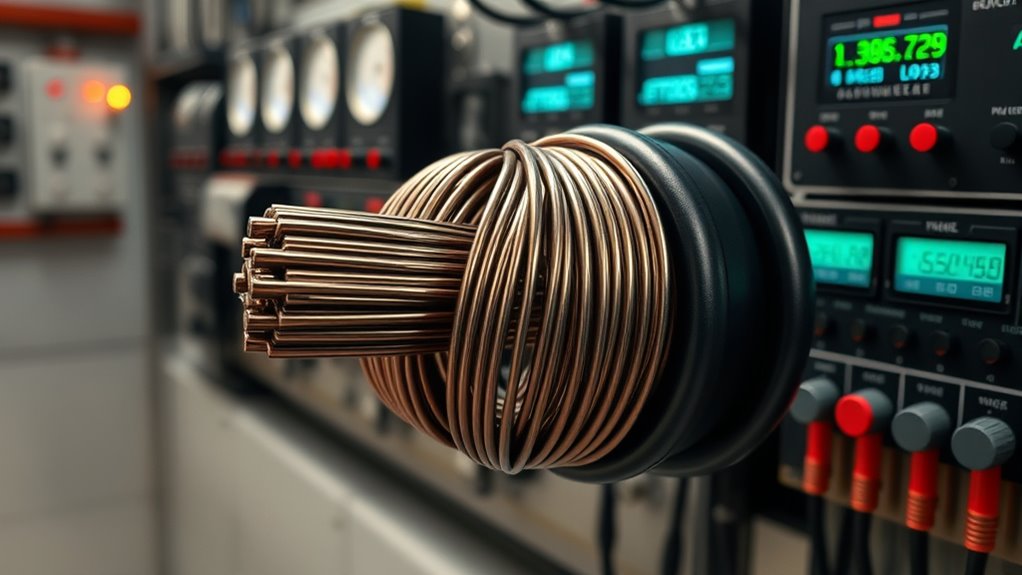
Given their unique design, Rogowski coils offer several distinct advantages that make them ideal for various applications.
To begin with, they’re lightweight and flexible, allowing easy installation around live conductors without circuit interruption—perfect for retrofitting existing systems.
In addition, with a non-magnetic air core, Rogowski coils excel in current monitoring, as they don’t saturate at high currents. This guarantees accurate measurement of large alternating current (AC) without distortion.
Furthermore, they’ve a wide frequency response, handling high-frequency signals up to 30 MHz, which is vital for applications involving high-speed transients.
Finally, their inherent linearity provides precise measurements across a wide dynamic range.
Limitations and Considerations
Although Rogowski coils boast several advantages, it’s important to evaluate their limitations before implementing them in your system.
A Rogowski coil is suitable for measuring alternating current (AC), but it can’t accurately measure direct current (DC) due to its reliance on changing magnetic fields. Its output voltage needs integration to provide a precise current measurement, adding complexity with extra electronic components.
Unlike traditional current transformers, Rogowski coils have lower sensitivity because they lack a high-permeability magnetic core, which affects their current-sensing effectiveness in certain applications.
Additionally, the accuracy can be influenced by the conductor’s positioning within the coil, resulting in potential errors of 1-3%.
Finally, maximum input voltage limitations and voltage breakdown constraints restrict their use in high-voltage environments.
Applications in Electrical Systems

You’re about to explore how Rogowski coils excel in versatile current measurement across various electrical systems.
These coils offer robust power monitoring solutions, ensuring precise readings without interrupting ongoing operations.
Plus, they enhance fault detection efficiency, making them invaluable in maintaining and protecting electrical infrastructure.
Versatile Current Measurement
When it comes to versatile current measurement in electrical systems, Rogowski coils stand out for their exceptional flexibility and accuracy.
These coils are ideal for capturing Rogowski coil current, particularly when measuring currents in complex setups. As a current sensor, they excel in handling alternating current (AC) without the risk of saturation. You’ll find the voltage in the coil is directly proportional to the rate of change of current, offering precise readings.
With these benefits, Rogowski coils are ideal for various applications:
- Energy management: Easily retrofit existing systems to improve efficiency.
- Fault detection: Quickly identify issues without affecting the circuit.
- Harmonic analysis: Monitor harmonic currents in complex waveforms.
- High-speed transients: Measure rapidly changing currents with a wide frequency response.
Power Monitoring Solutions
In the domain of power monitoring solutions, Rogowski coils offer an unmatched blend of precision and convenience, making them invaluable in electrical systems. Their ability to measure high-speed transients and pulsed currents is crucial for variable-speed drives and UPS systems. Thanks to their non-intrusive design, you can install them around existing conductors without interrupting circuits, ensuring smooth integration into your power monitoring systems. With a frequency response up to 30 MHz, they excel at capturing rapidly changing currents and voltages, providing essential data for power quality diagnostics. Rogowski coils also monitor harmonic currents, aiding compliance with standards and boosting energy efficiency. Their lightweight and flexible design is perfect for tight spaces in complex systems.
| Feature | Benefit |
|---|---|
| High-Speed Measurement | Captures rapid transients |
| Non-Intrusive Design | Easy installation |
| Frequency Response | Up to 30 MHz |
| Flexibility | Fits in tight spaces |
Fault Detection Efficiency
Although the intricacies of electrical systems can often seem intimidating, Rogowski coils simplify fault detection with their impressive capabilities. Unlike traditional current transformers, Rogowski coils excel in fault detection systems by measuring rapidly changing AC currents with precision.
Their non-intrusive design allows for the installation of these devices around live conductors without disrupting service, making fault monitoring a breeze. Here’s why they’re effective:
- Rapid Measurement: They measure rapidly changing AC currents and transients, making them ideal for detecting faults.
- Wide Frequency Response: With a frequency response of up to 30 MHz, they reliably detect harmonic currents and transient events.
- Accurate Output: Their linear output characteristic guarantees precise fault current measurements for protective devices.
- Versatile Design: Lightweight and flexible, they fit tight spaces in industrial and renewable energy systems.
Rogowski coils enhance fault detection efficiency, boosting system reliability.
Comparison With Similar Devices
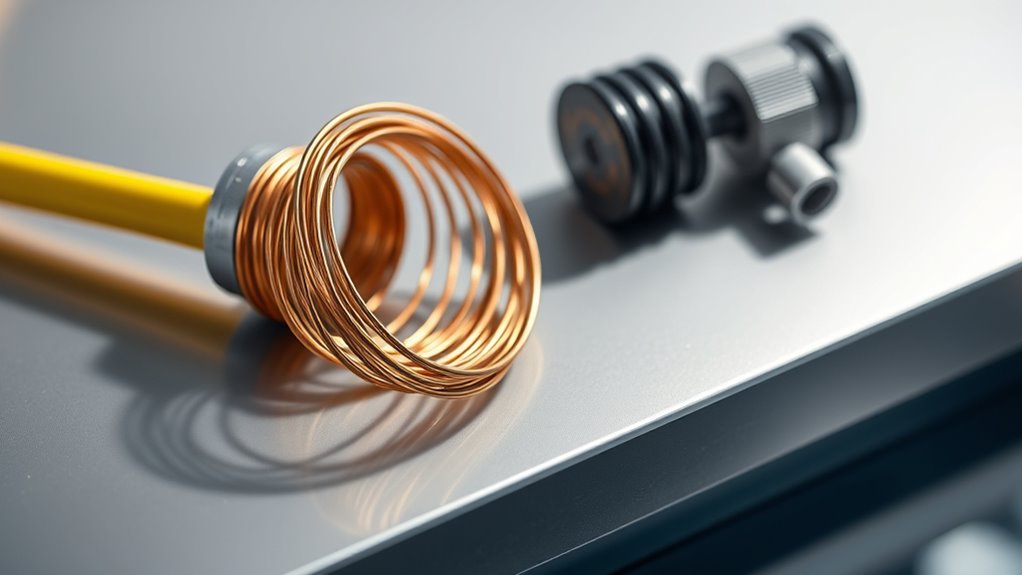
Rogowski coils stand out due to their unique design, which offers several advantages over similar devices, such as traditional current transformers and Hall effect sensors.
A Rogowski coil uses a flexible air core, making it non-intrusive and easy to install around live conductors without service interruption. Unlike current transformers, it doesn’t saturate at high currents, ensuring accuracy under heavy loads.
While it outputs a low-voltage AC signal that requires integration, it boasts an impressive frequency response of up to 30 MHz, making it perfect for high-speed transient measurements. Traditional current transformers, in contrast, have limited bandwidth.
Additionally, Rogowski coils are lighter and more flexible than Hall-effect sensors, providing a compact solution for high-current applications without the bulk of traditional devices.
Future Trends and Innovations
As technology evolves, the future of Rogowski coils holds promise for exciting innovations and trends.
You’ll see the development of integrated circuitry that pairs the coil with advanced signal processing, boosting measurement accuracy and speed.
Emerging trends include:
- Planar Rogowski coils utilize novel manufacturing techniques, enhancing efficiency and reducing sensitivity to stray magnetic fields.
- Miniaturization: Researchers are shrinking these coils for wearable tech and compact electronics, allowing precise current measurement in tight spaces.
- Wireless communication technologies: Expect real-time data transmission and remote monitoring capabilities in industrial environments.
- Durable and flexible coil materials: Advances in materials science will produce coils that withstand harsh conditions, enhancing performance and longevity.
These innovations are set to redefine how you utilize Rogowski coils in various applications.
Conclusion
You’ve explored the fascinating world of Rogowski coils, gaining insight into their historical roots and technical features. With their high linearity and broad frequency response, they’re perfect for accurate AC measurements. While they offer many advantages, such as easy installation and non-intrusiveness, it’s essential to consider their limitations in certain applications. As technology evolves, Rogowski coils are poised to play an even more significant role in electrical systems, offering innovative solutions to address future challenges.
FAQs
1. What Is a Rogowski Coil?
You’ve likely heard of a Rogowski coil. It’s a flexible current transformer you can use for measuring AC. Just wrap it around conductors for non-intrusive readings. It accurately measures high-speed transients and complex waveforms without saturation.
2. What Is the Difference Between CT and Rogowski Coils?
The main difference is that CTs have a rigid core, providing a direct current output, while Rogowski coils use a flexible air core, offering a low-voltage AC signal. Rogowski coils excel in high-current accuracy and linearity.
3. What Are the Advantages of Rogowski Coils?
You’ll find Rogowski coils advantageous due to their easy installation, flexibility, accurate measurements at high currents, and wide bandwidth. They’re cost-effective and don’t suffer from core saturation, making them ideal for various industrial applications.
4. What Are the Disadvantages of Rogowski Coils?
You’re dealing with limitations such as the need for an integrator and power supply, inaccuracy due to conductor positioning, and susceptibility to interference. Rogowski coils can’t measure DC currents and require calibration, which can be inconvenient.