

Types of Transducer: A Comprehensive Guide
When you consider the vast world of transducers, you’ll find yourself traversing through a landscape of devices designed for a specific purpose. From temperature transducers like thermocouples to pressure transducers that convert force, these tools are integral in transforming physical quantities into readable signals. But have you ever wondered how their operational principles differ or how they affect various industries? Understanding these nuances enhances your technical knowledge and opens up possibilities in application and innovation. Are you ready to explore the intricacies that set each type apart?
Key Takeaways
- Resistive transducers measure changes in resistance due to physical changes like temperature or pressure.
- Capacitive transducers detect variations in capacitance caused by changes in displacement or pressure.
- Inductive transducers measure inductance changes due to movement or position alterations.
- Piezoelectric transducers generate electrical signals from mechanical stress or vibrations.
- Photovoltaic transducers convert light energy directly into electrical signals.
Understanding Transducers
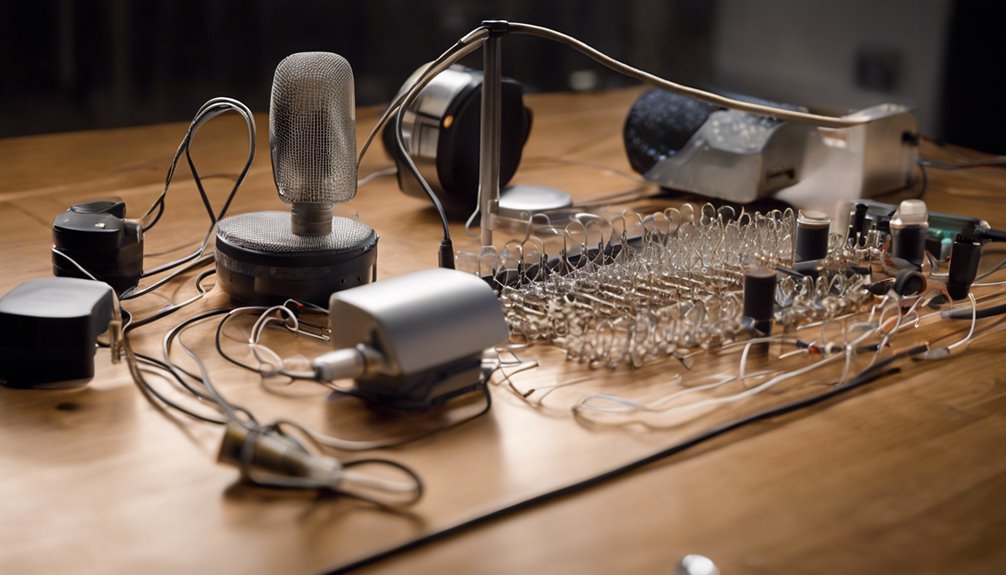
Transducers are essential components that transform physical quantities into electrical signals. They play an important role in measurement and control in various fields, such as industrial automation and medical devices.
You’ve likely encountered input transducers, or sensors, which detect and convert physical changes like temperature, pressure, or light into electrical signals. On the other side, output transducers, or actuators, take these electrical signals and convert them into physical actions, such as moving a motor or generating sound.
Understanding the operating principles of transducers is key. They can be active transducers, which generate electrical signals from the measured physical quantities, or passive transducers, requiring an external power source.
Different types, such as resistive, capacitive, inductive, and piezoelectric, each have specific applications based on their unique operating principles.
When evaluating transducers, you should consider their sensitivity—how effectively they convert a physical quantity into an electrical signal. Other important characteristics include linearity and stability, both critical for ensuring accurate measurement and reliable system performance.
With a solid grasp of these fundamentals, you’ll be better equipped to select the right transducer for any application and ensure effective and precise measurements.
Classification by Measurement Type
When exploring transducers, it’s helpful to classify them by the type of measurement they’re designed to perform. This approach organizes transducers into temperature, pressure, displacement, flow, and level transducers.
Each category is vital in converting specific physical phenomena into electrical signals.
Temperature transducers, including thermocouples and RTDs, are designed to measure temperature changes. They achieve this by translating these changes into electrical signals through variations in voltage or resistance.
Pressure transducers, such as piezoresistive and capacitive types, convert the physical force exerted on their diaphragms into proportional electrical signals. Thus, they are essential in industrial applications for monitoring pressure.
Displacement transducers, such as linear variable differential transformers (LVDTs), measure linear movement by converting it into an electrical output. They are widely used for precision measurements.
Flow transducers, including magnetic and ultrasonic flow meters, measure the flow rate of liquids or gases by translating flow characteristics into electrical signals, which is significant in numerous industrial processes.
Finally, level transducers, including capacitive and ultrasonic types, determine container substance levels by converting this measurement into an electrical signal for effective monitoring and control.
Operational Principles of Transducers

Understanding the operational principles of transducers is essential for selecting the right type for your application. Transducers are classified based on how they convert physical quantity, utilizing active or passive methods.
Active transducers, like piezoelectric transducers, generate electrical charges from mechanical stress. They’re perfect for applications such as ultrasound and vibration sensors. On the other hand, passive transducers, like resistive, capacitive, and inductive types, depend on external power and change resistance, capacitance, or inductance in response to physical changes.
Piezoelectric transducers are among the most common, leveraging mechanical stress to produce voltage.
Thermoelectric transducers, such as thermocouples, operate using the thermoelectric effect, which generates voltage based on temperature differences between two metals. This makes them invaluable for precise temperature measurements.
Hall effect transducers convert magnetic field strength into voltage signals, making them indispensable for measuring current and position in automotive and industrial systems.
Meanwhile, photovoltaic transducers, such as solar cells, use the photovoltaic effect to convert light energy directly into electrical energy, playing a pivotal role in solar power generation. Understanding these operational principles and how they relate to your needs is crucial for choosing the right transducer types.
Power Source Requirements
Choosing the right transducer often hinges on their power source requirements, impacting performance and application suitability.
You’ll find that active transducers generate their electrical signals without needing an external power source. They rely on the physical phenomena they detect for energy conversion. Take piezoelectric sensors, for example. They convert mechanical stress directly into electrical energy, offering excellent sensitivity and faster response times due to their self-generating nature.
Conversely, passive transducers require an external power source. They use this power to change their electrical parameters, such as resistance or capacitance, in response to changes in a physical quantity. For instance, a passive transducer’s strain gauge measures deformation by changing resistance when powered. This makes it ideal for applications where power consumption is a concern, like battery-operated devices.
Understanding the power requirements is essential as it affects efficiency and costs. Active transducers might demand more complex setups but provide better sensitivity.
Meanwhile, passive transducers tend to have simpler designs and lower costs due to their reliance on external power, making them a practical choice in many situations.
Key Components of Transducers

When exploring transducers, you’ll find that the sensing element is essential for detecting and initiating the conversion of physical quantities.
Understanding how signal processing circuitry amplifies and refines these signals is important for ensuring their accuracy and usefulness.
Don’t overlook calibration mechanisms; they secure precise measurements by aligning outputs with known standards.
Sensing Element Functionality
A transducer’s sensing element is its heart. It is vital for detecting and converting physical changes like temperature, pressure, or displacement into measurable signals. This core component interacts directly with physical quantities, guaranteeing accurate and reliable data.
The success of a transducer depends greatly on its sensing element’s characteristics:
- Sensitivity: This determines how effectively the sensing element detects small changes in physical quantities, like temperature or pressure.
- Linearity: A linear response guarantees that the output signal is directly proportional to the input, maintaining accuracy across the measurement range.
- Response Time: This is essential when you need real-time data, as it indicates how quickly the sensing element reacts to changes in the physical environment.
- Reliability: You want consistent performance over time, which hinges on the sensing element’s ability to maintain accuracy and sensitivity.
Different sensing elements use various principles to achieve these qualities. For instance, thermocouples employ the Seebeck effect for temperature measurement, while piezoelectric elements might be used for pressure or displacement.
Calibration is vital for confirming that your sensing element remains precise and comparing it against reference standards to maintain peak performance.
Signal Processing Circuitry
Signal processing circuitry in transducers is essential for refining and converting the raw signals from the sensing element into usable data. This circuitry typically includes amplifiers, filters, and analog-to-digital converters (ADCs) to enhance and transform the output signals for better usability and accuracy.
The amplification stage is critical; it boosts weak electrical signals by a factor ranging from 10x to 1000x, depending on your specific application needs. This step guarantees that even faint signals are strong enough for processing.
Filters are important for noise removal. They strip away unwanted frequency components so that only relevant information moves forward. This noise reduction assures that the data you’re working with is as clean as possible.
Once the signals are filtered and amplified, ADCs convert them from analog to digital form, making them compatible with digital systems. The digital signal processing (DSP) technique allows advanced signal manipulation, including data compression and error correction, enhancing overall data integrity.
The output interface is designed to be compatible with various systems, facilitating seamless integration into data acquisition and control systems. This compatibility allows you to incorporate the transducer’s refined data into your setup easily.
Calibration Mechanisms Importance
Calibration mechanisms are vital for guaranteeing that transducers deliver accurate and reliable measurements. By comparing a transducer’s output signal with known reference standards, you can adjust and fine-tune its performance. This process guarantees that your measurements are precise and valid across various applications.
Here are some key aspects to reflect upon:
- Regular Calibration: Transducers must be calibrated regularly to maintain their sensitivity and precision. Environmental factors can cause performance drift, so routine checks help keep measurements accurate.
- Output Signal Adjustments: Calibration methods often involve zeroing and span adjustments. These techniques align the transducer’s output signal with standard measurements, guaranteeing consistency.
- Validation Procedures: Using specialized equipment and following standardized procedures, you can validate a transducer’s accuracy across its full range, guaranteeing dependable measurements.
- Data Acquisition Systems: Effective calibration reduces errors in data acquisition systems, enhancing the reliability of measurements in industrial, scientific, and medical fields.
Applications Across Industries
Transducers are indispensable across various industries, from automotive to consumer electronics. In the automotive sector, transducers are essential for applications in sensors that monitor speed, detect tire pressure, and control engine systems, enhancing both safety and performance. You rely on these technologies daily without even realizing it.
In medical settings, transducers like thermocouples and piezoelectric sensors monitor crucial signs such as temperature and heart rate, guaranteeing accurate diagnostics and ideal patient care.
Industrial automation is another area where transducers shine. Pressure transducers and flow meters help maintain ideal operating conditions, improving efficiency in manufacturing processes. These devices ensure everything runs smoothly, minimizing downtime and maximizing productivity.
In the world of consumer electronics, you’re interacting with transducers more than you might think. Microphones and speakers—key components in devices like smartphones and home theater systems—enable sound input and signal output for communication and entertainment.
Finally, transducers measure important parameters like temperature, humidity, and pollutant levels in environmental monitoring. This data is essential for climate studies and public health assessments, helping experts understand and tackle pressing environmental issues.
Distinguishing Sensors From Transducers

While exploring the vast applications of transducers across various industries, you might wonder how these devices function and what sets them apart. At the core, sensors and transducers play essential roles in measurement and control systems. Here’s how you can distinguish them:
- Role in Conversion: As an input device, a sensor detects physical quantities like temperature or pressure and converts them into electrical signals. Meanwhile, a transducer can also work as an output device, converting electrical signals back into physical actions, such as a loudspeaker turning signals into sound.
- Device Types: All sensors are transducers, but not all transducers are sensors. Transducers encompass sensors (input) and actuators (output), each catering to specific roles in energy conversion.
- Components: Sensors generally consist of a sensing element and a conversion mechanism to transform physical quantities into signals. In contrast, output transducers, like actuators, require an energy source and a means to produce a physical output.
- Performance Metrics: Sensors’ performance is often gauged by their sensitivity and accuracy in detecting changes. Transducers, however, are evaluated on their efficiency in converting one form of energy to another.
Understanding these distinctions enhances your grasp of these essential technologies.
Conclusion
You’ve now clearly understood transducers and their diverse types, from temperature to flow transducers. Each has unique operational principles and power requirements, making them pivotal in various industries. Remember, while sensors detect changes, transducers go a step further by converting these changes into measurable signals. By recognizing these distinctions and applications, you can appreciate how transducers enhance technology and processes in our everyday lives. They’re essential for precise measurement and control.
FAQs
1. What Are 3 of the Most Common Transducer Types?
Pressure sensors, temperature sensors, and acoustic transducers are often encountered. Pressure sensors monitor pressure changes, temperature sensors track heat variations, and acoustic transducers convert sound into electrical signals for effective communication and audio processing.
2. What Are 5 Examples of Transducers?
You’re looking for transducer examples. Consider ultrasonic sensors, pressure transducers, temperature sensors, load cells, and optical sensors. Each converts physical phenomena into electrical signals, providing vital data for various applications. They’re essential in technology and engineering fields.
3. What Are the Different Types of Current Transducers?
When exploring current sensing technologies, you’ll find Hall effect transducers, Rogowski coil applications, transformer-based transducers, resistive current sensors, digital current transducers, and current-to-voltage converters. These technologies excel in AC monitoring, each with unique current measurement principles and specifications.
4. What Are the Two Types of Transducers?
There are two main types of transducers: input and output. Input transducers, like piezoelectric or capacitive sensors, convert physical changes into electrical signals. Output transducers, including optical or ultrasonic devices, transform electrical signals into mechanical actions.
