A Comprehensive Guide to Types of Faults
Types of Faults
The two types of faults are;
-
Symmetrical Faults
-
Unsymmetrical Faults
Symmetrical Types Of Faults
A Symmetrical Fault, also known as a balanced fault, is a type of electrical fault that occurs when all three phases (A, B, and C) in a three-phase power system are affected equally and simultaneously. In a symmetrical weakness, the fault currents in all three phases have the same magnitude and are 120 degrees out of step with each other. These faults typically result from conditions such as a short circuit between all three steps or a spot that equally impacts all stages.
-
All three lines are short-circuited without an earth connection at fault (L-L-L)
-
All three lines short-circuited with an earth connection at fault (L-L-L-G)
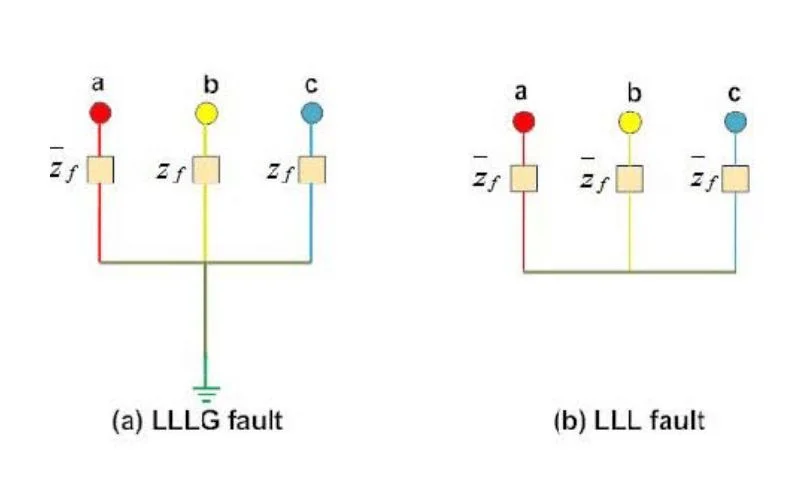
Causes and Effects of Faults in Power System
Unsymmetrical Types Of Faults
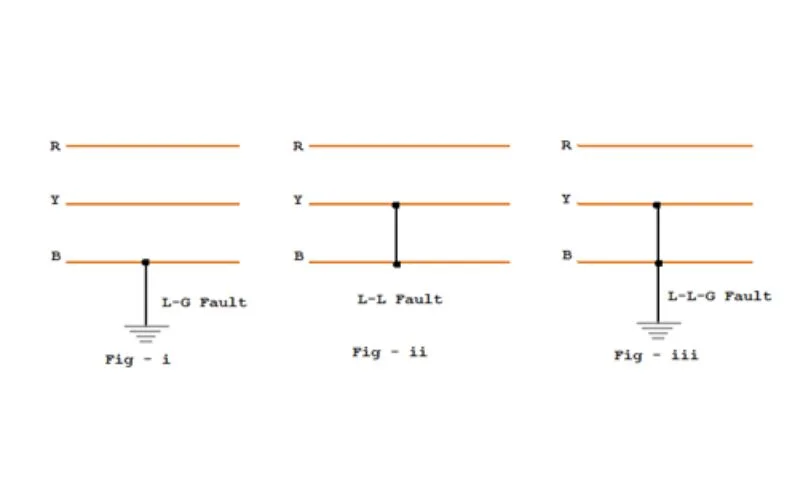
On the occurrence of an unsymmetrical fault, the currents in the three lines become unequal, and so does the displacement among them. However, the system impedances and the source voltages are always symmetrical through its main elements, viz. generators, transmission lines, synchronous reactors, etc.
Power Swing
-
Single line to ground fault (L-G)
-
Line to line fault (L-L)
-
Double line to ground fault (L-L-G)
-
It is a simple method and gives generality to fault performance studies.
-
It provides a useful tool for protection engineers, particularly in finding fault currents.
Single Line to Ground Fault (L-G)
A Single-line Ground Fault, or L-G fault, occurs when a phase conductor unintentionally contacts the ground or a conductive surface. This creates a short circuit, allowing a significant current to flow. L-G faults can lead to electrical fires, equipment damage, and safety hazards. Protective devices like circuit breakers and GFCIs mitigate L-G faults.
Double Line to Ground Fault (L-L-G)
A Double Line to Ground Fault, denoted as L-L-G fault, happens when two phase conductors simultaneously contact the ground or a conductive surface, causing a short circuit. This complex fault can result in equipment damage, power outages, and safety risks. Protective devices and fault detection systems are essential to isolate L-L-G faults promptly.
Line to Line Fault (L-L)
A Line Line Fault, an L-L fault, occurs when two phase conductors contact each other directly without grounding. This creates a short circuit, causing a rapid and substantial current flow. L-L faults are a significant concern in power distribution systems, leading to equipment damage, fires, and power disruptions. Protective measures like circuit breakers and relays detect and address L-L faults, safeguarding the power grid.
Normal Faults

Normal faults are characterized by vertical movement, where the hanging wall (the block of rock above the fault) moves downward relative to the footwall (the union of stone below the mark). These faults are associated with extensional tectonic forces, such as the stretching of the Earth’s crust. Normal defects often form fault-block mountains, where several fault segments create a series of elevated blocks and valleys.
Features of Normal Faults
- Fault Scarp: A cliff or escarpment formed along the fault line due to the vertical displacement of the hanging wall.
- Horst and Graben: The elevated block created by the upward displacement of the footwall is called a horst, while the lowered partnership formed by the downward removal of the hanging wall is called a graben.
Reverse Faults

Reverse faults are characterized by horizontal compression, where the hanging wall moves upward relative to the footwall. These faults are associated with concurrent tectonic forces, where two tectonic plates move toward each other. Reverse flaws are commonly found in regions with intense crustal compression, such as mountain ranges.
Features of Reverse Faults
- Thrust Faults: A special type of reverse fault with a low-angle fault plane. Thrust faults are responsible for stacking rock layers, creating overthrust mountains.
Strike-Slip Faults

Strike-slip faults involve horizontal movement along the fault plane with little vertical displacement. In strike-slip marks, the blocks of rock slide past each other horizontally. These faults are primarily associated with transform plate boundaries, where two plates slide past each other horizontally.
Features of Strike-Slip Faults
- San Andreas Fault: One of the most famous strike-slip faults, the San Andreas Fault in California is responsible for significant seismic activity due to the lateral motion of the Pacific and North American plates.
Transform Faults
Transform faults are a specific type of strike-slip fault found along the boundaries of tectonic plates. They allow horizontal motion between two plates, relieving stress caused by their relative movement. Transform defects are often associated with earthquake activity, as the plate friction is overcome in sudden bursts of energy release.
Features of Transform Faults
- Mid-Atlantic Ridge: A prominent underwater transform fault that runs through the Atlantic Ocean, separating the North American and Eurasian plates from the South American and African dishes.
Oblique-Slip Faults

Oblique-slip faults exhibit both horizontal and vertical movement, combining characteristics of both strike-slip and dip-slip faults. These faults are less common but can result from complex tectonic interactions.
Features of Oblique-Slip Faults
- Dextral and Sinistral Faults: In dextral faults, the block on the opposite side of the observer appears to move to the right, while in sinistral defects, it seems to move to the left.
Conclusion
Understanding the various types of faults is crucial for geologists and seismologists to predict and analyze seismic activity and the formation of geological features. These faults are dynamic and ever-changing, vital in the ongoing processes shaping the Earth’s crust. Whether they result from extension, compression, or lateral motion, faults are a testament to our planet’s lithosphere’s constant movement and transformation.