Types of Capacitors and Their Applications | Complete Guide
You’re likely surrounded by devices that rely on capacitors, but you might not realize the diversity and significance they bring to electronics. Understanding the different types of capacitors and their specific uses can give you insight into how they enhance device performance. Each type offers unique benefits, from the stability of ceramic capacitors in high-frequency circuits to the rapid energy discharge of supercapacitors. Curious about how this impacts your gadgets? Let’s explore further.
Key Takeaways
- Ceramic capacitors are suitable for high-frequency applications due to their stability and low losses.
- Electrolytic capacitors, with significant energy storage capacity, are ideal for DC power supply filtering.
- Tantalum capacitors offer high capacitance in compact designs, requiring correct polarity to avoid failure.
- Supercapacitors provide rapid charge and discharge cycles and are used in regenerative braking systems and backup power.
- Film capacitors, known for reliability, are used in applications requiring low self-inductance.
Understanding Capacitors and Their Basic Functionality

Capacitors are essential components in electronics, acting as small energy reservoirs. They store electrical energy by creating an electric field between two plates. The capacitance, defined by C = Q/V, depends on plate area, distance, and the dielectric material used.
You’ll find capacitors in various applications, from filtering to signal smoothing.
Ceramic capacitors are non-polarized, making them versatile for AC circuits. They provide stable capacitance with minimal changes over time.
Electrolytic capacitors, on the other hand, are polarized and used for larger capacitance needs, like energy storage. These types must be connected with the correct polarity.
Classification of Capacitors

When exploring the classification of capacitors, you’ll encounter fixed and variable types, each serving specific needs.
Fixed capacitors, categorized by construction materials like ceramic and electrolytic, maintain a constant capacitance, while variable capacitors allow adjustments for tuning.
Additionally, understanding the difference between polarized and unpolarized capacitors will help you choose the type for either DC or AC applications.
Fixed and Variable Type
In electronics, understanding the difference between fixed and variable capacitors is essential for selecting the right component for your circuit. A fixed capacitor offers a constant capacitance value, making it stable and reliable.
These are categorized by their dielectric material, including ceramic capacitors, film, and electrolytic types.
On the other hand, variable capacitors let you adjust capacitance values, which is vital in tuning circuits. They often feature air-spaced multi-plate designs for flexibility.
Trimmer capacitors, a subset of variable capacitors, are small and used for precise adjustments.
While polarized capacitors like electrolytic types have specific terminal orientations, non-polarized capacitors can be used in any direction, adding versatility for AC applications.
Choose based on your specific circuit needs.
Polarized vs. Unpolarized Capacitors
As you explore different capacitor types, it’s important to understand the distinction between polarized and unpolarized capacitors, especially when considering their applications.
Polarized capacitors, like electrolytic capacitors, have specific positive and negative terminals. They’re essential for DC applications, such as power supply filtering and coupling, because a mismatch in polarity can lead to failure. Their high capacitance values make them ideal for compact, high-density applications.
Conversely, unpolarized capacitors, such as ceramic and film, can be connected in any direction, making them suitable for AC circuits and high-frequency applications.
Their non-polarity and stability offer versatility without the risk of polarity-related issues. While they usually provide lower capacitance, their reliability in various conditions is unmatched.
Capacitor Construction Materials
Understanding the materials used in capacitor construction is essential for appreciating their varied applications and performance characteristics.
Capacitors are made using two conductive plates, typically metal foil like aluminum or silver, separated by a dielectric material.
Ceramic capacitors utilize ceramic dielectrics, offering high voltage ratings and stability, making them ideal for high-frequency uses.
Film capacitors employ thin plastic films as dielectrics. They are known for low self-inductance and reliability, making them suitable for cost-effective, stable applications.
Electrolytic capacitors use a metallic anode with an oxidized dielectric layer and an electrolyte, providing high capacitance but needing correct polarity.
Supercapacitors, however, skip traditional dielectrics by employing Helmholtz double-layers for exceptional capacitance densities, redefining energy storage potential.
Each material selection impacts the capacitor’s performance and application scope.
Exploring Ceramic Capacitors

When exploring ceramic capacitors, you’ll find their ceramic dielectric properties offer high voltage ratings and stable capacitance, making them perfect for high-frequency applications.
These capacitors, with their non-polarized nature, provide flexibility in circuits without worrying about polarity issues.
You’ll also appreciate the wide range of capacitance values, from a few picofarads to hundreds of microfarads in multilayer versions, accommodating various design needs.
Ceramic Dielectric Properties
Ceramic capacitors stand out because of their versatile dielectric properties, making them an excellent choice in numerous applications. These capacitors offer high voltage ratings and are non-polarized, allowing for flexible connections in AC circuits.
Here’s why they’re often preferred:
- Class 1 Capacitors: Known for stability and low losses, they’re ideal for precision applications.
- Class 2 Capacitors provide higher capacitance values but with less accuracy, making them suitable for general applications in power systems.
- High Voltage Handling: They can endure voltages above their ratings without damage, guaranteeing reliability during surges.
With capacitance values ranging from picofarads to microfarads, ceramic capacitors fit varied needs. Their dielectric materials guarantee they maintain functionality over time, despite some aging effects in Class 2 types.
High-Frequency Applications
Building on the ceramic capacitors ‘ versatile dielectric properties, their role in high-frequency applications becomes apparent. With low equivalent series resistance (ESR) and high voltage ratings, ceramic capacitors are preferred for RF circuits and decoupling tasks.
Multilayer ceramic capacitors (MLCCs) pack significant capacitance values into a compact size, perfect for high-density PCBs. Class 1 ceramic capacitors, like C0G/NP0 types, shine in precision timing circuits and oscillators due to their high stability and low losses. Non-polarity gives you flexibility in AC applications, minimizing the risk of polarity mistakes.
However, be mindful of temperature changes affecting capacitance values, especially in Class 2 ceramics like X7R and Y5V, which can degrade over time under high-frequency conditions.
Voltage and Capacitance Range
Ceramic capacitors are incredibly versatile due to their wide voltage and capacitance range. Their capacitance values span from a few picofarads to several microfarads, making them suitable for countless applications.
Ceramic capacitors can handle impressive voltage ratings, often exceeding 50 volts and reaching several kilovolts. When choosing the right type, consider the following:
- Class 1 capacitors, like the C0G or NP0 types, offer stable capacitance and low losses, working well up to 125°C.
- Class 2 capacitors, Such as X7R and Y5V, provide higher capacitance per volume but vary with temperature and applied voltage.
- MLCCs: Ideal for high-density applications, they deliver hundreds of microfarads compactly while maintaining high voltage ratings.
These features make ceramic capacitors essential in modern electronics.
Film Capacitors: Types and Uses
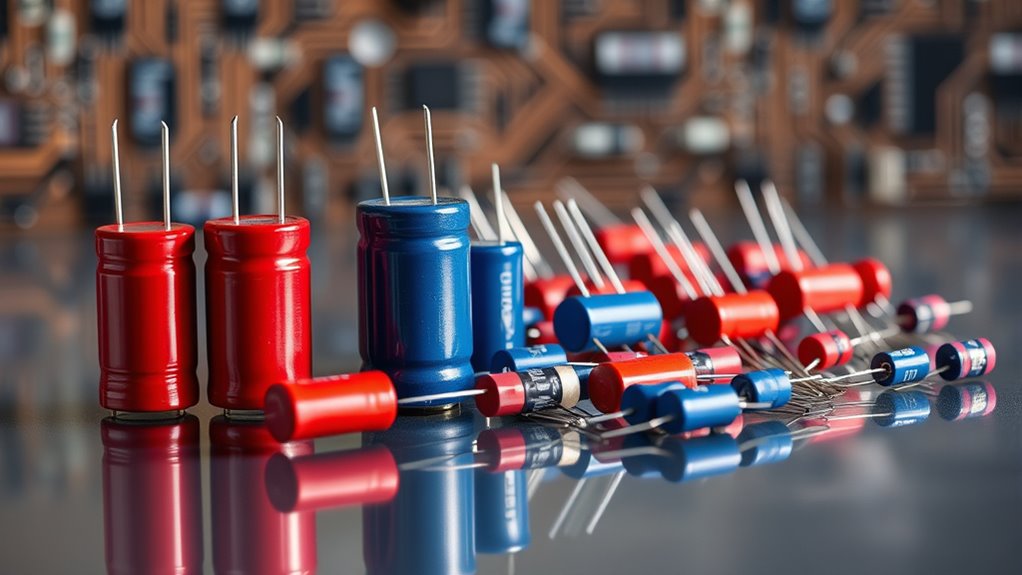
Although often overlooked, film capacitors play a crucial role in various electronic applications due to their high reliability and stability. They utilize dielectric materials like polypropylene and polyester, offering capacitance values from 5pF to 100µF. Their high reliability makes them perfect for power electronics, audio systems, and safety circuits. With low self-inductance, they handle reactive power surges effectively, making them indispensable for noise filtering and coupling in audio systems. Plus, their construction supports long-term storage, providing unmatched durability.
| Feature | Description | Application |
|---|---|---|
| Dielectric Materials | Polypropylene, Polyester | High reliability |
| Capacitance Values | 5pF to 100µF | Power electronics |
| Low Self-Inductance | Manages power surges | Noise filtering |
| Stability | Long-term storage capability | Audio systems |
| Shelf Life | Limitless | Safety circuits |
The Role of Electrolytic Capacitors in Circuits

Electrolytic capacitors are essential when working with circuits due to their high capacitance and the need for correct voltage polarity.
Their ability to store significant energy makes them ideal for power supply filtering, smoothing out voltage fluctuations in DC applications.
Always verify correct polarity to avoid damaging these components and compromising circuit performance.
Capacitance and Polarity Importance
Understanding the importance of capacitance and polarity in electrolytic capacitors is vital for their effective use in circuits. These polarized components have specific polarity requirements; connect them incorrectly, and you risk failure.
They’re perfect for DC power supply circuits because their large capacitance values make them ideal for smoothing and filtering, reducing voltage ripple considerably. However, pay attention to the voltage rating—exceed it, or connect with reverse polarity, and you might cause catastrophic failure.
To maintain their performance:
- Monitor voltage to avoid exceeding the capacitor’s capacity.
- Verify correct polarity when installing to prevent damage.
- Regular testing is essential to detect performance degradation over time.
These steps guarantee efficient energy storage and long-lasting operation in your circuits.
Power Supply Filtering Uses
Thanks to their impressive high capacitance values, electrolytic capacitors are crucial for power supply filtering. From 0.1µF to over 2,700,000µF, these capacitors smooth out voltage fluctuations in DC circuits. Their polarized nature means you’ve got to connect them correctly to prevent failure.
In power supply circuits, electrolytic capacitors reduce ripple voltage, enhancing the stability and performance of electronic devices. They also act as charge reservoirs, keeping the output voltage steady and reliable.
Electrolytic capacitors’ compact size and ability to handle high capacitance make them suitable for decoupling, filtering noise and transients from sudden load changes.
However, they have a limited lifespan due to electrolyte evaporation, so regular monitoring and replacement are critical for maintaining peak performance.
Dielectric Capacitors and Their Importance

Though often overlooked, dielectric capacitors play a significant role in electronics, especially in tuning applications. Known as variable capacitors, they’re vital for adjusting capacitance in radios and other devices. Altering the plate positions allows you to fine-tune frequencies in oscillators and filter circuits.
- Dielectric Material: Different materials, like ceramic or plastic films, impact capacitance stability and temperature performance.
- Capacitance Adjustment: Multi-plate configurations allow precise control over capacitance values, essential for achieving desired frequencies.
- Reliability: Thigh-high reliability makes them ideal for RF and audio frequency circuits.
Dielectric capacitors are indispensable in achieving precision and stability, ensuring your electronic devices perform best and consistently.
Key Features of Tantalum Capacitors

Tantalum capacitors offer several key features that make them indispensable in various applications.
You’ll appreciate their high capacitance values, ranging from 0.1 µF to 15,000 µF, which suit compact setups requiring significant energy storage. To avoid thermal runaway and failure, polarized devices must be connected with the right polarity.
Their reliable performance stems from excellent stability, with linear capacitance changes across temperatures. Unlike aluminum electrolytic capacitors, tantalum capacitors tolerate reverse voltages better, boosting their reliability in DC applications.
These capacitors excel in filtering and decoupling tasks, which are essential for mission-critical electronics. Consequently, they’re often found in military and aerospace systems, where dependable energy storage and performance are non-negotiable.
Tantalum capacitors consistently meet demanding requirements.
Supercapacitors: A Modern Approach to Energy Storage

Regarding modern energy storage solutions, supercapacitors stand out for their impressive ability to deliver rapid charge and discharge cycles.
These devices excel in high power density, making them essential for applications that require quick energy bursts. Their energy density ranges from 1 to 10 Wh/kg, lower than batteries but unmatched in speed.
Key Applications of Supercapacitors:
- Regenerative Braking Systems: Electric vehicles use regenerative braking systems to store and release energy quickly.
- Backup Power Systems: Provide fast-response energy storage for an uninterrupted power supply.
- Renewable Energy Storage: Support solar and wind power systems with rapid energy exchange.
With a typical voltage range of 2.5V to 3.0V per cell, supercapacitors can be configured to meet various energy requirements, offering a versatile energy storage option.
Non-Polarized Capacitors in AC Circuits

In AC circuits, non-polarized capacitors, such as ceramic and film types, shine because they can be connected without worrying about polarity, simplifying installation and reducing the risk of performance issues.
You’ll appreciate their versatility in handling alternating current, making them ideal for audio electronics and signal coupling. Their capacitance values range from picofarads to microfarads, offering flexibility in design.
These capacitors excel in filtering and decoupling applications, effectively suppressing unwanted noise and enhancing signal integrity. Low-equivalent series resistance (ESR) and high-frequency response minimize signal loss and distortion in high-speed circuits.
Whether you want to maintain clarity in audio systems or guarantee stable performance in fast-paced environments, non-polarized capacitors are your go-to choice.
Practical Applications of Various Capacitor Types

Though capacitors come in many types, each has unique attributes that make it suitable for specific applications.
If you’re dealing with high-frequency circuits, ceramic capacitors are your go-to choice for decoupling, thanks to their stability in capacitance values.
Do you need something for power supplies? Electrolytic capacitors, with their high capacitance values, are perfect for filtering and smoothing DC signals.
Film capacitors excel for audio applications or power electronics due to their low self-inductance and reliability.
Here’s a quick guide:
- Ceramic capacitors – Ideal for RF applications and decoupling.
- Electrolytic capacitors – Best for power supply circuits.
- Film capacitors – Perfect for audio and power electronics.
Conclusion
You’ve explored the diverse world of capacitors, each offering unique benefits for different applications. Ceramic capacitors shine in high-frequency circuits, while electrolytic ones are essential for power supply filtering. Tantalum capacitors are compact and stable, perfect for sensitive electronics, and supercapacitors bring rapid energy storage to modern technologies like electric vehicles. Understanding these components helps you enhance electronic device performance and reliability, ensuring you choose the right capacitor for your specific needs.
FAQs
1. What Are the Applications of Different Types of Capacitors?
You need to understand that ceramic capacitors work well for high-frequency circuits, electrolytic capacitors are great for power supplies, film for audio and stability, tantalum for critical tasks, and supercapacitors excel in energy storage and electric vehicles.
2. Should I Use a Ceramic or Electrolytic Capacitor?
A ceramic capacitor is a good choice for high-frequency or AC applications due to its nonpolarized nature and low ESR. Opt for an electrolytic capacitor to ensure proper polarity if you need higher capacitance in DC circuits.
3. What Is the Difference Between the Different Types of Capacitors?
The main differences are capacitance range, voltage rating, and application suitability. Ceramic capacitors are compact and non-polarized, while electrolytic ones offer higher capacitance for power supplies but are polarized and have a limited lifespan.
4. What Is a 0.1 UF Capacitor Used For?
In audio systems, you use a 0.1 µF capacitor to filter noise, power supplies for voltage stability, RF for coupling, timing circuits for delays, and electronics to enhance signal integrity by bypassing noise.