Tunnel Diodes: A Quantum Leap in Electronics
Tunnel diodes, also known as Esaki diodes after their inventor, Leo Esaki, are a unique and fascinating type of diode with properties distinguishing them from other diodes like silicon and germanium. These diodes operate on a quantum mechanical phenomenon known as quantum tunneling. In this article, we will explore what tunnel diodes are, how they work, their applications, and their advantages and disadvantages.
What is a Tunnel Diode?
A tunnel diode is a special type characterized by its ability to exhibit negative resistance. Unlike conventional diodes, which show positive resistance, tunnel diodes can conduct in the reverse bias region under certain conditions. This property makes them invaluable in various electronic applications, especially high-frequency circuits.
The Working Principle

Tunnel diodes operate on the principle of quantum tunneling, where electrons can traverse energy barriers that classical physics suggests they cannot. This unique ability enables reverse bias conduction, setting tunnel diodes apart from conventional diodes.
Quantum Tunneling
The fundamental principle behind the operation of a tunnel diode is quantum tunneling. Quantum tunneling is a phenomenon in quantum mechanics where particles can pass through a potential energy barrier even if classical physics suggests they shouldn’t be able to. In tunnel diodes, electrons can move through the energy barrier in a way that allows for reverse bias conduction.
Energy Band Diagram
To understand the operation of tunnel diodes, let’s look at the energy band diagram. A bandgap in a regular semiconductor diode prevents electron flow in the reverse-bias direction. However, this bandgap is so narrow in a tunnel diode that electrons can “tunnel” through it. This results from tunnel diode construction’s unique material properties and dopant profiles.
Applications of Tunnel Diodes
Tunnel diodes have a range of applications owing to their unique characteristics. Some of the key applications include:
High-Frequency Oscillators
Tunnel diodes are often used in high-frequency oscillators. Their negative resistance property enables them to generate stable and high-frequency signals, making them suitable for microwave and RF applications.
Amplifiers
Tunnel diodes can also be employed in amplifier circuits. They offer high amplification, especially at high frequencies, which benefits applications such as radar systems and communication devices.
Pulse Shaping
Tunnel diodes produce precise and controlled pulses in pulse-shaping circuits, making them valuable in digital signal processing and radar technology applications.
Switching
Tunnel diodes can act as high-speed switching devices in digital logic circuits, particularly for applications requiring rapid switching.
Voltage-controlled Oscillators (VCOs)
Voltage-controlled oscillators are critical components in many electronic systems. Tunnel diodes can serve as the core of VCOs, providing accurate and stable frequency modulation.
Advantages of Tunnel Diodes
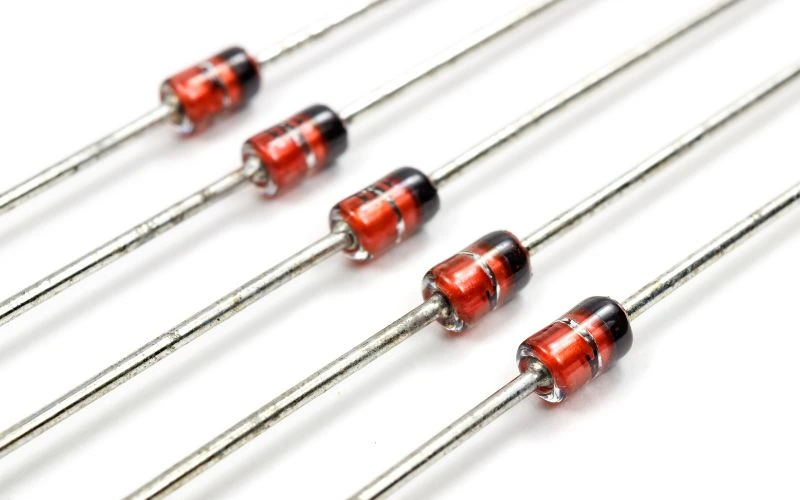
Tunnel diodes offer exceptional advantages, including high-frequency operation, low power consumption, instant switching, and temperature stability, making them indispensable in applications demanding efficiency and precision.
High-Frequency Operation
Tunnel diodes excel in high-frequency applications due to their negative resistance region. They can generate and amplify signals in the microwave and millimeter-wave frequency ranges.
Low Power Consumption
Compared to other semiconductor devices, tunnel diodes typically consume less power. This is especially advantageous in battery-powered applications where energy efficiency is crucial.
Instant Switching
Tunnel diodes can instantly switch between conducting and non-conducting states, making them ideal for high-speed digital and RF applications.
Temperature Stability
Tunnel diodes exhibit good temperature stability, ensuring consistent performance across various operating temperatures.
Disadvantages of Tunnel Diodes
While tunnel diodes excel in high-frequency domains, they have limitations, including a narrow voltage range, unsuitability for low-frequency applications, and limited availability compared to other diode types. Understanding these drawbacks is essential for informed usage.
Limited Voltage Range
Tunnel diodes have a relatively narrow voltage range in which they operate optimally. Beyond this range, they may not function as expected.
Not Suitable for Low-Frequency Applications
While tunnel diodes excel in high-frequency applications, they are less effective at lower frequencies, limiting their versatility.
Limited Availability
Tunnel diodes are not as widely available as other semiconductor devices, making them harder to source for certain applications.
The Evolution of Tunnel Diodes

Over the years, tunnel diodes have seen advancements and improvements in their design and performance. These developments have broadened their range of applications and made them more versatile. Let’s take a look at some of the key developments in tunnel diode technology:
Gallium Arsenide (GaAs) Tunnel Diodes
Gallium arsenide (GaA) tunnel diodes have become one of the most common materials used in their construction. GaAs tunnel diodes offer higher electron mobility than other materials, allowing for even better high-frequency performance. They have also shown improved temperature stability and reduced noise levels, making them attractive for various applications.
Integration with Other Components
Tunnel diodes can be integrated with semiconductor devices to create highly specialized circuits. For example, combining a tunnel diode with a transistor can create a tunnel diode amplifier widely used in radio-frequency applications. These integrated circuits offer enhanced functionality and performance.
Nanoscale Tunnel Diodes
Advancements in nanotechnology have led to the development of nanoscale tunnel diodes. These tiny diodes have applications in nanoelectronics and quantum computing. Their small size and precise control over properties make them valuable for emerging technologies.
Conclusion
In conclusion, tunnel diodes are intriguing semiconductor devices that owe their distinctive characteristics to quantum tunneling. They find applications in various fields, particularly in high-frequency and analog electronics. While they have advantages such as high-frequency operation and low power consumption, they are not well-suited for low-frequency applications. Understanding tunnel diodes’ unique capabilities and limitations is essential for harnessing their potential in electronic circuits.
FAQs
1. Can tunnel diodes be used in digital logic circuits?
Due to their specialized characteristics, tunnel diodes are not commonly used in digital logic circuits. They are primarily employed in high-frequency and analog applications, such as oscillators and amplifiers. Other semiconductor devices, like transistors, are more suitable for digital logic.
2. How do tunnel diodes differ from other diodes?
Because of their unique negative resistance property, tunnel diodes are distinct from conventional diodes like silicon or germanium diodes. While regular diodes only allow forward conduction, tunnel diodes can also conduct in the reverse bias region, which makes them particularly useful in high-frequency applications.
3. What materials are tunnel diodes typically made from?
Tunnel diodes are commonly constructed from gallium arsenide (GaAs) and indium phosphide (InP). These materials have the appropriate energy band structures and doping profiles to enable quantum tunneling and the negative resistance effect.