Transformer Efficiency Formula for Maximum Energy Savings
When you think about the efficiency of transformers, the formula that calculates the ratio of output power to input power becomes essential. This simple yet powerful equation can reveal much about how well a transformer performs. By understanding how iron and copper losses impact the overall efficiency, you can see where improvements can be made. How does this formula affect the design and daily operation of transformers? And what practical steps can you take to optimize energy efficiency in electrical systems? Let’s explore these questions further.
Key Takeaways
- Transformer efficiency is calculated as (Output Power / Input Power) * 100.
- Efficiency can be expressed as η = (Pout / Pin) * 100%.
- Maximum efficiency occurs when iron losses equal copper losses.
- Efficiency at any load condition: η = (Pout / (Pout + Total Losses)) * 100.
- Iron and copper losses are determined using open-circuit and short-circuit tests, respectively.
Understanding Transformer Efficiency
Understanding transformer efficiency means knowing how effectively a transformer converts input power to output power. Efficiency is the transformer’s output power ratio to its input power, typically ranging from 95% to 99%. Various factors influence this efficiency, primarily losses within the transformer.
There are two main types of losses: iron losses and copper losses. Iron losses, also known as core losses, include hysteresis and eddy current losses within the transformer’s iron core. Copper losses occur due to the resistance of the windings when electrical current flows through them. Both types of losses impact the overall efficiency of the transformer.
Achieving maximum efficiency in a transformer happens when iron losses equal copper losses. This balance optimizes the transformer’s performance, ensuring it runs as efficiently as possible.
The load level and power factor also play significant roles in determining efficiency. Typically, maximum efficiency is achieved at full load and a unity power factor.
Calculating Transformer Efficiency
When calculating transformer efficiency, you’ll evaluate the transformer’s output power ratio to its input power. Efficiency, typically ranging from 95% to 99%, measures how well a transformer converts input power into usable output power.
First, you need to identify the losses in the transformer. These losses are categorized as iron losses (core losses) and copper losses. Iron losses occur due to the alternating magnetic field in the transformer’s core and can be determined through open-circuit tests. On the other hand, copper losses result from the resistance of the winding and are identified using short-circuit tests.
A transformer operates best for maximum efficiency when its iron losses are equal to its copper losses. At this point, the performance is optimized, and the efficiency is at its peak.
You also need to consider the load conditions. Efficiency at any fraction of full load can be calculated by accounting for the total losses at that specific load condition.
Turn Ratio and Efficiency
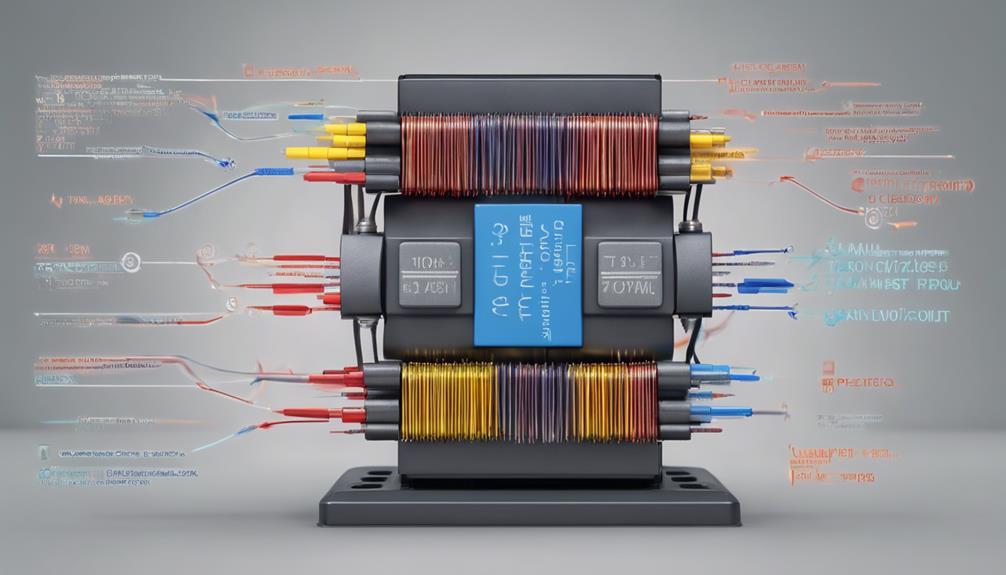
Calculating the turn ratio is essential for optimizing a transformer’s efficiency and ensuring it operates effectively. The turn ratio (Ns/Np), which represents the ratio of secondary coil turns to primary coil turns, directly impacts a transformer’s efficiency. Higher turn ratios typically contribute to greater efficiency, reducing system losses.
Copper losses depend on the current flowing through the primary and secondary windings and are influenced by the turn ratio. Minimizing these losses is important to achieving maximum efficiency at full load.
Core losses depend on the transformer’s rated voltage and the fixed core material, which also affect overall efficiency. Calculating the equivalent resistance, which accounts for both core and winding losses, helps you better understand how to optimize the transformer’s performance.
Understanding the relationship between turn ratios and efficiency helps design transformers that operate within ideal parameters. This is particularly important for applications requiring high efficiency, such as household appliances like microwaves, washers, and TVs.
All-Day Efficiency
All-day efficiency measures a transformer’s performance over an entire operational cycle, accounting for varying load conditions. This metric is important for distribution transformers that operate continuously throughout the day. Unlike instantaneous efficiency, all-day efficiency considers the impact of load fluctuations on overall transformer performance.
Core losses, which are independent of load, greatly affect all-day efficiency. You can minimize these losses and improve energy efficiency by focusing on maintaining lower core flux densities.
Here are some key points to keep in mind:
- Core losses: These are constant and don’t change with the load, making them a critical factor in all-day efficiency.
- Load fluctuations: These daily variations impact the transformer’s efficiency over time.
- Lower core flux densities: Designing transformers with lower core flux densities can reduce core losses and enhance overall efficiency.
It’s important to design distribution transformers with optimized core flux densities to improve transformer efficiency. This approach not only lowers core losses but also enhances the transformer’s overall energy efficiency.
Practical Applications

Realizing the practical applications of transformer efficiency formulas can transform how you manage energy consumption in electrical systems. By understanding the efficiency formula, you can accurately measure input and output power to assess power loss and overall performance. This knowledge is essential for optimizing energy utilization, ensuring that every watt of input power is effectively converted into useful output power.
In industrial settings, transformer efficiency is important for performance assessment. By regularly calculating efficiency, you can pinpoint areas where power loss occurs and take steps to minimize it. This leads to significant energy savings and enhances the cost-effectiveness of your operations. For instance, upgrading an inefficient transformer with a more efficient model can drastically reduce energy wastage and lower operational costs.
Moreover, the efficiency formula aids in the optimization of transformer design. Engineers use these calculations to develop transformers that maximize output power while minimizing losses. This is particularly important in large-scale power distribution networks, where even small efficiency improvements can lead to substantial energy savings.
Ultimately, leveraging transformer efficiency formulas helps you achieve better energy utilization, reduced power loss, and improved cost-effectiveness, making your electrical systems more sustainable and efficient.
Conclusion
You can optimize energy use and enhance system performance by grasping transformer efficiency. Calculating efficiency with the right formula helps you identify and minimize losses. Understanding the turn ratio’s role and considering all-day efficiency guarantees your transformers operate at their best. Apply these insights in practical scenarios to make informed decisions and boost energy efficiency. Keep refining your approach to stay ahead in electrical system management.
FAQs
What is the transformer efficiency formula, and why is it important?
The transformer efficiency formula is 𝜂=𝑃out𝑃in×100%, where 𝜂 represents efficiency, 𝑃out is the output power, and 𝑃in is the input power. This formula is crucial because it measures how effectively a transformer converts electrical input power into usable output power, highlighting areas where energy losses occur and providing insights for optimization.
How do iron and copper losses affect transformer efficiency?
Iron losses (core losses) occur due to the alternating magnetic field in the transformer’s core, while copper losses arise from the resistance in the windings. Both types of losses reduce the transformer’s overall efficiency. Achieving maximum efficiency typically involves balancing these losses, as equal iron and copper losses result in optimal performance.
What practical steps can be taken to improve transformer efficiency?
Conduct regular maintenance to minimize losses, use high-quality core materials to reduce iron losses, and ensure proper winding techniques to lower copper losses to enhance transformer efficiency. Additionally, designing transformers with optimal turn ratios and operating them close to their full load capacity can significantly improve efficiency and reduce energy consumption.