Temperature Coefficient of Resistance: Definition & Formula
You might have heard about the Temperature Coefficient of Resistance (TCR), but aren’t sure what it means. Imagine a material’s electrical resistance changing as temperatures rise or fall. That’s what TCR is all about. It tells you how much resistance will shift with temperature changes. Some materials have positive TCRs, while others have negative ones. Curious about how this affects your electrical systems and why it matters? There’s more to uncover.
Understanding Temperature Coefficient of Resistance
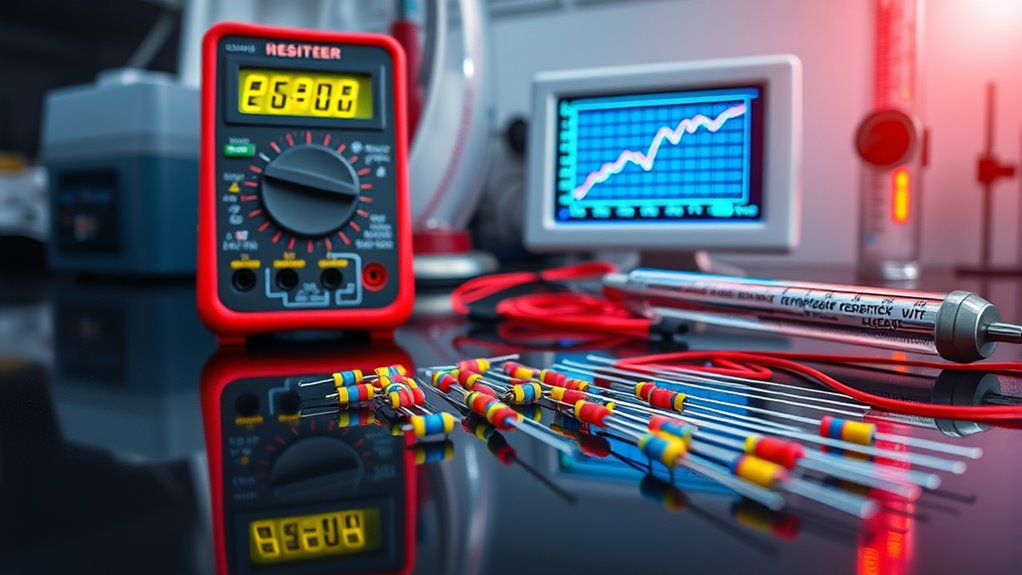
Anyone working with electrical systems must grasp the concept of temperature coefficient of resistance (TCR). TCR, represented by the Greek letter alpha (α), quantifies how a material’s resistance changes with temperature.
This is particularly important when dealing with precision applications, as it predicts how resistors react over different temperature ranges. A positive TCR indicates that resistance increases with rising temperature, as in metals like copper and nickel. Conversely, a negative TCR means resistance decreases with temperature, typical in materials like silicon.
To calculate TCR, use the formula: TCR = ((R₂ – R₁) / (R₁(T₂ – T₁))) × 10⁶. Understanding TCR helps you design more efficient and reliable electrical systems.
Positive vs. Negative Temperature Coefficients
Understanding the differences between positive and negative temperature coefficients is key to optimizing performance when dealing with electrical systems.
Positive Temperature Coefficient (PTC) materials, like copper and nickel, increase resistance as temperature rises. This resistance change makes them ideal for overcurrent protection, as they can help prevent circuit damage by limiting current flow.
Conversely, Negative Temperature Coefficient (NTC) materials, such as carbon and silicon, decrease in resistance with rising temperature, making them perfect for temperature sensing applications. NTC thermistors offer temperature compensation in circuits.
Each material’s temperature coefficient affects how resistance changes with temperature fluctuations, so selecting the right component is crucial for circuit reliability. Understanding these characteristics ensures better performance and longevity in your systems.
Temperature Coefficient of Metals

Understanding the differences between PTC and NTC materials lays the groundwork for exploring how metals behave under changing temperatures.
Metals like copper, silver, iron, and nickel have a positive temperature coefficient, meaning their resistance increases with temperature. For instance, copper’s temperature coefficient is about 0.004041 per °C, making it a reliable choice for electrical applications. Silver follows closely with a TCR of approximately 0.0038 per °C, prized for its conductivity.
Iron, with a TCR of 0.005671 per °C, and nickel at 0.005866 per °C, also demonstrate this positive relationship. In contrast, constantan—a notable exception—has a negative temperature coefficient, decreasing resistance with heat.
Understanding these coefficients helps you predict how metals will perform under varying temperatures.
Temperature Coefficient of Semiconductors
The world of semiconductors, with materials like silicon and germanium, offers fascinating insights into how resistance behaves with temperature changes.
These semiconductors exhibit a negative temperature coefficient, meaning their resistance decreases as temperature increases. This temperature dependence occurs because higher temperatures boost charge carrier concentration, enhancing conductivity. Silicon’s temperature coefficient is about -0.075°C, while germanium’s is approximately -0.048°C, making them ideal for temperature sensing applications.
NTC thermistors are often used in temperature measurement and control systems. They use the semiconductors’ unique property of decreasing resistance with rising temperatures to provide accurate readings.
The Arrhenius equation describes this behavior, showing resistance decreases exponentially as temperature rises. This property is crucial for their role in electronic devices, as they maintain efficient operation with temperature changes.
Calculating Temperature Coefficient of Resistance
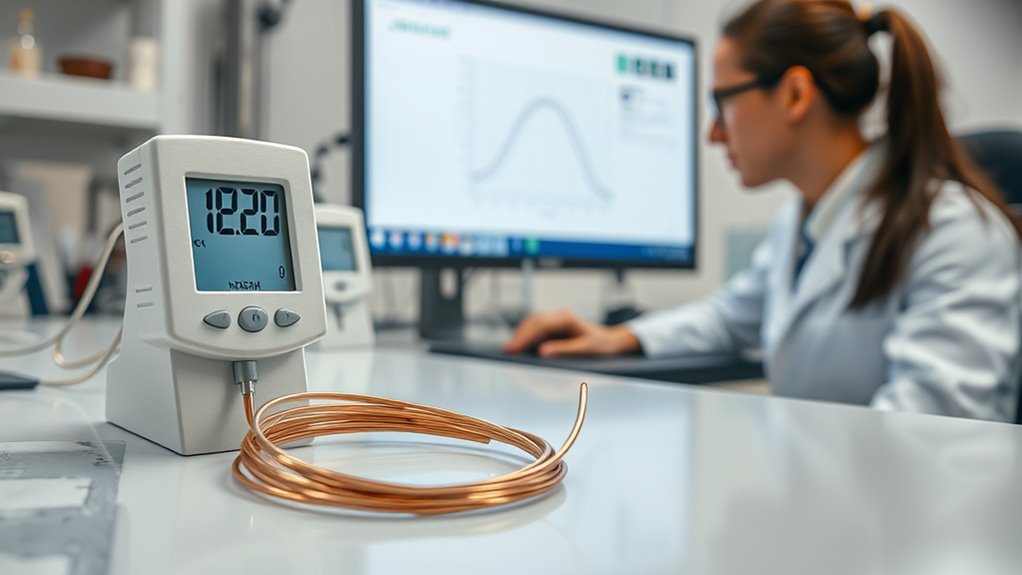
Calculating the temperature coefficient of resistance (TCR) is essential for understanding how materials respond to temperature changes.
You can determine the TCR using the formula: TCR = (frac{(R_2 – R_1)}{R_1(T_2 – T_1)} times 10^6), where (R_1) and (R_2) are the material’s resistances at initial and final temperatures, (T_1) and (T_2).
This calculation quantifies how much a material’s resistance changes per degree Celsius or Kelvin, with results in parts per million (ppm).
For example, copper’s positive TCR of about 0.004041/°C indicates that resistance increases with temperature. Conversely, silicon’s negative TCR of -0.075/°C shows that resistance decreases as temperature rises.
Accurately calculating TCR is crucial for precision in resistive components, especially in standardized applications.
Impact of Temperature on Circuit Resistance
When temperature changes, it directly impacts the resistance of a circuit, influencing its overall performance.
As temperature increases, the resistance of materials like copper also rises due to its positive temperature coefficient of resistance (TCR), around 0.004041. This change in resistance can cause significant shifts in the circuit’s behavior.
For example, an increase in temperature from 20°C to 35°C can reduce the load voltage from 12.5 volts to 12.42 volts. Such variations affect individual circuits and large-scale systems, such as power transmission networks.
Utility companies must account for these changes, especially seasonal fluctuations, to maintain efficiency. Understanding TCR is essential for designing circuits that remain reliable despite temperature variations.
Applications of Temperature Coefficient of Resistance
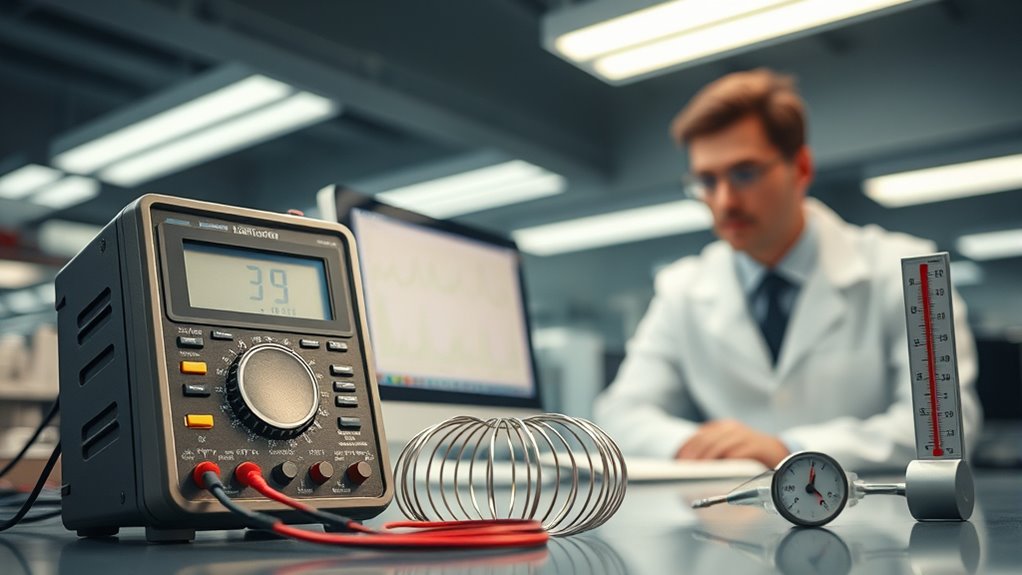
Understanding the applications of the Temperature Coefficient of Resistance (TCR) is essential in designing reliable electronic systems. TCR becomes a key player when the temperature increases, especially in temperature sensors.
Materials like silicon and germanium, with a high negative TCR, become more sensitive as their resistance decreases, enhancing their sensing capabilities. For overcurrent protection, PTC thermistors, utilizing a positive temperature coefficient, rapidly increase resistance when temperature rises, preventing overheating by limiting current flow.
In contrast, NTC thermistors with negative TCR manage inrush currents, protecting devices at startup. Precision resistors, such as those made from Manganin and Constantan, boast low TCR values, ensuring minimal resistance variation.
This stability is crucial for maintaining efficiency in power electronics and sensitive circuits.
Factors Affecting Temperature Coefficient in Resistors
While designing circuits, you’ll find that several factors can significantly affect the temperature coefficient of resistance (TCR) in resistors.
As temperature increases, the purity of the material plays a crucial role. Higher purity materials typically yield more stable and lower TCR values.
The thickness of copper foil also matters; thicker foils can alter thermal characteristics, impacting the coefficients due to varied heat dissipation.
Additionally, the dimensions of electrodes or pads can change how heat spreads, affecting the TCR during use.
Misalignment between the current path and sensing lines can lead to inaccurate resistance measurements as temperature increases, thus impacting TCR.
Lastly, the board’s design and layout greatly influence thermal performance, demanding careful consideration in resistor selection.
Practical Implications for Electrical Systems

Recognizing the role of the temperature coefficient of resistance (TCR) ensures electrical systems run smoothly and efficiently.
You must account for temperature variations since they can significantly impact resistance levels. This is especially important for utility companies designing power transmission lines. They consider the TCR to manage changes in resistance due to seasonal temperature variations, which affect voltage and current flow.
Even small resistance changes from temperature fluctuations can lead to voltage drops over long distances, reducing network efficiency. Precision resistors with minimal TCR values are crucial for sensitive applications like measuring instruments.
Understanding TCR helps prevent overheating and circuit failures, as components with high TCR might need additional temperature compensation strategies.
Advances in Temperature Coefficient Measurement Methods
As technology evolves, the temperature coefficient of resistance (TCR) measurement has significantly advanced, offering greater precision and reliability. Precision thermistors and digital multimeters are indispensable for accurately determining resistance changes across temperature ranges.
Automated temperature cycling systems streamline the process, providing consistent TCR measurements at various temperatures. The MIL-STD-202 Method 304 is your go-to standardized approach, ensuring consistent results in different settings.
High-resolution data acquisition systems capture even the smallest resistance changes, which is crucial for analyzing materials with non-linear TCR properties. Recent developments in materials science, such as thin-film resistors with low temperature coefficients, can now be measured using laser-based techniques.
These innovations enhance precision, are especially useful in high-temperature environments, and expand your measurement methods toolkit.
Conclusion
In understanding the Temperature Coefficient of Resistance (TCR), you grasp how materials respond to temperature changes, impacting their electrical resistance. You’ll appreciate how metals and semiconductors behave differently by distinguishing between positive and negative TCRs. Calculating TCR helps you design reliable circuits, considering factors affecting resistors. You’ll also explore practical applications and advances in measurement methods, ensuring your electrical systems perform optimally despite temperature fluctuations, making your designs efficient and robust against environmental changes.