Understanding Single-phase Transformers: Basics and Benefits
When you think about the electrical devices you use daily, you might not realize how essential a single-phase transformer is in making them work efficiently. With its primary and secondary windings, this device helps step up or down voltage levels, ensuring that your electronics receive the correct amount of power. Understanding the working principle of mutual induction that drives these transformers can give you insights into their reliability and efficiency. But what makes them particularly suitable for residential and small business applications, and how do they stack up against other transformers?
Key Takeaways
- Single-phase transformers have one primary and one secondary winding for stepping voltage up or down.
- They operate on mutual induction between windings, ensuring energy transfer without direct connection.
- Common applications include residential settings, home appliances, and small businesses requiring 230V power.
- Types include isolation, step-up, step-down, and autotransformers, each suited for specific voltage regulation needs.
- Faraday’s Law of Induction underpins their operation, with changing magnetic fields inducing voltage in the secondary winding.
What Is a Single-Phase Transformer?

A single-phase transformer, which has one primary and one secondary winding, efficiently steps up or steps down voltage levels for various electrical devices. You’ll find these transformers in homes and small businesses where three-phase power isn’t necessary. The primary winding is where the input voltage is applied, and depending on the need, the secondary winding provides either a higher or lower output voltage.
One of the key benefits of single-phase transformers is their compact size and lightweight design. This makes them easier to install and maintain compared to their three-phase counterparts. Because of this, they’re an ideal choice for residential applications, such as powering household appliances, lighting systems, and smaller industrial equipment.
When voltage levels need to be managed for devices that don’t require the complexity of three-phase power, a single-phase transformer is a practical and efficient solution. It’s especially useful in areas where space and weight are considerations or where the electrical load doesn’t justify the use of a more complex transformer.
Working Principle
Understanding how a single-phase transformer works involves grasping the principle of mutual induction between its primary and secondary windings. When an alternating current (AC) flows through the primary winding, it creates an alternating magnetic field. This magnetic field then induces a voltage in the secondary winding through mutual induction. Fundamentally, the changes in voltage and current in one winding directly affect the other winding.
To make it clearer, here’s a simple table:
| Component | Primary Winding | Secondary Winding |
|---|---|---|
| Current Type | Alternating Current | Induced by mutual induction |
| Magnetic Field | Generated by AC | Affected by the primary magnetic field |
| Voltage Induction | Due to alternating current | Induced by primary winding’s magnetic field |
| Energy Transfer | Electrical to Magnetic | Magnetic to Electrical |
| Dependence | Proportional to secondary winding’s properties | Proportional to primary winding’s properties |
The efficiency of single-phase transformers depends on their design, materials used, and core type. These transformers are primarily used in residential applications to either step up or step down voltage levels. By understanding mutual induction and the role of alternating current, you can appreciate how voltage induction in the windings enables these transformers to function effectively.
Construction
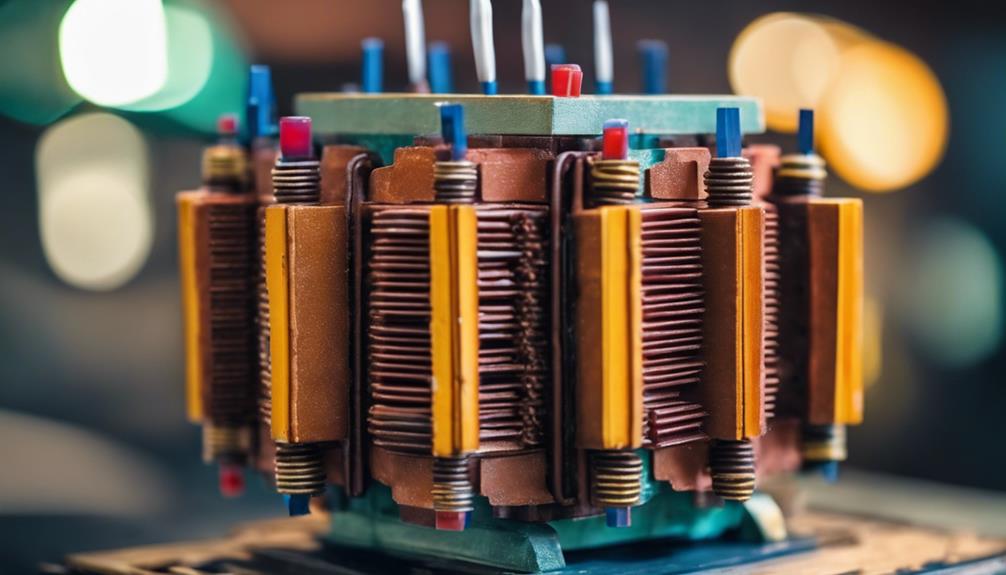
The construction of a single-phase transformer involves integrating a primary winding, a magnetic core, and a secondary winding, all separated by insulating materials to guarantee safe operation. The primary winding is where electrical power first enters the transformer. This winding produces a magnetic flux when electricity flows through it.
The magnetic core is important by linking the primary and secondary windings, creating a closed magnetic circuit. This core is typically made from laminated sheets of silicon steel, which help reduce energy losses and improve efficiency. The magnetic core ensures that the magnetic flux generated in the primary winding transfers effectively to the secondary winding.
Mutual induction occurs between the primary and secondary windings to achieve the desired output voltage. Thanks to the magnetic core, this process allows energy transfer from the primary to the secondary winding without a direct electrical connection.
Insulating materials separate the primary and secondary windings, preventing short circuits and ensuring the transformer’s reliability. The entire assembly, including the windings and the core, is enclosed in a tank. This tank protects the components and aids in cooling during operation, ensuring the transformer runs efficiently and safely.
Types of Single-Phase Transformers
Several types of single-phase transformers are designed for specific applications and operational needs. These transformers have one primary and one secondary winding, simplifying their construction compared to three-phase transformers.
Depending on your requirements, you might choose among the following types:
- Isolation Transformers: These isolate the load from the power source, providing safety and reducing noise through mutual inductance.
- Step-Up Transformers: These increase the voltage from the primary to the secondary winding, making them ideal for applications requiring higher voltage levels.
- Step-Down Transformers: These decrease the voltage from the primary to the secondary winding. They are commonly used in residential areas to bring high transmission voltages down to usable levels.
- Autotransformers: These have a single winding that acts as both primary and secondary windings, offering compact size and cost efficiency but less isolation.
When choosing a type, consider the mounting options available for easy installation and the materials used in the windings, such as copper or aluminum.
Each type operates on single-phase power, typically carrying 230V, making it suitable for residential and smaller industrial settings. Understanding these types can help you select the right transformer to meet your needs.
Applications
Single-phase transformers are essential in residential settings, where they power everyday home appliances and guarantee voltage regulation. These transformers are perfect for smaller loads, making them ideal for individual homes and small businesses. They step up or down voltage levels to match the requirements of various electrical devices, ensuring your appliances operate efficiently and safely.
One of the main reasons single-phase transformers are widely used in homes is their compact size and ease of installation. They handle lower power capacities than three-phase transformers, making them suitable for residential electrical systems where the power demand isn’t as high. This safeguards that your household circuits remain stable and your devices are protected from voltage fluctuations.
Here’s a brief overview of some common applications and benefits of single-phase transformers:
| Application | Benefit |
|---|---|
| Home Appliances | Reliable power supply |
| Voltage Regulation | Consistent electrical performance |
| Small Businesses | Easy installation and maintenance |
Advantages and Disadvantages
When you weigh the advantages and disadvantages of single-phase transformers, it’s clear they offer simplicity in design and cost efficiency but come with limitations in power capacity and efficiency. Single-phase transformers are ideal for residential and light commercial applications because they’re smaller and easier to install than their three-phase counterparts. Their primary and secondary winding are straightforward, making them a cost-effective solution for everyday electrical needs.
However, they do have some drawbacks:
- Limited power capacity: Single-phase transformers cannot handle as much power as three-phase transformers, making them unsuitable for heavy industrial or motor loads.
- Lower efficiency: They tend to be less efficient than three-phase transformers, which means more energy loss during operation.
- Unbalanced loads: Using single-phase transformers in systems with heavy motor loads can lead to unbalanced loads, which can potentially cause operational issues.
- Specific applications only: They’re commonly used in appliances, lighting, and small machinery where three-phase power isn’t required.
Despite these disadvantages, single-phase transformers remain a practical choice for many applications due to their simplicity and cost-effectiveness. When considering their use, always weigh these factors to determine if they efficiently meet your specific power needs.
Faraday’s Law of Induction
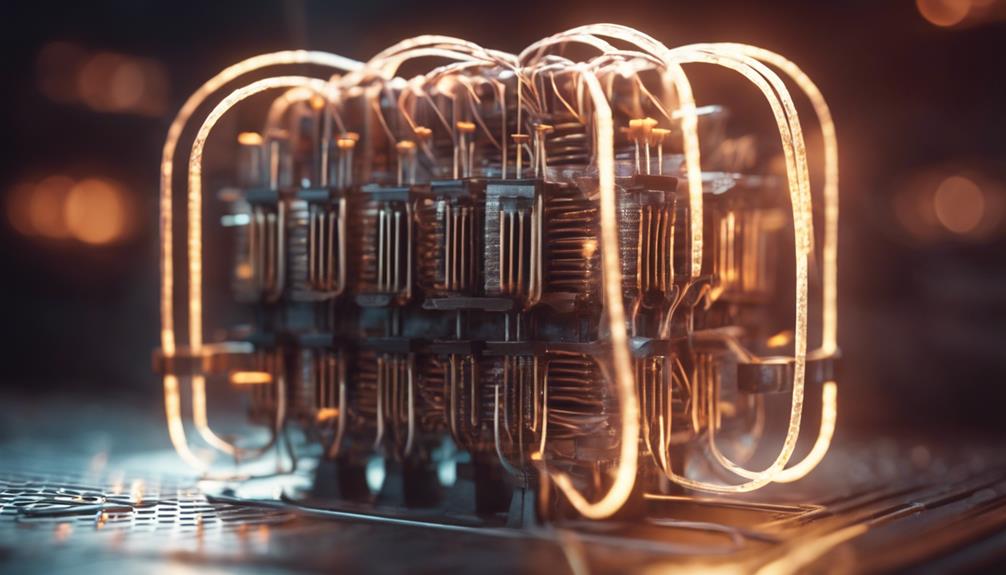
At the heart of transformer operation is Faraday’s Law of Induction, which states that a changing magnetic field induces an electromotive force (EMF) in a conductor. This principle, known as Faraday’s law of electromagnetic induction, is key to understanding how transformers work.
When an alternating current is applied to the primary winding of a transformer, it creates a varying magnetic field around it. This changing magnetic field cuts through the secondary winding, inducing an EMF.
The induced EMF in the secondary winding generates the transformer’s voltage output. According to Faraday’s Law, the magnetic flux change rate is directly proportional to the magnitude of the induced EMF. So, the faster the magnetic field changes, the greater the induced EMF in the secondary winding. This relationship is fundamental to the transformer’s ability to efficiently step up or down voltage levels.
Understanding Faraday’s Law is important for grasping the operation and functionality of single-phase transformers, which rely on mutual inductance between the primary and secondary windings. Mastering this concept will give you deeper insight into how transformers convert electrical energy from one voltage level to another.
Conclusion
To sum up, you’ve seen how single-phase transformers are essential for voltage regulation in residential and small business settings. They operate on mutual induction, making them simple and cost-effective.
Understanding their working principle, construction, and various types allows you to appreciate their wide range of applications and benefits. Though they have some drawbacks, their advantages make them indispensable in everyday electrical systems.
Faraday’s Law of Induction is central to their operation, ensuring efficient performance.