

A Guide to Role of PMMC Instrument in Electrical Measurement:
PMMC, short for Permanent Magnet Moving Coil, is an instrument that is vital in electrical engineering. They reliably measure DC, or direct current, in various applications, ensuring maximum efficiency and safety. The amazing thing about these tools is that they turn scientific principles into practical utilities – the force on a moving coil in a permanent magnet’s field tells us the current flow. Now, let’s explore this complex science made simple yet useful.
The PMMC instrument, or Permanent Magnet Moving Coil instrument, is renowned for its precision in measuring DC. Its key components include a moving coil, permanent magnet, control springs, damping system, pointer, and scale, offering accurate readings and low power consumption.
The Role of PMMC Instrument
Imagine measuring water flow in a river without a reliable flow meter. It would be quite challenging, right? Accurately measuring direct current (DC) is crucial for various applications in electrical engineering. This is where PMMC instruments step in. These instruments are like trusted gauges that provide precise voltage and current measurements. Their importance cannot be overstated, especially when maintaining safety and efficiency within electrical systems.
PMMC instruments are carefully designed to ensure accurate measurement. They consist of essential components such as a moving coil, a permanent magnet, control springs, a damping system, a pointer, and a scale. These elements work together seamlessly to deliver reliable readings, allowing engineers and technicians to monitor and troubleshoot electrical circuits confidently.
Accuracy and Reliability
One of the key aspects that make PMMC instruments indispensable is their accuracy. With an accuracy rating of +/- 1%, these instruments provide consistent and dependable measurements, ensuring that systems operate optimally and safely.
For instance, in an automotive application where electrical currents must be precisely monitored to ensure the proper functioning of critical systems such as engine control units or safety features, PMMC instruments play a crucial role in accurate measurements.
Flexibility in Measurement Range
Another noteworthy feature of PMMC instruments is their ability to measure a wide range of voltages and currents effectively. This flexibility allows these instruments to be utilized in various settings and applications without needing constant recalibration or adjustment.
In laboratory environments, where experiments may involve different voltage and current levels, PMMC instruments can adapt to these changing requirements, giving researchers the confidence that their measurements are accurate across various parameters.
The ability of PMMC instruments to deliver precise measurements with high reliability and flexibility speaks to their central role in supporting the diverse needs of electrical engineers across a spectrum of applications.
Now, let’s delve into the intricate mechanisms that enable PMMC instruments to achieve such precise measurements.
The Inner Workings of PMMC Instrument
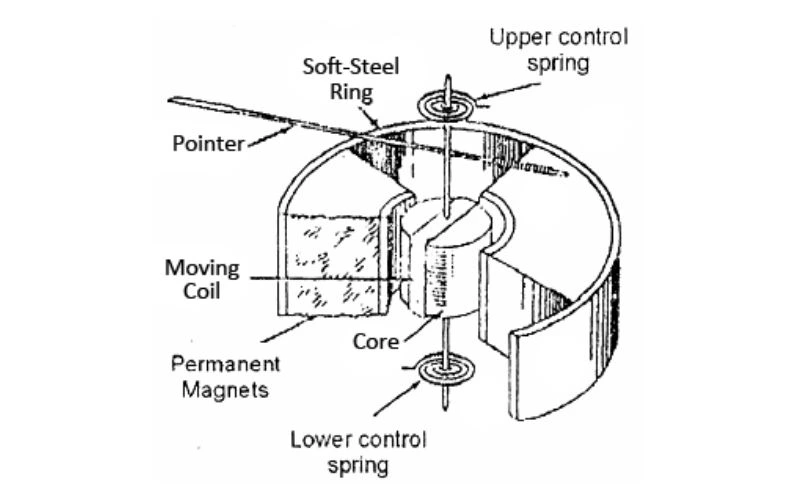
A PMMC instrument may appear simple on the surface, but its operation involves fascinating physics principles. A PMMC meter’s core is the interaction between a permanent magnet and a moving coil. When an electric current flows through the coil, it experiences a force due to the magnetic field generated by the permanent magnet. This force causes the coil to move directly proportional to the current passing through it.
The key to understanding this interaction lies in the fundamental concept of electromagnetism. As the current passes through the coil, it produces its magnetic field, which interacts with the magnetic field of the permanent magnet. This interaction results in a mechanical movement of the coil, which is then translated into a measure of current flow. This direct relationship between current and coil movement makes PMMC instruments highly accurate for measuring direct currents.
Importance of Magnetic Field Strength
For the proper operation of a PMMC instrument, the magnetic field strength is within a specific range, typically 0.1 to 0.2 Tesla. This ensures that the force exerted on the moving coil remains consistent, allowing for precise measurements.
For context, think of it like this: just as you need water pressure to run a faucet at home effectively, a PMMC instrument needs a specific magnetic field strength level to function accurately.
Understanding this interplay between electric current and magnetic fields underscores why PMMC instruments are ideal for measuring direct currents with remarkable precision. This reliable and consistent relationship has made these instruments indispensable in electrical measurements, particularly for applications requiring accurate readings.
Now, let’s explore how the construction materials and design elements play vital roles in ensuring the accuracy and reliability of PMMC instruments.
Accurate DC Measurement and PMMC Methodology
PMMC instruments play a pivotal role when accurately measuring direct currents. Picture this: the movement of a coil within a magnetic field serving as your guide to precision. The unique design of PMMC instruments allows them to deliver exact measurements of direct currents, making them an indispensable tool in electrical engineering.
The methodology employed in PMMC instruments revolves around maintaining the deflecting torque in direct proportion to the current passing through the coil. This proportional relationship is key to ensuring accurate measurement of DC. In other words, as the current passes through the coil changes, so does the deflecting torque, enabling precise readings that reflect the true value of the measured direct current.
To put this into perspective, envision a finely tuned instrument that responds sensitively to current changes. A small tweak in the current results in an immediate response from the instrument’s pointer. This level of sensitivity facilitates accurate and reliable measurements, providing electrical engineers with invaluable data for their work.
But what makes PMMC instruments so well-suited for accurate DC measurement? It’s all about their design and operational features. The moving coil, combined with a permanent magnet and control springs, creates an instrument that thrives on accuracy and dependability.
| Instrument Feature | Benefit |
| Moving Coil | Sensitive response to changes in current |
| Permanent Magnet | Provides a constant magnetic field for consistent operation |
| Control Springs | Maintain proper movement and stability for precise measurements |
| Damping System | Minimizes oscillations for steady readings |
Understanding these distinctive components highlights why PMMC instruments are revered for their unparalleled accuracy in measuring direct currents.
Having dived into how PMMC instruments ensure accurate DC measurement, it’s time to explore their capabilities more deeply.
Advantages and Disadvantages of PMMC Instrument

PMMC instruments, with their unique design, offer several advantages that make them an essential tool for accurate DC measurements and electrical engineering applications. Let’s first explore the advantages of PMMC instruments.
Advantages of PMMC Instrument
The correctly divided scale of PMMC instruments allows for precise readings, which is essential for accurate measurements in electrical engineering. This feature ensures that the instrument provides detailed and reliable data for analysis, making it a preferred choice in various fields such as power systems, electronic circuit design, and industrial automation.
Furthermore, low power consumption sets PMMC instruments apart regarding energy efficiency. With the growing emphasis on sustainable energy practices, acquiring accurate measurements while conserving energy is a significant advantage in modern electrical systems and laboratories.
The high accuracy of PMMC instruments contributes to their reliability in measuring different voltage and current ranges. In applications where precision is paramount, such as testing electrical components or calibrating equipment, the ability to rely on the accuracy of PMMC instruments is invaluable.
Another key advantage of PMMC instruments is their adaptability to measure different voltage and current ranges. This versatility allows for various applications, from low-voltage circuit testing to high-current power system monitoring, providing engineers with a comprehensive tool for diverse electrical measurement needs.
While PMMC instruments offer several advantages that make them indispensable in various electrical engineering scenarios, it’s crucial to consider their limitations.
Disadvantages of PMMC Instrument
One primary limitation of PMMC instruments is their restriction to DC measurements only. This constraint restricts their use in applications requiring AC measurements or a combination of AC and DC analysis. While they excel in providing accurate DC measurements, alternative instrumentation is necessary for comprehensive electrical analysis involving AC circuits.
In addition to their limited application to DC measurements, the higher cost associated with PMMC instruments compared to other types of instruments can pose a challenge, particularly for budget-constrained projects or educational institutions. The initial investment required for acquiring PMMC instruments may deter some users from utilizing this technology in certain scenarios.
We cannot undervalue the significance of understanding these drawbacks when considering the application of PMMC instruments in diverse electrical engineering contexts.
Imagine having a toolbox with various tools designed for specific tasks. Just like a wrench might not be suitable for every kind of bolt, PMMC instruments have strengths and limitations that should be carefully considered before implementation in electrical measurement processes.
By weighing the advantages and disadvantages of PMMC instruments, engineers and professionals can make informed decisions regarding using accurate electrical measurements and instrumentation.
Moving forward, let’s now explore the potential errors that can affect the performance of PMMC instruments in electrical measurements.
PMMC Instrument Errors and Their Common Causes
PMMC instruments are renowned for their accuracy in measuring DC. However, like any instrument, they are susceptible to errors affecting precision. Understanding these common causes of errors is crucial for ensuring accurate measurements and maintaining the reliability of PMMC instruments.
One common cause of error in PMMC instruments is aging. Just like any other mechanical device, the components of a PMMC instrument can deteriorate over time, affecting its accuracy. For instance, the permanent magnet’s strength may diminish, or the control springs might lose their elasticity. These changes can lead to deviations in the measurements, making regular maintenance essential to ensure optimal performance.
Temperature effects can also significantly impact the accuracy of PMMC instruments. Temperature variations can cause expansion or contraction of the materials used in the instrument, leading to changes in the tension of the control springs or affecting the magnetism of the permanent magnet. Such fluctuations can result in measurement errors, emphasizing the need for temperature-controlled environments when using PMMC instruments for precise measurements.
Weak magnets and springs are additional factors contributing to PMMC instrument errors. If the permanent magnet’s strength diminishes or the control springs lose their elasticity, the deflecting torque may be affected, leading to inaccurate readings. These components are critical in ensuring proper deflection of the moving coil, making regular checks and replacements important for maintaining measurement accuracy.
An extended range of the moving coil is another common cause of errors in PMMC instruments that shouldn’t be overlooked. Let’s explore this further.
Calibration and Maintenance of PMMC Instrument

Proper calibration and regular maintenance are vital for the optimal performance and accuracy of PMMC instruments. Calibration involves comparing readings on one piece of equipment or system with another calibrated and referenced to a known set of parameters, ensuring accurate and reliable readings. On the other hand, maintenance practices help prevent errors and ensure the longevity of these instruments.
Calibration frequency is critical for maintaining the accuracy of PMMC instruments, typically occurring once every 6 months. This frequency can vary based on usage, environmental conditions, and industry standards. Regular calibration ensures accurate readings and helps identify underlying issues before they escalate into significant problems.
Importance of Calibration
Calibration upholds the precision and functionality of PMMC instruments by adjusting their performance to conform to international or industry-specific standards. Regular calibration ensures they meet the required accuracy levels and comply with regulatory standards. Proper and timely calibration can improve accuracy by +/- 0.5%, significantly enhancing the reliability of measurements conducted using PMMC instruments.
To put this into perspective, consider a scenario where an electrical engineer uses an uncalibrated PMMC instrument to measure current in a circuit. Due to inaccuracy, there might be deviations in the actual current values, leading to faulty assessments and potentially compromising the safety and efficiency of the entire electrical system.
Vitality of Maintenance
In addition to calibration, regular maintenance is crucial for ensuring the longevity and efficient operation of PMMC instruments. Typical maintenance tasks may include cleaning, lubricating, checking for mechanical wear, and ensuring all components function optimally.
Performing routine maintenance prevents errors and extends the lifespan of PMMC instruments by up to 20%. This simple yet effective practice can substantially contribute to ensuring that PMMC instruments continue to provide accurate measurements over an extended period.
Regarding PMMC instrument maintenance, proactive measures such as cleaning and lubrication mitigate common causes of errors like aging, temperature effects, weak magnets, weak springs, and mechanical wear – factors that significantly affect accuracy and performance if not addressed proactively through regular maintenance protocols.
In summary, proper calibration at regular intervals and effective maintenance practices are the cornerstones of ensuring precise functionality and longevity of PMMC instruments. At mytech-info.com, we offer detailed guides encompassing comprehensive calibration procedures and proven maintenance practices tailored to uphold the precision and reliability of PMMC instruments for diverse applications in electrical engineering.
For further guidance on calibrating and maintaining your PMMC instruments, visit our comprehensive guide on magnets at mytech-info.com/category/magnet/.
