How to Choose the Right Transformer for a Project
When selecting the appropriate transformer for your project, you need to consider several key factors to maximize performance and reliability. Start by determining whether you need a single-phase or three-phase transformer, as this choice will greatly impact your system’s efficiency. Next, you must confirm the input and output voltage compatibility to avoid any mismatches resulting in equipment failure. Calculating the kVA rating is crucial to meet your project’s power demands accurately. But there’s more to the process than just these fundamentals. What other factors could make or break your project’s success?
Key Takeaways
- Assess the project’s required kVA rating based on maximum load demand.
- Verify primary and secondary voltage ratings for compatibility with your system.
- Determine the correct transformer phase type (single-phase or three-phase).
- Consider the transformer’s efficiency and potential losses for optimal performance.
- Ensure the transformer’s kVA rating matches or exceeds peak load conditions.
Importance of Transformers
The significance of transformers in electrical systems can’t be overstated. They play a key role in electricity distribution, guaranteeing that your power supply is efficient and reliable. When selecting the right transformer, it is essential to size it correctly. This not only aids in efficient power delivery but also minimizes power loss, enhancing overall system performance.
Transformers make power systems scalable and flexible, allowing you to adapt to varying power demands. Their ability to adjust voltage levels ensures electricity can travel long distances without significant losses, making your system more cost-effective. Whether dealing with normal operations or unexpected disturbances, a well-chosen transformer will enhance your system’s reliability.
Understanding a transformer’s KVA rating is an essential factor when selecting one. The KVA rating helps you accurately accurately accurately match the transformer’s capacity to your load requirements, guaranteeing that your power supply meets your needs without overloading the system. Proper sizing of transformers based on these ratings is crucial for maintaining peak performance and the longevity of your electrical infrastructure.
Understanding Nameplate Parameters
Understanding the information on a transformer’s nameplate is vital when selecting it. The nameplate lists key parameters, such as the transformer’s voltage ratings, including primary and secondary voltages. Knowing these helps you match the transformer to your system’s voltage requirements.
Another significant detail is the KVA rating, which indicates the transformer’s power rating. This tells you the maximum load the transformer can handle. Matching the transformer’s KVA rating to your load guarantees efficient power delivery and prevents overloading.
You’ll also find the primary current listed, which is crucial for determining the size of the input wiring and protection devices.
The nameplate often includes the load voltage, which helps you verify that the transformer’s output meets your equipment’s needs.
Additionally, the nameplate provides information on winding connections and impedance values, which are essential for system stability and performance. By understanding these parameters, you can select and size transformers accurately, ensuring they meet your project’s specific requirements.
In essence, the nameplate data is your guide to making informed decisions, ensuring the transformer you choose is well-suited for your application and operates efficiently within its rated capacity.
Calculating Design Parameters
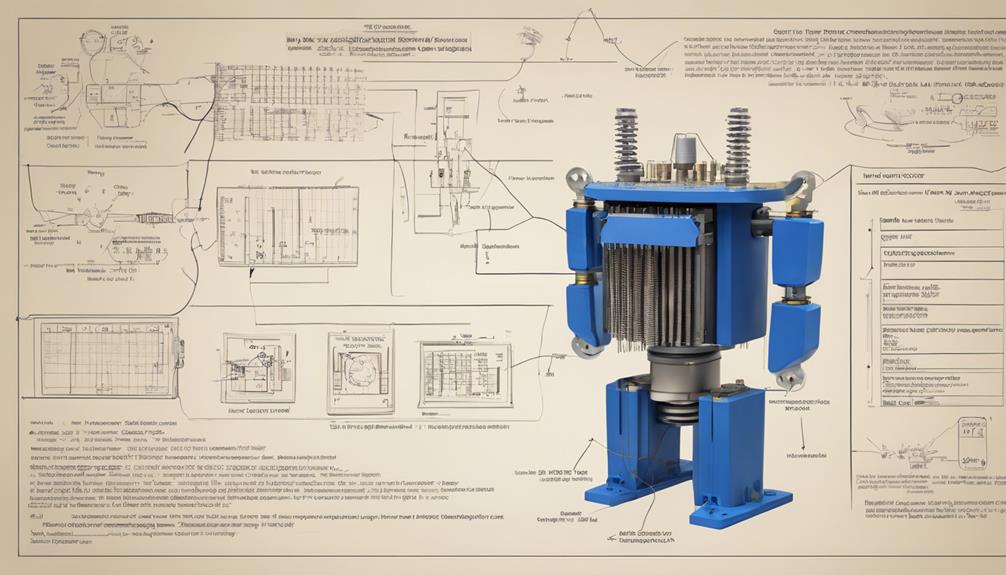
Once you’ve understood the key nameplate parameters, it’s time to calculate design parameters to guarantee your transformer operates effectively. Start with the primary side by determining the current, number of turns, and conductor size. Calculate the primary current using the formula:
[ I_{primary} = rac{P}{V_{primary}} ]
where ( P ) is power and ( V_{primary} ) is primary voltage. Next, determine the number of turns per volt, which aids in calculating the total number of turns on the primary winding:
[ Turns per volt = rac{N_{primary}}{V_{primary}} ]
Calculate the voltage, current, and wire size for the secondary side. The secondary current can be determined using the following:
[ I_{secondary} = rac{P}{V_{secondary}} ]
Make sure to match the wire size to the current to prevent overheating.
Here’s a quick reference table to assist you:
| Parameter | Formula |
|---|---|
| Primary Current | ( I_{primary} = rac{P}{V_{primary}} ) |
| Turns per Volt | ( rac{N_{primary}}{V_{primary}} ) |
| Secondary Current | ( I_{secondary} = rac{P}{V_{secondary}} ) |
| Core Area | Based on magnetic flux requirements |
| Conductor Size | Based on the current capacity |
These calculations guarantee your transformer handles the required power effectively, maintaining peak performance for both primary and secondary circuits.
Estimating Winding Weight
Calculating design parameters guarantees your transformer operates efficiently. Estimating winding weight is equally important for accurate design and sizing. Start by determining the copper wire’s cross-sectional area and volume. You need this base information to proceed with your calculations.
First, calculate the bobbin perimeter and turn length on the primary side. Knowing the number of turns required will help determine the total copper wire length. For instance, if your transformer needs to handle a specific KVA, you should know the load, current, and voltage requirements to calculate the transformer size accurately.
Next, consider the copper density. Once you have the total wire length and cross-sectional area, multiply these to find the volume. With copper’s density in hand, you can calculate the total mass of the copper wire. Accurate winding weight estimation is essential for ensuring your transformer can handle the expected load without overheating or inefficiencies.
Selecting and Sizing Transformers
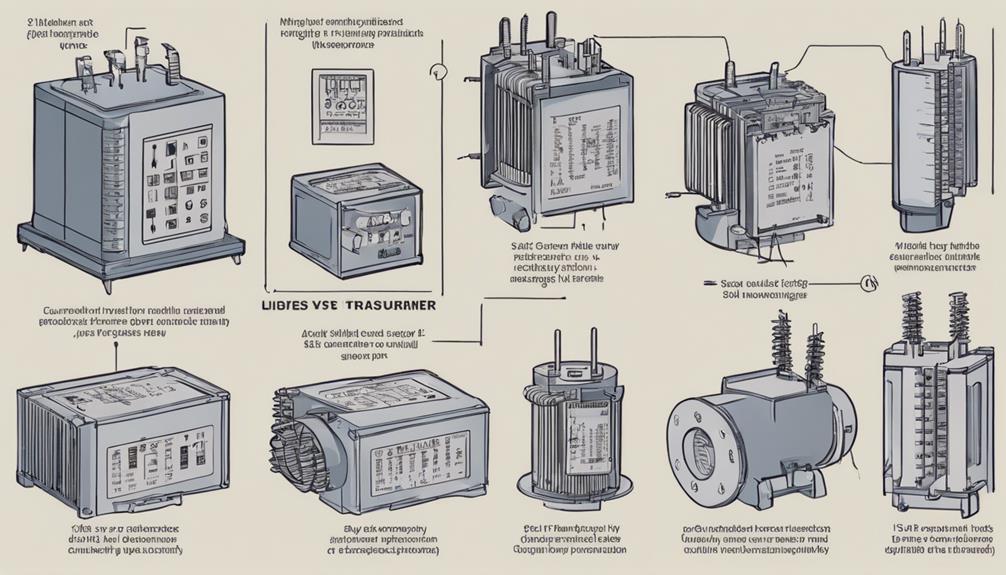
Selecting and sizing transformers involves a few important steps to guarantee peak performance for your project.
First, determine the required transformer phase type based on your power supply—either 1-phase or 3-phase. This ensures compatibility with your system.
Next, calculate the input and output voltage needed, considering the primary and secondary voltage requirements. This step is essential for ensuring the transformer matches the voltage levels necessary for your application.
Using the kVA rating system will help you accurately size the power transformer. This ensures efficient power delivery without overloading the system. Referencing sizing charts and tables for different kVA options allows you to effectively match the transformer capacity to your load requirements.
Before selecting a transformer, you know these key parameters—phase type, input/output voltage, and kVA size. This preparation will save you time and potential challenges down the line.
Transformer Ratings and Sizing
When selecting a transformer, eat the necessary kVA based on your load needs, considering peak load conditions.
It’s essential to align the voltage ratings to your system to guarantee proper operation.
Don’t forget to include a starting factor, such as 125%, to accommodate any extra current during device startup.
Calculating Required Kva
Determining the necessary kVA for a transformer starts with knowing the load voltage (V) and current flow (I) needed for your application. To calculate the required kVA, use the kVA = V x I / 1,000 formula. This will help you determine the transformer capacity required to handle your load’s voltage and current demands.
When calculating the necessary kVA, remember to account for starting factors and specialized loads, such as motors or medical equipment. These often have higher initial power requirements, impacting the appropriate kVA rating. For instance, a motor might require a higher kVA rating during startup than during regular operation.
Standard transformer sizes, like three kVA and six kVA, are designed to meet common capacity needs. However, for precise applications, you might need to opt for a larger size or consult a professional to ensure precision. This is particularly crucial for equipment with unique power requirements.
Matching Voltage Ratings
Getting the voltage ratings right on your transformer is important for the success of your project. Confirming that the transformer’s primary and secondary voltage ratings align with your input voltage requirements and output needs is vital. Mismatched voltage ratings can result in inefficiencies, malfunctions, or even damage to your electrical equipment.
Start by checking the nameplate data on the transformer. This information provides the primary and secondary voltage ratings, which should match your project’s specifications. When selecting a transformer, you must verify that the voltage matches correctly to maintain safety and efficiency.
If the voltage ratings don’t align with your requirements, you risk compromising the integrity and reliability of your entire electrical system.
Consulting with a reputable transformer company can also help confirm that you’ve selected the appropriate transformer for your project. They can help you understand the voltage rating and verify that the primary voltage matches your input voltage requirements and that the secondary voltage meets your output needs.
Correct voltage matching isn’t just a technical necessity; it’s crucial for your electrical system’s smooth operation and longevity.
Accounting for Peak Load
Accurately accounting for peak load conditions is crucial when sizing a transformer to ensure it can handle your project’s maximum power demand. When selecting a transformer, it is vital to consider how much power your system will need during peak load conditions. This will help guarantee that your transformer will have the appropriate kVA rating to meet these demands without overloading.
If your transformer isn’t sized based on peak load requirements, you risk system disruptions during high-demand periods. These interruptions can result in costly downtime and potential damage to your electrical infrastructure. By carefully assessing your project’s maximum power demand, you can determine the correct transformer sizing that will provide reliable performance even during peak loads.
Understanding peak load requirements is crucial for accurate transformer sizing. You should opt for a transformer with a kVA rating that matches or exceeds your peak load conditions. This practice ensures the longevity and reliability of your transformer and helps maintain the overall efficiency of your electrical system.
Transformer Efficiency and Losses

When examining transformer efficiency, you must understand how to calculate efficiency metrics by considering the output power relative to the input power.
Reducing transformer losses, such as those from core and coil resistance, enhances performance.
Calculating Efficiency Metrics
To effectively calculate transformer efficiency, you’ll need to evaluate the output power relative to the input power. Transformer efficiency is a key metric that helps you assess performance. To find this, divide the transformer’s output power by its input power. However, various factors, like core losses, coil resistance, and dielectric losses, can impact this efficiency.
Understanding the power factor is vital because it affects the transformer’s capacity and efficiency. A lower power factor means more current is needed for the same power amount, increasing losses. Hence, a high power factor should be aimed at to maximize efficiency.
It’s important to consider the different types of losses within a transformer. Core losses, often due to hysteresis and eddy currents, and copper losses, arising from the resistance in the coil windings, are primary contributors. Additionally, dielectric losses in the insulating materials can also reduce efficiency.
Regular maintenance and proper design can greatly improve efficiency by reducing these losses. For instance, ensuring that the transformer operates within its specified capacity can minimize copper losses. Adequate design and material selection can also help decrease core and dielectric losses.
Reducing Transformer Losses
Considering the importance of transformer efficiency calculated in the previous section, it’s evident that minimizing losses is vital for peak performance. Transformer efficiency relies on reducing core losses and coil resistance, which directly impact the overall efficiency. Core losses, often due to hysteresis and eddy currents in the core material, can be minimized through high-grade core materials. Similarly, coil resistance, mainly from copper windings, contributes to copper losses, which can be lessened using thicker wires or better-conducting materials.
Properly sizing your transformer is crucial. You can significantly improve efficiency by matching the transformer to the load requirements and considering the power factor. Reducing losses enhances efficiency and results in cost savings and better system performance.
Here’s a quick reference table for minimizing transformer losses:
| Loss Type | Cause | Mitigation Strategy |
|---|---|---|
| Core Losses | Hysteresis, Eddy currents | Use high-grade core materials |
| Coil Resistance | Copper windings | Thicker wires, better conductors |
| Dielectric Losses | Insulation material | High-grade insulation |
| Load Losses | Load variations | Properly size transformer |
| Stray Losses | Leakage flux | Optimize design |
Transformer Types and Applications
Transformers come in various types, each tailored for specific applications and needs. Due to their availability in different sizes and configurations, single-phase transformers are the best choice for residential and small commercial projects.
If you’re working on a larger industrial setup, three-phase transformers are essential for efficiently handling higher power loads.
Autotransformers are cost-effective for efficient voltage regulation in electrical systems. They use a single winding, making them lighter and more economical than traditional transformers.
Constant-voltage transformers are indispensable for sensitive electronics projects. They maintain a stable output voltage, protecting devices from voltage fluctuations.
When measuring current accurately, you should use current transformers. They provide high precision and offer electrical isolation, guaranteeing safety and reliability.
Speaking of safety, safety transformers are specifically designed to provide electrical insulation and protect against electric shock, making them ideal for installations where safety is paramount.
Each type of transformer serves a unique purpose, so understanding their applications will help you choose the right one for your project. This way, you secure your electrical systems’ efficiency, safety, and reliability.
Maintenance and Safety

When it comes to maintaining and ensuring the safety of your transformers, regular testing and upkeep are non-negotiable. Start by regularly testing the oil and maintaining proper insulation. These steps are essential for the best performance and greatly enhance your transformer’s efficiency and lifespan. High-quality materials, like larger copper wire, reduce losses and improve efficiency, further extending the lifespan of your equipment.
Implementing a proactive maintenance schedule is key. Regular inspections and servicing can prevent minor issues from becoming major problems. Always guarantee you follow industry standards to keep your operation safe and compliant. This means adhering to guidelines for transformer sizing based on load requirements. Correct sizing is crucial for safety and efficiency, as an undersized transformer can overheat, while an oversized one can lead to unnecessary energy losses.
Lastly, never compromise on safety. Ensure your transformers meet all required industry standards. This won’t only prevent accidents but also guarantee safe operation. By focusing on maintenance, insulation, and efficiency, you’ll extend the lifespan of your transformers and ensure they operate safely and effectively for years to come.
FAQs
1. How Do You Select the Right Transformer?
You select the right transformer by evaluating size requirements, voltage rating, and load capacity. Check the efficiency rating and cooling method, and factor in cost considerations. Confirm it meets your project’s specific power needs without compromising performance.
2. How Do I Calculate What Transformer I Need?
To calculate your transformer needs, calculate the load and check the voltage requirements. Then, to ensure transformer efficiency, consider size, perform a cost analysis, and perform a compatibility check to ensure everything fits your project specs.
3. What Is the 80% Rule for Transformers?
The 80% rule for transformers means you shouldn’t load them above 80% of their rated capacity. This guarantees efficiency standards, proper voltage regulation, best power factor, manageable temperature rise, and cost considerations, extending your transformer’s lifespan.
4. How Do I Know What Transformer to Buy?
To know what transformer to buy, determine the voltage rating, power capacity, and load type. Consider efficiency rating, size constraints, and temperature limits. Consult sizing charts or experts to guarantee the transformer meets all your project needs.