History of Linear Induction Motor Technology: Evolution and Impact
Imagine you’re exploring the evolution of linear induction motors, a technology that’s reshaped transportation and industry. It all began in the 1840s with Charles Wheatstone‘s ideas, and by 1905, Alfred Zehden’s patent made practical applications possible. Considering these developments, you might wonder how Hermann Kemper’s 1935 model and Dr. Eric Laithwaite’s transverse flux principle in the late 1940s brought this technology closer to the maglev trains of 1984. What other innovations and challenges did pioneers face along this fascinating journey? There’s much more to uncover about this transformative technology. Learn more about the History of Linear Induction Motor Technology.
Key Takeaways
- Charles Wheatstone laid the groundwork for linear motors in the 1840s.
- Alfred Zehden patented a practical linear induction motor design in 1905, advancing real-world applications.
- Hermann Kemper’s 1935 working model demonstrated the motor’s capabilities, inspiring innovations in transportation.
- Dr. Eric Laithwaite’s full-size model in the late 1940s introduced the transverse flux principle, enhancing efficiency.
- The 1984 launch of maglev technology in Birmingham showcased linear induction motors’ potential in transportation.
Origins and Early Developments

The journey of linear induction motors began in the 1840s with Charles Wheatstone‘s innovative concept of the first known linear motor. This foundational idea laid the groundwork for future developments in this fascinating field.
In 1905, Alfred Zehden made a significant leap by patenting a feasible design for a linear induction motor. His contribution marked a vital milestone, pushing the limits of what’s possible with this technology.
In 1935, Hermann Kemper built a working model of a linear induction motor, demonstrating its potential in transportation and lifting applications. This real-world application showcased the motor’s ability to generate linear motion, a departure from traditional rotary designs.
By the late 1940s, Dr. Eric Laithwaite had developed the first full-size working model, introducing the transverse flux principle. This innovation enhanced the motor’s speed and efficiency, paving the way for more advanced applications.
One of the most exciting early developments was the launch of maglev technology for public transportation in Birmingham in 1984. This commercial application highlighted the linear induction motor’s potential to revolutionize transportation, making travel faster, smoother, and more efficient.
Key Innovations and Patents
You’ll find that the timeline of pioneering patents and breakthroughs in linear induction motors begins with Charles Wheatstone’s foundational concepts in the 1840s.
Alfred Zehden’s 1905 patent advanced practical applications for trains and lifts, setting the stage for Hermann Kemper’s 1935 working model.
Eric Laithwaite’s innovations in the late 1940s, including the transverse flux principle and magnetic repulsion, paved the way for modern maglev technologies.
Pioneering Patents Timeline
The timeline of pioneering patents for linear induction motors highlights key innovations shaping this transformative technology. It all began with Charles Wheatstone in the 1840s. His 1845 patent marked one of the earliest references to linear induction motors.
In 1905, when Alfred Zehden secured a U.S. patent for a linear induction motor tailored for trains and lifts, this pivotal moment laid the groundwork for future advancements in this field.
Hermann Kemper took things a step further by constructing a working model of the linear induction motor, advancing its practical application.
In the late 1940s, Dr. Eric Laithwaite developed the first full-size working model of a linear induction motor, incorporating the transverse flux principle. This innovation notably boosted the motor’s speed and efficiency, paving the way for future developments.
In 1984, the first commercial maglev system using linear induction motor technology was launched in Birmingham. This landmark event demonstrated the real-world applicability and commercial potential of these pioneering patents and innovations.
It’s a reflection of the transformative power of this remarkable technology.
Foundational Technological Breakthroughs
Although linear induction motors have a history spanning over a century, the foundational technological breakthroughs that truly transformed the field’s landscape are the most significant. These advancements can be traced back to Charles Wheatstone‘s work in the 1840s, which marked the earliest exploration of linear electric motors. His efforts laid the groundwork for future innovations.
Fast-forward to 1905, when Alfred Zehden patented a design for a linear induction motor (US 782312), making significant strides toward practical transportation applications such as trains and lifts.
1935 Hermann Kemper advanced these concepts further by constructing a working linear induction motor model. This demonstration showcased the motor’s potential and inspired further technological advancements.
In the late 1940s, Dr. Eric Laithwaite revolutionized the field with a full-size working model that utilized the transverse flux principle. This innovation enhanced the motor’s speed and efficiency, paving the way for new uses.
Finally, the maglev system introduced in Birmingham in 1984 highlighted the linear induction motor’s promise in transportation. This system underscored how foundational breakthroughs could lead to practical, real-world applications.
Each of these key innovations and patents has propelled the linear induction motor into new domains of possibility.
Pioneering Models and Prototypes

From the early days of invention, Charles Wheatstone’s work in the 1840s laid the groundwork for linear electric motors, setting the stage for future innovations. In 1905, Alfred Zehden patented a linear induction motor design, paving the way for its application in trains and lifts. This was a significant leap in making these motors practical. In 1935, Hermann Kemper brought the concept to life with a working model, pushing the boundaries of what was possible.
Then came Eric Laithwaite, who, in the late 1940s, developed the first full-size working model of a linear induction motor. His introduction of the transverse flux principle marked a milestone in achieving greater efficiency and speed. Today, you can see how these pioneering models have evolved in modern applications like the Electromagnetic Aircraft Launch System (EMALS), which showcases their role in military aerospace operations.
Here’s a glance at the timeline of these groundbreaking developments:
| Year | Innovator | Contribution |
|---|---|---|
| 1840s | Charles Wheatstone | Laid the groundwork for linear motors |
| 1905 | Alfred Zehden | Patented a practical motor design |
| 1935 | Hermann Kemper | Built a working model |
| The late 1940s | Eric Laithwaite | Developed a full-size working model |
| 2010 | Modern Engineers | EMALS implementation |
Principles of Operation
Understanding the principles of operation for linear induction motors (LIMs) is essential because they rely on generating force through a moving magnetic field interacting with conductors to produce linear motion.
A magnetic field moves along the track when the LIM’s primary coil is energized. This moving field induces eddy currents in the conductive secondary, which generate opposing magnetic fields. According to Lenz’s law, these opposing fields generate thrust, propelling the motor forward.
Adjusting the supply frequency and the number of poles allows you to precisely control the LIM’s synchronous speed.
The motor’s velocity, or linear traveling field speed, is calculated using the supply frequency and pole pitch, which are key factors in determining how fast the LIM can move.
However, remember that slip, the difference between synchronous and actual speed, plays an important role in the motor’s performance. High slip can reduce efficiency but is necessary for thrust generation.
Technical Specifications and Design

When examining the technical specifications and design of linear induction motors (LIMs), one can see that they typically feature a flat, laminated magnetic core with transverse slots for coil placement. This design creates a moving magnetic field vital for their operation.
The secondary component usually consists of an aluminum sheet, sometimes with an iron backing plate, to boost performance efficiency. These design choices enhance the LIM’s overall function.
LIMs come in two main configurations: short primary and short secondary. The short primary configuration uses truncated coils, making it suitable for applications requiring compact setups. In contrast, the short secondary configuration employs a smaller conductive plate, which can be advantageous in different settings.
Transverse flux LIMs take this further by using twin poles with opposite winding directions, which improves thrust characteristics and performance efficiency.
Linear induction motors are often preferred in long-distance traction applications due to their design advantages over linear synchronous motors. Their ability to provide consistent thrust over extended distances makes them ideal for such purposes.
Performance Characteristics
Exploring the performance characteristics of linear induction motors (LIMs) reveals intriguing aspects of their operation, especially compared to their rotary counterparts.
LIMs often struggle with efficiency due to performance losses. These losses are mainly linked to end effects and the magnitude of slip, which can considerably alter the thrust characteristics.
Unlike rotary motors, LIMs experience increased performance losses with larger air gaps. These require larger capacitors to maintain proper inductance levels, further affecting efficiency.
Despite these challenges, LIMs offer several advantages. Their maintenance requirements are remarkably lower. Thanks to fewer moving parts and no need for gearboxes, LIMs reduce the potential for mechanical wear and complications.
Additionally, their secondary configurations show impressive versatility, sometimes mimicking the behavior of rotary machines.
Here’s a quick breakdown of LIMs’ performance traits:
- Lower efficiency: Performance losses due to end effects and slip.
- Thrust variability: Considerably affected by slip magnitude.
- Maintenance ease: Fewer moving parts and no gearboxes.
- The capacitor needs: Larger air gaps demand larger capacitors.
- Versatile secondary configurations: Can mimic rotary motor behavior.
Understanding these characteristics helps you appreciate linear induction motors’ unique strengths and limitations.
Transportation and Industrial Applications
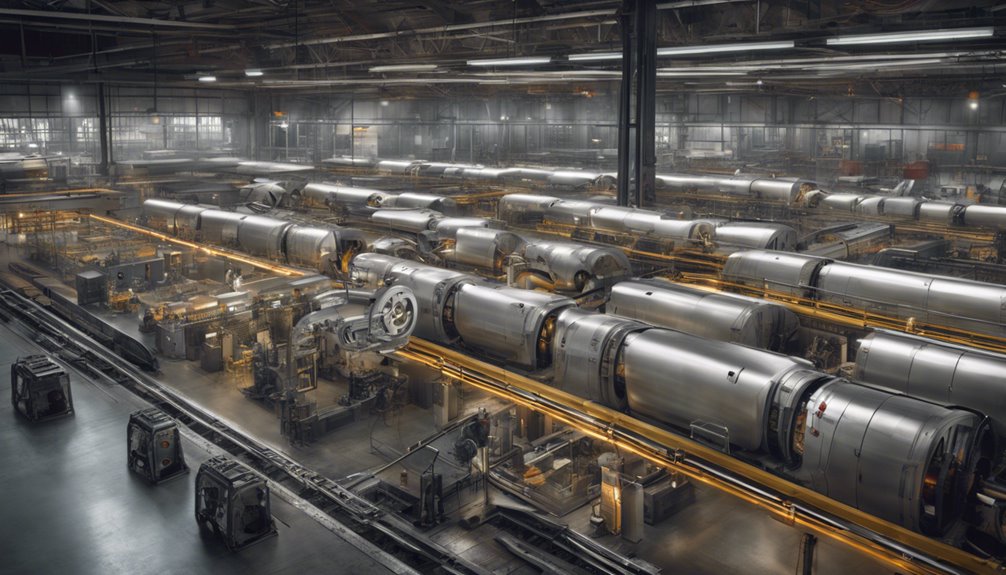
Linear induction motors (LIMs) are revolutionizing transportation and industrial applications with unique capabilities. They’re at the heart of maglev train systems like Japan’s Linimo, providing high-speed and efficient transportation with minimal mechanical wear. You might recall the Birmingham Airport Maglev shuttle, which operated from 1984 to 1995 and showcased LIM technology over a 600-meter stretch. Guangzhou Metro uses about 130 kilometers of LIM-powered routes in urban transit, highlighting their effectiveness in densely populated areas.
| Application | Example |
|---|---|
| Maglev Train Systems | Japan’s Linimo |
| Urban Transit | Guangzhou Metro |
| Airport Shuttle | Birmingham Maglev (1984-1995) |
| Amusement Rides | Rapid acceleration |
| Industrial Handling | Enhanced speed and accuracy |
In industrial applications, LIMs enhance automated material handling systems, boosting speed and accuracy on production lines and logistics. Their ability to deliver rapid acceleration is also evident in amusement rides, where high performance is essential. LIMs reduce mechanical wear, making them ideal for durable and efficient applications. As you explore these innovations, you’ll see how LIMs are reshaping the landscape of transportation and industry, providing solutions that were once thought impossible.
Future Prospects and Trends
You’ll witness exciting advancements in linear induction motors with smart integrations and sustainable design innovations.
These technologies promise compact efficiency improvements, reducing energy consumption while enhancing performance.
As you explore these trends, consider how they could transform industries and everyday life.
Emerging Smart Integrations
As the world embraces technological advancements, linear induction motors (LIM) aren’t left behind. Exciting trends are emerging in their smart integrations.
You’re witnessing a shift in which smart sensors and IoT connectivity transform LIM technology. These integrations dramatically enhance operational efficiency by enabling real-time monitoring and predictive maintenance. Imagine smart sensors picking up the slightest irregularities and IoT systems relaying this data instantly. This means fewer breakdowns and optimized performance.
Energy efficiency stands at the forefront as artificial intelligence algorithms optimize control systems for LIMs. This is particularly pivotal in high-speed applications like automated manufacturing processes where precision is key.
In addition, exploring renewable energy sources, such as solar and wind, aims to power LIMs sustainably and reduce dependence on traditional grids.
In urban infrastructure, smart integrations in transportation systems are set to revolutionize public transit. Imagine autonomous vehicles utilizing LIM technology to enhance speed and efficiency across cities.
Here are some fascinating possibilities:
- Smart sensors for predictive maintenance
- IoT connectivity for seamless data exchange
- AI algorithms refining control systems
- Renewable energy adaptations for greener power
- Urban mobility enhancements in public transit
These innovations pave the way for a smarter, more efficient future.
Sustainable Design Innovations
In sustainable design innovations, ongoing research transforms linear induction motors (LIMs) into more energy-efficient and environmentally friendly devices. The sensors are becoming integral to green technology. By harnessing renewable energy sources
You’re seeing a shift toward compact, lightweight designs that reduce material usage and enhance energy efficiency during production and operation. This aligns perfectly with sustainability goals in modern manufacturing.
Smart technology integration is another exciting advancement. You can optimize motor performance with IoT-enabled monitoring systems, leading to notable energy savings and reduced waste. This smart tech guarantees that your LIMs are functioning at their peak, conserving resources.
Exploring alternative materials is also at the forefront of innovation. Manufacturers are reducing the ecological impact of LIM production and disposal by using biodegradable components.
Modular designs are also gaining traction, allowing for easy upgrades and repairs. This approach extends the lifespan of motors and promotes resource conservation, as you won’t need to replace entire systems frequently.
These sustainable design innovations pave the way for a future where linear induction motors contribute considerably to a cleaner, more efficient world.
Compact Efficiency Improvements
Building on the momentum of sustainable design innovations, compact efficiency improvements in linear induction motors promise to reshape their future applications. As these motors become more compact, they will be integrated into tighter spaces without sacrificing performance.
Research actively explores novel materials and manufacturing techniques like 3D printing, making linear motors lighter and more efficient. This reduces energy consumption and boosts their thrust-to-weight ratio, making them ideal for various applications.
Smart technologies and IoT are revolutionizing the monitoring of linear induction motors. Real-time monitoring and predictive maintenance capabilities help optimize operational efficiency, ensuring the motors run smoothly and sustainably.
Future designs aim to minimize end effects and air gaps, which can greatly improve performance.
Here’s what you can expect from these innovations:
- Reduced energy consumption: Lighter materials and efficient designs minimize energy use.
- Enhanced thrust-to-weight ratio: Improved performance and suitability for diverse applications.
- Real-time monitoring: IoT integration enables smarter, more responsive systems.
- Sustainability: Energy recovery systems harness excess energy, boosting efficiency.
- Advanced manufacturing techniques: 3D printing and novel materials produce more compact and efficient motors.
These advancements are set to drive the future of linear induction motor technology.
Conclusion
You’ve journeyed through the fascinating history of linear induction motor technology, discovering its origins and groundbreaking innovations. From Wheatstone’s early concepts to Laithwaite’s transverse flux principle, each advancement has shaped modern applications like maglev transportation. These motors revolutionize industries with their efficiency and potential. As you look to the future, anticipate more exciting developments and applications. Linear induction motors aren’t just a part of history—they’re paving the way for tomorrow’s technology.
FAQs
1. When Was the Linear Induction Motor Invented?
You must know that the linear induction motor was invented using early inventions and experimental designs. Through academic research and engineering challenges, technological advancements led to industrial applications and transportation systems, enhancing efficiency and promising future developments with a global impact.
2. Who Invented the Linear Motor?
You’d look at historical inventors like Charles Wheatstone and Dr. Eric Laithwaite. They’ve markedly impacted motor technology evolution, leading to modern adaptations in transportation systems, efficiency improvements, and engineering milestones in linear motor applications and electromagnetic propulsion.
3. What Is the History of Linear Synchronous Motors?
You explore the history of linear synchronous motors, noting their rise for precise control and efficiency. Linear motor applications include maglev trains, with advantages like high thrust-to-weight ratios. Future trends focus on innovative designs and improved control systems.
4. What Is a Linear Induction Motor?
You’re exploring linear induction motors, which rely on electromagnetic principles for motion. These motors are essential in magnetic levitation technology, boost energy efficiency in transportation applications, and enhance industrial automation. Their design principles promise future developments and improved performance metrics.