DC Series Motor Speed Control Techniques – Explained
When you’re working with DC series motors, understanding the various speed control techniques can be essential for optimizing performance, techniques like the field diverter method and tapped field control offer unique advantages for different applications. For instance, field diverters can swiftly modify speed by diverting current, while tapped field control allows for more precise adjustments. But there’sthere’so take into account, such as how paralleling field coils and armature resistance control impact efficiency and load suitability. You’re You’rely wondering how shunted armature control and series-parallel control fit into the picture. Let’s eLet’deletee methods in detail.
Key Takeaways
- FieldThe Diverter Method uses variable resistance across the field winding for quick speed adjustments.
- Tapped Field Control adjusts speed in steps by connecting different points of the field winding.
- Paralleling Field coil change in the field winding for practical speed control.
- Armature Control Techniques introduce variable resistance in series with the armature for precise speed adjustments.
- SerieSeries-parallel controls motors in series and parallel configurations, minimizing energy loss and achieving efficient speed control.
Field Diverter Method
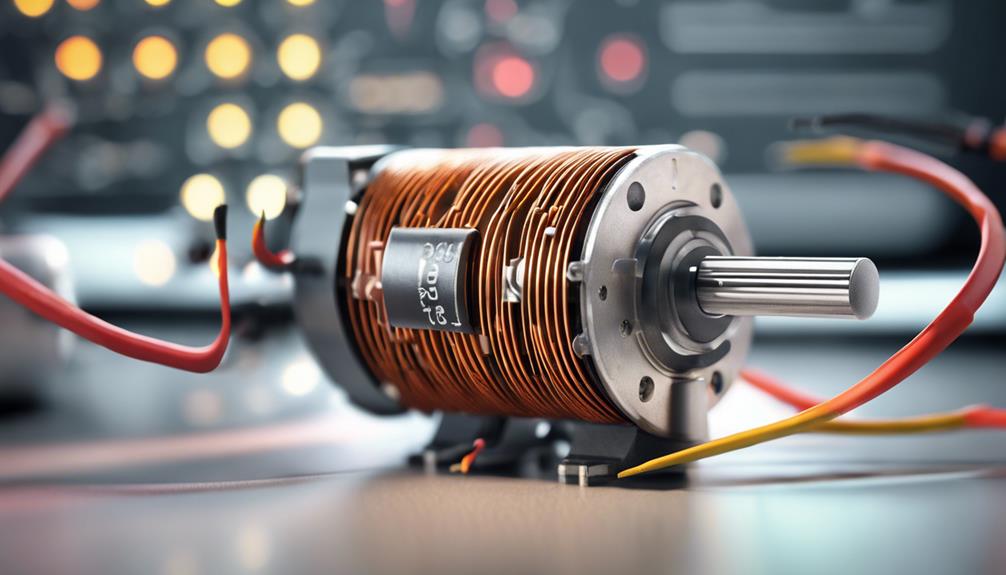
When you need to control the speed of a DC series motor quickly, the Field Diverter Method offers an efficient solution. This method involves resistance, often a rheostat, connected across the series field winding. Adjusting this field diverter resistance allows you to divert a portion of the series field current, effectively reducing the overall field current and magnetic flux.
As you decrease the flux in the motor, the speed increases, making this method particularly useful for applications requiring sharp speed changes. The Field Diverter Method is commonly employed in electric drives where quick and accurate speed adjustments are essential. By manipulating the magnetic field strength through this flux control method, you gain precise control over the motor’smotor’smance.
This practical and straightforward approach allows you to achieve the desired speed control without complex modifications. With the ability to finely tune the series field current, the Field Diverter Method stands out as a reliable technique for managing the speed of DC series motors.
Whether you’re you’reg with industrial machinery or electric vehicles, this method provides the responsiveness and flexibility needed for efficient operation.
Tapped Field Control
Tapped Field Control offers a straightforward way to adjust the speed of a DC series motor by tapping into the field windings at various points. By connecting different points on the field winding, you can control the motor’smotor’sin steps. This method works by incrementally adjusting the number of turns in the field winding, allowing you to vary the speed.
When you cut out resistance in the winding, you increase the motor’smotor’sprogressively. This is because reducing resistance in the field winding allows more current to flow through the armature, which in turn increases the motor’smotor’s Basically, you’re you’resing the field flux, resulting in higher speed. This technique of speed control is particularly useful in applications like electric traction, where precise speed adjustments are important.
Tapped Field Control provides a reliable and effective means of motor control because it allows for variable speed changes without complex circuitry. By sectionstapping into different field winding sections, you can achieve the desired speed control of your DC series motor.
This method ensures that your motor operates efficiently under varying load conditions, offering a practical solution for speed regulation.
Paralleling Field Coils
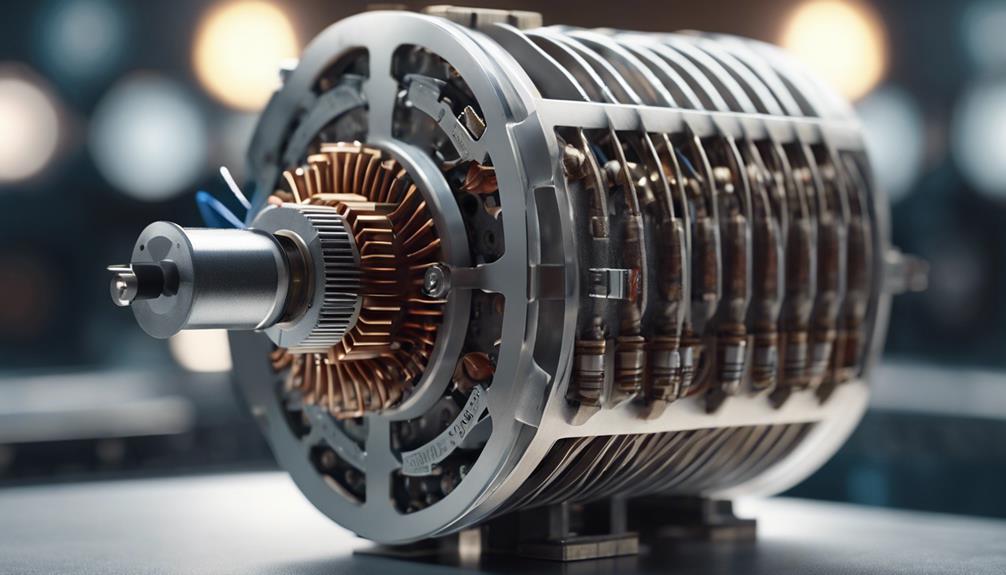
Paralleling field coils effectively allows you to adjust a DC motor’s speed by changing the field winding’s resistancehod. The DC series motor speed control, which involves grouping field coils in different configurations to alter their combined resistance. By doing so, you can efficiently control the motor’smotor’sto meet specific requirements.
Field coils grouping is a straightforward technique. When you regroup the field coils, you change the overall resistance in the circuit, which directly impacts the motor’smotor. For instance, this method is often employed in fan motors to achieve the desired speed control without requiring complex electronic components.
Adjusting resistance through paralleling field coils offers a practical speed control solution. By varying the field winding resistance, you can achieve precise DC motor speed regulation, making it suitable for a variety of applications.
This approach isn’t oisn’tractical but also provides efficient speed control, ensuring the motor operates at peak performance levels.
Armature Resistance Control
When using the armature resistance control method, you can manage speed by introducing a variable resistance in series with the armature.
However, keep in mind that this approach can lead to power dissipation concerns, especially under heavy loads.
Balancing the resistance is key to ensuring efficient operation without excessive energy loss.
Variable Resistance Method
Often employed for its simplicity and cost-effectiveness, the armature resistance control method adjusts the speed of a DC series motor by varying the resistance in series with the armature. This Variable Resistance Method is a key DC Series Motor Speed Control technique. By increasing the resistance, you reduce the voltage applied to the motor’smotor’sre, thereby lowering the speed. This method effectively leverages the Armature Voltage Control technique, differing from Field Control, where the field windingwinding’sance is varied instead.
Speed regulation is important inDC serieintors, especially in applications like cranes, hoists, and trains, where maintaining constant torque at different speeds is essential. The Armature Resistance Control method offers a straightforward and practical way to achieve this by using a variable resistor. This resistor can be adjusted, providing precise control over the motor speed to meet varying load conditions.
The Back EMF Equation comes into play here, as it indicates that the motor’smotor’sis directly proportional to the back electromotive force. By controlling the armature resistance, you can manage this back EMF and, consequently, the motor speed. This method stands out among Speed Control Methods for its ease and affordability.
Power Dissipation Concerns
One major concern inarmature resistance control is the significant power dissidue to the circuit’s added resistancecircuit. When you use this method for DC Series Motor Speed Control, you’re you’relly introducing more resistance within the armature circuit to manage speed. While this method is cost-effective and widely used, especially for applications demanding constant torque, it has its drawbacks.
The added resistance leads to power dissipation, which means energy is lost as heat. This can be particularly problematic under light loads, where the series resistance reduces the motor speedthe efficiency drops due to the heat produced.
Even though armature resistance control allows for precise adjustments in speed regulation, you need to weigh these adjustments against the potential energy losses.
Despite these concerns, armature resistance control remains a practical and economical solution for maintaining speed consistency in DC series motors. The method provides a balance between cost and functionality, but you should always consider the trade-off with power dissipation.
Shunted Armature Control
Shunted Armature Control lets you fine-tune the speed of DC series motors by adjusting the shunting resistance with rheostats. This method of armature control is highly effective for achieving precise speed control. By varying the shunting resistance, you can alter the applied voltage and influence the exciting current. This directly affects the motor speed, allowing you to seamlessly seamlessly adapt to different load conditions.
In practical terms, Shunted Armature Control offers a versatile solution for applications like cranes, hoists, and trains, where precise speed regulation is essential. Since you’re you’reing the voltage, you can achieve a wide range of motor speeds without sacrificing efficiency. This method stands out because it provides a cost-effective way to control DC series motors, and it’s pait’sularly beneficial under varying load conditions.
Using rheostats to adjust the shunting resistance ensures a reliable and efficient means of voltage adjustment. This enables you to maintain excellent motor performance and easily handle different operational demands. Shunted Armature Control is a proven technique that offers both precision and flexibility, making it an essential tool in many industrial applications.
Series-Parallel Control
Building on the flexibility and precision of Shunted Armature Control, Series-Parallel Control offers another effective method for managing the speed of DC series motors by using two or more motors in paired configurations. This technique involves connecting the motors in series and parallel arrangements, allowing for efficient speed control and reliable operation.
Initially, starting resistance is used to manage the high inrush current and is gradually cut out as the motor speed increases. Removing control resistance completely allows each motor to run at half its normal speed, providing a balanced and controlled acceleration. This method guarantees reduced power wastage and maintains efficient speed control across various operational stages.
Consider the following points to grasp the benefits of Series-Parallel Control:
- Efficient Speed Control: You achieve precise speed adjustments by using series and parallel configurations.
- Reduced Power Wastage: Gradual removal of starting and control resistance minimizes energy loss.
- Reliable Operation: The method provides dependable performance, especially when managing multiple motors.
Conclusion
To sum up, you’ve you’verange of effective techniques to control the speed of DC series motors. Whether you’re you’rethe field diverter method, tapped field control, paralleling field coils, or armature resistance control, each approach offers unique benefits.
Shunted armature contreries-parallel control provide reliable and cost-effective solutions for precise adjustments. By understanding and applying these methods, you can guarantee peak performance and efficiency for your motor applications.
FAQs
What is a DC series motor, and why is speed control important?
A DC series motor is a type of direct current motor where the field windings are connected in series with the armature. Speed control is important because:
- Application-Specific Requirements: Different applications require different motor speeds for optimal performance.
- Energy Efficiency: Proper speed control can reduce energy consumption.
- Extended Motor Life: Controlling speed appropriately can prevent overloading and overheating, extending the motor’smotor’san.
What are the common techniques for controlling the speed of a DC series motor?
Several techniques can be used to control the speed of a DC series motor, including:
- Armature Voltage Control:
- Method: Vary the voltage supplied to the motor’smotor’sre.
- Effect: Increasing the armature voltage increases the speed, while decreasing it reduces the speed.
- Applications: Common in industrial applications where precise speed control is required.
- Field Flux Control:
- Method: Adjust the field winding current to change the magnetic flux.
- Effect: Increasing the field current reduces speed (due to increased flux), while rducing the field current increases speed.
- Applications: Used where a wide range of speed control is needed, such as in electric trains.
- Armature Resistance Control:
- Method: Insert a variable resistor in series with the armature circuit.
- Effect: Increasing the resistance reduces the armature current and, consequently, the speed.
- Applications: Suitable for applications where a decrease in speed is required for a short duration, like in cranes.
- Tapped Field Control:
- Method: Use a field winding with taps at different points, allowing selection of different amounts of winding in the circuit.
- Effect: Changing the number of active turns in the field winding alters the motor speed.
- Applications are used in applications where discrete speed levels are sufficient, such as conveyor systems.
- Thyristor-Based Control:
- Method: Use thyristors (SCRs) to control the voltage applied to the motor.
- Effect: Provides smooth and efficient control over a wide range of speeds by varying the firing angle of the thyristors.
- Applications: Common in modern DC drive systems for applications like rolling mills and paper machines.
How does armature voltage control work for speed regulation?
In armature voltage control:
- Variable Voltage Supply: A variable voltage source, such as a DC-DC converter, is used to adjust the voltage supplied to the armature.
- Speed Variation: The motor speed is directly proportional to the armature voltage. As you increase the voltage, the speed increases, and vice versa.
- Advantages: Provides smooth and continuous speed control, making it ideal for applications requiring precise speed adjustments.
What are the advantages of using field flux control in a DC series motor?
Field flux control offers several advantages:
- Wide Range of Control: Allows for a broad range of speed adjustment.
- Energy Efficiency: Adjusting the field current can be more energy-efficient than other methods, especially at low speeds.
- Reduced Mechanical Wear: Lower speeds result in less mechanical wear, extending the life of motor components.
- Simple Implementation: Easy to implement with simple control circuits.
When should armature resistance control be used for speed control?
Armature resistance control is best used when:
- Temporary Speed Reduction: You need to reduce the speed for a short duration, such as during heavy load conditions.
- Cost-Effective Solution: It’s a It’s-effective method for applications where precise speed control isn’t risn’ted.
- Intermittent Use: Suitable for applications where the motor doesn’tdoesn’te continuously, as continuous use can lead to energy loss and heating due to resistors.
What are the limitations of using tapped field control for speed regulation?
Tapped field control has some limitations:
- Discrete Speed Levels: Offers only a limited number of fixed speed settings, not continuous control.
- Complexity: Requires multiple taps and switching mechanisms, which can complicate the circuit.
- Limited Range: The range of speed control is often narrower compared to other methods like armature voltage control.
How does thyristor-based control improve speed regulation?
Thyristor-based control improves speed regulation by:
- Smooth Control: Allows for smooth and precise speed adjustments by controlling the voltage applied to the motor.
- High Efficiency: Offers efficient speed control with minimal energy loss, making it ideal for heavy-duty industrial applications.
- Wide Speed Range: Provides control over a wide range of speeds, suitable for various applications.
What are some practical applications of DC series motor speed control?
DC series motor speed control is used in various applications, including:
- Electric Vehicles: Precise speed control is essential for smooth acceleration and deceleration.
- Cranes and Hoists: Allows for controlled lifting and lowering of heavy loads.
- Rolling Mills: Requires continuous speed adjustments to handle different materials and thicknesses.
- Electric Trains: Provides smooth acceleration and deceleration for comfortable passenger travel.
- Conveyor Systems: Controls the speed of conveyors to match production line requirements.
Understanding and implementing these speed control techniques can enhance the performance and efficiency of DC series motors in a wide range of applications.