Demystifying the Imposing Characteristics of a DC Series Motor
Armature Current and Mechanical Load
Armature Torque Vs Armature Current

Up to Magnetic Saturation Φ ∝ Ia, the armature torque Ta is directly proportional to the square of the armature current (i.e., Ta ∝ I2a). If the armature current is doubled over, the armature torque almost increases fourfold. Thus the armature torque vs. armature current curve up to magnetic saturation is a parabola, shown in the characteristic curve OA. On the other hand, once the magnetic saturation is reached, the Ta is directly proportional to the Ia. As a result, the armature torque vs. armature current magnetic saturation characteristic is a straight line, which is shown in curve AB.
From this curve, we understood that a DC series motor’s starting torque is higher when compared to the DC shunt motor. We know that Ta ∝ Φ (i.e.) Series Motor (Ta∝ I2a) > Shunt Motor (Ta ∝ Ia).
Characteristics of a DC Series Generator
DC series or series-wound generators are widely used electrical machines that convert mechanical energy into electrical energy. These generators exhibit unique characteristics that make them suitable for specific applications. This section explores the key elements of DC series generators and their significance in various industries.
Output Voltage Regulation
One of the distinctive characteristics of DC series generators is their ability to regulate the output voltage. As the load connected to the generator increases, the armature current rises, strengthening the magnetic field produced by the armature windings. This improved magnetic field results in a higher back electromotive force (EMF) and a higher generated voltage. This inherent voltage regulation makes DC series generators well-suited for applications requiring consistent voltage levels, such as battery charging systems and industrial machinery.
High Starting Torque
DC series generators are known for their high starting torque, which enables them to deliver power to heavy loads during startup. The series field winding, connected in series with the armature, provides a high magnetic field intensity, allowing the generator to produce substantial torque. This characteristic makes DC series generators suitable for applications such as electric traction systems, where initial torque is critical for accelerating heavy vehicles or machinery.
Adaptability to Variable Loads
DC series generators exhibit excellent adaptability to variable loads. As the load connected to the generator changes, the armature current adjusts accordingly, resulting in a corresponding change in the generated voltage. This adaptability makes DC series generators well-suited for applications where load requirements vary, such as electric locomotives, cranes, and elevators.
Limited Overload Capacity
DC series generators have a limited overload capacity due to the relationship between armature current and field winding. If the load connected to the generator exceeds its rated capacity, the armature current increases significantly, leading to increased magnetic field strength. However, this increase has a practical limit, as excessive armature current can cause magnetic saturation and overheating in the windings. Therefore, DC series generators are typically designed to operate within their rated capacity to ensure safe and reliable performance.
Simple Construction and Cost-effectiveness
DC series generators have a relatively simple construction consisting of a series field winding, an armature winding, and a commutator. This simplicity contributes to their cost-effectiveness in comparison to more complex generator designs. The straightforward construction also makes DC series generators easier to maintain and repair.
Speed Vs. Armature Current Characteristic

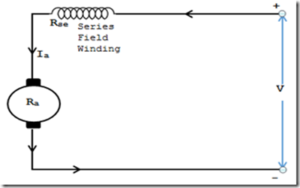
We know that back EMF Eb = V-Ia(Ra+Rse).
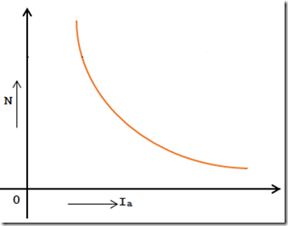
As soon as the Ia increases, the back EMF Eb is reduced due to a drop in Ia(Ra+Rse)even though the flux increases. Still, Ia(Ra+Rse) is less in usual circumstances and might be vomited.
Therefore, N ∝ (1/ Φ). The speed vs. armature current characteristic follows the hyperbolic curve up to magnetic saturation {∝ (1/ Φ)}. Afterward, the flux remains perpetual and so makes sure of the speed.
The figure above shows the circuit diagram series motor. In a series motor, the current flows in the field winding and the armature are the same. The armature current will increase whenever the mechanical load of the motor increase. As a result, the flux will increase in the series motor when the armature current increases and vice versa.
Speed vs. Armature Torque Characteristic
DC Motor Voltage Equation and power Equation
We conclude the three important points from the above three characteristics of a series motor.
- The starting torque of a series motor is high since initially Ta∝ I2a.
- The series motor runs at variable speed because it adjusts speed automatically when there is a change in load.
- During no load condition, the armature current is very small, and also the flux. As a result, the speed of the series motor is very high. This is very unsafe for the machines, which may damage due to centrifugal forces set up in the rotational parts. Hence the series motor should not be started at no-load. Always the series motor should start with minimum load to keep the speed within limits.
Conclusion
Moreover, DC series motors’ constitutional speed control characteristics allow for seamless operation speed alteration, providing circumscribe control and adaptability in various working conditions. Their simple and reliable design has stood the test of time, crystallizing their place as a cornerstone in electric motors.