Armature Reaction in Alternator | Effects & Explanation
You’ve probably heard the term “armature reaction” in the context of alternators, but do you know what it entails? It’s all about how the armature currents interact with the main magnetic field, and this interaction isn’t always straightforward. Depending on the load’s power factor, the effects can vary, impacting everything from terminal voltage to machine efficiency. Curious about how this plays out in real-world applications?
Understanding Armature Reaction in Alternators

When diving into the concept of armature reaction in alternators, you must grasp how the armature currents’ magnetic field affects the main magnetic field created by the field windings. This interaction makes the armature flux, which can alter the main field flux. Depending on the load power factor, the armature reaction can exhibit demagnetizing effects, affecting the magnitude of the armature’s impact on terminal voltage. These variations in terminal voltage can influence the performance of electrical machines. Understanding these dynamics is crucial for performance optimization. By managing the armature reaction, you can guarantee that alternators operate efficiently, maintaining the generated voltage within the desired limits and enhancing the machine’s overall efficiency.
Effects of Power Factor on Armature Reaction
Although it might not seem obvious at first, the power factor of a load plays an essential role in determining the nature of armature reaction in an alternator. The power factor influences whether the armature flux distorts, opposes, or assists the main field flux. With a leading power factor, you’ll notice a magnetizing effect where the armature flux helps the main field flux, boosting the generated voltage. Conversely, a zero lagging power factor causes a demagnetizing effect, as the armature flux opposes the main field flux, reducing generated voltage. The armature reaction is cross-magnetizing at unity power factor, meaning it distorts the main flux without altering its strength. The load current and power factor are key in determining these effects on performance.
Armature Reaction at Unity Power Factor
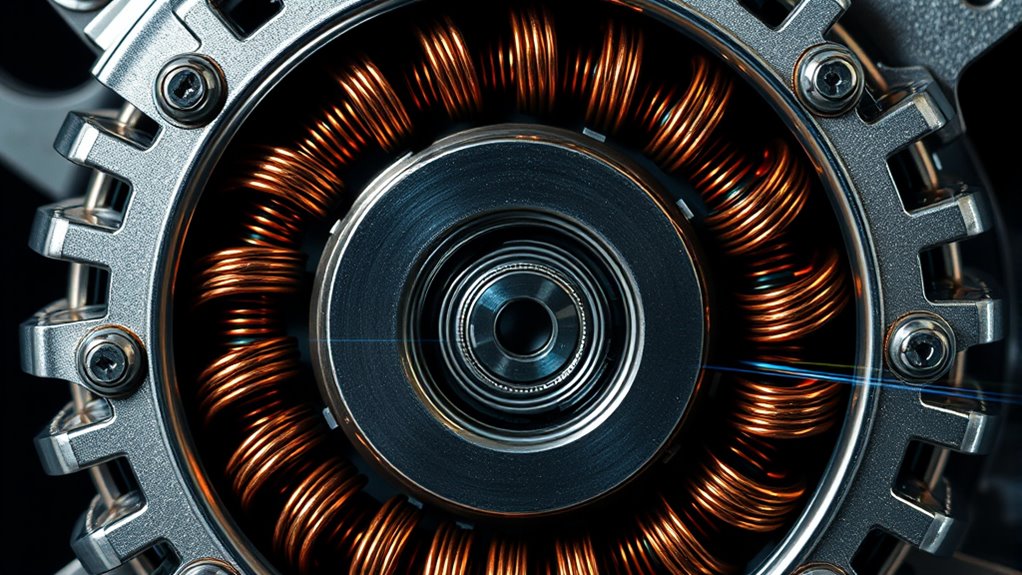
Even at unity power factor, armature reaction significantly impacts an alternator’s performance. The armature current aligns with the induced EMF, causing the armature flux to align. Here’s what you should know:
- Cross-Magnetizing Effect: The induced EMF is laggard by 90 degrees, and both the main field flux and armature flux are affected by it.
- Flux Distribution: This interaction distorts the flux distribution, increasing flux density at trailing pole tips and reducing it at leading pole tips.
- Terminal Voltage: This distortion can cause a slight drop in terminal voltage under load conditions.
- Magnetic Field: While the strength of the magnetic field remains unchanged, the armature reaction primarily alters flux distribution.
Understanding these aspects helps in managing alternator performance effectively.
Armature Reaction at Lagging Zero Power Factor
In a lagging zero power factor, armature reaction becomes vital to evaluate. At this power factor, the armature current lags the induced electromotive force by 90 degrees, causing the armature flux to oppose the main field flux. This opposition creates a demagnetizing effect, weakening the main field flux and reducing the alternator’s generated voltage. Consequently, you’ll notice a greater terminal voltage drop due to the stronger opposing forces than the unity power factor. Understanding these dynamics is essential for optimizing alternator performance. By recognizing how different load conditions affect armature reaction at a lagging zero power factor, you can guarantee efficient operation and maintain the reliability of your electrical system.
Armature Reaction at Leading Power Factor

Having explored the effects of armature reaction at a lagging zero power factor, let’s examine how the scenario changes when operating at a leading power factor. Here, the armature current leads the induced emf by 90 degrees, causing the armature flux to also lead. This results in a magnetizing effect as the interaction between the armature and main field flux enhances the main field flux. This leads to:
- Increased generated voltage.
- More efficient alternator operation.
- Compensation for voltage drops due to load variations.
- Optimized performance with capacitive loads.
Understanding this behavior is crucial for optimizing performance, as the enhanced field flux guarantees stability in your alternator. This condition results in a more reliable and efficient system, especially in applications with prevalent capacitive loads.
Nature and Implications of Armature Reaction
Armature reaction, a pivotal concept in alternator functionality, is crucial in determining the machine’s performance. It occurs when the armature’s magnetic field interacts with the main magnetic field, affecting the alternator’s flux distribution. Depending on the load power factor, this interaction can cause different effects. A unity power factor results in a cross-magnetizing effect, distorting the flux distribution by increasing and decreasing flux density at the trailing and leading pole tips. A lagging power factor induces a demagnetizing effect, opposing the main field, which leads to performance degradation. Conversely, a leading power factor causes a magnetizing effect that aligns with the field flux, boosting the generated voltage. The impact rotates at synchronous speed and is influenced by load characteristics.
Armature Reaction in Synchronous Motors
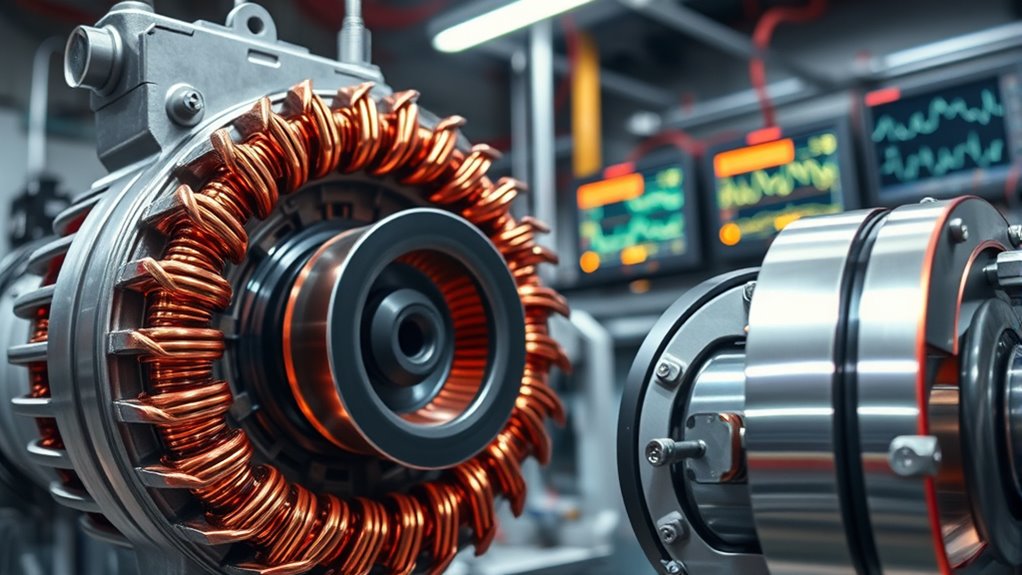
Synchronous motors, like alternators, experience the influence of armature reaction, yet the effects on performance are distinctly different. When dealing with these motors, understanding the role of armature reaction is essential. Here’s what you need to know:
- Lagging Power Factor: The armature reaction creates a mix of magnetizing and cross-magnetizing effects, which can boost the magnetic field strength.
- Leading Power Factor: The reaction becomes partly demagnetizing, impacting efficiency negatively.
- Magnetic Field Interaction: The interplay between armature current and the magnetic field guarantees stable operation.
- Performance Optimization: Recognizing these reactions aids in improving motor performance and efficiency.
Grasping these aspects will enhance your ability to effectively design and operate synchronous motors.
Armature Reaction Reactance and Its Impact
When analyzing alternator performance, understanding the concept of armature reaction reactance is crucial. This fictitious reactance helps quantify the voltage drop caused by armature reaction under different load conditions. The armature reaction reactance varies with the load’s power factor, affecting voltage regulation and stability. With a lagging power factor, the armature reaction creates a demagnetizing effect, increasing reactance and causing a notable voltage drop. Conversely, the armature reaction enhances the main flux for a leading power factor, lowering reactance and elevating terminal voltage. This understanding is critical for optimizing alternator performance as it directly impacts efficiency and output voltage stability. Considering these factors, you can guarantee that our alternator operates efficiently across various operational scenarios.
Key Concepts of Armature Reaction
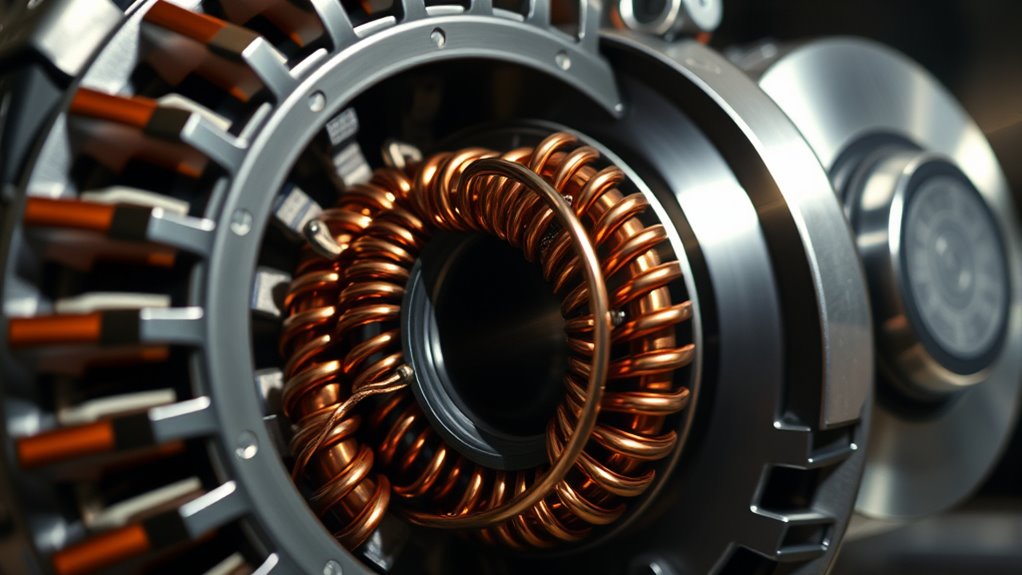
As you explore the key concepts of armature reaction, focus on how it affects magnetic flux in alternators. You’ll notice that the load’s power factor is essential in determining whether the armature reaction is cross-magnetizing, demagnetizing, or magnetizing. Analyzing these effects is critical for understanding voltage drop and optimizing the performance of your electrical machines.
Effects on Magnetic Flux
Understanding the effects of armature reaction on magnetic flux in an alternator is essential for grasping its impact on performance. When your alternator is under load, the armature reaction interacts with the main magnetic flux, and its effects vary with the power factor:
- Unity Power Factor: Armature reaction causes a cross-magnetizing effect, distorting the main field flux without changing its strength.
- Lagging Power Factor Load: The reaction demagnetizes, weakening the main field flux and reducing terminal voltage.
- Leading Power Factor Load: The magnetizing effect enhances the main field flux, increasing terminal voltage.
- Mixed Load Conditions: Armature reaction may show a combination of effects, impacting overall alternator efficiency.
Load Power Factor Impact
Building on the effects of armature reaction on magnetic flux, let’s explore how load power factor impacts this phenomenon in alternators. The power factor of the load dictates whether the armature reaction will distort, oppose, or assist the main field flux. You get a cross-magnetizing effect at a unity power factor, slightly distorting the main field flux without altering its strength. With a lagging zero power factor load, the armature current lags the induced electromotive force by 90 degrees, creating a demagnetizing effect that weakens the main field flux, harming voltage regulation and efficiency. Conversely, a leading power factor load results in a magnetizing impact, as the armature current leads the induced emf by 90 degrees, enhancing the main field flux and boosting voltage.
Voltage Drop Analysis
When examining voltage drop in alternators, it’s essential to consider the concept of armature reaction reactance. This fictitious reactance, measured in ohms per phase, isn’t across any physical component but greatly influences terminal voltage. Here’s how different power factors affect the voltage drop:
- Unity Power Factor: Armature reaction causes a minor terminal voltage drop due to the cross-magnetizing effect, distorting the main flux.
- Lagging Power Factor: The demagnetizing effect reduces the main flux, resulting in a larger voltage drop.
- Leading Power Factor: The magnetizing effect increases the main flux, causing a rise in terminal voltage.
- Overall Impact: The Magnitude of reactance varies with armature current and load power factor, dictating the extent of voltage drop.
Conclusion
You’ve now got a solid grasp of how armature reaction impacts alternator performance. By understanding its relationship with the power factor, you can better predict whether the reaction will be demagnetizing, magnetizing, or cross-magnetizing. This knowledge is essential for optimizing efficiency and voltage regulation. Remember, the nature of armature reaction can also extend to synchronous motors, influencing their operation. Remember these concepts, and you’ll manage alternator systems more effectively.
FAQs
1. What Is the Armature Reaction of an Alternator?
You’re exploring how the magnetic field affects induced voltage in an alternator. This involves alternator design and efficiency factors, balancing synchronous operation, load impact, and power generation. For ideal performance, consider coil winding, rotor dynamics, and voltage regulation.
2. What Is an Armature Reaction?
When the stator winding’s magnetic field interacts with the rotor dynamics in synchronous machines, you’re dealing with an armature reaction. This affects alternator efficiency, voltage regulation, and power generation through electromagnetic induction, influenced by electrical load and armature design.
3. How to Reduce Armature Reaction in an Alternator?
Optimizing the arrangement and using magnetic shielding can reduce armature reaction. To enhance rotor design, implement excitation control, load balancing, and pole alteration. Effectively utilize compensating winding, auxiliary devices, transformer use, and field current management.
4. What Does the Armature Do in an Alternator?
You design the armature of an alternator to enhance electrical efficiency and power output. The winding configuration affects rotor operation and magnetic field interaction, impacting mechanical stability, thermal management, load characteristics, and, ultimately, voltage regulation.